~1 min
Average Reply Time
~1 hour
To Be Matched With A Tutor
30 Min Trial
75% Find Their Tutor On The 1st Trial
$20-35+/hr
Premium Yet Affordable Learning
Hire The Best Sensors and Actuators Tutor


Sensors and Actuators labs due Friday and the transfer function still isn’t making sense? That’s exactly where MEB steps in.
Sensors and Actuators Tutor Online
Sensors and Actuators is an undergraduate and graduate engineering course covering transduction principles, signal conditioning, actuator drive circuits, and interfacing methods that equip students to design and analyse physical measurement and control systems.
MEB offers 1:1 online tutoring and homework help in 2800+ advanced subjects — including Sensors and Actuators. If you’ve searched for a Sensors and Actuators tutor near me and landed here, you’re in the right place. Every session is matched to your exact syllabus, your current gaps, and your deadline. One session often shifts the understanding that weeks of lecture notes couldn’t.
- 1:1 online sessions tailored to your course and university syllabus
- Expert-verified tutors with hands-on instrumentation and control backgrounds
- Flexible time zones — US, UK, Canada, Australia, Gulf
- Structured learning plan built after a diagnostic session
- Ethical homework and assignment guidance — you understand the work, then submit it yourself
52,000+ students across the US, UK, Canada, Australia, and the Gulf have used MEB since 2008 — including students in Electrical Engineering subjects like Sensors and Actuators, Instrumentation and Control Engineering, and Embedded Systems.
Source: My Engineering Buddy, 2008–2025.
How Much Does a Sensors and Actuators Tutor Cost?
Most Sensors and Actuators tutoring sessions run $20–$40/hr. Graduate-level or highly specialised work — MEMS design, piezoelectric modelling, industrial fieldbus protocols — can reach $100/hr. Not sure of your rate yet? Start with the $1 trial: 30 minutes of live 1:1 tutoring or one homework question explained in full.
| Level / Need | Typical Rate | What’s Included |
|---|---|---|
| Standard undergraduate | $20–$35/hr | 1:1 sessions, homework guidance |
| Advanced / Graduate-level | $35–$100/hr | Expert tutor, niche depth, research support |
| $1 Trial | $1 flat | 30 min live session or 1 homework question |
Availability tightens at end-of-semester and during finals periods. Book early if you have a lab report or exam within the next three weeks.
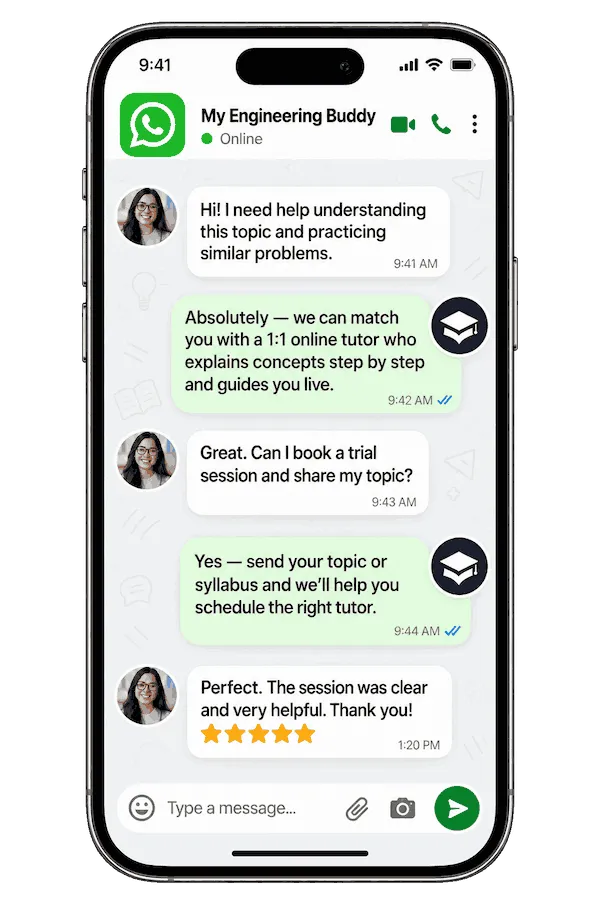
WhatsApp MEB for a quick quote — average response time under 1 minute.
Who This Sensors and Actuators Tutoring Is For
Sensors and Actuators sits at the intersection of electronics, mechanics, and signal processing. Most students hit a wall when the theory moves from passive components to real transducer behaviour and noise analysis. This service is built for exactly that.
- Undergraduate EE, ECE, or Mechatronics students stuck on sensor characterisation or op-amp signal conditioning circuits
- Graduate students working on MEMS, IoT sensor nodes, or actuator drive systems for dissertations
- Students retaking after a failed first attempt — gaps in Wheatstone bridge analysis or ADC interfacing are fixable fast
- Students with a coursework or lab submission deadline approaching who need targeted help in the next 1–2 weeks
- Parents watching a student’s confidence drop alongside grades in a course that “seemed fine at first”
- Students at universities including MIT, Georgia Tech, Imperial College London, TU Delft, University of Toronto, ETH Zurich, and UNSW who need supplemental 1:1 depth beyond lecture hours
At MEB, we’ve found that Sensors and Actuators trips students up not because the maths is impossible — it’s because nobody connected the physics of the transducer to the circuit model to the digital output. Once that thread is visible, the whole course clicks into place.
1:1 Tutoring vs Self-Study vs AI vs YouTube vs Online Courses
Self-study works if your textbook is clear and your gaps are small. AI tools give fast definitions but can’t watch you misread a transfer function and correct it live. YouTube covers the basics of resistance temperature detectors well enough — it stops when you need to debug your specific lab setup. Online courses are fixed-pace and don’t care about your exam date. 1:1 tutoring with MEB is calibrated to your exact Sensors and Actuators module: your lab sheet, your exam board, your week 7 gap. That’s the difference.
Outcomes: What You’ll Be Able To Do in Sensors and Actuators
After working with a Sensors and Actuators tutor through MEB, you’ll be able to solve transducer selection problems given specific measurement range and sensitivity requirements, analyse signal conditioning circuits including bridge configurations and instrumentation amplifiers, model sensor dynamic response using first- and second-order transfer functions, explain the trade-offs between different actuator types (electromagnetic, piezoelectric, thermal), apply ADC resolution and sampling rate calculations to real interfacing scenarios, and present calibration and error analysis in lab reports with the rigour markers actually want to see.
Based on feedback from 40,000+ sessions collected by MEB from 2022 to 2025, 58% of students improved by one full grade after approximately 20 hours of 1:1 tutoring in subjects like Sensors and Actuators. A further 23% achieved at least a half-grade improvement.
Source: MEB session feedback data, 2022–2025.
Supporting a student through Sensors and Actuators? MEB works directly with parents to set up sessions, track progress, and keep coursework on schedule. WhatsApp MEB — average response time is under a minute, 24/7.
What We Cover in Sensors and Actuators (Syllabus / Topics)
Track 1: Sensor Principles and Characterisation
- Transduction mechanisms: resistive, capacitive, inductive, piezoelectric, optical
- Sensor static characteristics: sensitivity, linearity, hysteresis, resolution, range
- Dynamic response: first-order and second-order sensor models, time constants
- Temperature sensors: RTDs, thermocouples, thermistors — principles and error sources
- Strain gauges and Wheatstone bridge configurations
- Pressure and flow measurement principles
- Calibration procedures and uncertainty analysis
Core texts: Sensors and Signal Conditioning by Ramon Pallas-Areny & John Webster; Measurement Systems: Application and Design by Ernest Doebelin.
Track 2: Signal Conditioning and Data Acquisition
- Instrumentation amplifiers: topology, CMRR, gain setting
- Active filter design for sensor signal conditioning
- Noise sources in sensor systems: thermal, shot, 1/f noise
- Analog-to-digital conversion: resolution, sampling rate, quantisation error
- Grounding, shielding, and PCB layout for low-noise sensor circuits
- Multiplexing and data acquisition system architecture
- Interfacing with microcontrollers: SPI, I2C, UART protocols
Core texts: Op Amp Applications Handbook by Walt Jung (Analog Devices); The Art of Electronics by Horowitz & Hill.
Track 3: Actuator Systems and Drive Circuits
- Electromagnetic actuators: DC motors, stepper motors, solenoids — torque and force equations
- Piezoelectric actuators: charge amplifiers, hysteresis, creep
- Thermal and shape-memory actuators
- Power electronics for actuator drive: H-bridge, PWM control, gate drivers
- Closed-loop actuator control: PID implementation for position and velocity
- MEMS sensors and actuators: fabrication overview, electrostatic drive, resonant sensing
Core texts: Electromechanical Motion Devices by Paul Krause et al.; Fundamentals of Microfabrication and Nanotechnology by Marc Madou.

What a Typical Sensors and Actuators Session Looks Like
The tutor opens by checking the previous topic — usually signal conditioning op-amp design or sensor transfer function derivation from the last session. From there, you and the tutor work through the current problem on screen: maybe it’s calculating the sensitivity of a capacitive pressure sensor, or debugging why your Wheatstone bridge output isn’t linear. The tutor uses a digital pen-pad to draw circuit diagrams and annotate frequency response plots in real time. You replicate the steps or explain the reasoning back. The session closes with a concrete practice problem — derive the noise floor for a given instrumentation amplifier configuration — and the next topic is flagged: ADC interfacing and sampling rate selection. Nothing is vague. Every session ends knowing what you’re doing next.
How MEB Tutors Help You with Sensors and Actuators (The Learning Loop)
Diagnose: In the first session, the tutor asks you to walk through a recent problem or lab result. From that, they identify exactly where the understanding breaks — most commonly, students conflate sensitivity with resolution, or they can’t connect the physical transducer model to the equivalent circuit.
Explain: The tutor works through a live example using a digital pen-pad — drawing the Wheatstone bridge, annotating the op-amp gain stages, sketching the Bode plot. Not slides. Not a pre-made video. Live, for your specific question.
Practice: You attempt the next problem with the tutor present. This is where most self-study fails — there’s no one to catch the moment you apply the wrong formula or misread the datasheet.
Feedback: The tutor works through your attempt step by step, showing exactly where marks would be lost and why. The correction is specific: “here you used peak voltage instead of RMS — that’s a 3-mark error in the exam.”
Plan: Before the session ends, the tutor sets the next topic and a practice task. Progress is tracked across sessions so nothing is revisited unnecessarily.
Sessions run over Google Meet. The tutor uses a digital pen-pad or iPad with Apple Pencil for real-time annotation. Before your first session, share your university syllabus or course outline, a recent lab report or homework problem you struggled with, and your exam or coursework deadline. The first session covers the diagnostic and the first substantive topic. Start with the $1 trial — 30 minutes of live tutoring that also serves as your first diagnostic.
Students consistently tell us that the moment Sensors and Actuators starts making sense is when someone draws the signal path — from physical phenomenon to conditioned voltage to digital value — in one continuous diagram. That’s what we do in the first session.
Tutor Match Criteria (How We Pick Your Tutor)
Not every electronics tutor is qualified for Sensors and Actuators. Here’s what MEB checks before making a match.
Subject depth: Tutors must demonstrate working knowledge of transducer physics, signal conditioning circuit design, and actuator drive systems — not just general electronics. Many hold postgraduate degrees or have industry experience in instrumentation, industrial automation, or MEMS.
Tools: Every tutor uses Google Meet plus a digital pen-pad or iPad with Apple Pencil. Circuit annotation and signal flow diagrams happen live on screen.
Time zone: Matched to your region — US, UK, Gulf, Canada, or Australia. No 3am sessions unless you want them.
Goals: Whether you need to pass a lab exam, close a specific gap in control systems concepts, or get research-level support for a graduate thesis on IoT sensor nodes, the tutor is selected for that scope.
Unlike platforms where you fill out a form and wait, MEB responds in under a minute, 24/7. Tutor match takes under an hour. The $1 trial means you test before you commit. Everything runs over WhatsApp — no logins, no intake forms.
Study Plans (Pick One That Matches Your Goal)
After the diagnostic, the tutor builds the specific sequence. The common plans: Catch-up (1–3 weeks) — fast-track through sensor characterisation, signal conditioning, and actuator drive circuits before a lab exam or deadline. Exam prep (4–8 weeks) — structured revision across all three tracks, past paper practice, and mark-scheme drilling. Weekly support — ongoing sessions aligned to lecture pace, keeping homework and lab reports on track throughout the semester.
Pricing Guide
Sensors and Actuators tutoring starts at $20/hr for standard undergraduate work. Graduate-level support — MEMS, advanced noise analysis, closed-loop actuator control — runs $50–$100/hr depending on tutor expertise and topic depth.
Rate factors: university level, topic complexity, how close the deadline is, and tutor availability. A student needing help with basic RTD calculations pays differently than one modelling piezoelectric hysteresis for a master’s thesis.
Availability drops fast in the four weeks before finals. If your exam or submission is within six weeks, don’t wait.
For students targeting top engineering programmes or industry roles in precision instrumentation, robotics, or aerospace sensing systems, tutors with direct professional or research backgrounds are available at higher rates — share your specific goal and MEB will match the tier to your ambition.
Start with the $1 trial — 30 minutes, no registration, no commitment. WhatsApp MEB for a quick quote.
FAQ
Is Sensors and Actuators hard?
It’s genuinely challenging because it combines electronics, mechanics, and signal processing in one course. Students who struggle most usually have a gap in op-amp theory or Laplace transforms. Those gaps are fixable in a few focused sessions with a specialist Sensors and Actuators tutor.
How many sessions are needed?
For a specific exam gap — say, signal conditioning or ADC interfacing — three to five sessions is typical. A full-course catch-up from scratch takes closer to 12–15 hours. The tutor maps this after the first diagnostic, so you’re not guessing.
Can you help with homework and assignments?
Yes. MEB tutoring is guided learning — you understand the work, then submit it yourself. The tutor explains the method and reasoning; you complete and submit your own work. See our Academic Integrity policy and Why MEB page for full details on what we help with and what we don’t.
Will the tutor match my exact syllabus or exam board?
Yes. Share your university, course code, and module outline over WhatsApp before the first session. The tutor aligns to your specific syllabus — not a generic Sensors and Actuators curriculum — so no session time is wasted on topics you’re not assessed on.
What happens in the first session?
The tutor runs a short diagnostic — usually a walkthrough of a recent problem or lab result. From that, they identify the exact gap and start addressing it in the same session. You’ll leave with a clear picture of what’s wrong and a concrete next step.
Is online tutoring as effective as in-person?
For Sensors and Actuators, yes — circuit annotation, signal flow diagrams, and worked problems transfer well to a shared screen with a digital pen-pad. Most MEB students report it’s faster than in-person because there’s no travel, no scheduling friction, and sessions start on time.
What’s the difference between a sensor and a transducer — and why does it matter for exams?
A transducer converts one form of energy to another; a sensor is a transducer that produces an output signal proportional to a physical quantity. Exam questions often use both terms interchangeably — understanding the distinction stops you from losing marks on definition-heavy short-answer questions.
Can MEB help with MEMS and microfabrication topics in Sensors and Actuators?
Yes. MEMS sensor design, electrostatic actuation, resonant sensing, and microfabrication process overviews are all covered. These graduate-level topics need tutors with postgraduate backgrounds — MEB vets for exactly this. Rates for MEMS-level work start at $50/hr.
Do you cover sensor interfacing with Arduino, Raspberry Pi, or STM32?
Yes. Interfacing topics — I2C, SPI, UART, ADC configuration, and firmware-level signal reading — are covered alongside the underlying electronics theory. If your course involves Arduino programming or microcontroller labs, the tutor covers both layers.
Can I get Sensors and Actuators help at midnight?
Yes. MEB operates 24/7 across time zones. WhatsApp at midnight and you’ll typically get a response within a minute. Session booking for the same night is possible depending on tutor availability in your time zone.
How do I get started?
Three steps: WhatsApp MEB with your course details and the topic you’re stuck on. MEB matches you with a verified Sensors and Actuators tutor — usually within an hour. Start with the $1 trial: 30 minutes live or one homework question explained in full. No registration required.
Trust & Quality at My Engineering Buddy
Every MEB tutor goes through subject-specific screening before their first session. For Sensors and Actuators, that means demonstrating competence in transducer theory, signal conditioning design, and actuator systems — not just general EE. Tutors complete a live demo evaluation and are reviewed after every session. Rated 4.8/5 across 40,000+ verified reviews on Google. MEB has been operating since 2008, serving over 52,000 students across the US, UK, Canada, Australia, Gulf, and Europe.
MEB tutoring is guided learning — you understand the work, then submit it yourself. For full details on what we help with and what we don’t, read our Academic Integrity policy and Why MEB.
MEB covers 2,800+ subjects across Electronics Engineering, Embedded Systems tutoring, and closely related fields like Internet of Things (IoT) help. The platform is built for advanced learners — undergraduate through PhD — who need more than a generic tutor. See our tutoring methodology for how sessions are structured.
MEB has served students across 2,800+ advanced engineering and science subjects since 2008. The platform was built specifically for the kind of technical depth that Sensors and Actuators, Digital Signal Processing, and Industrial Automation demand.
Source: My Engineering Buddy, 2008–2025.
Try your first session for $1 — 30 minutes of live 1:1 tutoring or one homework question explained in full. No registration. No commitment.
WhatsApp MEB now
and get matched within the hour.
Explore Related Subjects
Students studying Sensors and Actuators often also need support in:
- Analog Circuits
- Signals and Systems
- Semiconductor Devices
- Operational Amplifiers
- PCB Design
- FPGA Design
- Distributed Control Systems (DCS)
Next Steps
Ready to move? Here’s what to do now:
- Share your university, course code, hardest topic, and current deadline
- Share your availability and time zone
- MEB matches you with a verified Sensors and Actuators tutor — usually within 24 hours
- First session starts with a diagnostic so every minute is used well
Before your first session, have ready: your university syllabus or course outline, a recent lab report or homework problem you struggled with, and your exam or submission deadline. The tutor handles the rest.
A common pattern our tutors observe is that students who bring one specific unsolved problem to the first session make faster progress than those who arrive with a vague “I don’t understand sensors.” Specificity is the starting point.
Source: MEB tutor observation, 2008–2025.
A common pattern our tutors observe is that the students who improve fastest are those who treat the $1 trial not as a test of MEB, but as their first real diagnostic. Come with a problem. Leave with a plan. That’s what the trial is for.
Visit www.myengineeringbuddy.com for more on how MEB works.
WhatsApp to get started or email [email protected].
Reviewed by Subject Expert
This page has been carefully reviewed and validated by our subject expert to ensure accuracy and relevance.