




~1 min
Average Reply Time
~1 hour
To Be Matched With A Tutor
30 Min Trial
75% Find Their Tutor On The 1st Trial
$20-35+/hr
Premium Yet Affordable Learning
Hire The Best Music Tutor

Most students who struggle with Music don’t lack talent. They lack someone who can stop them mid-bar and say: that’s where the gap is.
Music Tutor Online
Music is the study and practice of organised sound — encompassing theory, composition, ear training, performance, and history — equipping students to read, analyse, create, and perform music across classical, contemporary, and academic contexts.
MEB connects you with a private Music tutor online matched to your level, instrument, and goals. Whether you’re working through a conservatoire curriculum, an A Level or IB Music programme, a university module, or building real performance skills from scratch, a Music tutor near me online means sessions happen on your schedule — no commute, no waiting rooms. Our Fine Arts tutoring platform has served 52,000+ students since 2008, and Music sits at the heart of that catalogue.
- 1:1 online sessions tailored to your syllabus, instrument, or course
- Expert-verified tutors with subject-specific performance and academic backgrounds
- Flexible time zones — US, UK, Canada, Australia, Gulf
- Structured learning plan built after a diagnostic session
- Structured practice plans and progress tracking across every skill level
52,000+ students across the US, UK, Canada, Australia, and the Gulf have used MEB since 2008 — across Music and related subjects including Music Theory tutoring, Music History help, and Counterpoint tutoring.
Source: My Engineering Buddy, 2008–2025.
How Much Does a Music Tutor Cost?
Most Music tutoring sessions run $20–$40/hr. Graduate-level, conservatoire-prep, or specialist instrument coaching can reach $100/hr. Not sure where you land? Start with the $1 trial — 30 minutes of live 1:1 instruction to test the match before committing to anything.
| Level / Need | Typical Rate | What’s Included |
|---|---|---|
| Beginner / School Level | $20–$30/hr | 1:1 sessions, notation, ear training, practice plans |
| A Level / IB / Undergraduate | $30–$50/hr | Harmony, composition, set works, performance prep |
| Graduate / Conservatoire Prep | $50–$100/hr | Advanced theory, orchestration, audition coaching |
| $1 Trial | $1 flat | 30 min live session or one question fully explained |
Tutor availability tightens significantly around A Level and IB exam periods. Book early if you’re in a sprint window.
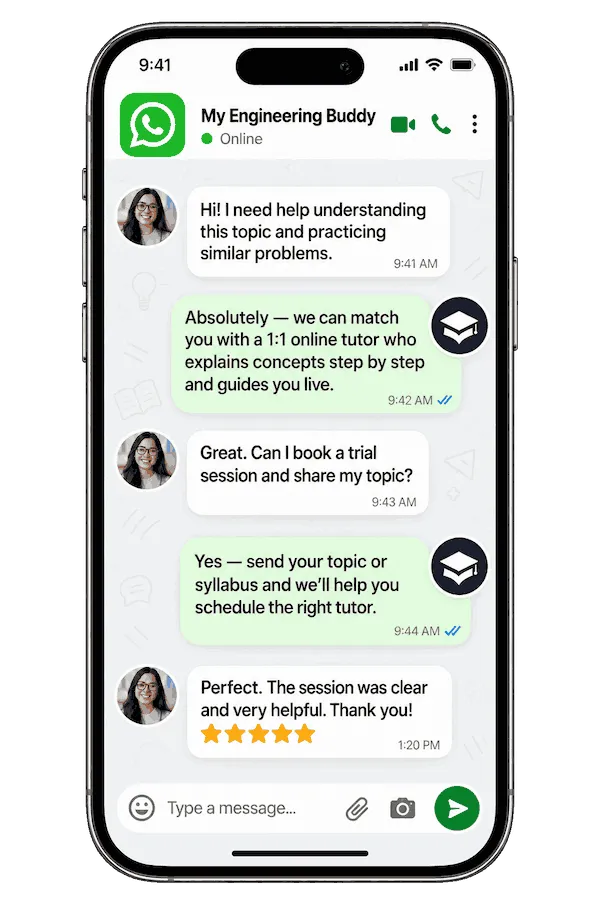
WhatsApp MEB for a quick quote — average response time under 1 minute.
Who This Music Tutoring Is For
Music tutoring at MEB covers a wide range of students and goals. If any of the following sounds familiar, you’re in the right place.
- School students working through GCSE, A Level, IB, or AP Music who need structured support on composition, harmony, or set works analysis
- Undergraduate students at universities such as Berklee, Royal College of Music, King’s College London, University of Toronto, or the University of Melbourne, tackling music theory, ear training, or music history modules
- Graduate students and researchers working on musicology, ethnomusicology, or music education programmes
- Adult learners building real instrument or vocal skills with structured practice plans and a tutor who adapts to their pace
- Students retaking after a failed first attempt at an A Level or IB Music exam — this is one of the most common reasons students come to MEB, and it’s fixable
- Parents watching a child’s confidence drop alongside their grades in Music performance or theory assessments
1:1 Tutoring vs Self-Study vs AI vs YouTube vs Online Courses
Self-study works if you’re disciplined — but Music without feedback means practising mistakes. AI tools can explain chord progressions or notation rules but can’t hear you play or diagnose why your sight-reading keeps breaking down at bar 12. YouTube is useful for overviews of harmonic analysis or instrument technique, but it stops exactly when your specific question starts. Online courses give structure at a fixed pace with no room for your particular gaps. A 1:1 online Music tutor from MEB works through your actual score, your actual weaknesses, in real time — whether that’s modal harmony, ornament execution, or your composition NEA.
Outcomes: What You’ll Be Able To Do in Music
After working with a Music tutor through MEB, students consistently report gains that are specific and measurable. You’ll be able to analyse a set work — identifying harmonic structure, texture, and compositional devices — with the precision an examiner expects. Apply voice-leading rules correctly in four-part harmony exercises without the parallel fifths that cost marks. Write a composition brief response that addresses all assessment criteria. Explain rhythmic and melodic development in an unfamiliar extract under timed conditions. Present a performance with stronger technical control and genuine musical understanding behind every interpretive choice.
Progress varies by starting level and how consistently you practise between sessions — but these are the outcomes students describe after sustained 1:1 work.
Based on feedback from 40,000+ sessions collected by MEB from 2022 to 2025, students working 1:1 on Music consistently report noticeably stronger technique, clearer understanding of harmonic and compositional form, and faster progress than self-directed practice alone. Progress varies by starting level and practice frequency.
Source: MEB session feedback data, 2022–2025.
Supporting a student through Music? MEB works directly with parents to set up sessions, track progress, and keep coursework on schedule. WhatsApp MEB — average response time is under a minute, 24/7.
What We Cover in Music (Syllabus / Topics)

Music Theory and Harmony
- Scales, modes, and key signatures — major, minor, church modes, and beyond
- Chord construction, Roman numeral analysis, and harmonic function
- Four-part (SATB) voice leading — parallel motion rules, cadences, modulation
- Counterpoint — species counterpoint, imitative writing, fugue structure
- Rhythmic notation, time signatures, and metric modulation
- Modal harmony and non-functional progressions in 20th-century contexts
- Figured bass realisation and continuo practice
Core texts include The AB Guide to Music Theory (Eric Taylor), Tonal Harmony (Kostka, Payne & Almén), and Counterpoint in Composition (Salzer & Schachter).
Set Works, Musical Analysis, and Music History
- Close analysis of set works across A Level, IB, and university syllabuses — naming structural, harmonic, and textural features precisely
- Contextualising composers and works within historical periods — Baroque, Classical, Romantic, 20th century, and contemporary
- Comparative analysis of unfamiliar extracts using taught frameworks
- Aural skills — interval recognition, chord quality identification, dictation practice
- Score reading and annotation for listening paper preparation
- Essay writing for music history and analysis modules
Useful references include The Oxford History of Western Music (Taruskin), A History of Western Music (Grout & Palisca), and Tate research resources for cross-disciplinary arts context.
Composition, Performance, and Practical Skills
- Composition briefs — responding to a stimulus, meeting exam board word counts, balancing creativity with technical accuracy
- NEA and coursework composition support — structuring drafts, checking against mark schemes
- Instrument technique coaching — fingering, bow hold, breath control, posture, adapted to instrument and level
- Sight-reading practice — building fluency and reducing breakdown points
- Performance preparation — interpretive decisions, marking scores, managing nerves
- Recording and submitting practical work — understanding assessment criteria
Tutors draw on Music Theory in Practice (ABRSM), The Musician’s Way (Klickstein), and exam board specification documents from AQA, Edexcel, OCR, and IB.
What a Typical Music Session Looks Like
The tutor opens by reviewing the harmony exercise or composition draft from the previous session — checking whether the parallel octaves issue identified last time has been corrected. From there, you and the tutor work through a new excerpt together on screen: the tutor annotates the score in real time using a digital pen-pad, circling where the bass line contradicts the Roman numeral analysis you’ve written. You try the next phrase yourself, then explain your chord choice out loud. The tutor corrects where needed — not by giving the answer, but by asking what function that chord is serving. The session closes with a specific task: harmonise the given melody using only diatonic chords, ready to share before the next session. Next topic: preparation for the listening paper’s unfamiliar extract question.
How MEB Tutors Help You with Music (The Learning Loop)
Diagnose: In the first session, the tutor identifies exactly where the gap is — not “struggles with theory” but “loses marks on cadence identification and doesn’t recognise a Neapolitan sixth on hearing.” That specificity shapes every session that follows.
Explain: The tutor works through live examples on screen — annotating scores, playing audio clips, writing out harmonic reductions using a digital pen-pad. No pre-recorded lecture. Everything responds to what you’re actually confused about in the moment.
Practice: You attempt the next problem while the tutor watches. In Music, that might mean harmonising a phrase, identifying a chord from a played extract, or writing the opening of a composition in a specified style. The tutor doesn’t step in early.
Feedback: Step-by-step error correction follows — not “this is wrong” but “the tenor voice crosses the alto on beat 3, and here’s why that costs you marks.” Students learn where their reasoning broke down, not just where the answer was.
Plan: Each session ends with a practice task and a note of what comes next. Whether you need ear training drills, a composition draft reviewed, or a run-through of an unfamiliar extract under timed conditions, the sequence is mapped.
Sessions run on Google Meet. The tutor uses a digital pen-pad or iPad with Apple Pencil for score annotation. Before your first session, share your exam board and syllabus (or course outline), a recent past paper attempt or composition draft, and your exam or deadline date. The first session serves as your diagnostic. Start with the $1 trial — 30 minutes of live tutoring that functions as your first diagnostic at no real cost.
At MEB, we’ve found that Music students who bring a specific score or past paper question to session one make progress roughly twice as fast as those who come with a vague sense of being behind. The more specific the starting point, the more useful every minute becomes.
Tutor Match Criteria (How We Pick Your Tutor)
Not every Music tutor is right for every student. Here’s what MEB looks at.
Subject depth: Tutors are matched by instrument, exam board, and syllabus — an A Level AQA Music student gets a tutor who knows the AQA set works, not a generalist with a music degree.
Tools: Every tutor uses Google Meet with a digital pen-pad or iPad and Apple Pencil — essential for score annotation and real-time harmonic analysis in Music.
Time zone: Matched to your region — US, UK, Gulf, Canada, or Australia — so sessions happen at a reasonable hour for both sides.
Goals: Whether you’re targeting a grade boundary, working on a composition NEA, building aural skills, or preparing for an audition, the tutor is selected for that specific aim.
Unlike platforms where you fill out a form and wait, MEB responds in under a minute, 24/7. Tutor match takes under an hour. The $1 trial means you test before you commit. Everything runs over WhatsApp — no logins, no intake forms.
Study Plans (Pick One That Matches Your Goal)
After the diagnostic session, your tutor builds a sequence based on one of three approaches: a catch-up plan (1–3 weeks) for students who need to close specific gaps before an exam — typically targeting harmony errors or set work gaps; an exam prep plan (4–8 weeks) with structured coverage of all paper components in order of mark weight; or weekly support aligned to coursework deadlines and composition submission dates. The tutor decides the sequence — you bring the materials.
Pricing Guide
Music tutoring fees start at $20/hr for school-level support and run to $40/hr for most undergraduate and A Level work. Graduate-level musicology, conservatoire audition prep, and specialist instrument coaching can reach $100/hr — the rate reflects the tutor’s professional background, not just their degree.
Rate factors: your level, the specific topics, how urgent the timeline is, and tutor availability in your time zone. Availability is tightest in April–May (A Level and IB exam windows) and November–December.
For students targeting conservatoires, graduate music programmes at universities such as the Royal Academy of Music, Juilliard, or the Sydney Conservatorium of Music, tutors with professional performance or composition backgrounds are available at higher rates — share your specific goal and MEB matches the tier to your ambition.
Start with the $1 trial — 30 minutes, no registration, no commitment. WhatsApp MEB for a quick quote.
Students consistently tell us that the hardest part of starting is not knowing how behind they actually are. The $1 trial session solves that — the tutor diagnoses the gap and gives you a clear picture of what it takes to close it before you spend a pound or dollar more.
MEB has been running 1:1 Music lessons since 2008. That’s 18 years of matching students who said “I just don’t understand harmony” with tutors who could show them exactly why — and fix it in one session.
Source: My Engineering Buddy, 2008–2025.
FAQ
Is Music hard?
Music has genuinely difficult components — four-part harmony, aural dictation, and compositional briefs challenge most students. The theory is learnable with the right guidance. Performance demands consistent practice. Neither is insurmountable with structured 1:1 support.
How many sessions are needed?
Most students working toward an A Level or IB Music exam see real progress within 8–12 sessions. Students with larger gaps or a composition NEA to complete often benefit from weekly sessions across a full term. The tutor maps this after the diagnostic.
How do you structure practice between sessions?
The tutor sets a specific task at the end of every session — a harmony exercise, a short composition draft, or an aural drill. You complete it before the next meeting. MEB tutoring is guided learning — you do the practice, the tutor corrects and builds on it.
Will the tutor match my current level and goals?
Yes. MEB matches by instrument, exam board, syllabus, and goal — not just by subject name. An IB Music student analysing Shostakovich gets a different tutor profile from an adult learning fingerstyle guitar for the first time.
What happens in the first session?
The tutor reviews what you’ve shared — past paper attempt, composition draft, or syllabus — and runs a short diagnostic. By the end of 30 minutes, you have a clear picture of the gaps and a session plan. This is also what the $1 trial covers.
Are online lessons as effective as in-person?
For Music theory, analysis, composition, and aural work — yes, fully equivalent. For instrument technique, online works well for most students; the tutor can see posture, fingering, and bow hold clearly over video. Some students prefer in-person for performance coaching specifically.
Can I get Music help at midnight?
MEB operates 24/7. Tutors span multiple time zones, so late-night sessions for students in the US, Gulf, or Australia are standard — not an exception. WhatsApp MEB at any hour to check availability and get matched.
What if I don’t like my assigned tutor?
Request a different tutor. MEB does this without friction — message via WhatsApp, explain what isn’t working, and a new match is arranged. The $1 trial exists partly for this reason: low cost, no obligation, real test of fit.
What’s the difference between Music Theory and Music as a subject?
Music as an academic subject covers theory, history, set works, composition, and performance — the full picture. Music Theory tutoring focuses specifically on the technical language of music: harmony, counterpoint, form, and notation. MEB covers both, separately or together.
Can a tutor help with my composition NEA or coursework?
Yes. Tutors guide composition coursework — helping you develop ideas, check technical accuracy against the mark scheme, and refine the final submission. MEB tutoring is guided learning; you write and submit the work yourself.
Do you offer group Music sessions?
MEB specialises in 1:1 sessions only. Group sessions are not offered. The whole model is built around a tutor responding to one student’s specific gaps — group formats remove that precision.
How do I get started?
Start with the $1 trial: 30 minutes of live tutoring or one question fully explained. Three steps: WhatsApp MEB, get matched within the hour, start your trial session. No registration, no forms, no commitment beyond that first session.
Trust & Quality at My Engineering Buddy
Every MEB tutor goes through subject-specific vetting — not a generic background check. For Music, that means demonstrating knowledge of current exam board specifications (AQA, Edexcel, OCR, IB), relevant instrument or composition credentials, and the ability to explain harmonic analysis at the level the student needs. Tutors complete a live demo evaluation before joining. Rated 4.8/5 across 40,000+ verified reviews on Google.
MEB tutoring is guided learning — you understand the work, then submit it yourself. For full details on what we help with and what we don’t, read our Academic Integrity policy and Why MEB.
MEB has served 52,000+ students across the US, UK, Canada, Australia, Gulf, and Europe in 2,800+ subjects since 2008. Within Fine Arts, students regularly come to MEB for Performing Arts tutoring, Drama tutoring, and support with Art History — subjects that sit alongside Music in many A Level and IB programmes. The methodology behind every session is documented at our tutoring methodology page.
Our experience across thousands of sessions shows that Music students who come in thinking they have a “theory problem” usually have a much more specific issue — a gap in cadence recognition or voice leading — that a good tutor can identify and fix within two sessions.
18 years, 52,000+ students, 4.8/5 on Google. MEB’s track record in Music and the broader Fine Arts isn’t a claim — it’s a number you can ask about when you WhatsApp us.
Source: My Engineering Buddy, 2008–2025.
Explore Related Subjects
Students studying Music often also need support in:
Next Steps
Ready to start? Here’s what to do:
- Share your exam board or course, your hardest component right now, and your exam or deadline date
- Share your availability and time zone
- MEB matches you with a verified Music tutor — usually within 24 hours
- Your first session starts with a diagnostic so every minute is used on what actually matters
Before your first session, have ready: your exam board and syllabus (or course outline), a recent past paper attempt or a composition you’ve struggled with, and your exam or deadline date. The tutor handles the rest.
Visit www.myengineeringbuddy.com for more on how MEB works.
WhatsApp to get started or email [email protected].
Reviewed by Subject Expert
This page has been carefully reviewed and validated by our subject expert to ensure accuracy and relevance.




