




~1 min
Average Reply Time
~1 hour
To Be Matched With A Tutor
30 Min Trial
75% Find Their Tutor On The 1st Trial
$20-35+/hr
Premium Yet Affordable Learning
Hire The Best Spanish Tutor

Most students who struggle with Spanish aren’t missing intelligence — they’re missing a tutor who catches the exact moment a verb tense breaks down.
Spanish Tutor Online
Spanish is a Romance language spoken by over 500 million native speakers worldwide, taught across school, university, and professional contexts. It equips learners with spoken fluency, written accuracy, and cross-cultural communication skills across Europe, Latin America, and beyond.
MEB connects you with a Spanish tutor near me — or anywhere online — who has worked with students across AP, IB, A Level, GCSE, DELE, university language modules, and conversation courses. Whether you’re behind on coursework, heading into an oral exam, or need structured grammar support, a 1:1 online Spanish tutor from MEB builds sessions around your actual syllabus. Part of our broader Language tutoring provision covering 2,800+ subjects since 2008.
- 1:1 online sessions tailored to your course, exam board, or syllabus level
- Expert-verified tutors with Spanish-specific teaching backgrounds
- Flexible time zones — US, UK, Canada, Australia, and the Gulf covered
- Structured learning plan built after a first diagnostic session
- Ethical homework and assignment guidance — you understand before you submit
52,000+ students across the US, UK, Canada, Australia, and the Gulf have used MEB since 2008 — including students in Language subjects like Spanish, French tutoring, and Italian tutoring.
Source: My Engineering Buddy, 2008–2025.
How Much Does a Spanish Tutor Cost?
Most Spanish tutoring sessions at MEB run $20–$40 per hour, depending on level and exam board. Advanced university modules or DELE preparation may reach $60–$70/hr. The $1 trial gets you 30 minutes of live tutoring or a full explanation of one homework question — no registration needed.
| Level / Need | Typical Rate | What’s Included |
|---|---|---|
| Standard (GCSE, A Level, AP, IB) | $20–$35/hr | 1:1 sessions, homework guidance |
| Advanced / University / DELE | $35–$70/hr | Expert tutor, oral exam prep, niche depth |
| $1 Trial | $1 flat | 30 min live session or 1 homework question |
Tutor availability tightens sharply in the 6 weeks before AP exam windows and A Level seasons. Book early if you’re working to a fixed date.
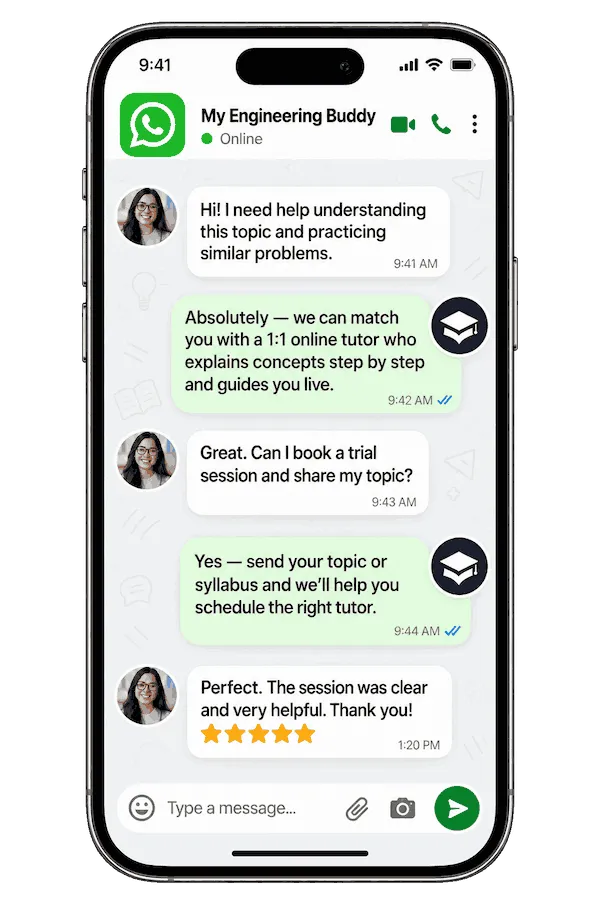
WhatsApp MEB for a quick quote — average response time under 1 minute.
Who This Spanish Tutoring Is For
Spanish tutoring at MEB covers a wide range of students — from those tackling GCSE writing tasks for the first time to postgraduates analysing García Márquez in the original. The sessions adapt. The level doesn’t matter as much as the gap you need to close.
- Students retaking GCSE or A Level Spanish after a grade that missed the mark
- Students with a university conditional offer that depends on their Spanish result
- AP Spanish Language and Culture or AP Spanish Literature and Culture exam candidates 4–6 weeks out with gaps still to close
- IB Spanish A or Spanish B students preparing for internal assessments or final papers
- University students in language modules at institutions like UC Santa Barbara, King’s College London, McGill, or the University of Sydney needing structured grammar and composition support
- Parents watching a child’s confidence drop alongside their grades in Spanish
- Adult learners building conversational or professional fluency for travel, work, or DELE certification
If you’re preparing for DELE B2 or C1, the $1 trial session gives you a direct read on where your written production and listening comprehension actually stand.
1:1 Tutoring vs Self-Study vs AI vs YouTube vs Online Courses
Self-study works if you’re disciplined, but Spanish pronunciation and subjunctive use don’t self-correct without feedback. AI tools can translate and explain grammar rules instantly — they can’t hear your spoken errors or catch the pattern in your written mistakes across three assignments. YouTube covers vocabulary and tense introductions well; it stops when you’re stuck on the difference between por and para in a specific essay context. Online courses move at a fixed pace regardless of whether you’ve genuinely absorbed the preterite before moving to the imperfect. 1:1 tutoring with MEB is live, corrects errors in the moment, and calibrates entirely to your Spanish course, exam board, and the topics you’re losing marks on right now.
Outcomes: What You’ll Be Able To Do in Spanish
After structured 1:1 sessions, students consistently move from passive recognition of grammar rules to active, accurate use. You’ll write compositions that handle the subjunctive and conditional correctly, not just identify them in a multiple-choice item. You’ll analyze literary and non-literary texts in AP or IB formats — constructing arguments in Spanish, not translating them from English in your head. You’ll speak with enough control to handle IB individual oral assessments or DELE oral production tasks without collapsing under spontaneous prompts. You’ll apply register distinctions between formal written Spanish and spoken interaction in ways that actually earn marks in the writing and speaking components your board assesses.
Supporting a student through Spanish? MEB works directly with parents to set up sessions, track progress, and keep coursework on schedule. WhatsApp MEB — average response time is under a minute, 24/7.
Based on feedback from 40,000+ sessions collected by MEB from 2022 to 2025, 58% of students improved by one full grade after approximately 20 hours of 1:1 tutoring in subjects like Spanish. A further 23% achieved at least a half-grade improvement.
Source: MEB session feedback data, 2022–2025.
What We Cover in Spanish (Syllabus / Topics)

Grammar, Writing, and Composition
- Verb tenses: preterite vs imperfect, subjunctive mood (present and past), conditional and future
- Ser vs estar — context-dependent use in written and spoken Spanish
- Subjunctive triggers: expressions of doubt, emotion, will, and hypothetical conditions
- Essay writing in Spanish: thesis construction, paragraph structure, formal register
- Translation tasks and prose composition (A Level, university)
- GCSE and A Level writing tasks: structured responses to image prompts and stimulus material
Key textbooks: Camino al español (Cambridge), Spanish Grammar in Context (Butt & Benjamin), A New Reference Grammar of Modern Spanish (Butt & Benjamin, 5th ed.).
Speaking and Oral Examination Preparation
- IB Individual Oral: photo/stimulus discussion, linking to global issues, spontaneous questions
- AP Spanish Language and Culture: simulated conversation tasks and presentational speaking
- A Level speaking exam: role-play, general conversation, discussion of themes and texts
- DELE oral production: sustained monologue, task-based interaction, formal register under timed conditions
- Pronunciation: vowel clarity, stress patterns, regional accent awareness
- Fluency-building: circumlocution strategies for when vocabulary gaps arise mid-conversation
Key resources: Así se habla (Teach Yourself), DELE B2/C1 official preparation guides (Instituto Cervantes), board-specific past papers for speaking components.
Literature, Texts, and Cultural Analysis
- AP Spanish Literature and Culture: prescribed texts including García Lorca, Borges, Sor Juana Inés de la Cruz
- IB Spanish A: literary commentary, written assignment, individual oral on works in translation
- A Level texts: set novels and film study (varies by board — AQA, Edexcel, WJEC covered)
- Analytical essay writing in Spanish: argumentation, textual evidence, critical register
- Cultural contexts: colonial history, Siglo de Oro, Latin American literary movements
- Unseen text analysis: inference, tone, narrative technique in prose and poetry
Key textbooks: The Cambridge Companion to the Spanish Novel, AP Spanish Literature and Culture: Exam Prep (various publishers), board-specific set text editions. Students studying Spanish Literature tutoring often move between this track and the grammar track in alternating sessions.
At MEB, we’ve found that students who lose marks in Spanish writing exams almost never have a vocabulary problem. The issue is almost always verb tense sequencing — preterite, imperfect, and subjunctive used correctly in isolation but inconsistently when writing under pressure. One targeted session on this pattern shifts the whole essay mark.
What a Typical Spanish Session Looks Like
The tutor opens by checking the previous session’s task — for example, a written paragraph using the imperfect subjunctive in reported speech. The student shares their attempt on screen. The tutor reads through it using a digital pen-pad, annotating directly: marking where tense choice breaks down, where ser/estar is swapped, where register slips from formal to informal without cause. Together, they rewrite two or three problem sentences — the student proposes the correction, the tutor confirms or redirects. From there, the session moves to the next component: oral exam simulation, unseen text analysis, or a new grammar pattern in context. The student speaks, writes, or translates in real time. The tutor corrects immediately — not at the end. The session closes with one concrete task: a short written paragraph, a timed speaking exercise, or three past-paper questions on the next topic. The tutor notes it. The student knows exactly what they’re preparing before the next session.
How MEB Tutors Help You with Spanish (The Learning Loop)
Diagnose: In the first session, the tutor reviews a piece of your recent Spanish work — an essay, a translation, a speaking recording, or a past-paper attempt. They identify the three or four patterns causing the most mark loss, not a general list of grammar rules to review.
Explain: The tutor works through a live example using a digital pen-pad on Google Meet — showing the subjunctive trigger in context, not just defining it. Students learning Portuguese tutoring alongside Spanish often find this comparative approach accelerates both.
Practice: The student attempts the same structure immediately — in a new sentence, then a paragraph, then under timed conditions. The tutor watches and waits before intervening.
Feedback: Error correction is step-by-step. The tutor explains why a verb tense was wrong — not just that it was wrong — and connects it to the mark scheme so the student understands the cost of that error in an exam context.
Plan: At the end of each session, the tutor maps the next topic in sequence, sets a short task, and notes where the student sits against their exam timeline. Nothing is left open-ended.
Sessions run on Google Meet with a digital pen-pad or iPad and Apple Pencil for live annotation. Before your first session, share your exam board (or course outline), the Spanish topic you find hardest, and your exam or deadline date. Start with the $1 trial — 30 minutes of live tutoring that also serves as your first diagnostic.
Students consistently tell us that the moment they stop translating from English in their head and start thinking directly in Spanish — even imperfectly — their spoken and written marks improve together. The tutor’s job is to build enough active recall that translation becomes unnecessary. That usually takes 8–12 hours of targeted 1:1 work.
Tutor Match Criteria (How We Pick Your Tutor)
Not every Spanish speaker is a Spanish tutor. MEB matches on four criteria.
Subject depth: The tutor is matched to your specific level — GCSE, AP, IB, A Level, DELE, or university module — and your exam board where applicable. A tutor covering AP Spanish Literature knows the prescribed text list. A tutor covering A Level AQA knows the film and novel set that year.
Tools: All tutors work on Google Meet with a digital pen-pad or iPad and Apple Pencil. Written correction happens live on screen — not in a separate document emailed after the session.
Time zone: Tutors are matched to your region — US, UK, Canada, Australia, or the Gulf — so session times work without anyone compromising their schedule.
Goals: Whether you need exam scores, coursework completion, or conversational fluency, the tutor is told your specific objective before the first session. Generic Spanish tutoring is not what MEB does.
Unlike platforms where you fill out a form and wait, MEB responds in under a minute, 24/7. Tutor match takes under an hour. The $1 trial means you test before you commit. Everything runs over WhatsApp — no logins, no intake forms.
Study Plans (Pick One That Matches Your Goal)
After the first diagnostic session, the tutor builds a specific session sequence. Three common plans: catch-up (1–3 weeks) closes the most urgent gaps before an exam — typically grammar accuracy and one skills component; exam prep (4–8 weeks) covers all assessed components in order of weight with past-paper practice built in from week two; weekly support runs alongside your semester, aligned to coursework deadlines and internal assessment dates. The tutor adjusts the sequence after each session based on what’s actually moving and what isn’t.
Pricing Guide
Spanish tutoring at MEB starts at $20/hr and runs to $40/hr for most levels. Graduate-level language modules, DELE C1/C2 preparation, and advanced literary analysis with tutors who hold postgraduate Spanish qualifications are available up to $100/hr.
Rate factors: your level, the complexity of the exam component, how close your exam date is, and tutor availability in your time zone. Rates for peak exam periods — particularly the AP May window and A Level spring season — reflect higher demand on experienced tutors.
For students targeting places at institutions with competitive language entry requirements, tutors with research or professional backgrounds in Hispanic studies and linguistics are available at higher rates. Share your specific goal and MEB will match the tier to your ambition.
Start with the $1 trial — 30 minutes, no registration, no commitment. WhatsApp MEB for a quick quote.
Spanish is the second most widely spoken language by native speakers globally — and the most studied foreign language in US schools and universities, with over 8 million enrolled learners according to the Modern Language Association.
Source: Modern Language Association Enrollment Survey, 2022; British Council.
Try your first session for $1 — 30 minutes of live 1:1 tutoring or one homework question explained in full. No registration. No commitment. WhatsApp MEB now and get matched within the hour.
FAQ
Is Spanish hard to learn?
Spanish is classified as a Category I language by the US Foreign Service Institute — one of the more accessible for English speakers. Pronunciation is consistent, but verb conjugation, the subjunctive mood, and gendered nouns are where most students hit a wall and need targeted help.
How many sessions are typically needed?
Most students working toward a specific exam see clear improvement in 8–15 sessions. Students with wider gaps — say, a year of missed grammar foundations — need 20+ hours. The first diagnostic session gives the tutor enough information to map an honest timeline.
Can you help with homework and assignments?
Yes — MEB tutoring is guided learning. The tutor explains the grammar rule, works through an example with you, and you produce the work yourself before submitting. See our Academic Integrity policy and Why MEB page for full details on what we help with and what we don’t.
Will the tutor match my exact syllabus or exam board?
Yes. MEB tutors are matched to your specific board — AQA, Edexcel, WJEC, IB, AP, Cambridge International, or your university module. The tutor knows which texts are set, which speaking tasks are assessed, and which grammar structures carry the most marks in your specific exam.
What happens in the first Spanish session?
The tutor reviews a recent piece of your Spanish work — an essay draft, a past-paper attempt, or a homework task. They identify the 3–4 patterns causing the most mark loss. From the second session onward, every session targets those patterns specifically.
Is online Spanish tutoring as effective as in-person?
For grammar, writing, and text analysis — yes, fully. Speaking practice works well over video with a tutor who gives immediate spoken correction. The digital pen-pad replicates what a whiteboard does in person. The gap between online and in-person for Spanish tutoring is minimal when the tutor is skilled.
What is the difference between AP Spanish Language and Culture and AP Spanish Literature and Culture?
AP Spanish Language focuses on interpersonal communication, presentational writing, and listening comprehension across real-world themes. AP Spanish Literature covers prescribed texts from Spain and Latin America — literary analysis in Spanish, prose commentary, and essay writing. Many students sit one; students aiming for Spanish majors sometimes sit both. MEB tutors cover each separately.
Can MEB help with the IB Spanish Individual Oral?
Yes. The IB Individual Oral requires students to discuss a visual stimulus linked to global issues and connect it to works studied. MEB tutors run full oral simulations, give spoken feedback, and practise the spontaneous question phase — the part most students underestimate and most tutors skip.
Do you offer help with DELE exam preparation?
Yes. MEB tutors cover DELE A2 through C1, with sessions focused on the specific task types in each level — written production, reading comprehension, listening, and oral interaction. DELE C1 requires particular attention to formal written register and extended oral production under timed conditions.
Can I get Spanish help at midnight or on weekends?
Yes. MEB tutors operate across US, UK, Gulf, and Australian time zones — which means late-night sessions in one region are daytime sessions for a tutor in another. Weekend availability is standard. WhatsApp MEB and the response comes back in under a minute regardless of when you send it.
How do I get started?
Three steps: WhatsApp MEB with your exam board, hardest topic, and exam date. MEB matches you with a verified Spanish tutor — usually within the hour. Your first session starts with a diagnostic and costs $1. No forms, no waiting, no commitment beyond that first session.
Trust & Quality at My Engineering Buddy
Every MEB tutor goes through subject-specific screening — not a general teaching interview. For Spanish, that means demonstrating fluency at or above the level they’re teaching, knowledge of the specific exam board’s mark scheme and assessment criteria, and a live demo session evaluated before they join the platform. Ongoing session feedback from students feeds into tutor performance reviews. Rated 4.8/5 across 40,000+ verified reviews on Google. MEB has been operating since 2008 and serves 52,000+ students across the US, UK, Canada, Australia, the Gulf, and Europe.
MEB tutoring is guided learning — you understand the work, then submit it yourself. For full details on what we help with and what we don’t, read our Academic Integrity policy and Why MEB.
MEB covers 2,800+ subjects in the Language category and adjacent disciplines. Students working on Spanish frequently also work on German tutoring, Arabic tutoring, and Latin tutoring — often within the same semester when their university language requirements span more than one language. See our tutoring methodology for how sessions are structured across all language subjects.
SLA (second language acquisition) research consistently shows that corrective feedback delivered immediately during oral and written production accelerates accuracy gains faster than delayed correction — making live 1:1 sessions particularly well suited to language learning.
Source: Lyster & Ranta (1997), corrective feedback in communicative language teaching; Mackey & Goo (2007) meta-analysis of interaction and SLA.
A common pattern our tutors observe is that students who have been self-studying Spanish with apps like Duolingo arrive knowing a lot of vocabulary but producing verb forms incorrectly under pressure. Vocabulary breadth is not the gap. Accurate production under timed exam conditions is. Those are two different problems — and only one of them responds to more vocabulary drills.
Explore Related Subjects
Students studying Spanish often also need support in:
Next Steps
Before your first session, have ready: your exam board and syllabus (or course outline), a recent past-paper attempt or homework you struggled with, and your exam or deadline date. The tutor handles the rest.
- Share your exam board, hardest component, and current timeline
- Share your availability and time zone
- MEB matches you with a verified Spanish tutor — usually within 24 hours
Your first session opens with a diagnostic so every minute is used well. Visit www.myengineeringbuddy.com for more on how MEB works.
WhatsApp to get started or email [email protected].
Reviewed by Subject Expert
This page has been carefully reviewed and validated by our subject expert to ensure accuracy and relevance.




