




~1 min
Average Reply Time
~1 hour
To Be Matched With A Tutor
30 Min Trial
75% Find Their Tutor On The 1st Trial
$20-35+/hr
Premium Yet Affordable Learning
Your Building Service grades aren’t failing because you’re not smart — they’re failing because HVAC load calculations and psychrometric charts need someone to walk you through them live.
Building Service Tutor Online
Building Service engineering covers the design and integration of mechanical, electrical, and plumbing systems within buildings — including HVAC, lighting, fire protection, and drainage — equipping students to deliver safe, energy-efficient built environments.
Finding a reliable Building Service tutor near me used to mean sifting through freelance profiles with no quality guarantee. MEB’s 1:1 online tutoring and homework help in civil engineering connects you with a verified expert who knows your exact syllabus — whether you’re working through HVAC psychrometrics, electrical load scheduling, or sustainable MEP design. One session can shift what three weeks of lecture slides couldn’t.
- 1:1 online sessions tailored to your course syllabus and assessment format
- Expert-verified tutors with subject-specific MEP and building systems knowledge
- Flexible time zones — US, UK, Canada, Australia, Gulf
- Structured learning plan built after a diagnostic session
- Ethical homework and assignment guidance — you understand the work, then submit it yourself
52,000+ students across the US, UK, Canada, Australia, and the Gulf have used MEB since 2008 — including students in civil engineering subjects like Building Service, building automation systems, and energy management.
Source: My Engineering Buddy, 2008–2025.
How Much Does a Building Service Tutor Cost?
Most Building Service tutoring sessions run $20–$40/hr. Graduate-level MEP design, energy modelling, or LEED-focused coursework may reach $60–$100/hr. Not sure if MEB is right for you? Start with the $1 trial — 30 minutes of live 1:1 tutoring or one homework question explained in full.
| Level / Need | Typical Rate | What’s Included |
|---|---|---|
| Standard (most undergraduate levels) | $20–$40/hr | 1:1 sessions, homework guidance |
| Advanced / Specialist (MEP, LEED, grad-level) | $40–$100/hr | Expert tutor, deep niche coverage |
| $1 Trial | $1 flat | 30 min live session or 1 homework question |
Tutor availability tightens in April–May and November–December when semester deadlines and final exams converge. Book early if your submission window is close.
WhatsApp MEB for a quick quote — average response time under 1 minute.
Who This Building Service Tutoring Is For
Building Service pulls together thermodynamics, fluid mechanics, electrical systems, and sustainability standards into a single discipline. That breadth catches a lot of students off guard — especially when assignments move from theory to system design without much warning.
- Undergraduate students who can follow lectures but freeze when it’s time to size an HVAC system from scratch
- Students with a conditional university offer hinging on this module’s grade
- Graduate students juggling MEP coursework with research commitments and tight deadlines
- Students 4–6 weeks from finals with significant gaps in psychrometrics, heat load calculations, or electrical distribution
- Students retaking after a failed first attempt at a Building Service or MEP-heavy module
- Parents watching a student’s confidence drop alongside their assignment marks
MEB tutors have supported students at Georgia Tech, TU Delft, University of Melbourne, UCL, University of Toronto, Penn State, and ETH Zurich — among many others.
1:1 Tutoring vs Self-Study vs AI vs YouTube vs Online Courses
Self-study works if you’re disciplined, but Building Service calculations don’t self-correct. AI tools give fast answers — they can’t diagnose why your heat load keeps coming out wrong. YouTube is useful for MEP overviews; it stops dead when you’re stuck on a psychrometric chart midway through an assignment. Online courses move at a fixed pace with no room for your specific exam board’s format. With a 1:1 online Building Service tutor from MEB, every session is calibrated to your syllabus, your errors, and your exam date — nothing generic, nothing wasted.
Outcomes: What You’ll Be Able To Do in Building Service
After working with an MEB Building Service tutor, you’ll be able to solve HVAC load calculations using psychrometric data, analyze heating and cooling demands for multi-zone buildings, model electrical distribution systems and check against load schedules, explain the interaction between passive design strategies and active MEP systems, and apply relevant codes — including ASHRAE standards and local building regulations — to real design scenarios. Confidence in these areas tends to move assignment grades quickly once the underlying logic clicks.
Based on feedback from 40,000+ sessions collected by MEB from 2022 to 2025, 58% of students improved by one full grade after approximately 20 hours of 1:1 tutoring in subjects like Building Service. A further 23% achieved at least a half-grade improvement.
Source: MEB session feedback data, 2022–2025.
Supporting a student through Building Service? MEB works directly with parents to set up sessions, track progress, and keep coursework on schedule. WhatsApp MEB — average response time is under a minute, 24/7.
What We Cover in Building Service (Syllabus / Topics)

HVAC and Thermal Systems
- Psychrometric processes: heating, cooling, humidification, dehumidification
- Cooling and heating load calculations (CLTD, RTS, or software-aided methods)
- Air handling unit design and duct sizing
- Refrigeration cycles: vapour compression and absorption systems
- Thermal comfort standards (ASHRAE 55, ISO 7730)
- Ventilation rates and indoor air quality requirements
- Energy recovery systems: heat wheels, run-around coils
Core texts include ASHRAE Fundamentals Handbook, Faye McQuiston’s Heating, Ventilating, and Air Conditioning, and Roger Legg’s Air Conditioning System Design.
Electrical and Lighting Systems
- Electrical load scheduling and diversity factors
- Distribution board design and cable sizing
- Lighting design: lux levels, luminaire selection, daylight integration
- Power factor correction and harmonic distortion
- Emergency lighting and fire alarm system layouts
- Low-voltage and extra-low-voltage system integration
Tutors reference IET Wiring Regulations (BS 7671), CIBSE Lighting Guide LG7, and Derek Smith’s Building Services Engineering.
Plumbing, Drainage, and Fire Protection
- Hot and cold water system design: storage, pressure, flow rates
- Soil, waste, and rainwater drainage sizing
- Fire suppression systems: sprinkler hydraulics and coverage design
- Legionella risk assessment and water treatment protocols
- Sustainable drainage systems (SuDS) and greywater recycling
- Gas supply and pressure regulation within buildings
Key references: CIBSE Guide G (Public Health Engineering), BS EN 12845 (sprinkler systems), and Peter Burberry’s Building Services.
At MEB, we’ve found that Building Service students who struggle most are usually those trying to treat HVAC, electrical, and plumbing as three unrelated subjects. The tutors who get results fastest are the ones who help students see the system interactions — how a change in occupancy load ripples through ventilation, cooling, and electrical demand simultaneously.
What a Typical Building Service Session Looks Like
The tutor opens by checking where you got stuck in the previous topic — often psychrometric chart readings or duct sizing from the session before. From there, you and the tutor work through a live problem on screen: the tutor uses a digital pen-pad to annotate diagrams, sketch system layouts, and walk through calculation steps in real time. You replicate the method on a new problem while the tutor watches and corrects errors the moment they appear — not after. The session closes with a specific practice task (for example, sizing a simple VAV system using given space loads) and a note on what the next session will cover, so you arrive prepared.
How MEB Tutors Help You with Building Service (The Learning Loop)
Diagnose: In the first session, the tutor identifies exactly where your understanding breaks down — whether that’s psychrometric processes, electrical load scheduling, or interpreting CIBSE guidance. No assumptions. The diagnostic shapes everything that follows.
Explain: The tutor works through live examples using a digital pen-pad, showing you the reasoning behind each calculation step — not just the answer. For Building Service, this usually means annotated system diagrams alongside worked numerics.
Practice: You attempt problems while the tutor is present. This is where most of the learning happens. Passive watching doesn’t fix calculation errors; active doing does.
Feedback: The tutor corrects errors step by step and explains why marks get lost in typical assignment and exam marking schemes — including how to present answers to satisfy CIBSE and ASHRAE-based marking criteria.
Plan: At the end of each session, the tutor sets the next topic, agrees a practice task, and updates the progression sequence. No two students follow the same path.
Sessions run over Google Meet with a digital pen-pad or iPad and Apple Pencil. Before your first session, send over your course outline or assignment brief and any recent work you’ve struggled with. The first session starts with the diagnostic — so the $1 trial does double duty as a standing start. Whether you need a quick catch-up before an exam, structured revision over 4–8 weeks, or ongoing weekly support through the semester, the tutor maps the session plan after that first diagnostic.
Start with the $1 trial — 30 minutes of live tutoring that also serves as your first diagnostic.
Try your first session for $1 — 30 minutes of live 1:1 tutoring or one homework question explained in full. No registration. No commitment. WhatsApp MEB now and get matched within the hour.
Tutor Match Criteria (How We Pick Your Tutor)
Not every tutor with an engineering degree is qualified to teach Building Service. MEB matches on four criteria.
Subject depth: The tutor must have direct experience with your specific syllabus area — HVAC system design, MEP integration, or sustainable building systems — not just general mechanical or civil engineering background.
Tools: Every MEB Building Service tutor uses Google Meet with a digital pen-pad or iPad and Apple Pencil. Calculations and system diagrams are worked through visually, in real time.
Time zone: Tutors are matched to your region — US, UK, Gulf, Canada, or Australia — so session times are practical, not a compromise.
Goals: Whether you need to pass a resit, push for a distinction, complete a specific MEP assignment, or build long-term conceptual depth in green building design, the tutor is selected to fit that aim — not assigned randomly.
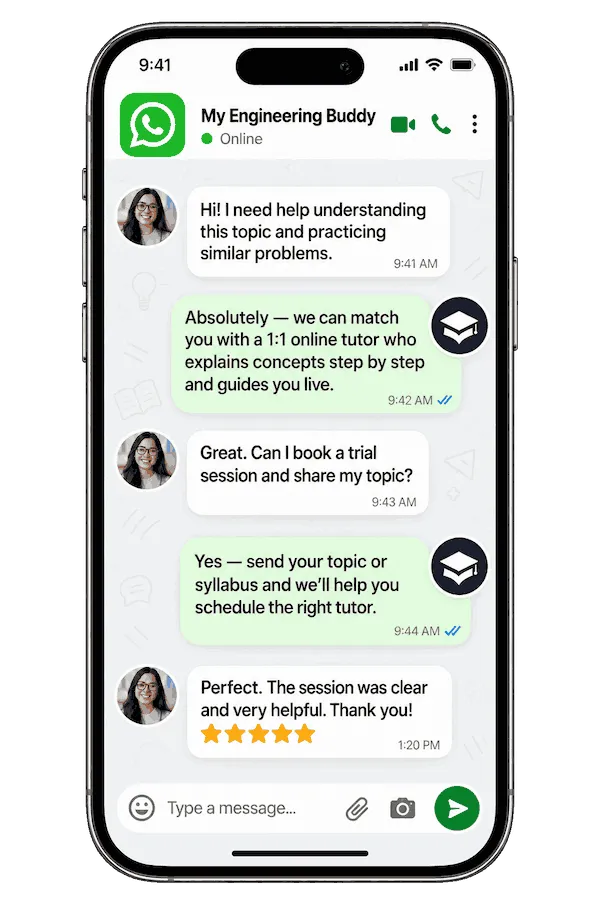
Unlike platforms where you fill out a form and wait, MEB responds in under a minute, 24/7. Tutor match takes under an hour. The $1 trial means you test before you commit. Everything runs over WhatsApp — no logins, no intake forms.
Pricing Guide
Building Service tutoring starts at $20/hr for standard undergraduate-level work and runs to $40/hr for more complex MEP system design coursework. Graduate-level topics — energy modelling, LEED documentation support, advanced HVAC simulation — can reach $100/hr depending on tutor specialisation and timeline.
Rate factors include your course level, the complexity of the topic (psychrometrics vs general building physics, for example), your deadline urgency, and tutor availability. Demand peaks in April–May and November–December. If your exam or submission is within four weeks, book promptly.
For students targeting roles at firms like Arup, WSP, or Buro Happold — or pursuing CIBSE, ASHRAE, or LEED professional credentials — tutors with industry MEP backgrounds are available at higher rates. Share your specific goal and MEB will match the tier to your ambition.
Start with the $1 trial — 30 minutes, no registration, no commitment. WhatsApp MEB for a quick quote.
MEB covers 2,800+ subjects across civil, mechanical, and electrical engineering — including facilities engineering, fire fighting and safety protection engineering, and renewable energy — all at the same 1:1 standard since 2008.
Source: My Engineering Buddy, 2008–2025.
FAQ
Is Building Service hard?
It’s one of the more demanding engineering modules because it requires you to integrate thermodynamics, fluid mechanics, and electrical systems simultaneously. Most students find HVAC load calculations and psychrometric chart work the steepest part. It’s manageable with structured 1:1 guidance.
How many sessions are needed?
Students with specific assignment gaps often see a clear improvement in 3–5 sessions. Those preparing for finals across multiple Building Service topics typically benefit from 10–20 hours spread over 4–8 weeks. The tutor sets a session plan after the first diagnostic.
Can you help with homework and assignments?
Yes. MEB tutoring is guided learning — you understand the work, then submit it yourself. Tutors walk you through the method, check your reasoning, and help you identify errors. See our Academic Integrity policy and Why MEB page for full details on what we help with and what we don’t.
Will the tutor match my exact syllabus or exam board?
Yes. Building Service is delivered across multiple universities and professional bodies — CIBSE, ASHRAE, and various national frameworks. When you message MEB, share your course outline or module handbook. The tutor is matched to your specific content, not a generic MEP overview.
What happens in the first session?
The tutor runs a short diagnostic — asking you to explain a recent problem you struggled with and checking your understanding of core concepts. This shapes the entire session plan. By the end of the first session, you’ll know exactly which topics to prioritise and in what order.
Is online tutoring as effective as in-person?
For Building Service, yes — often more so. Digital pen-pad annotation means the tutor can mark up system diagrams, psychrometric charts, and calculation tables in real time on screen. Students report that seeing the tutor’s reasoning visually, step by step, is clearer than watching someone write on a whiteboard from a distance.
Can I get Building Service help at midnight or on weekends?
Yes. MEB operates 24/7. Tutors span US, UK, Gulf, and Australian time zones, so late-night or weekend sessions are standard — not exceptions. WhatsApp MEB at any hour and you’ll typically have a tutor match confirmed within the hour.
What if I don’t like my assigned tutor?
Request a different tutor via WhatsApp. There’s no form, no delay, no penalty. MEB will rematch you, usually within a few hours. The $1 trial is partly designed for this — you test the fit before committing to a session package.
Do Building Service tutors cover CIBSE and ASHRAE standards?
Yes. Most Building Service coursework in the UK references CIBSE Guides (A, B, F, G) and relevant British Standards. US and international programmes typically use ASHRAE standards. MEB tutors are matched to your regulatory framework, not a generic engineering approach.
What’s the difference between Building Services Engineering and MEP engineering — and does MEB cover both?
Building Services Engineering and MEP (Mechanical, Electrical, Plumbing) engineering refer to the same discipline under different naming conventions — MEP is more common in North America; Building Services Engineering is standard in the UK and Australia. MEB tutors cover both framings and all associated coursework.
How do I get started?
Message MEB on WhatsApp — it takes under a minute. Share your course, current topic, and exam or deadline date. MEB matches you with a verified Building Service tutor, usually within the hour. Your first session starts with the $1 trial and a diagnostic so no time is wasted.
Can MEB help with Building Information Modelling (BIM) as it applies to building services?
Yes. Many Building Service courses now include MEP coordination using BIM tools. MEB tutors who specialise in BIM 360 and related platforms can support you on both the software application and the underlying MEP system design principles simultaneously.
Trust & Quality at My Engineering Buddy
Every MEB tutor goes through a subject-specific screening process before taking sessions. This includes a live demo evaluation, review of academic and professional credentials, and ongoing session feedback monitoring. Tutors are matched only to subjects they can demonstrate depth in — not just adjacent fields. Rated 4.8/5 across 40,000+ verified reviews on Google, MEB has been matching students with subject-specific tutors since 2008.
MEB tutoring is guided learning — you understand the work, then submit it yourself. For full details on what we help with and what we don’t, read our Academic Integrity policy and Why MEB.
MEB serves students across the US, UK, Canada, Australia, the Gulf, and Europe in 2,800+ subjects. Within civil engineering, the platform covers Building Service alongside closely related areas such as structural engineering tutoring, environmental engineering help, and geotechnical engineering tutoring — all delivered at the same 1:1 standard, with the same tutor-matching process, since 2008. Visit the Bureau of Labor Statistics for data on engineering occupations and career context for building services professionals.
Students consistently tell us that Building Service clicked when they stopped memorising formulas and started understanding what each system is trying to achieve physically. That shift — from formula recall to system logic — is what MEB tutors work toward from session one.
Explore Related Subjects
Students studying Building Service often also need support in:
- Building Materials
- Sustainable Design & Development
- Water and Wastewater Treatment
- Energy Management
- Air Pollution Control
- Structural Analysis
- Estimation and Costing in Civil Engineering
Next Steps
Getting started takes less than two minutes.
- Share your exam board or course outline, the topics giving you the most trouble, and your current timeline
- Share your availability and time zone
- MEB matches you with a verified Building Service tutor — usually within 24 hours, often within the hour
- Your first session begins with a diagnostic so every minute is used well from the start
Before your first session, have ready: your course outline or module handbook, a recent assignment or problem you struggled with, and your exam or submission deadline date. The tutor handles the rest.
Visit www.myengineeringbuddy.com for more on how MEB works.
WhatsApp to get started or email [email protected].
Reviewed by Subject Expert
This page has been carefully reviewed and validated by our subject expert to ensure accuracy and relevance.




