~1 min
Average Reply Time
~1 hour
To Be Matched With A Tutor
30 Min Trial
75% Find Their Tutor On The 1st Trial
$20-35+/hr
Premium Yet Affordable Learning
Hire The Best Green Building Design Tutor

Most students who fail a Green Building Design module can’t explain LEED credits, passive solar strategies, or building energy modeling — and no textbook fixes that alone.
Green Building Design Tutor Online
Green Building Design is the practice of designing buildings to minimize environmental impact through energy efficiency, sustainable materials, and occupant health — evaluated against rating systems such as LEED, BREEAM, or WELL at undergraduate and graduate levels.
MEB provides 1:1 online tutoring and homework help in 2,800+ advanced subjects, including Green Building Design. Whether you’re searching for a Green Building Design tutor near me or need live expert support at 2 a.m. before a submission, our verified tutors cover everything from passive design strategies to building energy modeling software. Part of our broader Civil Engineering tutoring programme, this service is built for students who need more than a lecture slide re-read.
- 1:1 online sessions tailored to your specific course, university, or rating system (LEED, BREEAM, WELL)
- Expert-verified tutors with subject-specific knowledge in sustainable design, energy analysis, and green certification
- Flexible time zones — US, UK, Canada, Australia, Gulf
- Structured learning plan built after a diagnostic session
- Ethical homework and assignment guidance — you understand the work, then submit it yourself
52,000+ students across the US, UK, Canada, Australia, and the Gulf have used MEB since 2008 — including students in Civil Engineering subjects like Green Building Design, Sustainable Design & Development, and Energy Management.
Source: My Engineering Buddy, 2008–2025.
How Much Does a Green Building Design Tutor Cost?
Most Green Building Design sessions run $20–$40/hr. Graduate-level or specialist work — LEED AP exam prep, building energy modeling, parametric sustainability analysis — can reach $60–$100/hr. Not sure if it’s worth it? Start with the $1 trial: 30 minutes of live tutoring or one homework question explained in full.
| Level / Need | Typical Rate | What’s Included |
|---|---|---|
| Standard (most undergrad levels) | $20–$35/hr | 1:1 sessions, homework guidance, passive design topics |
| Advanced / Graduate / LEED Prep | $35–$100/hr | Expert tutor, energy modeling, certification strategy |
| $1 Trial | $1 flat | 30 min live session or one full homework question |
Tutor availability tightens significantly in April–May and October–November when sustainability capstone and LEED exam deadlines cluster. Book early.
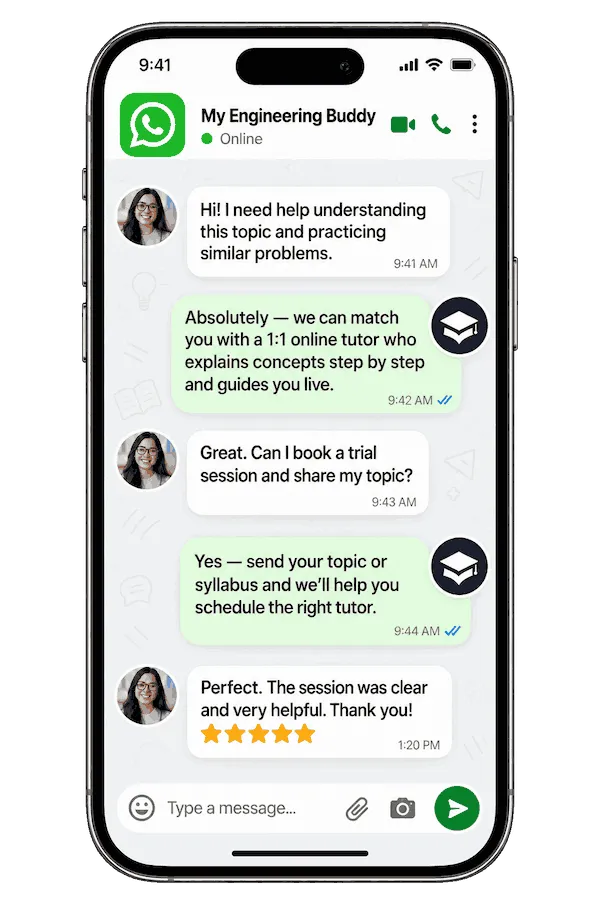
WhatsApp MEB for a quick quote — average response time under 1 minute.
Who This Green Building Design Tutoring Is For
Green Building Design attracts students from architecture, civil engineering, mechanical engineering, and environmental science — but the course content often cuts across all four in ways no single background fully prepares you for. If you’re covering passive solar, life cycle assessment, and HVAC energy loads in the same semester, gaps open fast.
- Undergraduate students in architecture, civil, or environmental engineering struggling with energy performance calculations
- Graduate students preparing a sustainability thesis or capstone project involving LEED or BREEAM frameworks
- Students with a university conditional offer depending on passing a sustainability-related module
- Students 4–6 weeks from a final exam with significant gaps in daylighting analysis or life cycle assessment still to close
- Students preparing for the LEED Green Associate or LEED AP credential exam
- Parents watching a child’s confidence drop alongside their grades in a sustainability design studio
Students come from universities across the US (MIT, Georgia Tech, UC Berkeley), UK (University College London, University of Edinburgh), Australia (University of Melbourne), and the Gulf (King Abdullah University of Science and Technology, American University of Sharjah).
1:1 Tutoring vs Self-Study vs AI vs YouTube vs Online Courses
Self-study works if you’re disciplined — but Green Building Design involves multi-variable tradeoffs (thermal mass vs glazing ratio vs orientation) that are hard to calibrate alone. AI tools explain concepts quickly but can’t diagnose whether your passive cooling strategy actually makes sense for your climate zone. YouTube covers LEED overview videos well; it stops when you’re stuck on a specific credit calculation. Online courses are structured but run at a fixed pace with no one correcting your energy model assumptions mid-run. With MEB’s 1:1 Green Building Design tutoring, a tutor works through your actual assignment on screen, catches the mistake in your EUI calculation, and explains why — live.
Outcomes: What You’ll Be Able To Do in Green Building Design
After focused 1:1 sessions, students can apply passive design principles — orientation, shading, thermal mass — to a real building site with justification. They analyze energy use intensity (EUI) figures and explain variance across climate zones. They model daylighting scenarios and interpret results from tools like EnergyPlus or DesignBuilder. They write LEED credit narratives with accurate documentation and point calculations. They present life cycle assessments with correct system boundary definitions and interpret results across impact categories.
Based on feedback from 40,000+ sessions collected by MEB from 2022 to 2025, 58% of students improved by one full grade after approximately 20 hours of 1:1 tutoring in subjects like Green Building Design. A further 23% achieved at least a half-grade improvement.
Source: MEB session feedback data, 2022–2025.
Supporting a student through Green Building Design? MEB works directly with parents to set up sessions, track progress, and keep coursework on schedule. WhatsApp MEB — average response time is under a minute, 24/7.
What We Cover in Green Building Design (Syllabus / Topics)

Track 1: Passive Design Strategies & Building Physics
- Solar geometry — sun path diagrams, altitude and azimuth angles by latitude
- Passive solar heating: direct gain, indirect (Trombe wall), isolated gain systems
- Natural ventilation: cross-ventilation, stack effect, wind-driven airflow
- Thermal mass selection — concrete, brick, rammed earth: heat capacity calculations
- Daylighting design: daylight factor, window-to-wall ratio, glare control strategies
- Climate-responsive design: Köppen classification applied to building envelope decisions
- Shading devices — fixed vs movable, overhang depth calculation
Core texts: Sun, Wind & Light (Brown & DeKay), A Green Vitruvius (European Commission), Mechanical and Electrical Equipment for Buildings (Grondzik & Kwok).
Track 2: Green Rating Systems — LEED, BREEAM & WELL
- LEED v4.1 credit categories: Location & Transportation, Sustainable Sites, Water Efficiency, Energy & Atmosphere, Materials & Resources, Indoor Environmental Quality
- LEED point calculations — prerequisite vs optimisation credits, minimum programme requirements
- BREEAM assessment methodology: weighting, Evidence Notes, BREEAM In-Use vs New Construction
- WELL Building Standard: Air, Water, Nourishment, Light, Movement, Thermal Comfort, Sound, Mind, Community
- Integrating rating system goals at concept design, schematic, and construction document stages
- Energy modelling as a LEED prerequisite: EAp2 requirements, whole-building energy simulation
Core texts: LEED Reference Guide for Building Design and Construction (USGBC), BREEAM Technical Standards (BRE), Mechanical and Electrical Equipment for Buildings (Grondzik & Kwok).
Track 3: Building Energy Modelling & Life Cycle Assessment
- Energy use intensity (EUI) benchmarks by building type — CBECS data, ASHRAE 90.1 baselines
- Building energy simulation tools: EnergyPlus, DesignBuilder, eQUEST — input parameters and output interpretation
- Embodied carbon vs operational carbon — calculation approaches and reduction strategies
- Life cycle assessment methodology: ISO 14040/14044, system boundaries, functional unit definition
- Environmental Product Declarations (EPDs) — reading and applying in material selection
- Net-zero energy building (NZEB) design pathways and on-site renewable integration
- Post-occupancy evaluation — bridging the performance gap between modelled and actual energy use
Core texts: Building Performance Simulation for Design and Operation (Hensen & Lamberts), Environmental Life Cycle Assessment (Curran), ASHRAE Standard 90.1.
At MEB, we’ve found that students who struggle with Green Building Design usually hit one of three walls: they can describe passive strategies but can’t calculate them, they know the LEED categories but can’t map credits to a real project, or they can run an energy model but don’t know what to do when the numbers come back wrong. The tutor diagnoses which wall you’ve hit in the first session.
What a Typical Green Building Design Session Looks Like
The tutor opens by checking your last topic — say, a daylighting analysis or LEED credit narrative you attempted. You share your screen or upload the file via Google Meet. The tutor reviews your daylight factor calculations or credit documentation on the digital pen-pad, marks where the logic breaks down, and rebuilds the method with you step by step — covering things like correct interior reflectance values or the difference between regulated and unregulated energy loads in your baseline model. You then work through a parallel example yourself while the tutor watches and corrects in real time. The session closes with a specific task: recalculate the EUI using the corrected inputs, or draft the credit narrative for EA Credit 2 using today’s approach. Next topic is noted before you log off.
How MEB Tutors Help You with Green Building Design (The Learning Loop)
Diagnose: In the first session, the tutor identifies exactly where understanding breaks down — whether that’s passive solar geometry, LEED prerequisite requirements, life cycle inventory interpretation, or energy model input logic. Generic revision is out. The session targets the actual gap.
Explain: The tutor works through problems live using a digital pen-pad — annotating building sections, tracing heat flow through a Trombe wall, or stepping through an ASHRAE 90.1 baseline comparison. You watch it built from scratch, not read off a slide.
Practice: You attempt the next problem with the tutor present — your own daylighting calculation, your own LEED point tally. The tutor doesn’t take over. They watch you work and intervene only when a mistake is about to compound.
Feedback: Every error gets a specific explanation — not just “that’s wrong” but why that assumption about thermal mass fails in a hot-humid climate, or why your system boundary definition invalidates the LCA result. Marks are traceable to decisions.
Plan: At the end of each session, the tutor sets the next topic, flags which LEED credits or passive design strategies to review, and notes your exam or submission date. The sequence adjusts as you improve.
Sessions run on Google Meet with a digital pen-pad or iPad and Apple Pencil. Before your first session, have your course outline or LEED reference guide, a recent assignment or past paper you struggled with, and your deadline date ready. The tutor handles everything else from there. Start with the $1 trial — 30 minutes of live tutoring that also serves as your first diagnostic.
Students consistently tell us that the moment a tutor rebuilds a passive solar calculation from the site coordinates up — rather than from a formula — is when Green Building Design finally makes sense as a system rather than a checklist.
Source: MEB student feedback, compiled 2022–2025.
Try your first session for $1 — 30 minutes of live 1:1 tutoring or one homework question explained in full. No registration. No commitment. WhatsApp MEB now and get matched within the hour.
Tutor Match Criteria (How We Pick Your Tutor)
Not every engineer who knows LEED can teach it under exam pressure. MEB matches on four criteria.
Subject depth: Tutors hold degrees or professional credentials in architecture, civil engineering, mechanical engineering, or environmental design — with demonstrable experience in green rating systems and building energy analysis at the level you’re studying. Environmental engineering tutoring and building automation systems help draw from the same vetted pool.
Tools: Every tutor uses Google Meet and a digital pen-pad or iPad with Apple Pencil. No slides sent in advance, no passive screen-sharing. Live problem-solving only.
Time zone: Matched to your region — US, UK, Gulf, Canada, or Australia. Late-night sessions are available.
Goals: Exam score targets, LEED credit mastery, capstone project support, or ongoing weekly homework guidance — the tutor is briefed before session one.
Unlike platforms where you fill out a form and wait, MEB responds in under a minute, 24/7. Tutor match takes under an hour. The $1 trial means you test before you commit. Everything runs over WhatsApp — no logins, no intake forms.
Study Plans (Pick One That Matches Your Goal)
Three structures work for Green Building Design depending on where you are. Catch-up (1–3 weeks): students behind on passive design or LEED fundamentals, one gap closed per session. Exam prep (4–8 weeks): structured revision across all tracks — passive strategies, rating systems, energy modelling — timed to your final exam or capstone deadline. Weekly support: ongoing sessions aligned to your semester, covering each new topic as it arrives. The tutor builds the exact sequence after the diagnostic.
Pricing Guide
Green Building Design tutoring starts at $20/hr for standard undergraduate modules. Graduate-level work, LEED AP exam preparation, and building energy modelling sessions typically run $40–$100/hr depending on tutor depth and topic complexity. Rate factors include your level, how niche the topic is, your timeline, and tutor availability.
Peak demand — April through May and October through November — limits availability fast. If you have a fixed deadline, don’t leave the booking late.
For students targeting LEED AP BD+C, WELL AP, or graduate research positions in high-performance building design, tutors with professional consulting or research backgrounds are available at higher rates. Share your specific goal and MEB will match the tier to your ambition.
Start with the $1 trial — 30 minutes, no registration, no commitment. WhatsApp MEB for a quick quote.
The edX platform lists over 40 courses touching sustainability and green building — but none of them can stop and ask why your thermal mass calculation assumes a 24-hour temperature swing in a maritime climate. That’s what a 1:1 tutor does.
Source: edX Engineering, 2024; MEB tutor feedback, 2022–2025.
FAQ
Is Green Building Design hard?
It’s genuinely multi-disciplinary — you need thermal physics, material science, regulatory literacy, and design judgment simultaneously. Students from a pure engineering background often find the rating system credit logic frustrating. Architecture students often struggle with the quantitative energy analysis. Both are manageable with the right support.
How many sessions are needed?
Students with a single weak area — say, LEED credit calculations — usually resolve it in 3–5 sessions. Students covering the full course from passive design through to life cycle assessment typically use 10–20 hours across a semester. The tutor gives a clearer estimate after the first diagnostic.
Can you help with homework and assignments?
MEB tutoring is guided learning — you understand the work, then submit it yourself. The tutor explains the method, works through a comparable example, and checks your reasoning — not your final answer. See our Academic Integrity policy and Why MEB page for full details on what we help with and what we don’t.
Will the tutor match my exact syllabus or exam board?
Yes. Before the first session, share your course outline, institution, and whether you’re working toward LEED, BREEAM, or a university-specific framework. The tutor is briefed and prepares accordingly — not a generic green building overview.
What happens in the first session?
The tutor runs a short diagnostic — asking you to walk through a recent problem or explain a concept in your own words. This identifies the real gap, not the assumed one. The rest of the session addresses the highest-priority issue and sets the plan for subsequent sessions.
Is online tutoring as effective as in-person?
For Green Building Design specifically, yes — the core tools are digital anyway. Energy models, LEED documentation, and daylighting software all run on-screen. The tutor annotates in real time on the digital pen-pad. Students in the Gulf and Australia consistently report the same quality as students who meet tutors locally.
What’s the difference between LEED Green Associate and LEED AP? Can MEB help with both?
The Green Associate covers LEED fundamentals and is the entry credential. LEED AP adds a specialty — most commonly BD+C for building designers. MEB tutors cover both: Green Associate concept review and LEED AP BD+C exam strategy, credit documentation, and practice questions. Specify which you’re targeting at booking.
Can I get Green Building Design help at midnight?
Yes. MEB operates across time zones and tutors are available late-night for students in the US, Gulf, and Australia. WhatsApp MEB any time — median response is under a minute. Sessions can be arranged the same day, including evenings and weekends.
What if I don’t understand energy modelling software — can the tutor still help?
Absolutely. Tutors cover EnergyPlus, DesignBuilder, and eQUEST at the conceptual and operational level — from setting up a baseline model to interpreting EUI outputs. If your course uses a different tool, share the name at booking and MEB will confirm the right tutor match. Get building service engineering help or energy modelling support from the same pool.
Does MEB offer group Green Building Design sessions?
No. All sessions are 1:1 — one student, one tutor, one hour. This is deliberate. Group sessions average progress to the middle. MEB sessions move at your pace, address your specific errors, and cover your actual assignment — not someone else’s.
How do I get started?
Three steps: WhatsApp MEB with your subject, level, and deadline. MEB matches you with a verified tutor — usually within a few hours. Start your first session with the $1 trial — 30 minutes live or one full homework question explained.
Is there a specific week in the semester when students usually contact MEB for Green Building Design?
Two clusters: week 3–4 when passive design calculations and LEED prerequisites are introduced, and the 4–6 weeks before final exams or capstone submissions. Both are manageable — but the later you leave it, the narrower the tutor availability window. Earlier contact means more session flexibility and a calmer preparation arc.
Trust & Quality at My Engineering Buddy
Every MEB tutor is vetted through application review, subject-specific testing, and a live demo session before they teach a single student. Tutors with Green Building Design backgrounds hold degrees or professional credentials in architecture, civil engineering, or environmental design — many with industry experience in LEED-certified project delivery or building performance consulting. Rated 4.8/5 across 40,000+ verified reviews on Google. Ongoing feedback from each session is reviewed and tutors are updated or replaced if quality drops. Structural engineering tutoring and renewable energy help go through the same vetting process.
MEB tutoring is guided learning — you understand the work, then submit it yourself. For full details on what we help with and what we don’t, read our Academic Integrity policy and Why MEB.
MEB has served 52,000+ students across the US, UK, Canada, Australia, Gulf, and Europe in 2,800+ subjects since 2008. Within Civil Engineering and sustainability disciplines, the platform covers Green Building Design alongside closely related areas including facilities engineering tutoring and air pollution control help. Tutors are matched by subject, level, and time zone — not assigned by an algorithm. See our tutoring methodology for the full matching and quality process.
Students consistently tell us that the biggest shift in Green Building Design comes when they stop treating LEED credits as a checklist and start reading a building as a system — climate, envelope, mechanical, and occupant behaviour all interacting. That shift usually happens in session 2 or 3, not in a textbook.
Explore Related Subjects
Students studying Green Building Design often also need support in:
- Building Materials
- Energy Management
- Solid Waste Management
- Geotechnical Engineering
- Water Resources Engineering
- Wind Engineering
- Quantity Surveying
Next Steps
Ready to start? Here’s what to do.
- Share your exam board or course outline, your hardest topic, and your current timeline
- Share your availability and time zone
- MEB matches you with a verified tutor — usually within 24 hours
- First session starts with a diagnostic so every minute is used well
Before your first session, have ready: your course outline or LEED/BREEAM reference guide (or university syllabus), a recent assignment or past paper you struggled with, and your exam or deadline date. The tutor handles the rest.
Visit www.myengineeringbuddy.com for more on how MEB works.
WhatsApp to get started or email [email protected].
Reviewed by Subject Expert
This page has been carefully reviewed and validated by our subject expert to ensure accuracy and relevance.