




~1 min
Average Reply Time
~1 hour
To Be Matched With A Tutor
30 Min Trial
75% Find Their Tutor On The 1st Trial
$20-35+/hr
Premium Yet Affordable Learning
Hire The Best Coastal Engineering Tutor

Wave runup calculations wrong. Breakwater design failing. Sediment transport models not converging. A specialist Coastal Engineering tutor fixes that fast.
Coastal Engineering Tutor Online
Coastal Engineering is an applied civil engineering discipline covering wave mechanics, sediment transport, shoreline management, and hydraulic structure design — equipping engineers to analyse and design solutions for erosion, flooding, and port infrastructure.
MEB offers 1:1 online civil engineering tutoring across 2,800+ advanced subjects, including a dedicated Coastal Engineering tutor online service. Whether you’re stuck on wave theory, struggling with tidal hydraulics, or working through a breakwater design assignment, the right tutor makes the gap close fast. If you’ve searched for a Coastal Engineering tutor near me, online 1:1 sessions give you the same live, interactive help — without the commute.
- 1:1 online sessions tailored to your exact course and syllabus
- Expert-verified tutors with coastal and hydraulic engineering backgrounds
- Flexible time zones — US, UK, Canada, Australia, Gulf
- Structured learning plan built after a diagnostic session
- Ethical homework and assignment guidance — you understand before you submit
52,000+ students across the US, UK, Canada, Australia, and the Gulf have used MEB since 2008 — including students in Civil Engineering subjects like Coastal Engineering, hydrology tutoring, and offshore engineering help.
Source: My Engineering Buddy, 2008–2025.
How Much Does a Coastal Engineering Tutor Cost?
Most Coastal Engineering tutoring sessions run $20–$40/hr. Graduate-level or highly specialised coastal modelling work can reach $70–$100/hr. New students can test the service for $1 — that covers 30 minutes of live 1:1 tutoring or a full explanation of one homework question.
| Level / Need | Typical Rate | What’s Included |
|---|---|---|
| Undergraduate (standard) | $20–$40/hr | 1:1 sessions, homework guidance |
| Graduate / Specialist | $40–$100/hr | Expert tutor, advanced modelling depth |
| $1 Trial | $1 flat | 30 min live session or 1 homework question |
Tutor availability tightens significantly around end-of-semester deadlines and capstone submission windows. Book early.
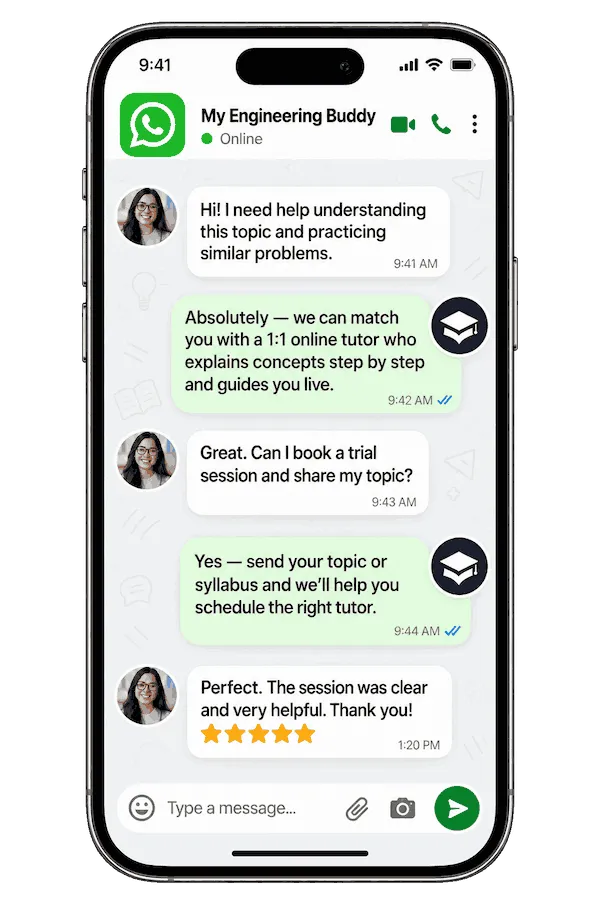
WhatsApp MEB for a quick quote — average response time under 1 minute.
Who This Coastal Engineering Tutoring Is For
Coastal Engineering is one of those subjects where lecture notes only take you so far. The moment you hit wave transformation problems, sediment budget calculations, or numerical model outputs, you need someone who can work through it with you in real time.
- Undergraduate civil or environmental engineering students with a coastal module
- Graduate students working on thesis chapters involving tidal dynamics or shoreline change modelling
- Students with a university conditional offer depending on their final-year project grade
- Students 4–6 weeks from submission with significant gaps still to close — including those who haven’t started their wave analysis section
- Parents watching a student’s confidence drop alongside their grades in a notoriously maths-heavy module
- Professionals pursuing coastal engineering CPD or certification who need structured assignment guidance
MEB has worked with students at universities including MIT, Delft, UCL, University of Queensland, Texas A&M, and TU Delft — some of the most demanding coastal engineering programmes in the world.
At MEB, we’ve found that Coastal Engineering students most often struggle not with the theory itself, but with translating wave equations into a design decision. That gap between knowing the formula and using it correctly in context — that’s exactly where a good tutor pays for itself.
1:1 Tutoring vs Self-Study vs AI vs YouTube vs Online Courses
Self-study works if you’re disciplined — but coastal engineering problems often have five interdependent steps, and one wrong assumption unravels the whole solution. AI tools give quick answers but can’t spot whether your wave height input is physically unreasonable. YouTube covers overviews of wave mechanics well, then stops when you’re stuck on a specific breakwater stability check. Online courses move at a fixed pace with no room for the question you actually have right now. 1:1 tutoring with MEB is live, calibrated to your exact university syllabus, and corrects your specific reasoning errors — not a generic version of them. In Coastal Engineering, where one misunderstood boundary condition can invalidate a full design, that level of real-time correction matters.
Outcomes: What You’ll Be Able To Do in Coastal Engineering
After working with an MEB Coastal Engineering tutor, students are able to solve wave transformation problems across shoaling, refraction, and diffraction scenarios with confidence. They can analyse sediment transport budgets using both empirical formulas and numerical approaches, and explain the assumptions and limitations of each. Students learn to apply design standards to rubble mound and vertical breakwater structures, present tidal prism calculations clearly in written reports, and model nearshore hydrodynamics using established frameworks. These aren’t abstract skills — they show up directly in coursework marks and capstone project assessments.
Supporting a student through Coastal Engineering? MEB works directly with parents to set up sessions, track progress, and keep coursework on schedule. WhatsApp MEB — average response time is under a minute, 24/7.
“Based on feedback from 40,000+ sessions collected by MEB from 2022 to 2025, 58% of students improved by one full grade after approximately 20 hours of 1:1 tutoring in subjects like Coastal Engineering. A further 23% achieved at least a half-grade improvement.”
Source: MEB session feedback data, 2022–2025.
What We Cover in Coastal Engineering (Syllabus / Topics)

Wave Mechanics and Nearshore Processes
- Linear and nonlinear wave theory (Airy, Stokes, cnoidal)
- Wave shoaling, refraction, diffraction, and breaking criteria
- Wave runup and overtopping calculations
- Nearshore current systems — longshore and rip currents
- Tidal theory, tidal prism, and tidal inlet dynamics
- Storm surge modelling and coastal flood risk assessment
Core texts: Coastal Engineering Manual (US Army Corps of Engineers), Dean & Dalrymple’s Water Wave Mechanics for Engineers and Scientists, Sorensen’s Basic Coastal Engineering.
Sediment Transport and Shoreline Change
- Longshore and cross-shore sediment transport — CERC formula and Bailard model
- Sediment budget analysis and littoral drift calculations
- Shoreline change modelling — one-line and multi-line models
- Beach nourishment design and performance evaluation
- Dune dynamics, barrier island behaviour, and estuarine sedimentation
- Numerical models: MIKE 21, Delft3D, XBeach (conceptual and applied)
Core texts: Komar’s Beach Processes and Sedimentation, van Rijn’s Principles of Sediment Transport, MIKE 21 technical documentation.
Coastal Structures and Harbour Engineering
- Rubble mound breakwater design — Hudson formula, Van der Meer equations
- Vertical wall and caisson breakwater stability analysis
- Seawall and revetment design under wave loading
- Harbour basin layout, resonance, and agitation analysis
- Jetty and groin design for inlet and shoreline management
- Climate change impacts on coastal infrastructure design life
Core texts: CIRIA’s Rock Manual, Shore Protection Manual (SPM), Bruun’s Port Engineering.
What a Typical Coastal Engineering Session Looks Like
The tutor opens by checking the previous session’s topic — usually wave transformation or sediment transport — and asking the student to walk through one problem from memory. From there, they work through the current sticking point on screen: for example, setting up a Van der Meer stability calculation for a rubble mound breakwater or running a tidal prism estimate for an inlet design. The tutor uses a digital pen-pad to annotate diagrams and walk through unit checks in real time. The student then replicates the method on a parallel problem while the tutor watches for the exact step where the reasoning breaks. The session closes with a specific practice task — usually two to three textbook problems on the same topic — and a note of what comes next: wave overtopping, perhaps, or a sediment budget calculation for the coursework chapter.
Students consistently tell us that the moment a Coastal Engineering session shifts from “the tutor explains” to “the student attempts while the tutor watches” is when real progress starts. Passive listening doesn’t build the muscle memory for hydraulic design problems. Working through it under gentle pressure does.
How MEB Tutors Help You with Coastal Engineering (The Learning Loop)
Diagnose: In the first session, the tutor identifies exactly where your understanding breaks down — whether that’s wave energy flux, the assumptions behind the CERC formula, or how to set up boundary conditions in a numerical model. Generic gap analysis is skipped. The tutor asks you to attempt a problem and watches where the reasoning goes wrong.
Explain: The tutor works through a live example using a digital pen-pad — annotating diagrams, marking up a wave rose, or stepping through a Hudson stability check equation by equation. You see the logic, not just the answer.
Practice: You attempt the next problem while the tutor stays present. No waiting. No asynchronous feedback. The session stays live so errors are caught in real time rather than compounding overnight.
Feedback: The tutor explains exactly which step cost marks — was it the choice of wave period input, the incorrect application of a depth-limited breaking criterion, or a unit conversion error? Each error type gets a targeted fix, not a general reminder to “check your working.”
Plan: After each session, the tutor maps the next topic in your sequence and sets a specific task. You enter the next session with work already done — which means the session can push further, faster.
Sessions run over Google Meet. Tutors use digital pen-pads or iPad with Apple Pencil. Before your first session, share your university module outline or project brief, plus any past coursework or exam questions you’ve struggled with. The first session begins with a diagnostic — start with the $1 trial and that diagnostic is built into the 30 minutes.
Whether you need a quick catch-up before a submission deadline, structured revision over 4–8 weeks, or ongoing weekly support through the semester, the tutor maps the session plan after the first diagnostic.
Tutor Match Criteria (How We Pick Your Tutor)
Not every civil engineer can tutor Coastal Engineering — the sub-discipline is specific enough that a generalist structural tutor won’t help you with wave transformation or breakwater stability. MEB’s matching process accounts for that.
Subject depth: tutors are matched to your specific module — undergraduate wave mechanics, graduate sediment transport modelling, or coastal structures design — not just to “civil engineering” broadly.
Tools: sessions run on Google Meet with a digital pen-pad or iPad and Apple Pencil — essential for annotating wave diagrams and working through equation derivations in real time.
Time zone: matched to your region — US, UK, Canada, Australia, or Gulf — so session times are realistic, not 2am compromises.
Goals: whether you need help with a specific assignment, exam preparation, conceptual depth in tidal hydraulics, or support through a capstone project, the tutor is selected to match that objective — not a generic brief.
Unlike platforms where you fill out a form and wait, MEB responds in under a minute, 24/7. Tutor match takes under an hour. The $1 trial means you test before you commit. Everything runs over WhatsApp — no logins, no intake forms.
Pricing Guide
Coastal Engineering tutoring starts at $20/hr for standard undergraduate modules. Rates reach $40–$70/hr for graduate-level work, and up to $100/hr for highly specialised topics like numerical coastal modelling or offshore coastal structure analysis.
Rate factors include your level, the complexity of the topic (wave mechanics vs. advanced sediment modelling), your timeline, and tutor availability. Availability tightens sharply at end-of-semester deadlines — especially during capstone submission periods.
For students targeting top coastal engineering programmes or professional accreditation through bodies like APEGA or similar engineering regulators, tutors with professional coastal design or research backgrounds are available at higher rates — share your specific goal and MEB will match the tier to your ambition.
Start with the $1 trial — 30 minutes, no registration, no commitment. WhatsApp MEB for a quick quote.
FAQ
Is Coastal Engineering hard?
Yes — it combines fluid mechanics, applied mathematics, geology, and structural design in ways that aren’t always well-explained in lectures. Students who struggle usually find that the maths is fine but the physical intuition for wave behaviour takes time to build. A tutor accelerates that.
How many sessions are needed?
Most students working on a specific assignment or exam gap see meaningful progress in 3–5 sessions. Students needing support across a full module typically benefit from 10–15 hours across a semester. The first diagnostic session determines the most efficient sequence.
Can you help with homework and assignments?
MEB tutoring is guided learning — you understand the work, then submit it yourself. The tutor explains methods, works through similar problems, and checks your reasoning — but your submission is your own work. See our Academic Integrity policy and Why MEB page for full details on what we help with and what we don’t.
Will the tutor match my exact syllabus or exam board?
Yes. MEB matches tutors to your specific university module — not just the subject name. Share your module outline, course code, or lecturer notes when you get in touch and the match will reflect your actual syllabus and assessment structure.
What happens in the first session?
The tutor runs a short diagnostic — asking you to attempt one or two problems while they observe. This identifies exactly where your understanding breaks down. The rest of the session addresses the most urgent gap. No time is wasted on topics you already know.
Is online tutoring as effective as in-person?
For Coastal Engineering, yes — wave diagrams and design calculations are annotated live on screen using a digital pen-pad, which is as clear as a whiteboard. Most students prefer the flexibility of not having to travel. Session recordings can be kept for review.
Can you help me get started with numerical modelling software like MIKE 21 or Delft3D?
Yes. MEB tutors can walk you through the conceptual setup of coastal numerical models — boundary conditions, grid configuration, wave input, and output interpretation. This is a common request from graduate students writing thesis chapters that involve model-based results.
What’s the difference between Coastal Engineering and Offshore Engineering, and do I need both?
Coastal Engineering focuses on nearshore processes, shoreline management, and structures in the surf zone or harbour environment. Offshore engineering covers deep-water structures — platforms, pipelines, moorings — in open ocean conditions. Some graduate programmes include both. MEB tutors cover either or both depending on your module requirements.
Can I get Coastal Engineering help at midnight?
Yes. MEB operates 24/7 across all time zones. WhatsApp MEB at any hour — the average response time is under a minute. Tutors in compatible time zones are available for late-night sessions, which is common for students in the Gulf, Australia, or on submission-eve deadlines.
What if I don’t like my assigned tutor?
Request a replacement — no forms, no explanation required. WhatsApp MEB and a new match is arranged, typically within the hour. The $1 trial exists precisely to test fit before you commit to a full session block.
How do I get started?
Three steps: WhatsApp MEB with your module name and what you’re stuck on, get matched with a verified Coastal Engineering tutor — usually within the hour — then start your $1 trial session. That’s 30 minutes of live tutoring or one question explained in full.
Trust & Quality at My Engineering Buddy
Every MEB tutor is screened for subject-specific knowledge before their first session — not just engineering in general, but coastal and hydraulic engineering specifically. Candidates complete a live demo evaluation, and ongoing feedback from students is reviewed after every session. Tutors hold relevant degrees and, in many cases, have professional design or research experience in coastal and water resources engineering. Rated 4.8/5 across 40,000+ verified reviews on Google.
MEB tutoring is guided learning — you understand the work, then submit it yourself. For full details on what we help with and what we don’t, read our Academic Integrity policy and Why MEB.
MEB has served 52,000+ students across the US, UK, Canada, Australia, Gulf, and Europe since 2008 — covering 2,800+ subjects. Civil Engineering is one of the platform’s largest subject areas. Students needing water resources engineering tutoring, environmental engineering help, or geotechnical engineering tutoring regularly find their way to Coastal Engineering support as well — and MEB covers all of them. Learn more about how sessions are structured at our tutoring methodology page.
A common pattern our tutors observe is that students arrive with the right equations but wrong physical reasoning — they apply the Van der Meer formula without understanding what the damage parameter S actually represents. Getting that right takes one good conversation, not ten re-reads of the manual.
Explore Related Subjects
Students studying Coastal Engineering often also need support in:
- Hydrology
- Groundwater Engineering
- Open Channel Flow
- Dam Engineering
- Structural Engineering
- Wind Engineering
- Irrigation Engineering
- Earthquake Engineering
Next Steps
Here’s what to do right now:
- Share your module name, university, and the specific topic or assignment you’re stuck on
- Share your availability and time zone — sessions are matched to your schedule
- MEB matches you with a verified Coastal Engineering tutor — usually within the hour
- Your first session starts with a diagnostic so every minute is used on what actually matters
Before your first session, have ready: your module outline or course syllabus, a recent assignment or problem set you struggled with, and your submission or exam date. The tutor handles the rest.
Visit www.myengineeringbuddy.com for more on how MEB works.
WhatsApp to get started or email [email protected].
Try your first session for $1 — 30 minutes of live 1:1 tutoring or one homework question explained in full. No registration. No commitment. WhatsApp MEB now and get matched within the hour.
MEB tutors bring real coastal engineering depth — not just general civil knowledge. For wave mechanics, sediment transport, and breakwater design, that difference shows up in your marks within the first few sessions.
Source: My Engineering Buddy, 2008–2025.
Coastal Engineering draws on structural dynamics, soil mechanics, and fluid theory simultaneously — MEB tutors are matched on all three, not just one layer of the subject.
Source: My Engineering Buddy, 2008–2025.
Reviewed by Subject Expert
This page has been carefully reviewed and validated by our subject expert to ensure accuracy and relevance.




