~1 min
Average Reply Time
~1 hour
To Be Matched With A Tutor
30 Min Trial
75% Find Their Tutor On The 1st Trial
$20-35+/hr
Premium Yet Affordable Learning
Most students who fail patent law exams don’t misunderstand the law — they can’t apply the patentability tests under pressure.
Patent Law Tutor Online
Patent law governs the granting, enforcement, and licensing of patents — exclusive rights awarded to inventors for novel, non-obvious, and industrially applicable inventions. It equips students to analyse patentability, draft claims, and navigate prosecution before patent offices.
Finding a patent law tutor near me who understands both the legal doctrine and the technical subject matter of inventions is rare. MEB’s law tutoring connects you with tutors who work through patentability analysis, claim drafting, and USPTO or EPO procedure in live 1:1 sessions — online, at any hour. Whether you’re a law student working through a patent prosecution course or an engineering graduate tackling IP modules, your tutor calibrates every session to your exact syllabus. One session, clearly focused, moves you further than three hours alone with a textbook.
- 1:1 online sessions tailored to your law school course or IP module
- Expert-verified tutors with both legal and technical subject-matter knowledge
- Flexible time zones — US, UK, Canada, Australia, Gulf
- Structured learning plan built after a diagnostic session
- Ethical homework and assignment guidance — you understand before you submit
52,000+ students across the US, UK, Canada, Australia, and the Gulf have used MEB since 2008 — including students in Law subjects like Patent Law, Intellectual Property Law, and Copyright Law.
Source: My Engineering Buddy, 2008–2025.
How Much Does a Patent Law Tutor Cost?
Patent law tutoring at MEB starts at $20–$40/hr for most undergraduate and graduate law modules. Specialist tutors covering USPTO prosecution, EPO proceedings, or patent litigation strategy are available at higher rates — up to $100/hr for advanced or niche work. The $1 trial gives you 30 minutes of live 1:1 tutoring or one homework question fully explained before you spend anything more.
| Level / Need | Typical Rate | What’s Included |
|---|---|---|
| Standard (UG / JD modules) | $20–$35/hr | 1:1 sessions, homework guidance |
| Advanced / Specialist (LLM, bar prep, USPTO) | $35–$100/hr | Expert tutor, prosecution depth |
| $1 Trial | $1 flat | 30 min live session or 1 homework question |
Tutor availability tightens during exam periods and bar prep windows — book early if your deadline is within four weeks.
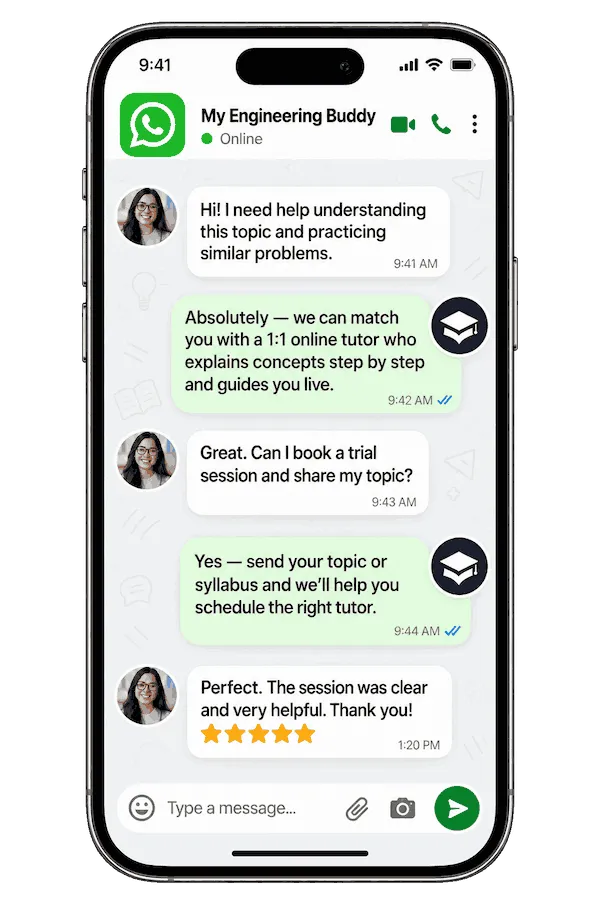
WhatsApp MEB for a quick quote — average response time under 1 minute.
Who This Patent Law Tutoring Is For
Patent law sits at the intersection of technical subject matter and legal doctrine. Most students struggle not because they don’t understand the law on paper, but because applying the patentability tests — novelty, non-obviousness, utility — to real-world inventions takes practice under guidance.
- JD and LLM students with a patent law or IP survey course on their transcript
- Engineering and science graduates pivoting into IP or technology law
- Students retaking a patent law module after a failed first attempt
- Students 4–6 weeks from finals with claim construction or prosecution procedure still unclear
- Students working through patent prosecution or patent bar preparation
- Parents supporting a law student whose grades are slipping alongside their confidence
Students from programmes at George Washington University Law, Chicago-Kent College of Law, Franklin Pierce School of Law, Boston University School of Law, UC Berkeley School of Law, and Queen Mary University of London’s IP law stream have all come to MEB for targeted support. The $1 trial is the lowest-risk way to find out whether the tutor is the right fit.
1:1 Tutoring vs Self-Study vs AI vs YouTube vs Online Courses
Self-study works if you’re disciplined, but patent law requires feedback on your reasoning — not just reading the statute. AI tools give fast definitions of obviousness or prior art, but they can’t walk through a real claim set with you and catch where your analysis breaks down. YouTube covers the basics of the patent system well and stops there. Online courses follow a fixed pace regardless of whether claim drafting or the prosecution timeline is the bit you’re actually stuck on. 1:1 tutoring with MEB is live, calibrated to your exact course, and corrects errors in your patentability analysis in the moment — before they become exam-day habits. In patent law, the gap between knowing the rule and applying it correctly is where marks are lost.
Outcomes: What You’ll Be Able To Do in Patent Law
After consistent 1:1 sessions, you’ll be able to apply the novelty and non-obviousness tests to a real invention fact pattern without prompting. You’ll analyze prior art searches and explain why a reference anticipates or merely renders a claim obvious. You’ll write and critique independent and dependent patent claims with an understanding of claim scope and prosecution history estoppel. You’ll present a clear freedom-to-operate argument or draft a response to an office action. You’ll solve patentability problems in timed exam conditions — not just in theory.
Based on feedback from 40,000+ sessions collected by MEB from 2022 to 2025, 58% of students improved by one full grade after approximately 20 hours of 1:1 tutoring in subjects like Patent Law. A further 23% achieved at least a half-grade improvement.
Source: MEB session feedback data, 2022–2025.
Try your first session for $1 — 30 minutes of live 1:1 tutoring or one homework question explained in full. No registration. No commitment. WhatsApp MEB now and get matched within the hour.
What We Cover in Patent Law (Syllabus / Topics)

Patentability and Substantive Patent Law
- Novelty analysis: absolute novelty, anticipation, and prior art disclosure
- Non-obviousness / inventive step: the Graham v. John Deere framework and EPO problem-and-solution approach
- Utility / industrial applicability requirements
- Subject matter eligibility: patent-eligible inventions, excluding abstract ideas and natural phenomena (Alice/Mayo doctrine)
- Written description, enablement, and best mode requirements
- Inventorship and ownership: assignment, employee inventions, joint inventors
Core texts: Merges, Menell & Lemley, Intellectual Property in the New Technological Age (Aspen); Mueller, Patent Law (Wolters Kluwer); USPTO MPEP (Manual of Patent Examining Procedure).
Patent Prosecution and Procedure
- Claim drafting: independent claims, dependent claims, method and apparatus claims
- USPTO application process: provisional vs. non-provisional applications
- Office actions: responding to rejections under 35 U.S.C. §§ 102, 103, 112
- Patent Cooperation Treaty (PCT): international filing strategy
- EPO prosecution: examination procedure and appeals before the Boards of Appeal
- Inter partes review (IPR) and post-grant proceedings before the PTAB
- Patent term, maintenance fees, and lapse
Useful references: Faber on Mechanics of Patent Claim Drafting (PLI); EPO Guidelines for Examination; USPTO Patent Center documentation.
Patent Litigation, Licensing, and Strategy
- Infringement analysis: literal infringement and doctrine of equivalents
- Defences: invalidity, inequitable conduct, prosecution history estoppel
- Remedies: injunctions, reasonable royalties, lost profits, enhanced damages
- Freedom-to-operate opinions and due diligence in M&A contexts
- Patent licensing: exclusive, non-exclusive, cross-licensing, and FRAND obligations
- Standard-essential patents and the interface with competition law — see coverage of economic and commercial law tutoring for competition law overlap
Recommended reading: Chisum on Patents (Matthew Bender); Layne-Farrar, Padilla & Schmalensee on FRAND licensing; the European Journal of International Law for international patent treaty analysis.
At MEB, we’ve found that patent law students who work through a real office action — responding to a § 103 rejection line by line — retain the prosecution framework far better than students who only read about it. The problem set has to be live and specific to land.
What a Typical Patent Law Session Looks Like
The tutor opens by checking the previous session’s topic — usually claim drafting or a patentability analysis problem set. From there, the student and tutor work through a specific scenario on screen: an invention disclosure, a prior art reference, and a set of draft claims. The tutor uses a digital pen-pad to annotate claim language in real time, marking exactly where scope is too narrow or where a dependent claim fails to add meaningful limitation. The student then rewrites a claim or drafts a response to a § 102 rejection while the tutor is present — no waiting until homework is returned to find out what went wrong. The session closes with a concrete task: one independent claim to draft from a new fact pattern, or one office action response section to complete before the next session. The next topic — typically § 103 obviousness analysis or PCT filing strategy — is noted and the tutor sends a short prep note in advance.
How MEB Tutors Help You with Patent Law (The Learning Loop)
Diagnose: In the first session, the tutor identifies exactly where your analysis breaks down. Most students arriving at MEB for patent law tutoring can recite the patentability requirements but struggle to apply them to an ambiguous invention — the tutor maps that gap specifically.
Explain: The tutor works through a live problem using a digital pen-pad — annotating a claim set, marking up a prior art reference, or stepping through the Graham v. John Deere factors on a real fact pattern. Nothing stays abstract for long.
Practice: You attempt the next problem while the tutor is present — claim drafting, an obviousness argument, or a prosecution response — so errors are caught before they become habits.
Feedback: The tutor goes through your reasoning step by step, explaining not just what was wrong but why an examiner or court would reject it. That distinction — between “wrong answer” and “wrong legal reasoning” — is where patent law marks are actually lost or gained.
Plan: At the end of each session, the tutor sets the next topic and a specific task. Progress is tracked across sessions, and the sequence adjusts if a new exam date or assignment deadline changes priorities.
Sessions run over Google Meet. The tutor uses a digital pen-pad or iPad with Apple Pencil to annotate claims and statutory text in real time. Before your first session, share your syllabus or course outline, any recent assignment or exam question you struggled with, and your exam or submission date. The first session serves as your diagnostic and sets the full topic sequence. Start with the $1 trial — 30 minutes of live tutoring that also functions as your first diagnostic.
Patent law sits across technical subject matter and legal doctrine. Students who work through real claim sets — not simplified textbook examples — close the application gap faster. That’s what MEB sessions are built around.
Source: My Engineering Buddy, tutor methodology notes, 2008–2025.
Tutor Match Criteria (How We Pick Your Tutor)
Not every lawyer can teach patent law, and not every patent attorney can teach it at law school exam level. MEB matches on four criteria.
Subject depth: Your tutor holds a law degree with an IP specialisation, or has USPTO registration, or has practical prosecution and litigation experience — matched to whether you need exam support, legal research help, or patent bar preparation.
Tools: Every tutor works on Google Meet with a digital pen-pad or iPad and Apple Pencil — so claim annotation and statutory mark-up happen visually, not through verbal description alone.
Time zone: Matched to your region. US, UK, Gulf, Canada, and Australia are all covered, including late-night slots for students in multiple time zones simultaneously.
Goals: Whether you need to close a specific exam gap, understand prosecution procedure for an LLM thesis, or build a complete working knowledge of USPTO practice, the tutor is briefed on your goal before the first session.
Unlike platforms where you fill out a form and wait, MEB responds in under a minute, 24/7. Tutor match takes under an hour. The $1 trial means you test before you commit. Everything runs over WhatsApp — no logins, no intake forms.
Study Plans (Pick One That Matches Your Goal)
After the diagnostic, your tutor builds a specific topic sequence. Catch-up plan (1–3 weeks): students behind on claim drafting or prosecution procedure with an assignment or exam imminent. Exam prep (4–8 weeks): structured revision across patentability, prosecution, and litigation components, timed to your exam date. Ongoing weekly support: session-by-session coverage aligned to your course schedule and coursework deadlines — common for LLM students with multiple patent law assessments across a semester. The tutor maps the exact sequence after the first session.
Pricing Guide
Patent law tutoring starts at $20–$40/hr for standard JD and undergraduate IP modules. Graduate-level work — LLM courses, patent bar preparation, USPTO prosecution procedure — runs $40–$100/hr depending on tutor depth and topic complexity. Rate factors include your level, the technical subject matter of the inventions covered, your timeline, and tutor availability.
Availability tightens during law school exam periods and patent bar windows in spring and autumn. Booking at least two weeks ahead is advisable if your exam is within six weeks.
For students targeting top IP law firms, in-house patent roles at technology companies, or USPTO registration, tutors with active prosecution practice and litigation backgrounds are available at the higher end of the rate range — share your specific goal and MEB will match the tier to your ambition.
Start with the $1 trial — 30 minutes, no registration, no commitment. WhatsApp MEB for a quick quote.
FAQ
Is patent law hard?
Yes — and specifically hard in a way that surprises students. The statutes are short. Applying them to real inventions, drafting claims with the right scope, and navigating prosecution procedure is where difficulty concentrates. Most students need guided practice, not more reading.
How many sessions are needed?
Depends on your starting point and goal. Closing a specific exam gap in claim drafting typically takes 4–6 sessions. Building end-to-end knowledge of prosecution procedure for an LLM or patent bar prep takes 15–25 sessions. The tutor advises after the diagnostic.
Can you help with homework and assignments?
MEB tutoring is guided learning — you understand the work, then submit it yourself. A tutor can walk you through a patentability analysis problem or a claim drafting exercise so your reasoning is solid before you write up. See our Academic Integrity policy and Why MEB page for full details on what we help with and what we don’t.
Will the tutor match my exact syllabus or exam board?
Yes. Share your course outline, university, and any exam or assessment details when you contact MEB. Tutors are matched to your specific programme — US patent law, UK IP law modules, EPO-focused courses, or international patent law under the PCT framework.
What happens in the first session?
The tutor runs a short diagnostic — usually a patentability problem or a set of draft claims — to locate exactly where your understanding breaks down. The rest of the session addresses those gaps directly. The topic sequence for subsequent sessions is set before you leave.
Is online tutoring as effective as in-person?
For patent law, online is often better. Claim annotation, statutory mark-up, and office action walk-throughs work well on shared screen with a digital pen-pad. You also get a wider pool of tutors — including active practitioners — than local in-person availability allows.
Can I get patent law help at midnight?
Yes. MEB operates 24/7 across time zones. WhatsApp a message any time — average response is under a minute, and tutors are available for late-night sessions in the US, UK, Gulf, Canada, and Australia.
What if I don’t like my assigned tutor?
Request a switch — no friction, no explanation needed. MEB matches a different tutor, usually within the same day. The $1 trial exists precisely so you can test the fit before committing to a full session block.
What is the difference between US patent law and European patent law?
US patent law (35 U.S.C., USPTO) follows a first-inventor-to-file system with specific rules on obviousness and subject matter eligibility under Alice/Mayo. European patent law (EPC, EPO) uses the problem-and-solution approach for inventive step. Tutors cover either system depending on your course.
Do I need a technical background to succeed in patent law?
Not necessarily, but it helps. Many law students without science degrees master patent law through structured practice on technology fact patterns. USPTO registration does require a technical degree — a tutor can advise on whether your background qualifies and how to prepare for the patent bar examination.
How do I find a patent law tutor in my city?
You don’t need to. MEB’s online sessions cover all major cities across the US, UK, Canada, Australia, and the Gulf. Location is irrelevant — the tutor works over Google Meet with full annotation capability. City-based searching limits your tutor pool unnecessarily.
How do I get started?
WhatsApp MEB — share your course, exam date, and the topic causing the most difficulty. MEB matches you with a verified tutor, usually within 24 hours. First session: $1 trial, 30 minutes live or one homework question fully explained. Three steps: WhatsApp, matched, start trial.
Trust & Quality at My Engineering Buddy
Every MEB patent law tutor is vetted before taking a session. Screening covers subject-specific knowledge — patentability doctrine, claim drafting, prosecution procedure — as well as teaching ability assessed through a live demo evaluation. Ongoing session feedback from students triggers reviews of any tutor whose quality falls below standard. Tutors hold law degrees with IP specialisations, USPTO registration, or active prosecution and litigation experience. Rated 4.8/5 across 40,000+ verified reviews on Google.
MEB tutoring is guided learning — you understand the work, then submit it yourself. For full details on what we help with and what we don’t, read our Academic Integrity policy and Why MEB.
MEB has served 52,000+ students across the US, UK, Canada, Australia, the Gulf, and Europe in 2,800+ subjects since 2008. Within Law, the platform covers Patent Law alongside administrative law tutoring, constitutional law tutoring, and tort law help — across every major jurisdiction and law school programme. Read more about the teaching approach at MEB’s tutoring methodology page.
Students consistently tell us that patent law is the course where they most needed someone to work through a real problem with them — not explain the statute again. That’s exactly what the 1:1 format is designed for.
Explore Related Subjects
Students studying Patent Law often also need support in:
- Business Law
- Civil Law
- Cyber Law
- Environmental Law
- Jurisprudence
- Legal Theory
- Private International Law (Conflict of Laws)
- Substantive Law
Next Steps
Before your first session, have ready: your exam board and syllabus (or course outline), a recent past paper attempt or homework question you struggled with, and your exam or submission deadline. The tutor handles the rest.
- Share your exam board or law school programme, the hardest topic, and your current timeline
- Share your availability and time zone
- MEB matches you with a verified patent law tutor — usually within 24 hours
The first session starts with a diagnostic so every minute is used well. Visit www.myengineeringbuddy.com for more on how MEB works.
WhatsApp to get started or email [email protected].
A common pattern our tutors observe is that patent law students arrive having memorised the patentability tests and leave, several sessions later, able to apply them to any invention fact pattern. That shift from recall to application is the one that moves grades.
Reviewed by Subject Expert
This page has been carefully reviewed and validated by our subject expert to ensure accuracy and relevance.