

Contact MEB Today To Get The Best
Design For Manufacturing & Assembly (DFM DFA & DFMA) Tutoring Online
Email: [email protected]



~1 min
Average Reply Time
~1 hour
To Be Matched With A Tutor
30 Min Trial
75% Find Their Tutor On The 1st Trial
$20-35+/hr
Premium Yet Affordable Learning
Hire The Best Design For Manufacturing & Assembly (DFM DFA & DFMA) Tutor





Most students lose marks in DFMA not because they can’t design — but because they’ve never been taught to think about manufacturability and assembly cost at the same time.
Design For Manufacturing & Assembly (DFM/DFA/DFMA) Tutor Online
Design For Manufacturing & Assembly (DFMA) is an engineering methodology that integrates DFM and DFA principles to reduce production costs, simplify assembly processes, and improve product quality during the design phase.
MEB offers 1:1 online tutoring and homework help in 2,800+ advanced subjects, including DFMA. If you’ve searched for a Design For Manufacturing & Assembly tutor near me, MEB connects you with a verified expert — matched to your course, exam board, and level — usually within an hour. Our industrial engineering tutoring covers everything from process optimisation to design methodology, and DFMA sits right at the heart of that. Students who work through the DFM/DFA/DFMA framework with a tutor move faster and make fewer costly design errors.
- 1:1 online sessions tailored to your course syllabus and project brief
- Expert verified tutors with manufacturing and product design backgrounds
- Flexible time zones — US, UK, Canada, Australia, Gulf
- Structured learning plan built after a diagnostic session
- Ethical homework and assignment guidance — you understand the work, then submit it yourself
52,000+ students across the US, UK, Canada, Australia, and the Gulf have used MEB since 2008 — including students in Industrial Engineering subjects like Design For Manufacturing & Assembly, Lean Manufacturing tutoring, and FMEA help.
Source: My Engineering Buddy, 2008–2025.
How Much Does a Design For Manufacturing & Assembly Tutor Cost?
Most DFMA tutoring sessions run $20–$40/hr. Graduate-level or niche manufacturing systems work can reach $70–$100/hr depending on tutor expertise and timeline. The $1 trial gets you 30 minutes of live 1:1 tutoring or a full explanation of one homework question — no registration required.
| Level / Need | Typical Rate | What’s Included |
|---|---|---|
| Undergraduate DFMA modules | $20–$35/hr | 1:1 sessions, homework guidance, design reviews |
| Graduate / Advanced | $35–$70/hr | Expert tutor, Boothroyd-Dewhurst methods, capstone support |
| $1 Trial | $1 flat | 30 min live session or 1 homework question explained in full |
Tutor availability tightens around semester project deadlines and finals periods. Book early if your submission date is within three weeks.
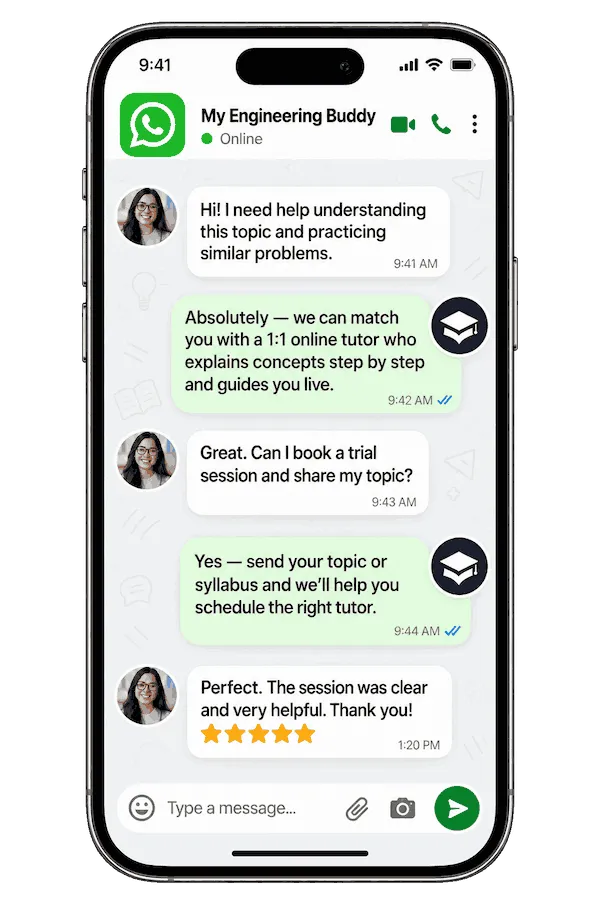
WhatsApp MEB for a quick quote — average response time under 1 minute.
Who This Design For Manufacturing & Assembly Tutoring Is For
DFMA sits at the junction of product design, industrial engineering, and operations management. It shows up in undergraduate mechanical and industrial engineering programmes, graduate manufacturing courses, and capstone design projects at universities including MIT, Georgia Tech, University of Michigan, Purdue, TU Delft, and Imperial College London.
- Undergraduate students tackling DFM/DFA theory for the first time and struggling to connect it to real assembly cost calculations
- Graduate students applying Boothroyd-Dewhurst analysis to a thesis or capstone project
- Students retaking after a failed first attempt — particularly those who missed marks on part-count reduction exercises or assembly efficiency scoring
- Students with a coursework or design project submission deadline approaching who need focused help fast
- Engineers in industry returning to formal study for a manufacturing systems credential
- Parents supporting a mechanical or industrial engineering student whose project grades have started to slide
If you need manufacturing science and engineering help or want to strengthen the design side of a production workflow, DFMA tutoring builds both at once.
1:1 Tutoring vs Self-Study vs AI vs YouTube vs Online Courses
Self-study works if you’re disciplined — but DFMA requires iterative feedback on your actual designs, which a textbook can’t give you. AI tools explain concepts quickly but can’t review your part geometry or spot errors in your DFA efficiency score. YouTube covers Boothroyd-Dewhurst introductions well; it stops when your specific assembly sequence doesn’t match the example. Online courses move at a fixed pace with no adjustment for your project brief. 1:1 tutoring with MEB is live, calibrated to your exact course and design problem, and corrects your reasoning in the moment — which is where DFMA learning actually happens.
Outcomes: What You’ll Be Able To Do in Design For Manufacturing & Assembly
After consistent 1:1 sessions, you’ll apply DFM principles to reduce machining complexity and material waste in real part designs. You’ll analyse assembly sequences using DFA scoring methods, identify redundant components, and calculate theoretical minimum part count. You’ll explain the trade-off between part consolidation and tooling cost — a question that regularly appears in both coursework and exam assessments. You’ll present a full DFMA analysis report with justified design changes, which is the standard deliverable in most capstone and graduate manufacturing modules.
“Based on feedback from 40,000+ sessions collected by MEB from 2022 to 2025, 58% of students improved by one full grade after approximately 20 hours of 1:1 tutoring in subjects like Design For Manufacturing & Assembly. A further 23% achieved at least a half-grade improvement.”
Source: MEB session feedback data, 2022–2025.
At MEB, we’ve found that DFMA students who bring an actual part or assembly sketch to their first session — even a rough one — make faster progress than those who start with theory alone. Real geometry forces the real questions.
What We Cover in Design For Manufacturing & Assembly (Syllabus / Topics)

Track 1: Design For Manufacturing (DFM) Principles
- Material selection and machinability constraints
- Tolerancing and surface finish — when tighter isn’t better
- Standard vs custom features: cost implications in batch and mass production
- Design for casting, forging, and injection moulding
- Part simplification and geometry rationalisation
- DFM checklists and design review procedures
Core texts: Product Design for Manufacture and Assembly by Boothroyd, Dewhurst & Knight (3rd ed.); Engineering Design by Dieter & Schmidt.
Track 2: Design For Assembly (DFA) Methods
- Boothroyd-Dewhurst DFA methodology — scoring and efficiency index
- Theoretical minimum part count analysis
- Manual vs automated assembly trade-offs
- Part orientation, feeding, and insertion difficulty ratings
- Poka-yoke (error-proofing) in assembly design
- Redesign case studies: reducing assembly time and defect rate
Core texts: Product Design for Manufacture and Assembly by Boothroyd et al.; Assembly Automation and Product Design by Boothroyd.
Track 3: Integrated DFMA Analysis and Capstone Applications
- Combined DFM/DFA scoring — total cost modelling
- Concurrent engineering and cross-functional design teams
- DFMA in the product development lifecycle (PDL)
- Life-cycle cost considerations and design-for-disassembly
- Applying FMEA tutoring alongside DFMA to catch failure risks early
- DFMA software tools: Boothroyd Dewhurst Inc. software, TeamCenter, and spreadsheet-based cost models
- Reporting and presenting a DFMA analysis — structure, justification, recommendations
Core texts: Concurrent Engineering Effectiveness by Clausing; The Design of Everyday Things by Norman (for usability integration).
What a Typical Design For Manufacturing & Assembly Session Looks Like
The tutor opens by checking the previous session’s task — usually a DFA efficiency calculation or a revised part design. If you got the efficiency index wrong, you work through the scoring method again on screen before anything else. From there, the session moves into the live problem: the tutor shares the part drawing or assembly diagram on Google Meet, and you work through the Boothroyd-Dewhurst analysis together — identifying which parts fail the minimum-part criterion, scoring insertion difficulty, and calculating revised assembly time. The tutor uses a digital pen-pad to annotate directly on your geometry. You explain your reasoning out loud; the tutor catches errors as they happen. The session closes with a specific redesign task and a clear list of which components to revisit before next time.
How MEB Tutors Help You with Design For Manufacturing & Assembly (The Learning Loop)
Diagnose: In the first session, the tutor asks you to walk through a recent homework problem or describe the project brief. Within 15 minutes, they’ve identified whether the gap is conceptual (you don’t understand why minimum part count matters), procedural (you can’t apply the DFA scoring method correctly), or analytical (you can apply it but misread the assembly sequence).
Explain: The tutor works through a live example on the digital pen-pad — annotating part geometry, stepping through the efficiency index calculation, and naming exactly where marks are lost in a typical exam or coursework submission.
Practice: You attempt the next problem while the tutor watches. No looking up answers. The tutor asks “why” at each step — which forces you to consolidate the method, not just copy it.
Feedback: Every error gets corrected at the step where it happened, not just at the final answer. You leave the session knowing what went wrong and why — not just what the right answer was.
Plan: The tutor sets the next topic in sequence (e.g. moving from manual DFA to automated assembly scoring, or from part-count analysis to full cost modelling) and notes what to bring to the next session.
Sessions run on Google Meet with a digital pen-pad or iPad and Apple Pencil. Before your first session, have your course syllabus, a recent assignment you struggled with, and your project deadline date ready. The first session is diagnostic — the tutor maps your gaps and builds the session plan from there. Start with the $1 trial — 30 minutes of live tutoring that also serves as your first diagnostic.
Students consistently tell us that the moment DFMA clicks is when they stop seeing DFM and DFA as two separate checklists and start treating them as one cost conversation. That shift usually happens in session three or four — not from reading, but from doing a live redesign under pressure.
Tutor Match Criteria (How We Pick Your Tutor)
Not every manufacturing engineer is the right DFMA tutor. MEB matches on four criteria.
Subject depth: Tutors hold degrees or professional experience in mechanical, industrial, or manufacturing engineering, with specific coursework or industry exposure in DFM/DFA/DFMA methods — not just general design engineering.
Tools: Every session runs on Google Meet with a digital pen-pad or iPad and Apple Pencil. Tutors annotate your actual drawings and calculations in real time.
Time zone: Matched to your region — US, UK, Gulf, Canada, or Australia — so late-night and early-morning sessions are always available.
Goals: Whether you need to close a gap before a final exam, complete a capstone DFMA report, or build a deeper understanding of concurrent engineering methodology, the tutor is matched to that specific aim.
Unlike platforms where you fill out a form and wait, MEB responds in under a minute, 24/7. Tutor match takes under an hour. The $1 trial means you test before you commit. Everything runs over WhatsApp — no logins, no intake forms.
Study Plans (Pick One That Matches Your Goal)
Catch-up (1–3 weeks): for students behind on a module or facing a submission in days — the tutor prioritises the highest-weight topics and works through them fast. Exam prep (4–8 weeks): structured sessions covering DFM principles, DFA scoring, and integrated DFMA analysis with past paper or coursework practice built in. Weekly support: ongoing sessions aligned to your semester schedule, tracking coursework milestones and keeping project work on track. The tutor builds the specific sequence after the first diagnostic session.
Pricing Guide
DFMA tutoring starts at $20/hr for standard undergraduate modules. Graduate-level work — capstone DFMA reports, thesis support, Boothroyd-Dewhurst software analysis — typically runs $35–$70/hr. Highly specialised manufacturing systems or concurrent engineering research support is available up to $100/hr.
Rate factors include level, topic complexity, timeline urgency, and tutor availability. Availability tightens sharply in the final three weeks of each semester.
For students targeting top graduate programmes or industry roles at firms like Boeing, Siemens, or Ford where DFMA competency is assessed directly, tutors with professional manufacturing backgrounds are available at higher rates — share your specific goal and MEB matches the tier to your ambition.
Start with the $1 trial — 30 minutes, no registration, no commitment. WhatsApp MEB for a quick quote.
MEB has supported students across 2,800+ engineering and applied science subjects since 2008 — covering everything from Six Sigma tutoring to reliability engineering help, with DFMA sitting at the practical centre of them all.
Source: My Engineering Buddy, 2008–2025.
FAQ
Is Design For Manufacturing & Assembly hard?
DFMA is conceptually straightforward but procedurally demanding. The Boothroyd-Dewhurst scoring method requires precision, and connecting DFM constraints to DFA efficiency in a single cost model is where most students lose marks. With a tutor walking through live examples, most students find the method manageable within a few sessions.
How many sessions do I need?
Students with one specific assignment or exam component typically need 3–5 sessions. Those working through a full DFMA capstone project from brief to final report usually need 8–15 sessions spread across the semester. The tutor gives a clearer estimate after the first diagnostic session.
Can you help with homework and assignments?
MEB tutoring is guided learning — you understand the work, then submit it yourself. The tutor explains the method, works through a similar example, and checks your reasoning. See our Academic Integrity policy and Why MEB page for full details on what we help with and what we don’t.
Will the tutor match my exact syllabus or exam board?
Yes. MEB tutors are matched to your specific course — whether that’s a Boothroyd-Dewhurst-based undergraduate module, a concurrent engineering graduate course, or a professional development programme. Share your course outline or syllabus when you contact us and the match is made from there.
What happens in the first session?
The tutor runs a diagnostic — asking you to explain a recent problem or describe your project brief. Within 15–20 minutes, they’ve mapped your gaps. The rest of the session starts working through the highest-priority area. You leave with a clear plan for the next two to three sessions.
Is online tutoring as effective as in-person?
For DFMA specifically, online works well — part drawings, assembly diagrams, and cost models are all shareable on screen, and the tutor can annotate directly using a digital pen-pad. Most students prefer the flexibility of not having to travel, especially during project-heavy periods.
What’s the difference between DFM, DFA, and DFMA — and do I need help with all three?
DFM focuses on simplifying parts for manufacturing processes. DFA focuses on reducing assembly time and part count. DFMA integrates both into a unified cost and efficiency analysis. Most university courses and industrial projects require all three — a tutor helps you understand where each applies and how they interact.
Can MEB help with Boothroyd-Dewhurst software or spreadsheet-based DFMA tools?
Yes. Tutors can walk through Boothroyd Dewhurst Inc. software outputs, help you build and interpret spreadsheet-based cost models, and explain how to structure a DFMA report around the software’s efficiency scoring. Share the tool or template you’re using when you contact MEB.
Do you offer group Design For Manufacturing & Assembly sessions?
MEB specialises in 1:1 tutoring — sessions are not shared between students. If you’re working on a group capstone project, each team member can book individual sessions, or the group can arrange a shared session by contacting MEB directly via WhatsApp to discuss options.
Can I get DFMA help at short notice — even late at night?
Yes. MEB operates 24/7 across all major time zones. WhatsApp response time is typically under one minute. Tutor matching usually takes under an hour. If you have a submission due in 48 hours, contact MEB now — sessions are often available the same day.
How do I get started?
Start with the $1 trial — 30 minutes of live DFMA tutoring or one homework question explained in full. Three steps: WhatsApp MEB, get matched with a verified tutor (usually within the hour), then start your trial session. No registration. No commitment.
How do I find a Design For Manufacturing & Assembly tutor in my city?
MEB tutoring is fully online — you don’t need a local tutor. Students in New York, London, Toronto, Dubai, Sydney, and across Europe all access the same verified tutors via Google Meet. Time zone matching means sessions fit your schedule regardless of location.
Trust & Quality at My Engineering Buddy
Every MEB tutor goes through subject-specific screening before their first session — including a live demo evaluation, degree and credential verification, and review of their manufacturing or industrial engineering background. Tutors with hands-on industry experience in DFM/DFA processes are prioritised for DFMA matches. Rated 4.8/5 across 40,000+ verified reviews on Google. Ongoing session feedback is reviewed to maintain quality across every tutor on the platform.
MEB tutoring is guided learning — you understand the work, then submit it yourself. For full details on what we help with and what we don’t, read our Academic Integrity policy and Why MEB.
MEB has served 52,000+ students across the US, UK, Canada, Australia, the Gulf, and Europe since 2008 — across 2,800+ subjects. In Industrial Engineering, that includes Lean Six Sigma tutoring, quality management help, and Statistical Process Control tutoring — all areas that intersect directly with DFMA in manufacturing programmes. The Institution of Engineering and Technology recognises design for manufacture as a core competency in engineering education; MEB’s DFMA tutors are matched to that standard.
A common pattern our tutors observe is that students treat DFMA as a one-off module rather than a recurring framework. Engineers who revisit it — especially during capstone and thesis work — consistently produce stronger, more defensible design decisions. That’s what repeat sessions are built for.
Explore Related Subjects
Students studying Design For Manufacturing & Assembly often also need support in:
- Computer Integrated Manufacturing (CIM)
- Production Planning
- Quality Assurance (QA)
- Total Quality Management (TQM)
- Simulation and Modeling
- Risk and Safety Analysis
- Statistical Quality Control
Next Steps
When you contact MEB, have these ready:
- Your course outline or syllabus — and which DFMA topics are causing the most trouble
- Your availability and time zone
- Your project submission date or exam date
Before your first session, also have ready: a recent past paper attempt or homework question you struggled with, and any design files or assembly diagrams relevant to your current project. The tutor handles the rest.
MEB matches you with a verified DFMA tutor — usually within 24 hours, often within the hour. The first session starts with a diagnostic so every minute is used well.
Visit www.myengineeringbuddy.com for more on how MEB works.
WhatsApp to get started or email [email protected].
Reviewed by Subject Expert
This page has been carefully reviewed and validated by our subject expert to ensure accuracy and relevance.




