

Hire Verified & Experienced
Development Economics Tutors
Email: [email protected]
4.8/5 40K+ session ratings collected on the MEB platform




Hire The Best Development Economics Tutor
Top Tutors, Top Grades. Without The Stress!
Most students who struggle with Development Economics aren’t missing intelligence — they’re missing someone who can connect the Harrod-Domar model to a real exam question in real time.
Development Economics Tutor Online
Development Economics is the branch of economics examining how low- and middle-income countries grow, reduce poverty, and build institutions. It equips students to analyse growth models, aid effectiveness, trade policy, and structural transformation using both quantitative and qualitative frameworks.
MEB provides 1:1 online tutoring and homework help in 2,800+ advanced subjects, including Economics and its specialist branches. If you’ve searched for a Development Economics tutor near me and found generic results, MEB offers something different: a verified tutor matched to your exact syllabus, exam board, or university module — with sessions running over Google Meet, no login required. One diagnostic session is usually enough to identify exactly where marks are being lost.
- 1:1 online sessions tailored to your specific syllabus or university module
- Expert-verified tutors with subject-specific knowledge in development theory and applied policy
- Flexible time zones — US, UK, Canada, Australia, Gulf
- Structured learning plan built after a diagnostic session
- Ethical homework and assignment guidance — you understand before you submit
52,000+ students across the US, UK, Canada, Australia, and the Gulf have used MEB since 2008 — including students in Economics subjects like Development Economics, International Economics, and Public Economics.
Source: My Engineering Buddy, 2008–2025.
How Much Does a Development Economics Tutor Cost?
Most Development Economics tutoring at MEB runs $20–$40/hr, covering undergraduate modules, A Level, IB, and AP Economics with a development focus. Graduate and specialist sessions reach up to $100/hr. New students can start with the $1 trial — 30 minutes of live 1:1 tutoring or one homework question explained in full, no registration needed.
| Level / Need | Typical Rate | What’s Included |
|---|---|---|
| Standard (A Level, IB, AP, early undergrad) | $20–$35/hr | 1:1 sessions, homework guidance |
| Advanced / Specialist (Masters, PhD, research methods) | $35–$100/hr | Expert tutor, niche depth, econometrics support |
| $1 Trial | $1 flat | 30 min live session or 1 homework question explained |
Tutor availability tightens around exam periods — particularly April–May for AP and IB, and May–June for A Level. Book early if you’re inside a 6-week window.
WhatsApp MEB for a quick quote — average response time under 1 minute.
Who This Development Economics Tutoring Is For
Development Economics draws students from economics, politics, international relations, and public policy. The content sounds accessible — poverty, aid, growth — but the assessments are demanding. Essay structure, model application, and data interpretation all need to work together, and most students have gaps in at least one of those areas.
- Undergraduate students struggling to apply growth models (Harrod-Domar, Solow, Lewis) to essay questions
- A Level and IB students working through development indicators, trade policy, and aid effectiveness
- Masters and PhD students needing support with development econometrics, fieldwork design, or thesis chapters
- Students retaking after a failed first attempt — particularly those who lost marks on evaluation and analysis, not knowledge recall
- Students at universities like LSE, University of Toronto, University of Sydney, ANU, Sciences Po, Georgetown, and Erasmus University Rotterdam whose modules move fast and assume prior fluency
- Parents watching a child’s confidence drop alongside their grades ahead of an A Level or IB exam
If your module involves econometrics tutoring or quantitative methods alongside the theory, MEB covers both. You do not need a separate tutor for the data side.
1:1 Tutoring vs Self-Study vs AI vs YouTube vs Online Courses
Self-study works if you’re disciplined, but Development Economics essays require structured argument — and you can’t self-mark that reliably. AI tools explain concepts quickly but can’t identify why your specific essay scored a 54% instead of a 68%. YouTube covers the Lewis model in 12 minutes; it stops when you ask why your exam board wants a different evaluation format. Online courses are structured but fixed — they don’t adapt when you’re three weeks from an exam and two topics behind. MEB’s 1:1 tutoring is live, calibrated to your exact module or exam board, and corrects the specific errors costing you marks in Development Economics — not errors in economics generally.
Outcomes: What You’ll Be Able To Do in Development Economics
After working with an MEB tutor, students can apply growth models like Solow and Harrod-Domar accurately to exam scenarios, analyse the effectiveness of foreign aid using real case evidence, explain structural transformation and the role of institutions in development, evaluate trade policy arguments with the balance examiners reward, and write essays that move from description to analysis to evaluation without prompting. These are the specific skills that separate a C from an A in most Development Economics assessments.
Supporting a student through Development Economics? MEB works directly with parents to set up sessions, track progress, and keep coursework on schedule. WhatsApp MEB — average response time is under a minute, 24/7.
Based on feedback from 40,000+ sessions collected by MEB from 2022 to 2025, 58% of students improved by one full grade after approximately 20 hours of 1:1 tutoring in subjects like Development Economics. A further 23% achieved at least a half-grade improvement.
Source: MEB session feedback data, 2022–2025.
What We Cover in Development Economics (Syllabus / Topics)
MEB tutors cover the full range of Development Economics content — from A Level and IB through to Masters-level research modules. Sessions are scoped to your syllabus from the first session.
Development Theory and Growth Models
- Harrod-Domar and Solow growth models — assumptions, limitations, exam application
- Lewis two-sector model and structural transformation
- Rostow’s stages of growth — how to evaluate, not just describe
- Endogenous growth theory and the role of human capital
- Institutions, governance, and the North framework
- Dependency theory and neo-colonial critique
Core texts: Todaro & Smith Economic Development (13th ed.), Ray Development Economics, Acemoglu & Robinson Why Nations Fail.
Poverty, Inequality, and Human Development
- Multidimensional poverty — HDI, MPI, and their measurement limitations
- Income inequality, Gini coefficients, and Lorenz curves
- Absolute vs relative poverty — definitions and policy relevance
- Gender, health, and education as development indicators
- The capability approach — Sen’s framework and its policy applications
- Sustainable Development Goals — structure and assessment in exam contexts
Core texts: Sen Development as Freedom, Alkire & Foster on MPI methodology, Deaton The Great Escape.
Trade, Aid, and Development Policy
- Import substitution vs export-led growth — evidence and evaluation
- Aid effectiveness debate — Sachs vs Easterly vs Moyo frameworks
- Foreign direct investment, remittances, and capital flows
- Debt relief, structural adjustment, and IMF/World Bank conditionality
- Microfinance and bottom-up development approaches
- Environmental sustainability and development trade-offs
Core texts: Easterly The White Man’s Burden, Collier The Bottom Billion, Sachs The End of Poverty. Students working on trade-related questions can also get international trade tutoring through MEB.
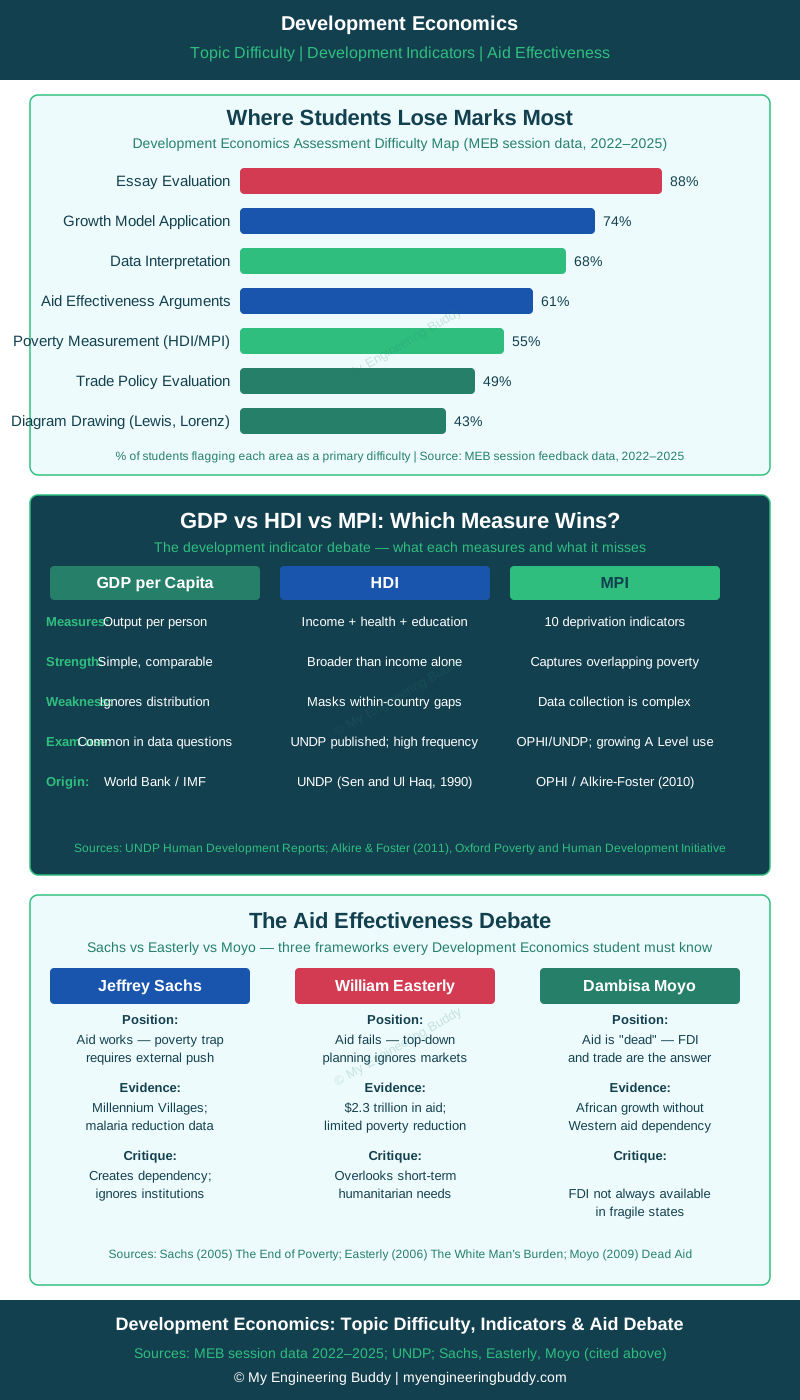
At MEB, we’ve found that students who struggle with Development Economics essays aren’t usually short on knowledge — they know the models. What they’re missing is a clear internal structure: claim, evidence, counter-argument, evaluation. That’s a teachable skill, and it’s where most of the marks go.
What a Typical Development Economics Session Looks Like
The tutor opens by checking the previous session’s topic — say, the limitations of the HDI as a development measure. From there, the student and tutor work through a recent past paper question or problem set on screen. The tutor uses a digital pen-pad to annotate the model essay structure, mark where evaluation is thin, and show exactly where the argument breaks down. The student attempts a paragraph or argument section independently, then talks through their reasoning. The tutor corrects at the point of error — not at the end. The session closes with a specific practice task: one timed essay introduction on a named topic, due before the next session, with the next session’s focus already agreed. Nothing is left vague.
How MEB Tutors Help You with Development Economics (The Learning Loop)
Diagnose: In the first session, the tutor reviews a past paper attempt or recent assignment. They identify exactly which skills are weak — is it model application, essay structure, evaluation depth, or data interpretation? That diagnosis sets the session sequence.
Explain: The tutor works through a live problem — a Solow model diagram, an aid effectiveness essay plan, a Gini coefficient interpretation — on screen using a digital pen-pad. Nothing is abstract. Every concept is anchored to a real exam question format.
Practice: The student attempts the next step with the tutor present. This is not homework — it happens in the session, so errors surface immediately rather than getting embedded.
Feedback: The tutor explains each error at the step where it occurred. Students learning why a mark was lost — not just that it was lost — retain the correction far better.
Plan: At the end of each session, the next topic and practice task are set. Progress is tracked across sessions, not just within them. For students using economic growth and development tutoring, this progression from model to application to exam-ready writing is the core of every engagement.
Sessions run on Google Meet with a digital pen-pad or iPad and Apple Pencil. Before your first session, share your syllabus or course outline, a recent piece of work you struggled with, and your exam or deadline date. The tutor uses all three to structure the first session from the first minute. Start with the $1 trial — 30 minutes of live tutoring that also serves as your first diagnostic.
Students consistently tell us that the turning point in Development Economics isn’t learning a new model — it’s learning how to evaluate one. Examiners at A Level and undergraduate level reward students who can explain why a model breaks down, not just what it predicts.
Tutor Match Criteria (How We Pick Your Tutor)
Match quality is what separates a useful session from a wasted one. MEB does not assign tutors by availability alone.
Subject depth: Tutors are matched to your specific level — A Level Edexcel, IB Economics SL/HL, undergraduate development modules, or Masters-level research methods. A tutor who knows Todaro and Sen from their own graduate studies covers this differently than a generalist economist.
Tools: Every tutor uses Google Meet and a digital pen-pad or iPad with Apple Pencil — the session is visual from the start.
Time zone: Matched to your region — US, UK, Gulf, Canada, Australia — so sessions run at hours that don’t compromise your sleep before exams.
Goals: Whether you need to close a specific gap before an exam, improve essay structure for coursework, or work through development econometrics for a dissertation, the match reflects that goal — not a generic tutor profile. Students needing political economy tutoring alongside development content can be matched to tutors with dual expertise.
Unlike platforms where you fill out a form and wait, MEB responds in under a minute, 24/7. Tutor match takes under an hour. The $1 trial means you test before you commit. Everything runs over WhatsApp — no logins, no intake forms.
Study Plans (Pick One That Matches Your Goal)
The tutor builds a specific session sequence after the diagnostic, but here are the common entry points: Catch-up (1–3 weeks) — for students behind on a specific module or topic cluster before an internal assessment or exam. Exam prep (4–8 weeks) — structured revision aligned to a specific exam date, covering all major topic areas with past paper practice built in. Weekly support — ongoing sessions aligned to semester or coursework deadlines, useful for students whose courses move fast and whose tutors need to stay ahead of the syllabus. The tutor maps the exact sequence after the first session.
Pricing Guide
Development Economics tutoring at MEB runs $20–$40/hr for most undergraduate, A Level, IB, and AP-level sessions. Graduate, Masters, and PhD-level sessions — particularly those involving econometric methods, dissertation supervision support, or niche development policy topics — run up to $100/hr. Rate factors include level, topic complexity, your timeline, and tutor availability.
Availability tightens sharply during April–June exam periods. If you’re inside six weeks of a deadline, book sooner rather than later.
For students targeting programmes at institutions like LSE, Georgetown, Sciences Po, or ANU — where Development Economics sits at the intersection of theory, policy, and quantitative methods — tutors with research and policy backgrounds are available at higher rates. Share your specific goal and MEB will match the tier to what you actually need.
Start with the $1 trial — 30 minutes, no registration, no commitment. WhatsApp MEB for a quick quote.
MEB has been running since 2008. 52,000+ students. 4.8/5 rated. The $1 trial exists because we’re confident the first session speaks for itself — no sales pitch required.
Source: My Engineering Buddy internal data, 2008–2025.
FAQ
Is Development Economics hard?
It’s conceptually demanding and assessment-heavy. Students who struggle usually find essay evaluation hardest — examiners want structured argument, not just model knowledge. The quantitative sections (growth accounting, Gini, data interpretation) catch students who expected a purely discursive subject.
How many sessions are needed?
Most students working toward an A Level or undergraduate exam see clear improvement within 8–12 sessions of focused work. Students with a specific gap — one topic or one essay skill — often need 3–5 targeted sessions. The diagnostic shapes the exact number.
Can you help with homework and assignments?
Yes. MEB tutoring is guided learning — you understand the work, then submit it yourself. The tutor explains the model, the argument structure, or the data interpretation. See our Academic Integrity policy and Why MEB page for full details on what we help with and what we don’t.
Will the tutor match my exact syllabus or exam board?
Yes. Tutors are matched to your specific syllabus — Edexcel A Level, IB Economics HL/SL, OCR, Cambridge International, or a named university module. Share your exam board and course outline when you first contact MEB via WhatsApp.
What happens in the first session?
The tutor reviews a piece of your recent work — a past paper attempt, an essay, a problem set — and identifies the specific gaps. From that point, the session plan is built around your actual weaknesses, not a generic Development Economics curriculum.
Is online tutoring as effective as in-person?
For Development Economics, yes. Essay structure, model diagrams, and data interpretation all translate well to Google Meet with a digital pen-pad. Most MEB students report that screen annotation is actually clearer than whiteboard teaching for complex diagrams like the Lewis model or Lorenz curves.
Can I get Development Economics help at midnight or on weekends?
Yes. MEB tutors operate across time zones — US, UK, Gulf, Australia, Canada. WhatsApp MEB at any hour and you’ll typically be matched within the hour. Peak exam season is busier; off-peak requests are usually faster to fulfil.
What’s the difference between Development Economics and Economics at A Level or undergraduate level?
Development Economics is a specialist branch focused on low- and middle-income countries, growth theory, poverty, and policy. At A Level it often appears within a broader Economics course. At university, it’s a standalone module or elective with its own theoretical frameworks, assessment style, and reading list — distinct from macro or micro courses.
Do I need a strong maths background for Development Economics?
At A Level and IB level, no — data interpretation and diagram analysis are sufficient. At undergraduate and Masters level, quantitative methods matter more. Regression analysis, growth accounting, and poverty measurement all appear in assessments. If you need mathematical economics tutoring alongside development content, MEB covers both in the same engagement.
What if my Development Economics module includes a fieldwork or research component?
MEB tutors with research methods backgrounds can support fieldwork design, survey methodology, qualitative data analysis, and dissertation chapter structure. Share your module outline when you contact MEB — the right tutor match depends on whether your assessment is theory-only or includes a research component.
How do I get started?
Start with the $1 trial — 30 minutes of live tutoring or one homework question explained in full. Three steps: WhatsApp MEB, get matched to a verified Development Economics tutor, start your trial session. No forms, no waiting list, no registration.
Try your first session for $1 — 30 minutes of live 1:1 tutoring or one homework question explained in full. No registration. No commitment.
WhatsApp MEB now
and get matched within the hour.
Trust & Quality at My Engineering Buddy
Every MEB tutor goes through a subject-specific screening process — qualifications check, live demo session evaluation, and ongoing review based on student feedback. Tutors covering Development Economics hold degrees in economics, development studies, international relations, or public policy, with many having postgraduate or research backgrounds in growth theory, poverty measurement, or applied development policy. Rated 4.8/5 across 40,000+ verified reviews on Google.
MEB tutoring is guided learning — you understand the work, then submit it yourself. For full details on what we help with and what we don’t, read our Academic Integrity policy and Why MEB.
MEB has served 52,000+ students across the US, UK, Canada, Australia, the Gulf, and Europe in 2,800+ subjects since 2008. The Economics subject area — covering Development Economics, macroeconomics tutoring, and microeconomics tutoring — is one of MEB’s highest-demand areas. You can read more about how tutors are selected and sessions structured at MEB’s tutoring methodology page.
The World Trade Organization tracks global trade and development data that MEB tutors regularly use to ground Development Economics sessions in current, real-world policy context — not just textbook theory.
Source: World Trade Organization.
Explore Related Subjects
Students studying Development Economics often also need support in:
- Agricultural Economics
- Behavioral Economics
- Environmental Economics
- Health Economics
- Institutional Economics
- Labor Economics
- Welfare Economics
Next Steps
When you contact MEB, share your exam board or university module name, the specific topic or component you’re finding hardest, and how many weeks you have until your exam or deadline. Share your time zone and availability so the tutor match is practical from day one.
MEB matches you with a verified Development Economics tutor — usually within 24 hours, often within the hour.
Before your first session, have ready:
- Your exam board and syllabus, or your course outline and module guide
- A recent past paper attempt or assignment you struggled with
- Your exam date or coursework deadline
The tutor handles everything else. First session starts with a diagnostic — so every minute is used on what you actually need.
Visit www.myengineeringbuddy.com for more on how MEB works.
WhatsApp to get started or email [email protected].
52,000+ Happy Students From Various Universities






How Much For Private 1:1 Tutoring & Hw Help?
Private 1:1 Tutoring and HW help Cost $20 – 35 per hour* on average.
Reviewed by Subject Expert
This page has been carefully reviewed and validated by our subject expert to ensure accuracy and relevance.
