

Contact MEB Today To Get The Best
Photovoltaic Cells & Solar Energy Panels Tutoring Online
Email: [email protected]



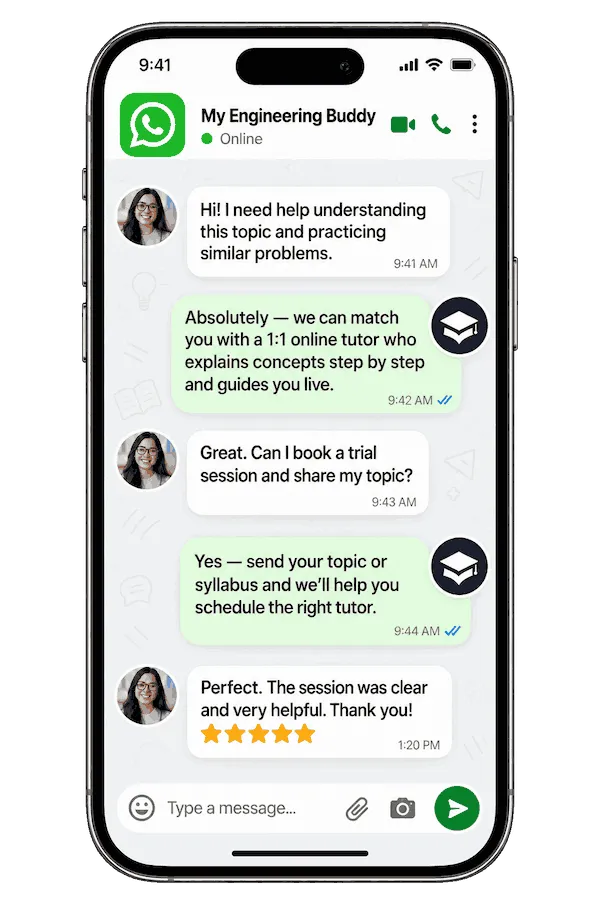
~1 min
Average Reply Time
~1 hour
To Be Matched With A Tutor
30 Min Trial
75% Find Their Tutor On The 1st Trial
$20-35+/hr
Premium Yet Affordable Learning
Hire The Best Photovoltaic Cells & Solar Energy Panels Tutor







Your solar energy calculations are off, your IV-curve derivations keep stalling, and the exam is six weeks away. That’s exactly when a 1:1 photovoltaic cells & solar energy panels tutor makes the difference between scraping a pass and actually understanding what’s happening inside a p-n junction.
Photovoltaic Cells & Solar Energy Panels Tutor Online
Photovoltaic cells convert sunlight into electricity via the photovoltaic effect in semiconductor p-n junctions. Solar energy panels combine multiple cells into modules for power generation, equipping students to analyse cell efficiency, energy yield, and system design.
MEB connects you with a verified photovoltaic cells & solar energy panels tutor online — a specialist in Electrical Engineering with hands-on knowledge of PV cell physics, panel configurations, and grid-tied system design. If you’ve searched for a photovoltaic cells & solar energy panels tutor near me, online 1:1 tutoring with MEB gives you the same depth as in-person — without the commute. Sessions are calibrated to your exact course module, syllabus, or research level, and your tutor corrects errors in real time.
- 1:1 online sessions tailored to your course module and syllabus
- Expert-verified tutors with subject-specific knowledge of PV physics and solar systems
- Flexible time zones — US, UK, Canada, Australia, Gulf
- Structured learning plan built after a diagnostic session
- Ethical homework and assignment guidance — you understand the work, then submit it yourself
52,000+ students across the US, UK, Canada, Australia, and the Gulf have used MEB since 2008 — including students in Electrical Engineering subjects like Photovoltaic Cells & Solar Energy Panels, power electronics tutoring, and semiconductor devices.
Source: My Engineering Buddy, 2008–2025.
How Much Does a Photovoltaic Cells & Solar Energy Panels Tutor Cost?
Most sessions run $20–$40/hr depending on level and topic complexity. Graduate and research-level PV work can reach $100/hr for tutors with industry or lab experience. Not sure yet? The $1 trial gets you 30 minutes of live 1:1 tutoring or a full explanation of one homework question — before you commit to anything.
| Level / Need | Typical Rate | What’s Included |
|---|---|---|
| Undergraduate (standard) | $20–$35/hr | 1:1 sessions, homework guidance |
| Advanced / Graduate | $35–$70/hr | Expert tutor, research-level depth |
| Specialist / Industry-level | Up to $100/hr | Professional PV background, niche depth |
| $1 Trial | $1 flat | 30 min live session or 1 homework question |
Availability tightens significantly during end-of-semester submission windows and final exam periods. Book early if you’re working to a fixed deadline.
WhatsApp MEB for a quick quote — average response time under 1 minute.
Who This Photovoltaic Cells & Solar Energy Panels Tutoring Is For
This isn’t a subject you can coast through on intuition. PV cells sit at the intersection of semiconductor physics, thermodynamics, and electrical circuit theory — and exam questions often demand you move fluently between all three. MEB tutoring is built for students who need that fluency, fast.
- Undergraduate EE and renewable energy students covering PV modules, cell models, and efficiency limits
- Masters and PhD students working on solar cell design, thin-film technologies, or grid integration research
- Students retaking after a failed first attempt — especially those who lost marks on equivalent circuit modelling or fill factor calculations
- Students with a university conditional offer depending on this grade in their electrical engineering programme
- Parents watching a child’s confidence drop alongside their grades in energy systems coursework
- Engineering students at universities including MIT, Imperial College London, TU Delft, ETH Zürich, University of Queensland, and University of Toronto
At MEB, we’ve found that students struggling with photovoltaic topics almost always have the same root problem: shaky semiconductor physics from a prior module. One session spent on p-n junction behaviour under illumination typically unblocks two or three weeks of PV coursework that felt impossible the day before.
1:1 Tutoring vs Self-Study vs AI vs YouTube vs Online Courses
Self-study works if you’re disciplined — but when you hit a dead end on Shockley diode equations or maximum power point tracking, there’s no feedback loop. AI tools give fast explanations but can’t diagnose why you keep losing marks on fill factor questions. YouTube covers PV overviews well but stops when your specific circuit model doesn’t match the simulation output. Online courses move at a fixed pace with no room for your actual exam board’s assessment style. 1:1 tutoring with MEB is live, calibrated to your exact PV course, and corrects errors in the session — not three days later when you’ve already submitted the wrong approach.
Outcomes: What You’ll Be Able To Do in Photovoltaic Cells & Solar Energy Panels
After consistent sessions, students can solve equivalent circuit problems for single-diode and two-diode PV cell models with confidence. They can analyse IV and PV curves to extract key parameters — open-circuit voltage, short-circuit current, fill factor, and conversion efficiency — and explain what degrades each one. Students learn to apply the Shockley equation under illumination conditions, model temperature and irradiance effects on panel output, and present energy yield calculations for real panel configurations. They can also evaluate MPPT strategies and explain the trade-offs between series and parallel panel arrangements for a given load.
Supporting a student through Photovoltaic Cells & Solar Energy Panels? MEB works directly with parents to set up sessions, track progress, and keep coursework on schedule. WhatsApp MEB — average response time is under a minute, 24/7.
Based on feedback from 40,000+ sessions collected by MEB from 2022 to 2025, 58% of students improved by one full grade after approximately 20 hours of 1:1 tutoring in subjects like Photovoltaic Cells & Solar Energy Panels. A further 23% achieved at least a half-grade improvement.
Source: MEB session feedback data, 2022–2025.
What We Cover in Photovoltaic Cells & Solar Energy Panels (Syllabus / Topics)

Track 1: PV Cell Physics and Device Models
- Semiconductor p-n junction behaviour under illumination
- The Shockley diode equation and its modification for PV cells
- Single-diode and two-diode equivalent circuit models
- Photocurrent generation, recombination mechanisms, and quantum efficiency
- Open-circuit voltage, short-circuit current, fill factor, and conversion efficiency
- Temperature coefficients and their effect on cell performance
- Thin-film technologies: amorphous silicon, CdTe, CIGS — structures and trade-offs
Core texts for this track include Luque & Hegedus Handbook of Photovoltaic Science and Engineering, Nelson The Physics of Solar Cells, and Würfel & Würfel Physics of Solar Cells.
Track 2: Solar Panel Systems and Energy Yield
- Series and parallel cell/module configurations and mismatch losses
- IV curve and PV curve analysis for modules and arrays
- Irradiance modelling: global horizontal irradiance (GHI), direct normal irradiance (DNI), diffuse horizontal irradiance (DHI)
- Maximum power point tracking (MPPT) — Perturb & Observe, Incremental Conductance, and other algorithms
- Shading effects, bypass diodes, and partial shading analysis
- Energy yield estimation and performance ratio calculations
- Grid-tied and off-grid system architecture, inverter selection, and battery integration
Useful references include Messenger & Abtahi Photovoltaic Systems Engineering and Kalogirou Solar Energy Engineering.
Track 3: Advanced Topics and Research-Level PV
- Multi-junction solar cells and concentration photovoltaics (CPV)
- Perovskite solar cells: structure, efficiency records, and stability challenges
- Tandem cell architectures and theoretical efficiency limits (Shockley–Queisser limit)
- Characterisation techniques: electroluminescence, photoluminescence, IV curve tracing
- Degradation mechanisms: LID, PID, soiling, and UV degradation
- PV system simulation tools: PVsyst overview, MATLAB/Simulink PV modelling
Graduate students often work from Green Solar Cells: Operating Principles, Technology and System Applications and current journal literature via IEEE Spectrum.
What a Typical Photovoltaic Cells & Solar Energy Panels Session Looks Like
The tutor opens by checking where you got stuck in the previous session — usually something like the derivation of the fill factor from IV curve parameters or a mismatch loss calculation that didn’t converge. From there, the session moves into whatever is live in your coursework: the tutor works through an equivalent circuit problem on the digital pen-pad while you watch the steps build in real time, then you replicate the derivation yourself and explain your reasoning at each stage. Common focal points include modelling irradiance-dependent short-circuit current, running MPPT logic through a specific algorithm, or setting up a shading analysis for a panel array. The session closes with a concrete problem set — usually two or three exam-style questions on the topic just covered — and the tutor notes exactly which topic opens next time. You leave knowing what to practise before the next session, not just what was covered.
Students consistently tell us that the moment a PV session clicks is when the tutor draws the equivalent circuit and the IV curve side by side on the pen-pad. Seeing both representations simultaneously — and tracing how a change in one maps to the other — is something no textbook diagram quite replicates.
How MEB Tutors Help You with Photovoltaic Cells & Solar Energy Panels (The Learning Loop)
Diagnose: In the first session, the tutor identifies exactly where your understanding breaks down — whether that’s semiconductor band theory, circuit modelling, or energy yield maths. They note which exam components you’re losing marks on and which topics are solid enough to build from.
Explain: The tutor works through live problems on a digital pen-pad — deriving the single-diode model, walking the IV curve, or stepping through an MPPT algorithm. You see the reasoning, not just the answer. For semiconductor devices tutoring prerequisites, the tutor covers those too if needed.
Practice: You attempt problems with the tutor present. No moving on until the method is yours. This is where most of the session time goes — and where the improvement actually happens.
Feedback: Every error gets corrected with an explanation of why it costs marks, not just what the right answer is. Students working on power systems help alongside PV often find that this cross-topic feedback is where the biggest gaps get closed.
Plan: The tutor maps the next session’s topic, sets a practice task, and adjusts the sequence based on how quickly you moved through the material today. Nothing is fixed — the plan shifts to match your actual progress.
Sessions run over Google Meet with a digital pen-pad or iPad and Apple Pencil. Before your first session, share your course module outline, any past paper attempts you’ve already tried, and your exam or submission deadline. The first session covers a diagnostic and your most urgent topic. Start with the $1 trial — 30 minutes of live tutoring that also serves as your first diagnostic. Whether you need a quick catch-up before an exam, structured revision over 4–8 weeks, or ongoing weekly support through the semester, the tutor maps the session plan after that first diagnostic.
MEB tutors cover both the theoretical depth — Shockley–Queisser limits, recombination physics — and the applied skills: PVsyst modelling, MPPT algorithm selection, and energy yield reporting for real installations.
Source: My Engineering Buddy tutor profiles, 2024.
Tutor Match Criteria (How We Pick Your Tutor)
Not every EE tutor knows PV cell physics at the level your course demands. MEB matches on four criteria.
Subject depth: Tutors are vetted for knowledge of the specific track you need — cell physics, panel systems, or advanced/research-level PV. A tutor covering energy storage systems tutoring alongside PV is matched only if they hold both competencies.
Tools: Every tutor works on Google Meet with a digital pen-pad or iPad and Apple Pencil. No exceptions — this is non-negotiable for a subject this calculation-heavy.
Time zone: Matched to your region — US, UK, Gulf, Canada, Australia — so sessions happen at times that don’t wreck your study schedule.
Goals: Whether you need exam score improvement, deeper conceptual understanding of PV physics, assignment guidance, or research support for a thesis on perovskite cells, the match reflects your specific goal.
Unlike platforms where you fill out a form and wait, MEB responds in under a minute, 24/7. Tutor match takes under an hour. The $1 trial means you test before you commit. Everything runs over WhatsApp — no logins, no intake forms.
Study Plans (Pick One That Matches Your Goal)
Catch-up (1–3 weeks): for students with specific gaps — equivalent circuit modelling, fill factor derivation, or MPPT theory — that need closing before a submission or exam. Exam prep (4–8 weeks): structured topic-by-topic revision across PV cell physics, panel systems, and energy yield, with past paper practice built in. Weekly support: ongoing sessions aligned to your semester timetable and coursework deadlines. The tutor builds the specific sequence after the diagnostic — nothing is decided before the tutor knows where you actually stand.
Pricing Guide
Rates start at $20/hr for standard undergraduate PV modules and reach $35–$70/hr for advanced coursework or graduate-level research support. Specialist tutors with professional solar industry or research lab backgrounds are available at higher rates — share your specific goal and MEB matches the tier to your needs.
Rate factors: level, topic complexity, how quickly you need sessions scheduled, and tutor availability. Availability drops fast in the final four weeks before university exam periods — book before that window closes.
For students targeting competitive graduate programmes or professional roles in solar energy, tutors with real project and research backgrounds are available. Share your goal on WhatsApp and MEB will find the right match.
Start with the $1 trial — 30 minutes, no registration, no commitment. WhatsApp MEB for a quick quote.
FAQ
Is photovoltaic cells and solar energy panels hard?
It’s genuinely demanding. The subject requires solid semiconductor physics, circuit analysis, and thermodynamics — often simultaneously. Students who struggle usually have a gap in p-n junction theory from an earlier module. One or two targeted sessions on that foundation typically unblocks the rest of the course.
How many sessions are needed?
Students with a specific gap — say, equivalent circuit modelling or fill factor calculations — often close it in 3–5 sessions. Students needing full exam preparation typically work over 8–15 sessions, spread across 4–8 weeks. The tutor maps the plan after your first diagnostic session.
Can you help with homework and assignments?
Yes. MEB tutoring is guided learning — you understand the work, then submit it yourself. See our Academic Integrity policy and Why MEB page for full details on what we help with and what we don’t. Tutors explain methods, work through similar problems, and help you check your reasoning before submission.
Will the tutor match my exact syllabus or exam board?
Yes. Before the first session, share your university module outline, exam board specification, or course syllabus. The tutor reviews it and calibrates every session to what your assessor actually expects — not a generic PV overview that wastes your prep time.
What happens in the first session?
The tutor runs a short diagnostic — reviewing a recent past paper attempt or assignment you struggled with, identifying exactly where the reasoning breaks down. From there, the session covers your most urgent topic. You leave with a clear plan for what comes next.
Is online tutoring as effective as in-person?
For a calculation-heavy subject like photovoltaic cells, yes — sometimes more so. The digital pen-pad lets the tutor annotate circuit diagrams and IV curves in real time on your screen. Students in the US, UK, and Gulf consistently report they can follow the working more clearly than in a physical classroom setting.
What is the difference between a single-diode and a two-diode PV cell model?
The single-diode model captures most practical cell behaviour and is standard in undergraduate courses. The two-diode model adds a second diode to account for recombination in the depletion region — more accurate for low irradiance conditions and often required at graduate or research level. Your tutor covers whichever model your course uses.
Do I need to know semiconductor physics before starting PV tutoring?
Some foundation helps, but it isn’t a prerequisite for starting. Many students come in with gaps in band theory or p-n junction physics — the tutor identifies those in the diagnostic and covers them as part of the PV session sequence. You don’t need to catch up separately before booking.
Can you help with PVsyst or MATLAB solar simulation assignments?
Yes. Tutors support simulation-based coursework in PVsyst for energy yield modelling and MATLAB/Simulink for PV cell and MPPT modelling. Share your assignment brief on WhatsApp and MEB will confirm tutor availability for your specific tool and version.
Can I get photovoltaic cells and solar energy panels help at midnight?
Yes. MEB operates across US, UK, Gulf, and Australian time zones. WhatsApp the team at any hour — response time averages under a minute. If your regular tutor isn’t available, a verified replacement with the same subject knowledge can be arranged for the same session slot.
What if I don’t like my assigned tutor?
Request a replacement on WhatsApp — no forms, no wait. MEB rematch takes under an hour. The $1 trial exists precisely so you’re not locked into anything before you’ve confirmed the fit. No-questions-asked tutor changes are standard, not an exception.
How do I get started?
Start with the $1 trial: 30 minutes of live 1:1 tutoring or one homework question explained in full. Three steps: WhatsApp MEB, get matched with a verified PV tutor within the hour, then start your trial session. No registration required.
Trust & Quality at My Engineering Buddy
Every MEB tutor goes through a structured vetting process: verified academic credentials, a live demo session evaluated by a senior subject expert, and ongoing review based on student feedback after each session. Tutors covering photovoltaic cells and solar energy panels hold degrees in electrical engineering, physics, or renewable energy — many with postgraduate or industry research backgrounds in PV systems. Rated 4.8/5 across 40,000+ verified reviews on Google. For power generation tutoring or adjacent renewable energy topics, the same vetting applies.
MEB tutoring is guided learning — you understand the work, then submit it yourself. For full details on what we help with and what we don’t, read our Academic Integrity policy and Why MEB.
MEB has served 52,000+ students across the US, UK, Canada, Australia, the Gulf, and Europe in 2,800+ subjects since 2008. Electrical Engineering is one of MEB’s largest subject areas — covering everything from power electronics and circuit analysis tutoring to specialist topics like photovoltaic cells and solar energy panels. Every tutor is matched to your specific module, not assigned by algorithm.
MEB has operated continuously since 2008 — longer than most tutoring platforms have existed. That track record in Electrical Engineering, including photovoltaic and renewable energy subjects, is what 52,000+ students have relied on.
Source: My Engineering Buddy, 2008–2025.
Explore Related Subjects
Students studying Photovoltaic Cells & Solar Energy Panels often also need support in:
- Battery Technology
- Smart Grid
- Electrical Machines
- Electromechanical Energy Conversion
- Power System Analysis
- Thermal Power Plants
- Sensors and Actuators
Next Steps
Ready to move forward? Here’s what to do.
- Share your exam board or university module code, your hardest topic right now, and your exam or submission date
- Share your availability and time zone — MEB covers US, UK, Gulf, Canada, and Australia
- MEB matches you with a verified photovoltaic cells & solar energy panels tutor — usually within 24 hours
- Your first session opens with a diagnostic so every minute is used on what actually matters
Before your first session, have ready:
- Your course module outline or exam board syllabus
- A recent past paper attempt or homework question you struggled with
- Your exam or submission deadline date
The tutor handles the rest.
Try your first session for $1 — 30 minutes of live 1:1 tutoring or one homework question explained in full. No registration. No commitment. WhatsApp MEB now and get matched within the hour.
Visit www.myengineeringbuddy.com for more on how MEB works. Or email [email protected] if WhatsApp isn’t your preference.
WhatsApp to get started or email [email protected].
Reviewed by Subject Expert
This page has been carefully reviewed and validated by our subject expert to ensure accuracy and relevance.




