~1 min
Average Reply Time
~1 hour
To Be Matched With A Tutor
30 Min Trial
75% Find Their Tutor On The 1st Trial
$20-35+/hr
Premium Yet Affordable Learning
Most students who fail Tensor Analysis don’t lack ability — they hit index notation on week three and never fully recover.
Tensor Analysis Tutor Online
Tensor Analysis is a branch of mathematics studying multilinear maps and tensor fields across vector spaces, equipping students to model physical laws, general relativity, continuum mechanics, and high-dimensional data in a coordinate-independent framework.
If you’re searching for a Tensor Analysis tutor near me, MEB connects you with verified expert tutors for 1:1 online Tensor Analysis tutoring and homework help — drawn from our mathematics tutoring network covering 2,800+ advanced subjects. Sessions are live, structured around your exact course syllabus, and built to close specific gaps — not just re-explain the textbook. Most students come in struggling with covariant derivatives, the metric tensor, or Christoffel symbols. That’s exactly where we start.
- 1:1 online sessions tailored to your university course or graduate syllabus
- Expert-verified tutors with graduate-level subject knowledge in differential geometry and tensor calculus
- Flexible time zones — US, UK, Canada, Australia, Gulf
- Structured learning plan built after a diagnostic session
- Ethical homework and assignment guidance — you understand the work before you submit
52,000+ students across the US, UK, Canada, Australia, and the Gulf have used MEB since 2008 — including students in Mathematics subjects like Tensor Analysis, Differential Equations, and Real Analysis.
Source: My Engineering Buddy, 2008–2025.
How Much Does a Tensor Analysis Tutor Cost?
Rates run $20–$40/hr for most undergraduate and graduate Tensor Analysis courses. Advanced or niche graduate-level work can reach up to $100/hr depending on tutor specialisation. You can start with a $1 trial — 30 minutes of live tutoring or one full homework question explained.
| Level / Need | Typical Rate | What’s Included |
|---|---|---|
| Undergraduate (most courses) | $20–$35/hr | 1:1 sessions, homework guidance |
| Graduate / Research Level | $35–$70/hr | Expert tutor, advanced depth |
| $1 Trial | $1 flat | 30 min live session or 1 homework question |
Tutor availability tightens significantly around end-of-semester exam periods — book early to secure your preferred slot.
WhatsApp MEB for a quick quote — average response time under 1 minute.
Who This Tensor Analysis Tutoring Is For
Tensor Analysis sits at the intersection of advanced mathematics and theoretical physics. Students arrive from very different directions — some from a differential equations background, others from a geometry course, others deep into a physics PhD — and their gaps differ accordingly.
- Undergraduate students in mathematics, physics, or engineering hitting tensor calculus for the first time
- Graduate students using tensors in general relativity, continuum mechanics, or machine learning research
- Students retaking after a failed first attempt — especially those who lost marks on index notation, covariant differentiation, or the Einstein summation convention
- PhD students needing a fast consolidation before a thesis defence or qualifying exam
- Students with an upcoming final exam and significant gaps still to close — start the $1 trial this week, not next
- Students at MIT, Caltech, Imperial College London, ETH Zürich, or the University of Toronto who need a tutor matched to their specific course structure
At MEB, we’ve found that Tensor Analysis students most often struggle not with the abstract definitions, but with translating between index notation and coordinate-free form. Recognising that specific gap in session one saves weeks of confusion downstream.
1:1 Tutoring vs Self-Study vs AI vs YouTube vs Online Courses
Self-study works if you’re disciplined, but tensor calculus has a steep notation curve and no feedback loop catches index errors before they compound. AI tools give fast symbol explanations but can’t diagnose whether you’re misapplying the Leibniz rule or just making a sign error. YouTube is good for overviews of covariant derivatives — it stops short when you’re stuck on a specific problem set. Online courses are structured but move at a fixed pace with no personalisation. 1:1 tutoring with MEB is live, calibrated to your exact course and textbook, and corrects errors in the moment — particularly the kind of systematic notation mistakes that silently derail Tensor Analysis students for weeks.
Outcomes: What You’ll Be Able To Do in Tensor Analysis
After working through Tensor Analysis with an MEB tutor, you’ll be able to apply the Einstein summation convention fluently across multi-index expressions, solve problems involving covariant and contravariant transformation laws without needing to reconstruct the derivation each time, and model physical laws such as the stress-energy tensor or the Riemann curvature tensor in a coordinate-independent form. You’ll be able to analyze how tensors transform under a change of basis, explain the geometric meaning of the metric tensor to an examiner, and write proofs or derivations in Ricci calculus at the level required by your course.
Based on feedback from 40,000+ sessions collected by MEB from 2022 to 2025, 58% of students improved by one full grade after approximately 20 hours of 1:1 tutoring in subjects like Tensor Analysis. A further 23% achieved at least a half-grade improvement.
Source: MEB session feedback data, 2022–2025.
Try your first session for $1 — 30 minutes of live 1:1 tutoring or one homework question explained in full. No registration. No commitment. WhatsApp MEB now and get matched within the hour.
What We Cover in Tensor Analysis (Syllabus / Topics)

Track 1: Foundations — Vectors, Covectors, and Index Notation
- Vector spaces, dual spaces, and the distinction between contravariant and covariant components
- Einstein summation convention — reading, writing, and avoiding common index errors
- Basis transformations and the transformation laws for tensors of arbitrary rank
- The metric tensor: raising and lowering indices, inner products in curved spaces
- Tensor products and contraction operations
- Symmetry and antisymmetry properties; the Levi-Civita symbol
Textbooks used in this track include Heinbockel’s Introduction to Tensor Calculus and Continuum Mechanics, Kay’s Tensor Calculus (Schaum’s), and Synge & Schild’s Tensor Calculus.
Track 2: Differential Geometry and Covariant Calculus
- Manifolds, tangent spaces, and coordinate charts
- Covariant differentiation and the connection coefficients (Christoffel symbols)
- Parallel transport and geodesics
- The Riemann curvature tensor, Ricci tensor, and Ricci scalar
- The Bianchi identity and its implications
- Lie derivatives and the geometry of vector fields
- Differential equations arising in curved-space geometry
Core references include Misner, Thorne & Wheeler’s Gravitation, Schutz’s A First Course in General Relativity, and Carroll’s Spacetime and Geometry.
Track 3: Applications in Physics and Engineering
- The stress tensor and strain tensor in continuum mechanics
- Maxwell’s equations in covariant (4-tensor) form
- The energy-momentum tensor and Einstein’s field equations — structure and physical meaning
- Tensors in fluid mechanics: rate-of-strain and vorticity tensors
- Applications to mathematical modeling in solid mechanics and structural analysis
- Introduction to tensor methods in machine learning and data science (e.g. tensor decomposition)
Textbooks used include Bowen & Wang’s Introduction to Vectors and Tensors, Ogden’s Non-Linear Elastic Deformations, and Itskov’s Tensor Algebra and Tensor Analysis for Engineers.
What a Typical Tensor Analysis Session Looks Like
The tutor opens by checking the previous topic — usually Christoffel symbols or parallel transport, depending on where you left off. You share your screen or a photo of the problem set. The tutor works through a representative problem using a digital pen-pad, narrating each index manipulation and sign decision in real time. Then you replicate the next problem while the tutor watches, catching notation errors or conceptual slips before they become habits. The session ends with a concrete practice task — two or three problems from your specific problem sheet — and the next topic noted so the following session doesn’t start cold. Sessions run on Google Meet. No logins beyond that.
How MEB Tutors Help You with Tensor Analysis (The Learning Loop)
Diagnose: In the first session, the tutor identifies exactly where the breakdown is. For most Tensor Analysis students, it’s one of three things: index notation errors, confusion between the covariant derivative and the partial derivative, or an incomplete understanding of what the metric tensor actually does. The tutor finds yours fast.
Explain: The tutor works through live problems using a digital pen-pad or iPad with Apple Pencil, showing every step — including the steps most textbooks skip. You see the derivation built from scratch, not just the result.
Practice: You attempt problems while the tutor is present. This is the part most students skip when studying alone, and it’s where the real learning happens in Tensor Analysis — you find out quickly whether you’ve understood the covariant transformation law or just watched it being done.
Feedback: The tutor corrects errors step by step, explaining exactly why a particular index manipulation was wrong and what it costs on an exam. Not just “that’s incorrect” — why, and how to catch it yourself next time.
Plan: At the end of each session, the tutor sets the next topic and practice tasks, and notes any recurring errors to revisit. Progress is tracked across sessions, not just within them.
Sessions run over Google Meet with a digital pen-pad or iPad + Apple Pencil. Before your first session, share your course syllabus or textbook chapter, a recent problem sheet or assignment you struggled with, and your exam date or deadline. The first session covers the diagnostic and the single highest-priority gap.
Start with the $1 trial — 30 minutes of live tutoring that also serves as your first diagnostic.
Students consistently tell us that Tensor Analysis clicks differently when someone works through the index manipulation live in front of them. Reading it in a textbook and watching it built step by step on a pen-pad are genuinely different experiences.
Tutor Match Criteria (How We Pick Your Tutor)
Not every mathematics tutor can teach Tensor Analysis. MEB matches on four specific criteria.
Subject depth: The tutor must have graduate-level knowledge of tensor calculus — either a postgraduate degree covering differential geometry, general relativity, or continuum mechanics, or demonstrable research experience using tensor methods. We check this before the tutor ever takes a session.
Tools: Every Tensor Analysis tutor works on Google Meet with a digital pen-pad or iPad + Apple Pencil. Index notation cannot be taught by typing.
Time zone: Matched to your region — US, UK, Gulf, Canada, or Australia — so sessions don’t require you to be up at 3am.
Goals: Whether you need exam-focused revision, conceptual depth for a thesis, or homework support through the semester, the tutor is selected for that specific purpose.
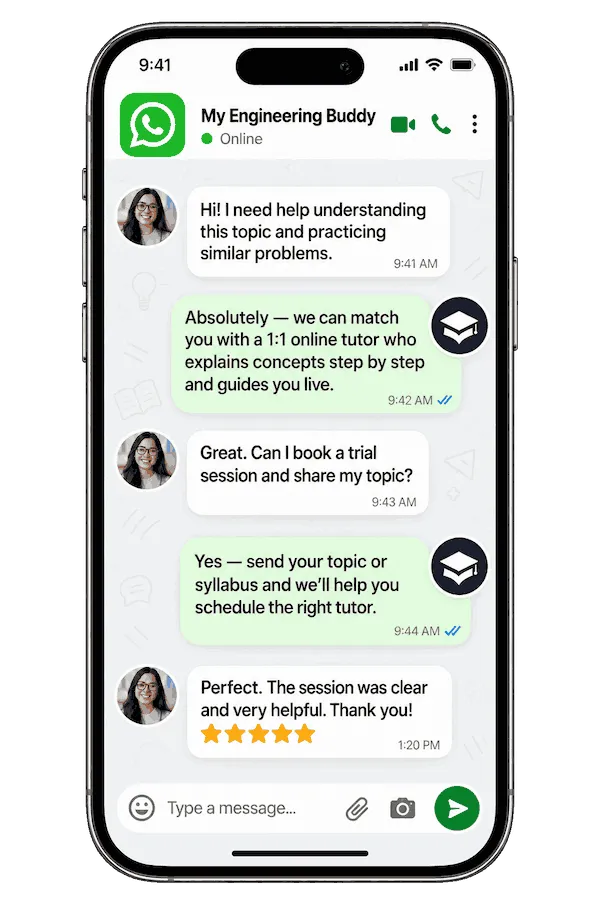
Unlike platforms where you fill out a form and wait, MEB responds in under a minute, 24/7. Tutor match takes under an hour. The $1 trial means you test before you commit. Everything runs over WhatsApp — no logins, no intake forms.
MEB tutors teaching Tensor Analysis hold graduate degrees in mathematics, theoretical physics, or engineering — many with research backgrounds in general relativity, continuum mechanics, or applied functional analysis. Every tutor passes a live demo evaluation before joining.
Source: My Engineering Buddy tutor vetting process, 2008–2025.
Study Plans (Pick One That Matches Your Goal)
The tutor builds the exact session sequence after the diagnostic, but here’s how the timelines typically map out. Catch-up (1–3 weeks): one or two sessions per week targeting the highest-priority gaps before an exam. Exam prep (4–8 weeks): structured coverage of the full syllabus with past-paper practice built in. Weekly support: ongoing sessions aligned to your lecture schedule and assignment deadlines, keeping pace with your course rather than recovering from it.
Pricing Guide
Most Tensor Analysis tutoring runs $20–$40/hr. Graduate-level and research-focused sessions with specialist tutors — particularly for general relativity or continuum mechanics applications — can reach up to $100/hr. Rate depends on course level, topic complexity, your timeline, and tutor availability.
For students targeting programmes at institutions like MIT, Caltech, Cambridge, or ETH Zürich, tutors with active research backgrounds in differential geometry or theoretical physics are available at higher rates — share your specific course and goal, and MEB will match the right tier.
Availability is limited during end-of-semester exam periods. Book early if your exam is within six weeks.
Start with the $1 trial — 30 minutes, no registration, no commitment. WhatsApp MEB for a quick quote.
FAQ
Is Tensor Analysis hard?
Yes — consistently rated one of the harder graduate mathematics topics. The difficulty is mostly notational: Einstein summation, index placement, and covariant versus partial derivatives trip up students who are otherwise strong. Once the notation becomes automatic, the concepts follow.
How many sessions are needed?
Most students close a specific gap in 3–5 sessions. Full course coverage — foundations through curvature and applications — typically takes 12–20 sessions. Your tutor maps this out after the first diagnostic session.
Can you help with homework and assignments?
Yes. MEB tutoring is guided learning — you understand the work, then submit it yourself. See our Academic Integrity policy and Why MEB page for full details on what we help with and what we don’t.
Will the tutor match my exact syllabus or exam board?
Yes. Share your course outline, textbook, or university module descriptor before the first session. Tutors are matched to your specific syllabus — not a generic Tensor Analysis curriculum — so sessions cover what you’re actually assessed on.
What happens in the first session?
The tutor runs a short diagnostic to locate your specific gaps — which topics, which notation errors, which derivations you can follow versus which you’re pattern-matching without understanding. The rest of the session addresses the highest-priority gap immediately.
Is online tutoring as effective as in-person?
For Tensor Analysis, yes — the digital pen-pad replicates a whiteboard precisely. Students at universities across four continents have worked through full tensor calculus courses with MEB tutors entirely online, with results comparable to in-person tutoring.
Can I get Tensor Analysis help at midnight?
Yes. MEB operates across time zones 24/7. WhatsApp MEB any time — average response is under one minute. Sessions can be booked same-day when tutors are available, including late-night slots for US and Gulf students.
What if I don’t understand the tutor’s teaching style?
Tell MEB on WhatsApp after session one. A replacement tutor is arranged at no extra cost. The $1 trial exists precisely so you test compatibility before committing to a full package.
Do you cover Tensor Analysis for machine learning and data science?
Yes. Tensor decomposition methods — Tucker decomposition, CP decomposition, tensor networks — are increasingly assessed in graduate machine learning and data science programmes. MEB has tutors who specialise in this intersection alongside the classical physics and engineering applications.
What’s the difference between Tensor Analysis and Linear Algebra — do I need both?
Linear algebra covers vectors and matrices in fixed coordinate systems. Tensor Analysis extends this to objects that transform consistently under coordinate changes — essential for physics and geometry. Most Tensor Analysis courses assume solid advanced college mathematics, including linear algebra. If your linear algebra is shaky, the tutor addresses that first.
How do I get started?
Start with the $1 trial — 30 minutes of live tutoring or one full question explained. Three steps: WhatsApp MEB, get matched with a verified tutor (usually within the hour), and begin your trial session. No registration required.
Trust & Quality at My Engineering Buddy
Every MEB tutor goes through a structured vetting process: subject-knowledge screening, a live demo evaluation assessed by a senior tutor, and ongoing session feedback review. Tensor Analysis tutors specifically must demonstrate graduate-level competence in at least one of the core application areas — differential geometry, general relativity, or continuum mechanics. Rated 4.8/5 across 40,000+ verified reviews on Google. MEB has been operating since 2008, and the tutoring methodology has been refined across more than 52,000 students.
MEB tutoring is guided learning — you understand the work, then submit it yourself. For full details on what we help with and what we don’t, read our Academic Integrity policy and Why MEB.
MEB serves students across the US, UK, Canada, Australia, Gulf, and Europe in 2,800+ subjects since 2008 — spanning the full Mathematics category, with particular depth in advanced topics like Tensor Analysis, Partial Differential Equations tutoring, and Complex Analysis help. If a subject is taught at graduate level anywhere in the world, MEB almost certainly has a tutor for it.
Explore Related Subjects
Students studying Tensor Analysis often also need support in:
Next Steps
Before your first session, have ready: your course syllabus or textbook (chapter and edition), a recent problem sheet or assignment you struggled with, and your exam or submission deadline. The tutor handles the rest.
- Share your exam board, course level, and hardest topic so far
- Share your availability and time zone
- MEB matches you with a verified Tensor Analysis tutor — usually within 24 hours
Visit www.myengineeringbuddy.com for more on how MEB works.
WhatsApp to get started or email [email protected].
A common pattern our tutors observe is that students who arrive with three weeks left and a shaky grip on covariant differentiation still close the gap — if they start immediately. Waiting another week rarely helps. Starting does.
Reviewed by Subject Expert
This page has been carefully reviewed and validated by our subject expert to ensure accuracy and relevance.