




~1 min
Average Reply Time
~1 hour
To Be Matched With A Tutor
30 Min Trial
75% Find Their Tutor On The 1st Trial
$20-35+/hr
Premium Yet Affordable Learning
Fourier series won’t converge. Function spaces aren’t clicking. Your problem sets are piling up — and the exam is six weeks out.
Harmonic Analysis Tutor Online
Harmonic Analysis is a branch of mathematics studying the representation of functions via superpositions of basic waves, covering Fourier series, transforms, and function spaces. It equips students to decompose signals and solve problems in analysis and applied mathematics.
If you’ve searched for a Harmonic Analysis tutor near me, you already know the subject doesn’t yield to passive reading. MEB connects you with a verified mathematics specialist for live 1:1 sessions built around your exact course — whether that’s a graduate real analysis sequence, an applied math module, or a signal-processing track. One session can shift what weeks of re-reading could not.
- 1:1 online sessions tailored to your course syllabus and current problem sets
- Expert-verified tutors with graduate-level subject knowledge in harmonic analysis and related fields
- Flexible time zones — US, UK, Canada, Australia, Gulf covered
- Structured learning plan built after a diagnostic session
- Ethical homework and assignment guidance — you understand the work before you submit it
52,000+ students across the US, UK, Canada, Australia, and the Gulf have used MEB since 2008 — including students in Mathematics subjects like Harmonic Analysis, Fourier Analysis, and Functional Analysis.
Source: My Engineering Buddy, 2008–2025.
How Much Does a Harmonic Analysis Tutor Cost?
Most Harmonic Analysis tutoring sessions run $20–$40/hr. Graduate-level or specialist sessions can reach $70–$100/hr depending on depth and tutor background. Not sure whether MEB is the right fit? Start with the $1 trial — 30 minutes of live tutoring, no commitment.
| Level / Need | Typical Rate | What’s Included |
|---|---|---|
| Standard (undergraduate) | $20–$35/hr | 1:1 sessions, homework guidance |
| Advanced / Graduate | $35–$100/hr | Expert tutor, research-level depth |
| $1 Trial | $1 flat | 30 min live session or 1 homework question explained |
Tutor availability tightens significantly during end-of-semester exam periods. Book early to secure a consistent slot.
WhatsApp MEB for a quick quote — average response time under 1 minute.
Who This Harmonic Analysis Tutoring Is For
Harmonic Analysis sits at a level where lecture notes alone rarely close the gap. Students typically arrive at MEB when the proof-writing demands of L² spaces or the abstraction of measure-theoretic Fourier analysis outpace what they can self-correct.
- Undergraduate students in advanced analysis or applied mathematics modules covering Fourier series and transforms
- Graduate students in mathematics, physics, or engineering whose coursework touches spectral theory or partial differential equations
- Students retaking after a failed first attempt in a real or functional analysis sequence
- PhD candidates needing to solidify foundational harmonic analysis before dissertation work
- Students at universities including MIT, Caltech, Cambridge, Imperial College London, ETH Zurich, University of Toronto, and the University of Melbourne whose programs require rigorous analysis prerequisites
- Students whose grasp of real analysis or measure theory has gaps that are now blocking progress in this course
At MEB, we’ve found that students who struggle in Harmonic Analysis almost always have the same underlying issue — a shaky handle on convergence. The Fourier machinery looks dense, but once convergence is solid, the structure becomes readable. That’s where the first session goes.
1:1 Tutoring vs Self-Study vs AI vs YouTube vs Online Courses
Self-study works if you’re disciplined and the proofs are within reach — but Harmonic Analysis proofs often aren’t. AI tools can state the Riemann–Lebesgue lemma, but they can’t see exactly where your argument breaks down. YouTube is fine for an overview of Fourier series; it stops when you’re three lines into an L^p convergence proof and stuck. Online courses are structured but set at a fixed pace, with no one to redirect you when your approach is wrong. With a 1:1 Harmonic Analysis tutor from MEB, every session is live, calibrated to your actual problem set, and corrects errors in real time — before they compound into an exam failure.
Outcomes: What You’ll Be Able To Do in Harmonic Analysis
After consistent sessions with an MEB tutor, you’ll be able to construct and evaluate Fourier series for piecewise smooth functions, including identifying pointwise and uniform convergence behavior. You’ll apply the Fourier transform on L¹ and L² spaces, use the convolution theorem correctly, and explain the Plancherel identity without prompting. You’ll solve boundary value problems using harmonic analysis techniques tied to differential equations, analyze function spaces including Sobolev and Hardy spaces at the level your course requires, and present rigorous proofs of classical results such as the Dirichlet kernel convergence theorem. None of these are guarantees — progress depends on starting level, session frequency, and work between sessions. But these are realistic targets for students who engage consistently.
Based on feedback from 40,000+ sessions collected by MEB from 2022 to 2025, 58% of students improved by one full grade after approximately 20 hours of 1:1 tutoring in subjects like Harmonic Analysis. A further 23% achieved at least a half-grade improvement.
Source: MEB session feedback data, 2022–2025.
What We Cover in Harmonic Analysis (Syllabus / Topics)

Track 1: Fourier Series and Classical Harmonic Analysis
- Trigonometric series and orthogonality on [-π, π]
- Pointwise, uniform, and L² convergence of Fourier series
- Dirichlet and Fejér kernels; Gibbs phenomenon
- Parseval’s theorem and Bessel’s inequality
- Cesàro summability and Abel summability
- Applications to boundary value problems and heat/wave equations
Core texts for this track include Stein & Shakarchi’s Fourier Analysis (Princeton) and Katznelson’s An Introduction to Harmonic Analysis.
Track 2: Fourier Transform and L^p Theory
- Fourier transform on L¹(ℝ) and L²(ℝ); inversion theorem
- Plancherel theorem and Parseval’s identity on L²
- Convolution, Young’s inequality, and the convolution theorem
- Schwartz space and tempered distributions; distributional Fourier transform
- Interpolation: Riesz–Thorin and Marcinkiewicz theorems
- Hardy–Littlewood maximal function and weak-type estimates
- Singular integrals: Hilbert transform and Calderón–Zygmund theory
Standard references include Folland’s Real Analysis and Grafakos’s Classical Fourier Analysis.
Track 3: Function Spaces and Advanced Topics
- Sobolev spaces H^s and W^{k,p}: definitions, embeddings, trace theorems
- Hardy spaces H^p and BMO (bounded mean oscillation)
- Littlewood–Paley theory and dyadic decompositions
- Pseudodifferential operators and their symbol classes
- Wavelets and multiresolution analysis — connection to wavelet transforms
- Applications in PDE regularity theory and numerical analysis
Recommended texts include Muscalu & Schlag’s Classical and Multilinear Harmonic Analysis and Mallat’s A Wavelet Tour of Signal Processing.
Students consistently tell us that Harmonic Analysis feels impenetrable until someone draws the connection between the abstract L^p machinery and what’s actually happening to the function. That moment of clarity — usually around the Plancherel theorem — changes how the entire course reads.
What a Typical Harmonic Analysis Session Looks Like
The tutor opens by reviewing the previous topic — often pointwise convergence of Fourier series or the Fourier transform inversion argument — and checking where the student lost the thread. From there, the session moves into the current problem set: the student attempts a proof on screen, the tutor watches via Google Meet, and marks where the logic breaks using a digital pen-pad. A common focal point is the step from formal manipulation to rigorous estimate — for instance, establishing a weak-type (1,1) bound for the Hardy–Littlewood maximal function. The tutor demonstrates one worked case, the student replicates it with a different function, then explains the reasoning aloud. The session closes with two or three practice problems set for independent work and a note on what the next session will cover — usually moving from maximal functions into the Hilbert transform or beginning Calderón–Zygmund theory, depending on course pace. Need help with complex analysis running alongside? That can be worked in too.
How MEB Tutors Help You with Harmonic Analysis (The Learning Loop)
Diagnose: In the first session, the tutor identifies exactly where your understanding breaks — whether that’s measure-theoretic foundations from functional analysis, convergence arguments, or the transition from classical Fourier series to the L² setting. This shapes every session that follows.
Explain: The tutor works through live examples using a digital pen-pad — writing out the Dirichlet kernel estimate step by step, or building the Calderón–Zygmund decomposition from scratch. No skipped steps. No assumed fluency.
Practice: You attempt a parallel problem with the tutor present. Harmonic Analysis is a subject where doing is the only way to consolidate — hearing a proof once isn’t enough.
Feedback: The tutor stops you mid-proof when the argument goes wrong, explains which step failed and why it would cost marks, then walks the correction. This is the step that self-study cannot replicate.
Plan: Each session ends with a concrete next-step list — specific problems, specific theorems to re-read, and a note on what the next session will open with. Progress is tracked, not assumed.
Sessions run on Google Meet. The tutor uses a digital pen-pad or iPad with Apple Pencil for live working. Before your first session, share your course syllabus or problem sheet and any recent work you’ve attempted. The first session runs as a diagnostic and covers your most pressing gap — whether that’s Fourier series convergence, L^p operator theory, or distribution theory. Start with the $1 trial — 30 minutes of live tutoring that also serves as your first diagnostic.
MEB tutors working in advanced mathematics subjects — including Harmonic Analysis, Abstract Algebra, and Topology — hold graduate degrees and in many cases active research experience. That depth matters when a student needs a proof corrected, not just explained.
Source: My Engineering Buddy, 2008–2025.
Tutor Match Criteria (How We Pick Your Tutor)
Not every mathematics tutor has the background to work at the level Harmonic Analysis demands. Here’s what MEB checks.
Subject depth: Graduate-level training in analysis — real analysis, functional analysis, or a field where harmonic analysis is applied directly (PDE, signal processing, mathematical physics).
Tools: Google Meet plus a digital pen-pad or iPad with Apple Pencil — because proof-writing requires a working surface, not a typed chat window.
Time zone: Matched to your region. US, UK, Gulf, Canada, and Australia sessions all scheduled within your available hours.
Goals: Whether you need to close a specific proof gap before an exam, build from measure theory foundations, or get ongoing weekly support through a semester, the match accounts for that.
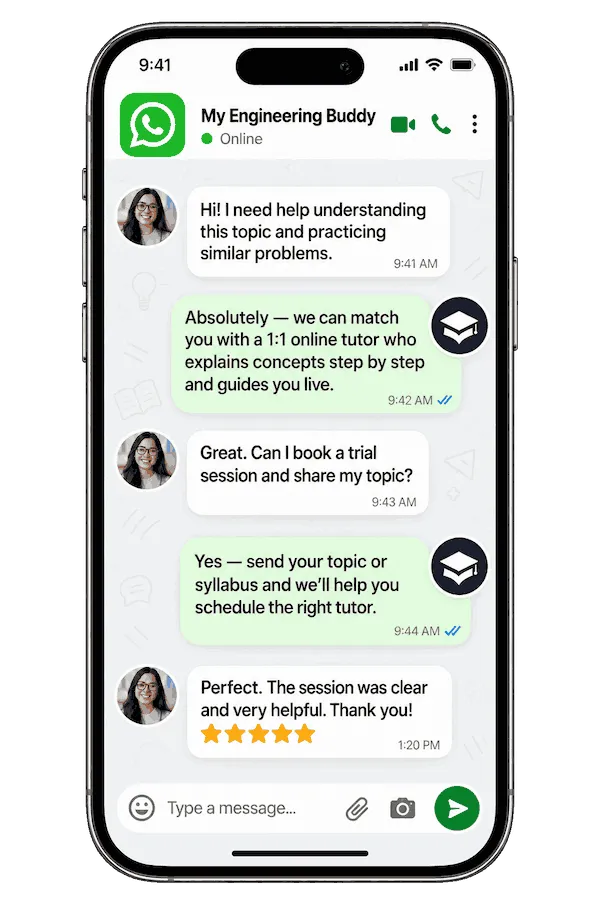
Unlike platforms where you fill out a form and wait, MEB responds in under a minute, 24/7. Tutor match takes under an hour. The $1 trial means you test before you commit. Everything runs over WhatsApp — no logins, no intake forms.
Study Plans (Pick One That Matches Your Goal)
Catch-up (1–3 weeks): for students behind on proof-based problem sets or with an upcoming exam and real gaps still open in Fourier theory or function spaces. Exam prep (4–8 weeks): structured revision working through past papers, theorem statements, and proof strategies. Weekly support: aligned to your semester schedule and coursework deadlines, building topic by topic. The tutor builds a specific session sequence after the diagnostic — no generic plan applied to every student.
Pricing Guide
Harmonic Analysis tutoring starts at $20/hr for standard undergraduate-level work. Graduate-level sessions — covering topics like Calderón–Zygmund operators, Hardy spaces, or pseudodifferential operators — typically run $50–$100/hr depending on tutor background and session depth.
Rate factors: course level, topic complexity (classical vs. multilinear harmonic analysis), timeline urgency, and tutor availability. Slots during end-of-semester crunch periods fill fast — especially for graduate-level analysis subjects.
For students targeting programs at institutions like Princeton, MIT, ETH Zurich, or Cambridge where harmonic analysis underpins doctoral coursework, tutors with active research backgrounds in analysis are available at higher rates — share your specific goal and MEB will match the tier to what you actually need.
Start with the $1 trial — 30 minutes, no registration, no commitment. WhatsApp MEB for a quick quote.
FAQ
Is Harmonic Analysis hard?
Yes — it’s one of the more demanding undergraduate and graduate mathematics subjects. The abstraction of function spaces, the precision required in convergence arguments, and the density of the proof-writing all create real difficulty. Systematic 1:1 support is one of the most effective ways to close those gaps.
How many sessions are needed?
Most students see a meaningful shift after 4–6 sessions. Students with specific exam gaps often need 8–12. Students seeking full-semester support typically book weekly. The tutor sets a realistic timeline after the first diagnostic session.
Can you help with homework and assignments?
MEB tutoring is guided learning — you understand the work, then submit it yourself. The tutor explains the method, works through similar examples, and helps you identify errors in your own reasoning. See our Academic Integrity policy and Why MEB page for full details on what we help with and what we don’t.
Will the tutor match my exact syllabus or exam board?
Yes. Share your course outline, lecture notes, or problem sheets before the first session. MEB matches you with a tutor whose background aligns to your specific course — whether that’s a classical Fourier analysis module, an L^p theory sequence, or an applied harmonic analysis track tied to signal processing.
What happens in the first session?
The tutor runs a diagnostic: reviews what you’ve covered, identifies where the understanding breaks, and establishes what the next 3–5 sessions should prioritise. You also work through at least one current problem together — the session is live and immediately practical.
Is online tutoring as effective as in-person?
For proof-based mathematics subjects, yes. The digital pen-pad on Google Meet replicates a whiteboard session closely. MEB tutors have run thousands of graduate-level analysis sessions online, and the feedback data shows no meaningful gap in student outcomes compared to in-person formats.
How do I get started?
WhatsApp MEB, describe your course level and most pressing topic, and you’ll be matched with a tutor — usually within an hour. The first session is the $1 trial: 30 minutes of live tutoring or one homework question explained in full. Three steps: WhatsApp, get matched, start the trial.
Can I get Harmonic Analysis help at midnight or on weekends?
Yes. MEB operates 24/7 across time zones. WhatsApp response times average under a minute regardless of the hour. Students in the Gulf, Australia, and the US West Coast regularly book sessions outside standard business hours without issue.
What if I don’t connect with my assigned tutor?
Tell MEB via WhatsApp. A replacement tutor is matched, typically within the same day. The $1 trial is specifically designed so you can test the fit before committing to a longer engagement — no pressure, no penalty for switching.
Do I need to know measure theory before starting Harmonic Analysis?
It depends on the course. Classical Fourier series can be studied with strong calculus and real analysis. L^p theory and distribution-based harmonic analysis typically require measure theory as a prerequisite. If yours does, MEB tutors can run parallel sessions in measure theory to build that foundation alongside the main course.
What’s the difference between Fourier Analysis and Harmonic Analysis?
Fourier Analysis is a central part of Harmonic Analysis but not the whole of it. Harmonic Analysis extends Fourier methods into abstract settings — function spaces, operator theory, and group representations. A course titled Harmonic Analysis typically assumes Fourier Analysis as background and moves significantly further into L^p and distribution theory.
Trust & Quality at My Engineering Buddy
Every MEB tutor in mathematics goes through subject-specific screening: live demo session, degree verification, and review of their ability to explain graduate-level proofs under real session conditions. Tutors are not self-certified — they’re evaluated before being matched with students. Rated 4.8/5 across 40,000+ verified reviews on Google. Ongoing session feedback is collected and used to reassign or remove tutors who don’t meet MEB’s quality standard.
MEB tutoring is guided learning — you understand the work, then submit it yourself. For full details on what we help with and what we don’t, read our Academic Integrity policy and Why MEB.
MEB has served 52,000+ students across the US, UK, Canada, Australia, the Gulf, and Europe since 2008, covering 2,800+ subjects. In Mathematics — including Harmonic Analysis, real analysis tutoring, and applied mathematics tutoring — MEB tutors hold graduate degrees and in many cases carry active research backgrounds. That depth is matched to what each student’s course actually demands. See more on how MEB selects and trains tutors at our tutoring methodology page.
Explore Related Subjects
Students studying Harmonic Analysis often also need support in:
- Ergodic Theory
- Dynamical Systems
- Group Theory
- Laplace Transform
- Integral Equations
- Nonlinear Dynamics
- Tensor Analysis
Next Steps
Before your first session, have ready: your course syllabus or lecture notes, a recent problem sheet or homework you struggled with, and your exam or deadline date. The tutor handles the rest.
- Share your exam board or course level and your hardest current topic
- Share your availability and time zone
- MEB matches you with a verified tutor — usually within 24 hours
The first session opens with a diagnostic so every minute is spent on what actually needs fixing — not a general overview.
Visit www.myengineeringbuddy.com for more on how MEB works.
Try your first session for $1 — 30 minutes of live 1:1 tutoring or one homework question explained in full. No registration. No commitment. WhatsApp MEB now and get matched within the hour.
WhatsApp to get started or email [email protected].
Reviewed by Subject Expert
This page has been carefully reviewed and validated by our subject expert to ensure accuracy and relevance.




