




~1 min
Average Reply Time
~1 hour
To Be Matched With A Tutor
30 Min Trial
75% Find Their Tutor On The 1st Trial
$20-35+/hr
Premium Yet Affordable Learning
Struggling with fabric construction, colour theory, or surface pattern briefs — and your submission date is closer than it feels?
Textile Design Tutor Online
Textile Design is the study of fabric structure, surface pattern, colour, and material properties, equipping students to design woven, knitted, printed, and embellished textiles for fashion, interiors, and industrial applications.
MEB provides 1:1 online tutoring and academic guidance in 2800+ advanced subjects — including a dedicated Textile Design tutor online for students across the US, UK, Canada, Australia, and the Gulf. Whether you’re wrestling with warp-and-weft construction, Jacquard repeat calculations, or a portfolio brief in Fashion Studies, a matched tutor works through it with you live. Search for a Textile Design tutor near me and MEB connects you within the hour — no forms, no waiting rooms.
- 1:1 online sessions tailored to your course syllabus and project briefs
- Expert-verified tutors with hands-on textile and design knowledge
- Flexible time zones — US, UK, Canada, Australia, Gulf covered
- Structured learning plan built after a first diagnostic session
- Ethical academic guidance — you understand the work before you submit
52,000+ students across the US, UK, Canada, Australia, and the Gulf have used MEB since 2008 — including students in Fashion Studies subjects like Textile Design, Fashion Design, and Fashion Communication.
Source: My Engineering Buddy, 2008–2025.
How Much Does a Textile Design Tutor Cost?
Most Textile Design tutoring sessions run $20–$40/hr. Advanced portfolio work, specialist CAD textile software support, or postgraduate-level research can reach up to $100/hr. The $1 trial gives you 30 minutes of live tutoring or a full explanation of one homework question before you commit to anything.
| Level / Need | Typical Rate | What’s Included |
|---|---|---|
| Standard (most levels) | $20–$35/hr | 1:1 sessions, homework guidance |
| Advanced / Specialist | $35–$70/hr | Expert tutor, niche depth (CAD, weave tech) |
| $1 Trial | $1 flat | 30 min live session or 1 homework question |
Tutor availability tightens around portfolio submission windows and end-of-semester deadlines — book early if you’re within six weeks of a hand-in.
WhatsApp MEB for a quick quote — average response time under 1 minute.
Who This Textile Design Tutoring Is For
Textile Design covers a wide range of students — from foundation-year students building their first fabric sample books to undergraduates producing full print collections and postgraduate researchers working on technical textile innovation. If your work involves materials, pattern, structure, or surface, this is for you.
- Undergraduate Textile Design students with unresolved gaps in weave notation or colour theory
- Students with a portfolio submission deadline approaching and unfinished design development sections
- Students retaking a module or year after a failed first attempt
- Students at institutions including Central Saint Martins, RISD, Parsons, RCA, Savannah College of Art and Design, and the University of the Arts London — where portfolio standards are high and feedback is limited between tutorials
- Parents watching a student’s confidence drop as submission deadlines stack up
- Students needing ethical academic guidance on technical briefs
1:1 Tutoring vs Self-Study vs AI vs YouTube vs Online Courses
Self-study works if you already understand the structure — it falls apart when you don’t know what you’re missing. AI tools can explain yarn count formulas but can’t look at your actual swatch and tell you why the twill broke. YouTube covers loom mechanics at a surface level and stops exactly when your specific warp tension problem starts. Online courses run at their pace, not yours. With MEB, a tutor looks at your actual brief, your actual sample, and your actual gap — and fixes it in real time. That difference matters most in Textile Design, where the work is visual, tactile, and highly individual.
Outcomes: What You’ll Be Able To Do in Textile Design
After working with an online Textile Design tutor, students consistently report being able to solve weave structure problems using accurate draft notation, analyse colour relationships using standard colour systems like Munsell or NCS, apply repeat-pattern logic to digital and screen-print layouts, explain fibre behaviour and fabric handle in written technical reports, and present a design development narrative that holds up under tutor critique. These are not generic skills. They are the specific competencies that get marked in Textile Design briefs at undergraduate and postgraduate level.
Based on feedback from 40,000+ sessions collected by MEB from 2022 to 2025, 58% of students improved by one full grade after approximately 20 hours of 1:1 tutoring in subjects like Textile Design. A further 23% achieved at least a half-grade improvement.
Source: MEB session feedback data, 2022–2025.
Supporting a student through Textile Design? MEB works directly with parents to set up sessions, track progress, and keep coursework on schedule. WhatsApp MEB — average response time is under a minute, 24/7.
Try your first session for $1 — 30 minutes of live 1:1 tutoring or one homework question explained in full. No registration. No commitment. WhatsApp MEB now and get matched within the hour.
What We Cover in Textile Design (Syllabus / Topics)

Fabric Structure and Weave Technology
- Plain, twill, and satin weave structures with draft notation
- Warp and weft calculations — thread count, sett, and yarn weight
- Jacquard and dobby patterning principles
- Knit structures: weft knit, warp knit, and stitch notation
- Non-woven fabric production — felting, bonding, and technical textiles
- Fibre properties and their effect on fabric handle, drape, and durability
Key references: The Complete Book of Drafting for Handweavers by Madelyn van der Hoogt; Fabric Structure and Design by Grosicki.
Surface Pattern and Print Design
- Repeat systems: half-drop, brick, mirror, and rotation repeats
- Screen printing, digital inkjet printing, and discharge techniques
- Colour separation and registration for multi-layer print
- Devore, resist, and discharge methods — technical and aesthetic application
- Pattern scaling for fashion vs interior end-use
- Fashion CAD tutoring for digital repeat and colourway work in Adobe Illustrator and Photoshop
Key references: Surface Design for Fabric by Richard Proctor; Repeat Patterns by Peter Phillips and Gillian Bunce.
Colour Theory and Design Development
- Colour systems: Munsell, NCS, Pantone — application in textile specification
- Colour forecasting and trend analysis for seasonal collections
- Design development narrative — from research source to final resolved design
- Mood board construction and visual research methodology
- Written contextual studies and critical analysis of textiles in art and culture
- Portfolio presentation standards and marking criteria for assessed projects
Key references: Colour and Culture by John Gage; The Fashion Designer’s Textile Directory by Gail Baugh.
What a Typical Textile Design Session Looks Like
The tutor opens by checking the previous week’s topic — usually the student’s progress on a weave draft or a surface pattern repeat. From there, student and tutor work through the specific problem on screen: it might be a broken twill sequence in a draft diagram, a colour separation issue in a digital print repeat, or a written critical analysis that lacks structure. The tutor uses a digital pen-pad to annotate directly on the student’s work. The student then re-attempts the correction or explains their reasoning back. The session closes with a defined practice task — for example, completing a full four-shaft draft with correct threading notation — and the next topic is agreed before the call ends. Sessions run on Google Meet and usually last 60 minutes.
How MEB Tutors Help You with Textile Design (The Learning Loop)
Diagnose: In the first session, the tutor asks you to walk through a recent brief or piece of work. Within 15 minutes, the gaps are clear — whether that’s technical (weave construction errors) or conceptual (not understanding how to build a design development argument).
Explain: The tutor works through the problem live, using a digital pen-pad to draw weave drafts, annotate print layouts, or mark up written work in real time. You see exactly how the tutor thinks through it.
Practice: You attempt the next problem while the tutor watches. In Textile Design, this might mean drafting a twill variant independently or rebuilding a repeat pattern from scratch.
At MEB, we’ve found that Textile Design students make the fastest gains not from reading more theory, but from producing work under a tutor’s eye — catching errors in the moment rather than discovering them in marked feedback three weeks later.
Feedback: The tutor identifies exactly where marks are lost — whether it’s a labelling error in a technical spec, a weak transition in a design development narrative, or a miscalculated thread sett — and shows how to fix it before the brief is submitted.
Plan: Each session ends with a clear next step. The tutor tracks which topics are resolved and which need another pass, building a short-term sequence toward your submission or exam date.
Sessions run on Google Meet. Tutors use a digital pen-pad or iPad with Apple Pencil for annotation. Before your first session, have your course brief, any current draft work, and your submission deadline ready. The first session starts with the diagnostic — so every minute counts from the start. Start with the $1 trial — 30 minutes of live tutoring that also serves as your first diagnostic.
Tutor Match Criteria (How We Pick Your Tutor)
Not every textile professional can tutor effectively. MEB matches on four criteria.
Subject depth: The tutor must have direct experience with the specific area of Textile Design you need — fabric construction, surface print, CAD-based design, or contextual studies — not just a general fashion background.
Tools: All tutors work on Google Meet with a digital pen-pad or iPad and Apple Pencil, so annotation on your actual work is built into every session.
Time zone: Tutors are matched to your region — US, UK, Gulf, Canada, or Australia — so sessions don’t start at 2am.
Goals: Whether you need to pass a module, build a portfolio for postgraduate application, or close a specific technical gap, the tutor selection is adjusted to match.
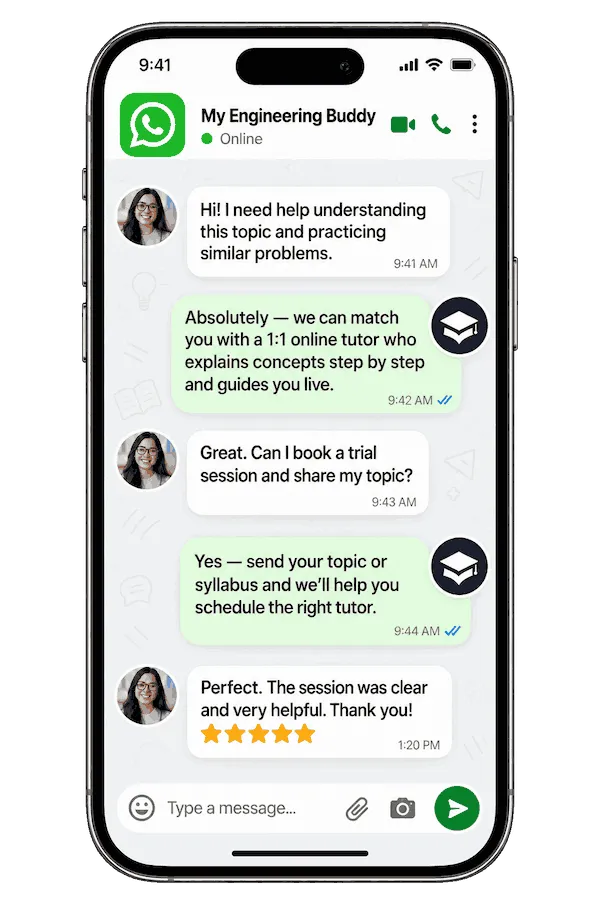
Unlike platforms where you fill out a form and wait, MEB responds in under a minute, 24/7. Tutor match takes under an hour. The $1 trial means you test before you commit. Everything runs over WhatsApp — no logins, no intake forms.
Study Plans (Pick One That Matches Your Goal)
Your tutor builds the session sequence after the first diagnostic — but here’s the general shape. A catch-up plan (1–3 weeks) targets students with a specific technical gap to close before a submission. Exam-prep or portfolio-prep plans (4–8 weeks) follow a structured topic-by-topic progression toward a fixed deadline. Weekly support aligns to your semester schedule and coursework hand-in dates, with the tutor adjusting pace as briefs shift. The tutor confirms the sequence at the end of session one.
Pricing Guide
Textile Design tutoring starts at $20/hr for standard undergraduate-level sessions. Graduate-level research, specialist technical textile topics, or tutors with professional industry backgrounds can reach up to $100/hr. Rate factors include the level of study, topic complexity, timeline urgency, and tutor availability.
Availability tightens significantly in the weeks before major portfolio submissions and end-of-year assessments. Book early if you’re approaching a deadline.
For students targeting programmes at institutions like the Royal College of Art, Parsons, or Central Saint Martins, tutors with professional textile industry or research backgrounds are available at higher rates — share your specific goal and MEB will match the tier to your ambition.
Start with the $1 trial — 30 minutes, no registration, no commitment. WhatsApp MEB for a quick quote.
Students consistently tell us that the gap between a pass and a merit in Textile Design isn’t talent — it’s knowing what the marker actually wants and being shown, not told, how to get there. That’s what a 1:1 session does that a YouTube video simply cannot.
FAQ
Is Textile Design hard?
It depends on your background. The technical side — weave notation, thread calculations, colour separation — has a steep learning curve for students without prior craft experience. The design development and critical writing elements challenge students who are strong on making but weaker on academic articulation. Both are fixable with targeted support.
How many sessions are needed?
Most students need 6–12 sessions to close a specific module gap. Ongoing weekly support through a semester is common for students juggling multiple briefs. The tutor gives a clearer estimate after the first diagnostic session.
Can you help with practice exercises?
Yes — MEB tutoring is guided learning. The tutor explains the concept, works through examples with you, and helps you understand the brief requirements. You produce and submit your own work. See our Academic Integrity policy and Why MEB page for full details on what we help with and what we don’t.
Will the tutor match my exact syllabus or exam board?
Yes. Before matching, MEB confirms your institution, course level, and brief requirements. Tutors are selected based on familiarity with your specific syllabus — whether that’s a UK degree course, a US BFA programme, or an international foundation year.
What happens in the first session?
The tutor reviews a recent piece of your work or walks through your current brief with you. This diagnostic takes around 15 minutes and shapes the rest of the session. By the end, you’ll have a clear short-term plan and at least one resolved problem.
Is online tutoring as effective as in-person?
For Textile Design theory, written work, CAD-based design, and weave notation, yes — screen sharing and digital pen annotation replicate in-person whiteboarding closely. For physical sampling and loom work, the tutor focuses on guiding your process and troubleshooting through video rather than hands-on demonstration.
Can I get Textile Design help at midnight?
Yes. MEB operates 24/7 via WhatsApp. Tutors span multiple time zones, so a student in the US or Gulf submitting a brief at 2am can usually be matched within the hour. Response time averages under one minute.
What if I don’t like my assigned tutor?
Tell MEB via WhatsApp. A replacement is arranged quickly — usually within the same day. The $1 trial exists precisely so you can test the match before committing to a block of sessions.
Do you offer group Textile Design sessions?
MEB specialises in 1:1 sessions only. Group sessions dilute the diagnostic precision that makes the format work — especially in a subject as portfolio-specific and individually assessed as Textile Design.
What’s the difference between Textile Design and Fashion Design tutoring?
Textile Design focuses on fabric construction, surface pattern, colour, and material — the building blocks. Fashion Sketching tutoring and fashion design support focus on silhouette, garment construction, and collection development. Many students need both, and MEB can provide separate matched tutors for each.
Can a tutor help with digital textile CAD software like Optitex or Style3D?
Yes. MEB has tutors experienced in Optitex tutoring and Style3D tutoring for students working with digital fabric simulation alongside their Textile Design coursework. Confirm the software when you WhatsApp MEB.
How do I get started?
WhatsApp MEB, share your brief or exam details, and you’re matched with a verified tutor — usually within the hour. The first session starts with a diagnostic. Three steps: WhatsApp → matched → start your $1 trial.
Trust & Quality at My Engineering Buddy
Every MEB tutor goes through subject-specific vetting — not just a CV check. Candidates complete a live demo session evaluated against MEB’s marking criteria, and ongoing session feedback determines whether they continue on the platform. Textile Design tutors are assessed on their ability to explain weave structure, give useful feedback on design development work, and navigate CAD tools where relevant. Rated 4.8/5 across 40,000+ verified reviews on Google.
MEB tutoring is guided learning — you understand the work, then submit it yourself. For full details on what we help with and what we don’t, read our Academic Integrity policy and Why MEB.
MEB has served 52,000+ students across the US, UK, Canada, Australia, the Gulf, and Europe in 2,800+ subjects since 2008. Fashion Studies is one of the strongest subject areas on the platform — with dedicated support in Textile Design, Fashion Marketing Management tutoring, and Fashion Merchandising tutoring. Find out more about MEB’s approach at our tutoring methodology page.
A common pattern our tutors observe is that Textile Design students arrive knowing how to make things but not how to write about them — or the reverse. The first session almost always reveals which side needs work, and the plan adjusts from there.
Explore Related Subjects
Students studying Textile Design often also need support in:
Next Steps
When you WhatsApp MEB, have these ready:
- Your course level, institution, and current brief or module name
- Your submission or exam date and the specific topic or section where you’re stuck
- Your time zone and availability for sessions
Before your first session, have ready: your course outline or brief, a recent piece of work or homework you struggled with, and your deadline date. The tutor handles the rest.
MEB matches you with a verified tutor — usually within 24 hours, often within the hour. The first session starts with a diagnostic so every minute is used well.
Visit www.myengineeringbuddy.com for more on how MEB works.
WhatsApp to get started or email [email protected].
Reviewed by Subject Expert
This page has been carefully reviewed and validated by our subject expert to ensure accuracy and relevance.




