




~1 min
Average Reply Time
~1 hour
To Be Matched With A Tutor
30 Min Trial
75% Find Their Tutor On The 1st Trial
$20-35+/hr
Premium Yet Affordable Learning
Most students who struggle with Constitutional Law don’t lack intelligence — they lack a tutor who can explain Marbury v. Madison in plain terms and then make them apply it under exam pressure.
Constitutional Law Tutor Online
Constitutional Law governs the foundational legal principles of a state, defining the structure of government, the distribution of powers, and the fundamental rights of individuals, as interpreted through constitutional texts and landmark judicial decisions.
MEB offers 1:1 online law tutoring across the full range of constitutional subjects — from the Commerce Clause to judicial review, separation of powers to First Amendment doctrine. If you’ve searched for a Constitutional Law tutor near me and found only generic platforms, MEB works differently: a verified tutor matched to your exact course, your exam board, and your timeline. Sessions run via Google Meet with a digital pen-pad, so case analysis and doctrinal frameworks get worked through in real time, not just recited back at you.
- 1:1 online sessions tailored to your law school syllabus or undergraduate course
- Expert-verified tutors with Constitutional Law subject-specific knowledge
- Flexible time zones — US, UK, Canada, Australia, Gulf
- Structured learning plan built after a diagnostic session
- Ethical homework and assignment guidance — you understand before you submit
52,000+ students across the US, UK, Canada, Australia, and the Gulf have used MEB since 2008 — including students in Law subjects like Constitutional Law, Administrative Law, and Human Rights Law.
Source: My Engineering Buddy, 2008–2025.
How Much Does a Constitutional Law Tutor Cost?
Most Constitutional Law sessions run $20–$40/hr depending on level and complexity. Graduate-level or bar-prep-focused sessions may reach $70–$100/hr. Before committing to a package, you can test everything with the $1 trial — 30 minutes live or one assignment question explained in full.
| Level / Need | Typical Rate | What’s Included |
|---|---|---|
| Undergraduate / Pre-law | $20–$35/hr | 1:1 sessions, case brief guidance |
| Law School / JD Level | $35–$70/hr | Expert tutor, issue-spotting, exam technique |
| $1 Trial | $1 flat | 30 min live session or 1 assignment question |
Tutor availability tightens significantly during law school exam periods — particularly November and April. Book early if your finals are within six weeks.
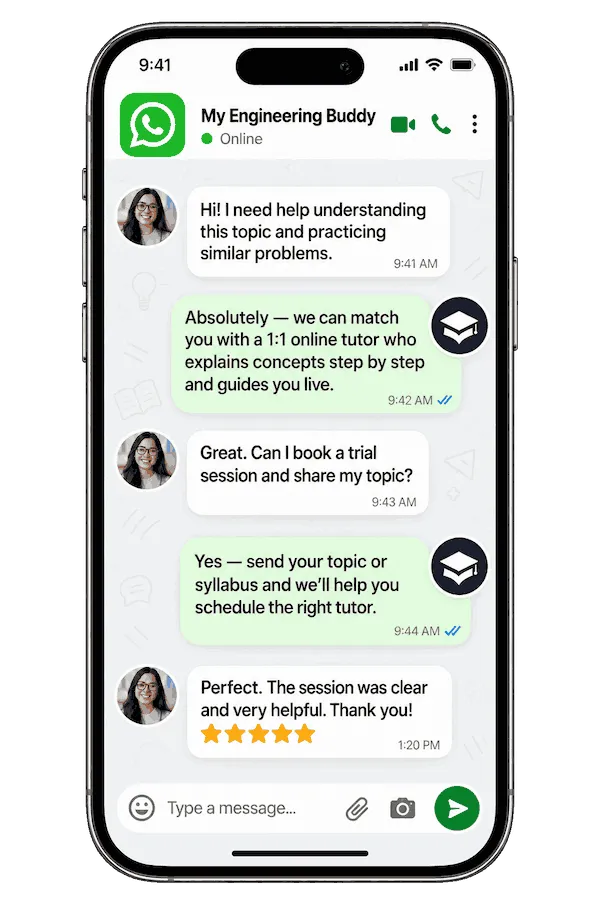
WhatsApp MEB for a quick quote — average response time under 1 minute.
Who This Constitutional Law Tutoring Is For
Constitutional Law draws students from pre-law tracks, JD programmes, LLB courses, and political science degrees. The concepts aren’t always hard to grasp — but applying them under timed exam conditions, where issue-spotting and doctrinal precision both matter, is where most students drop marks.
- Undergraduates in political science, government, or pre-law programmes struggling with constitutional doctrine
- JD students preparing for Constitutional Law finals or bar exam Constitutional Law questions
- Students retaking a Constitutional Law module after a failed first attempt
- Students with a university conditional offer depending on this grade
- LLB students at institutions like Georgetown, Yale Law, NYU Law, University of Toronto, LSE, King’s College London, ANU, or University of Melbourne
- Students 4–6 weeks from finals with significant doctrinal gaps still to close
- Parents watching a student’s confidence drop as case law volume builds
For pre-law students building LSAT skills alongside their coursework, MEB also covers legal studies tutoring and legal research help — subjects that sit directly alongside Constitutional Law in most pre-law and JD curricula.
At MEB, we’ve found that Constitutional Law students who struggle most aren’t weak on the facts — they’re weak on the structure. They can recite Lochner but can’t explain why it matters for the Commerce Clause question in front of them. That’s exactly what a tutor session targets.
1:1 Tutoring vs Self-Study vs AI vs YouTube vs Online Courses
Self-study works if you’re disciplined, but Constitutional Law case law is dense and the connections between doctrines aren’t obvious from a textbook alone. AI tools give fast definitions but can’t tell you why your issue-spotting answer lost four marks. YouTube is useful for an overview of judicial review — it stops there when you’re stuck on a specific Commerce Clause hypo. Online courses are structured but fixed-pace, with no one checking whether you actually understood McCulloch v. Maryland before moving on. 1:1 tutoring with MEB is live and calibrated to your exact syllabus — the tutor corrects your reasoning in the moment, not after you’ve already submitted the exam.
Outcomes: What You’ll Be Able To Do in Constitutional Law
After structured sessions with an MEB Constitutional Law tutor, you’ll be able to analyze separation of powers questions using the correct doctrinal framework, apply First Amendment balancing tests accurately under timed conditions, and explain the evolution of Commerce Clause jurisprudence from Gibbons v. Ogden to United States v. Lopez. You’ll write cleaner IRAC-structured exam answers on due process and equal protection questions — not just recall the cases, but apply them to novel fact patterns. You’ll also be able to present oral arguments on constitutional issues with greater confidence, a skill that matters in seminar formats across Georgetown, LSE, and ANU law programmes.
Based on feedback from 40,000+ sessions collected by MEB from 2022 to 2025, 58% of students improved by one full grade after approximately 20 hours of 1:1 tutoring in subjects like Constitutional Law. A further 23% achieved at least a half-grade improvement.
Source: MEB session feedback data, 2022–2025.
Supporting a student through Constitutional Law? MEB works directly with parents to set up sessions, track progress, and keep coursework on schedule. WhatsApp MEB — average response time is under a minute, 24/7.
What We Cover in Constitutional Law (Syllabus / Topics)

Track 1: Constitutional Foundations and Structure of Government
- Constitutional text interpretation — originalism vs. living constitutionalism
- Separation of powers: legislative, executive, and judicial functions
- Federalism: powers reserved to states vs. federal authority
- Judicial review — Marbury v. Madison and its doctrinal legacy
- The Supremacy Clause and federal preemption doctrine
- Commerce Clause evolution from Gibbons to Lopez to NFIB v. Sebelius
- Necessary and Proper Clause — implied powers and McCulloch v. Maryland
Recommended texts: Chemerinsky’s Constitutional Law: Principles and Policies (6th ed.), Stone et al. Constitutional Law (8th ed.), and Sullivan & Feldman’s Constitutional Law (19th ed.).
Track 2: Individual Rights — First Amendment and Freedom Doctrines
- Free speech — categorical vs. balancing approaches, content neutrality
- Freedom of religion: Establishment Clause and Free Exercise Clause
- Freedom of the press and prior restraint doctrine
- Right of assembly and association
- Second Amendment — District of Columbia v. Heller and its scope
- Fourth Amendment: search and seizure, warrant requirements, exceptions
- Fifth Amendment: self-incrimination, double jeopardy, takings clause
Recommended texts: Dworkin’s Freedom’s Law, Tribe’s American Constitutional Law (Vol. 1), and relevant LSAC prep guides from Law School Admission Council.
Track 3: Equal Protection, Due Process, and Contemporary Doctrine
- Fourteenth Amendment — equal protection and incorporation doctrine
- Levels of scrutiny: rational basis, intermediate, and strict scrutiny
- Substantive due process — from Lochner to Obergefell
- Procedural due process — what process is due and when
- Affirmative action doctrine and recent Supreme Court decisions
- Privacy rights — Griswold, Roe, Dobbs, and the unsettled landscape
- State action doctrine — when constitutional rights apply to private actors
Recommended texts: Balkin & Levinson’s casebook materials, Sunstein’s The Partial Constitution, and Ely’s Democracy and Distrust.
What a Typical Constitutional Law Session Looks Like
The tutor opens by checking the previous topic — usually a Commerce Clause problem or a First Amendment balancing question the student attempted independently. They’ll ask you to walk through your reasoning, not just the conclusion. From there, the session moves into the current topic: say, equal protection and levels of scrutiny. The tutor writes out the doctrinal test on screen using a digital pen-pad, then presents a fact pattern — a new state law, a hypothetical defendant — and asks you to spot the issues and apply the framework. When your analysis drifts, the correction comes immediately: “You jumped to strict scrutiny — tell me why that classification triggers it.” The session closes with one or two practice problems set for independent work, and the next session’s topic is confirmed so you can do a pre-read of the relevant cases.
How MEB Tutors Help You with Constitutional Law (The Learning Loop)
Diagnose: In the first session, the tutor identifies exactly where your reasoning breaks down — whether it’s confusing levels of scrutiny, misreading fact patterns, or losing marks on IRAC structure. This shapes every session that follows.
Explain: The tutor works through live problems on screen. Commerce Clause hypos, First Amendment balancing tests, due process questions — each one explained step by step on the digital pen-pad so you see the logic, not just the answer.
Practice: You attempt the next problem with the tutor present. No looking up the answer first. The tutor watches how you structure your response — this is where most Constitutional Law exam marks are actually won or lost.
Feedback: Error correction is specific. Not “that’s wrong” but “you applied rational basis to a racial classification — here’s why strict scrutiny is mandatory and what happens to your argument if you don’t catch that.” Marks are traced back to reasoning, not memory.
Plan: Each session ends with a clear next step — which cases to read, which doctrine to map out, and what the following session will test. No drifting. No repeating topics already covered.
Sessions run over Google Meet with a digital pen-pad or iPad and Apple Pencil. Before your first session, share your course syllabus or exam board specification and any past essays or problem questions you’ve attempted. Start with the $1 trial — 30 minutes of live tutoring that also serves as your first diagnostic. Whether you need a quick catch-up before finals, structured revision over six weeks, or ongoing weekly support through the semester, the tutor maps the session plan after that first diagnostic.
Students consistently tell us that the moment things clicked in Constitutional Law wasn’t when they memorised another case — it was when a tutor showed them how to apply a doctrinal test to a fact pattern they’d never seen before. That transferable skill is what exam questions actually test.
Tutor Match Criteria (How We Pick Your Tutor)
Not every law tutor is right for every student. MEB matches on four criteria.
Subject depth: The tutor must have genuine Constitutional Law expertise — not just general law knowledge. MEB verifies academic background, prior tutoring in the specific subject, and familiarity with the student’s course level and exam board or law school programme.
Tools: Every session uses Google Meet and a digital pen-pad or iPad with Apple Pencil. Constitutional Law requires working through doctrine visually — mapping case law, annotating fact patterns, building argument structures on screen.
Time zone: Matched to your region — US, UK, Gulf, Canada, or Australia. Late-night sessions for students in different time zones are standard, not exceptional.
Goals: Whether you’re aiming for an A in a JD course, shoring up exam technique before finals, or working through Civil Procedure tutoring and Constitutional Law in parallel, the match reflects your specific target — not a generic “law student” profile.
Unlike platforms where you fill out a form and wait, MEB responds in under a minute, 24/7. Tutor match takes under an hour. The $1 trial means you test before you commit. Everything runs over WhatsApp — no logins, no intake forms.
Study Plans (Pick One That Matches Your Goal)
After the diagnostic, your tutor builds one of three session sequences. Catch-up (1–3 weeks): rapid coverage of core doctrine — separation of powers, Commerce Clause, First Amendment — with daily problem practice if the exam is close. Exam prep (4–8 weeks): systematic coverage of all tracks, timed practice questions, and essay technique sessions in the final two weeks. Weekly support: ongoing sessions aligned to your semester schedule, covering each doctrine as your course introduces it. The tutor adjusts the sequence based on your diagnostic results — not a fixed template.
Pricing Guide
Constitutional Law tutoring starts at $20/hr for undergraduate and pre-law levels. JD and law school exam prep typically runs $35–$70/hr. Niche or graduate-level work with tutors who have professional legal practice backgrounds can reach $100/hr.
Rate factors include your current level, how close your exam or deadline is, and the specific doctrinal depth required. Availability tightens sharply in November and April — law school finals and bar-prep season both hit simultaneously.
For students targeting top law schools like Yale, Harvard, Columbia, or LSE, tutors with professional legal practice or judicial clerkship backgrounds are available at higher rates — share your specific goal and MEB will match the tier to your ambition.
Start with the $1 trial — 30 minutes, no registration, no commitment. WhatsApp MEB for a quick quote.
FAQ
Is Constitutional Law hard?
Yes — not because the cases are obscure, but because the skill being tested is doctrinal application under pressure, not recall. Students who struggle most can recite the cases but can’t apply the right framework to a new fact pattern in 45 minutes.
How many sessions are needed?
Most students see measurable improvement in issue-spotting and exam structure within 6–8 sessions. Full doctrinal coverage across all major tracks — federalism, individual rights, equal protection — typically takes 12–20 hours depending on starting level.
Can you help with homework and assignments?
MEB tutoring is guided learning — you understand the work, then submit it yourself. For case brief assignments, problem questions, and essay outlines, the tutor explains the framework and guides your analysis. See our Academic Integrity policy and Why MEB page for full details on what we help with and what we don’t.
Will the tutor match my exact syllabus or exam board?
Yes. MEB tutors are matched to your specific course — US Constitutional Law, LLB Constitutional and Administrative Law, or JD Con Law. If your course uses a specific casebook or covers a particular Supreme Court era, share that at booking and the tutor aligns to it.
What happens in the first session?
The tutor runs a diagnostic — typically a short problem question or a walk-through of a recent essay or exam attempt. They identify which doctrines are misapplied, where your IRAC structure breaks down, and what the session sequence should target. Nothing is wasted.
Is online tutoring as effective as in-person?
For Constitutional Law specifically, online is often better — the digital pen-pad lets tutors annotate case law, map doctrinal trees, and mark up your essay structure in real time, faster than a whiteboard allows. Students from NYU, Georgetown, and King’s College London report the same.
What’s the difference between Constitutional Law and Administrative Law, and can MEB help with both?
Constitutional Law covers the foundational structure of government and individual rights. Administrative Law tutoring focuses on how agencies exercise delegated power. They overlap significantly — particularly on due process and separation of powers — and MEB tutors cover both, often in the same session sequence.
Do you cover UK constitutional law as well as US constitutional law?
Yes. UK constitutional law — parliamentary sovereignty, the Human Rights Act 1998, constitutional conventions — is covered alongside US doctrine. The tutor is matched to your jurisdiction. Students at LSE, UCL, King’s, and Oxford are all served. Share your course outline at booking.
Can you help me prepare for Constitutional Law questions on the bar exam?
MEB covers Constitutional Law as a bar exam subject — including the MBE Constitutional Law component and essay practice for state bar exams. The focus shifts from academic case analysis to issue-spotting speed and answer structure under strict time constraints. Share your exam state and date at booking.
How do I find a Constitutional Law tutor in my city?
You don’t need to. MEB operates fully online — students in New York, London, Dubai, Toronto, and Sydney all use the same platform. Sessions run over Google Meet, matched to your time zone. No travel, no fixed location, same quality regardless of city.
Can I get Constitutional Law help at midnight?
Yes. MEB operates 24/7 across time zones. WhatsApp MEB at any hour — average response time under one minute. If your deadline is tomorrow and you’re stuck on a due process question at 11 pm, that’s exactly the situation MEB is built for.
How do I get started?
Start with the $1 trial — 30 minutes of live 1:1 tutoring or one question explained in full. Three steps: WhatsApp MEB, get matched to a Constitutional Law tutor within the hour, and start your trial session. No registration, no commitment.
Trust & Quality at My Engineering Buddy
Every MEB tutor passes a subject-specific screening process — academic background check, live demo session, and ongoing feedback review after each student engagement. Tutors covering Constitutional Law hold law degrees or advanced legal qualifications and are vetted for the specific doctrinal areas they teach: US Con Law, UK constitutional law, international constitutional frameworks. Rated 4.8/5 across 40,000+ verified reviews on Google. MEB has served 52,000+ students since 2008 across the US, UK, Canada, Australia, and the Gulf — 18 years of consistently matched tutors, not rotating pools of generalists. Read more about our tutoring methodology for how that matching process works in practice.
MEB tutoring is guided learning — you understand the work, then submit it yourself. For full details on what we help with and what we don’t, read our Academic Integrity policy and Why MEB.
MEB covers 2,800+ subjects — from Constitutional Law and Criminal Law tutoring to International Law help and Jurisprudence tutoring. Law is one of the strongest subject areas on the platform, with tutors covering every major sub-discipline from tort to constitutional doctrine.
MEB has operated since 2008 — through changes in Supreme Court doctrine, shifts in law school pedagogy, and the rise of online legal education. The platform’s Constitutional Law tutors have stayed current because that’s a condition of staying on the platform.
Source: My Engineering Buddy, 2008–2025.
Try your first session for $1 — 30 minutes of live 1:1 tutoring or one homework question explained in full. No registration. No commitment. WhatsApp MEB now and get matched within the hour.
Explore Related Subjects
Students studying Constitutional Law often also need support in:
Next Steps
Before your first session, have ready: your exam board and syllabus (or course outline), a recent past paper attempt or essay you struggled with, and your exam or deadline date. The tutor handles the rest.
- Share your exam board or law school programme, your hardest doctrinal area, and your current timeline
- Share your availability and time zone
- MEB matches you with a verified Constitutional Law tutor — usually within 24 hours
First session starts with a diagnostic so every minute is used well. Visit www.myengineeringbuddy.com for more on how MEB works.
WhatsApp to get started or email [email protected].
Reviewed by Subject Expert
This page has been carefully reviewed and validated by our subject expert to ensure accuracy and relevance.




