~1 min
Average Reply Time
~1 hour
To Be Matched With A Tutor
30 Min Trial
75% Find Their Tutor On The 1st Trial
$20-35+/hr
Premium Yet Affordable Learning
You built the page. It looked fine in Dreamweaver. Then it broke in Chrome — and your deadline is in 48 hours.
Dreamweaver Tutor Online
Adobe Dreamweaver is a visual and code-based web development environment used to design, build, and publish websites using HTML, CSS, JavaScript, and server-side scripting, equipping users to produce responsive, production-ready web pages.
MEB connects you with a Dreamweaver tutor online who knows the tool at a working level — not just the menus, but the underlying HTML and CSS that Dreamweaver generates, where it goes wrong, and how to fix it fast. If you’re searching for a Dreamweaver tutor near me, online 1:1 sessions give you the same live interaction without geography limiting your options. Tutors are available across the US, UK, Canada, Australia, and the Gulf. MEB covers software engineering and 2,800+ other advanced subjects — Dreamweaver sits within that wider technical curriculum where HTML, CSS, and front-end design converge.
- 1:1 online sessions tailored to your specific project or course requirements
- Expert-verified tutors with hands-on Dreamweaver and front-end development experience
- Flexible time zones — US, UK, Canada, Australia, Gulf
- Structured learning plan built after a diagnostic session
- Guided project support — we explain how it works, you build it yourself
52,000+ students across the US, UK, Canada, Australia, and the Gulf have used MEB since 2008 — including students in Software Engineering subjects like web design, front-end development, and Dreamweaver.
Source: My Engineering Buddy, 2008–2025.
How Much Does a Dreamweaver Tutor Cost?
Most Dreamweaver tutoring sessions run $20–$40/hr. Specialist work — complex server-side integration, advanced CSS grid layouts, or enterprise CMS builds — can reach $70/hr. The $1 trial gets you 30 minutes of live tutoring or one full project question explained, with no registration required.
| Level / Need | Typical Rate | What’s Included |
|---|---|---|
| Standard (most levels) | $20–$35/hr | 1:1 sessions, project guidance |
| Advanced / Specialist | $35–$70/hr | Expert tutor, niche depth |
| $1 Trial | $1 flat | 30 min live session or 1 project question |
Tutor availability tightens around semester submission deadlines and summer-intake course starts. Book early if your project deadline is within three weeks.
WhatsApp MEB for a quick quote — average response time under 1 minute.
Who This Dreamweaver Tutoring Is For
Dreamweaver sits at an awkward intersection: it’s visual enough to attract designers with no coding background, but powerful enough to require real HTML and CSS knowledge to use well. Most students hit trouble when the Design View diverges from what the browser actually renders.
- Students in web design, digital media, or IT courses that include a Dreamweaver project component
- Professionals transitioning from graphic design into front-end development
- Students whose Dreamweaver site won’t validate, won’t render correctly, or has broken responsive behaviour
- Students with a project submission deadline approaching and significant unresolved layout or code issues
- Freelancers building client sites in Dreamweaver who need to understand the CSS Dreamweaver writes rather than just clicking buttons
- Anyone who tried to learn Dreamweaver through YouTube tutorials and got stuck the moment their project moved beyond a template
Students from programmes at institutions including Arizona State University, Purdue University, RMIT, the University of the Arts London, Middlesex University, Humber College, and the American University of Sharjah have used MEB for web development project help. If your course requires a Dreamweaver deliverable, MEB tutors know the tool and can get you to submission-ready. Start with the $1 trial to confirm the fit before committing.
At MEB, we’ve found that students who struggle with Dreamweaver rarely have a Dreamweaver problem — they have a gap in core HTML and CSS understanding that the visual editor has been papering over. The tutor’s job is to close that gap, not just fix the immediate layout.
1:1 Tutoring vs Self-Study vs AI vs YouTube vs Online Courses
Self-study works if your project is simple and you’re comfortable reading documentation. AI tools explain concepts fast but can’t see your Dreamweaver file or diagnose why your fluid grid is collapsing on mobile. YouTube gets you through the basics and stops the moment your specific version behaves differently. Online courses follow a fixed structure that rarely matches your actual project brief. 1:1 tutoring with MEB is live, calibrated to your exact file and course requirements, and corrects errors the moment they appear — not after you’ve rebuilt the same broken layout three times.
Outcomes: What You’ll Be Able To Do in Dreamweaver
After working with an MEB Dreamweaver tutor, you’ll be able to build and troubleshoot a multi-page responsive website from scratch — not just within the Design View, but by reading and editing the underlying HTML and CSS Dreamweaver generates. You’ll apply CSS Fluid Grid Layout to produce pages that hold their structure across screen sizes. You’ll solve common rendering gaps between Dreamweaver’s Live View and production browsers. You’ll present a clean, validated codebase that passes W3C markup checks, and explain the structural choices in your layout to an examiner or client. You’ll also work confidently with Dreamweaver’s template and library features to manage site-wide consistency across multiple pages.
Based on feedback from 40,000+ sessions collected by MEB from 2022 to 2025, students working 1:1 on Dreamweaver consistently report faster resolution of layout and code errors, stronger understanding of the HTML and CSS Dreamweaver generates, and greater confidence producing a submission-ready site than through self-directed practice alone. Progress varies by starting level and project complexity.
Source: MEB session feedback data, 2022–2025.
What We Cover in Dreamweaver (Syllabus / Topics)

Track 1: HTML, CSS & the Dreamweaver Workspace
- Setting up a local site definition and managing root-relative file paths
- Switching between Design View, Code View, and Split View effectively
- Writing and editing semantic HTML5 within Dreamweaver’s code editor
- Applying and overriding CSS rules in the CSS Designer panel
- Understanding the cascade: how Dreamweaver-generated styles interact with your own
- Using Live View and the built-in browser preview to catch rendering discrepancies
- W3C validation — running checks and interpreting error output
Recommended references: Adobe Dreamweaver Classroom in a Book (Adobe Press); Learning Web Design by Jennifer Niederst Robbins (O’Reilly).
Track 2: Responsive Design & CSS Fluid Grid Layouts
- Creating a fluid grid layout document from scratch in Dreamweaver
- Configuring column counts and gutters for desktop, tablet, and mobile breakpoints
- Applying and customising Dreamweaver’s built-in responsive CSS classes
- Media query logic — reading, writing, and testing @media rules in Code View
- Troubleshooting collapsed containers and overflowing elements across breakpoints
- Using Dreamweaver’s Multiscreen Preview to check layouts at multiple viewport widths
Recommended references: Adobe Dreamweaver Classroom in a Book (Adobe Press); CSS: The Definitive Guide by Eric Meyer (O’Reilly). IEEE Spectrum publishes current coverage of browser rendering standards relevant to front-end development — see IEEE Spectrum.
Track 3: Templates, Libraries, Dynamic Content & Publishing
- Building and applying Dreamweaver templates with editable and locked regions
- Creating library items for reusable navigation and footer elements
- Introduction to server-side includes and basic PHP integration within Dreamweaver
- Connecting to a database source and configuring a basic dynamic page (where applicable)
- Setting up an FTP/SFTP remote server connection and deploying a live site
- Using the Files panel and synchronisation tools to manage local/remote discrepancies
- AJAX and JavaScript integration within Dreamweaver-managed pages
Recommended references: Adobe Dreamweaver Classroom in a Book (Adobe Press); Adobe’s official Dreamweaver documentation (online).
Platforms, Tools & Textbooks We Support
Dreamweaver tutoring at MEB covers the full Adobe Dreamweaver environment plus the adjacent tools students regularly need alongside it. Tutors work with you across whatever version your course or employer uses — CS6 through the current Creative Cloud release.
- Adobe Dreamweaver (CS6, CC — all versions)
- Adobe Photoshop (image slicing and web export for Dreamweaver assets)
- FileZilla and built-in FTP for deployment
- Chrome DevTools and Firefox Developer Tools (debugging Dreamweaver-generated CSS)
- W3C Markup Validation Service
- GitHub / Git for version control alongside Dreamweaver projects
- WordPress (for students migrating from Dreamweaver to CMS-based workflows)
What a Typical Dreamweaver Session Looks Like
The tutor opens by reviewing the CSS rule you were working on last time — specifically whether the media query breakpoints you set are firing correctly in Live View. You share your screen over Google Meet. The tutor pulls up Code View alongside Design View so both of you can see exactly what Dreamweaver has written and where the cascade is overriding your intended style. You work through the fluid grid container together, the tutor annotating on a digital pen-pad to mark which div is causing the overflow. You replicate the fix, the tutor checks your reasoning rather than just the result, then sets a specific task: rebuild the navigation bar using a Dreamweaver template so the change propagates site-wide. Next session topic — FTP deployment and live-server validation — is noted before you close.
How MEB Tutors Help You with Dreamweaver (The Learning Loop)
Diagnose: In the first session, the tutor identifies exactly where your Dreamweaver knowledge breaks down. Is it the file path structure? The CSS cascade? The gap between Design View and browser rendering? That gap is the starting point — not a generic curriculum.
Explain: The tutor works through live examples in your actual Dreamweaver file, not a clean demo project. Using a digital pen-pad, they annotate the code to show why Dreamweaver generated a particular rule and how to control or override it.
Practice: You attempt the next step yourself — modifying the grid, applying the template, deploying to the remote server — while the tutor watches and stays quiet unless you’re about to make an error that would cost real time to undo.
Feedback: Corrections are step-by-step and specific. “That selector is too broad — it’s targeting every div, not just the container” is more useful than “that’s wrong.” The tutor explains what the error would cost in a marked project or client handover.
Plan: Each session ends with a clear next topic and a concrete task to complete before the following session. Progress is tracked. If your submission deadline is in two weeks, the plan reflects that — not an idealised 12-week curriculum.
Sessions run over Google Meet with screen sharing. The tutor uses a digital pen-pad or iPad with Apple Pencil to annotate your code directly. Before your first session, share your project brief, the current state of your Dreamweaver site, and any specific error messages or validation failures you’re seeing. The first session is diagnostic — the tutor will identify the highest-priority issues and map the remaining sessions to your deadline. Start with the $1 trial — 30 minutes of live tutoring that also serves as your first diagnostic.
Try your first session for $1 — 30 minutes of live 1:1 tutoring or one project question explained in full. No registration. No commitment. WhatsApp MEB now and get matched within the hour.
Tutor Match Criteria (How We Pick Your Tutor)
Not every web developer knows Dreamweaver at a tutoring level. MEB screens specifically for this.
Subject depth: Tutors must demonstrate hands-on Dreamweaver experience — not just HTML/CSS knowledge in the abstract, but fluency with Dreamweaver’s specific workspace, template system, and CSS Designer panel.
Tools: All sessions use Google Meet with screen sharing. Tutors use a digital pen-pad or iPad with Apple Pencil to annotate code directly — critical for showing cascade logic visually.
Time zone: You’re matched to a tutor available in your region — US, UK, Gulf, Canada, or Australia — so sessions fit your schedule without 5am starts.
Goals: Whether you need to rescue a broken project submission, build Dreamweaver skills for a new role, or understand the tool well enough to stop relying on the Design View entirely, the tutor match reflects that specific goal.
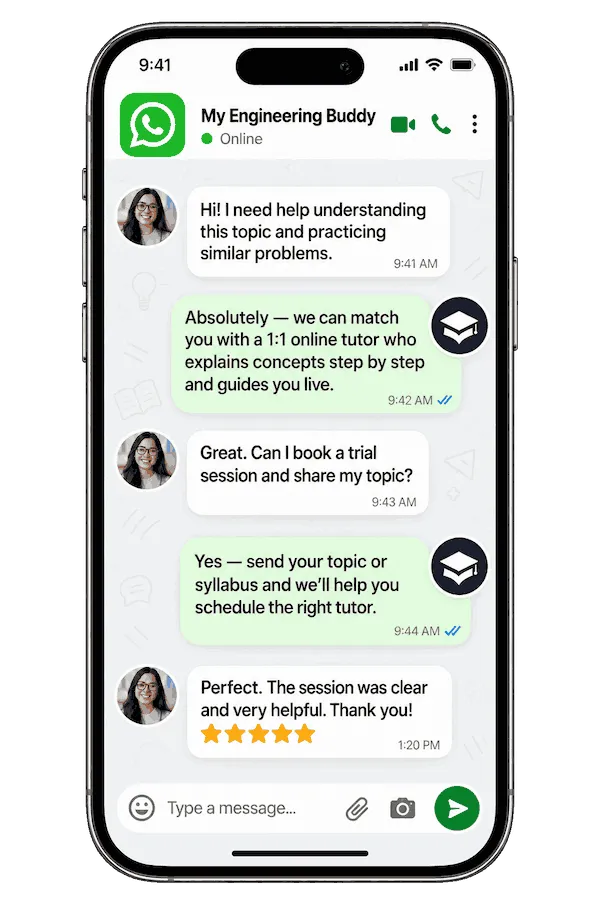
Unlike platforms where you fill out a form and wait, MEB responds in under a minute, 24/7. Tutor match takes under an hour. The $1 trial means you test before you commit. Everything runs over WhatsApp — no logins, no intake forms.
MEB has matched students with Adobe XD tutors, Photoshop tutors, and Dreamweaver specialists since 2008 — the same rigorous match process applies to every subject in the catalogue.
Source: My Engineering Buddy, 2008–2025.
Pricing Guide
Dreamweaver tutoring runs $20–$40/hr for most students. Advanced work — server-side scripting, complex dynamic site builds, or urgent pre-submission sessions — can reach $100/hr depending on tutor seniority and turnaround time needed.
Rate factors: your current level, the complexity of the project brief, how close your deadline is, and tutor availability. Availability drops sharply in the weeks before semester-end submission windows.
For students targeting roles at agencies, digital studios, or UX teams where Dreamweaver is part of a broader front-end toolkit, tutors with professional web development and CMS backgrounds are available at higher rates — share your specific goal and MEB will match the tier to your ambition.
Start with the $1 trial — 30 minutes, no registration, no commitment. WhatsApp MEB for a quick quote.
Students consistently tell us that the biggest barrier to booking a tutor isn’t cost — it’s not knowing whether the tutor will understand their specific project. That’s exactly what the $1 trial resolves. You know within 30 minutes whether the match is right.
FAQ
Is Dreamweaver hard to learn?
The interface is accessible, but the Design View creates a false sense of progress. When your layout breaks in a browser, you need real HTML and CSS knowledge to fix it. That’s where most students stall — and where a tutor makes the difference.
How many sessions will I need?
For a specific project issue — broken layout, failed validation, FTP deployment — one to three sessions often resolves it. For building solid Dreamweaver and front-end skills from scratch, most students benefit from six to twelve hours of structured 1:1 work.
Can you help with projects and portfolio work?
Yes. MEB provides guided project support — the tutor explains concepts, walks through the logic, and helps you understand what Dreamweaver is generating. You build and submit the work yourself. See our Policies page and Why MEB page for full details on what we help with and what we don’t.
Will the tutor match my exact syllabus or exam board?
Yes. Share your course outline, project brief, or assessment criteria before the first session. The tutor aligns the diagnostic and session plan to your specific deliverable — not a generic Dreamweaver curriculum.
What happens in the first session?
The tutor reviews your project file or current skill level, identifies the highest-priority gaps, and maps a session plan to your deadline. You leave the first session with specific tasks and a clear next topic — nothing is wasted.
Is online tutoring as effective as in-person?
For Dreamweaver specifically, online is often better — screen sharing lets the tutor see your actual file, your Code View, and your browser rendering simultaneously. A tutor in the same room can’t see all three at once as effectively.
Can I get Dreamweaver help at midnight?
Yes. MEB operates 24/7 via WhatsApp. Tutors are available across multiple time zones, so a student in the US, UK, Gulf, or Australia can reach a responsive tutor at unconventional hours — particularly useful when a submission deadline is approaching.
What if I don’t like my assigned tutor?
Request a change via WhatsApp. MEB matches a different tutor, usually within the hour. The $1 trial exists precisely so you can test compatibility before investing in a longer session block — no pressure, no awkward conversations.
Should I learn Dreamweaver or just use VS Code and write HTML by hand?
If your course or employer specifies Dreamweaver, learn it properly — it has real workflow advantages for template-managed multi-page sites. If you have a free choice, a Dreamweaver tutor can also help you evaluate which tool fits your actual project requirements.
Does Dreamweaver work with WordPress?
Dreamweaver can edit WordPress theme files locally, but it’s not the standard WordPress development environment. An MEB tutor can help you understand where Dreamweaver’s toolset overlaps with WordPress workflows and where you need a different approach — relevant if your course or client brief involves both.
How do I get started?
WhatsApp MEB, describe your project or course, and you’ll be matched with a verified Dreamweaver tutor — usually within the hour. The first session is the $1 trial: 30 minutes of live tutoring or one full project question explained. No registration required.
Trust & Quality at My Engineering Buddy
Every MEB tutor goes through subject-specific screening before taking a session. For Dreamweaver, that means demonstrating working knowledge of the tool — not just front-end development in general, but the Dreamweaver workspace, template system, CSS Designer, and FTP workflow specifically. Tutors complete a live demo evaluation and are reviewed continuously through session feedback. Rated 4.8/5 across 40,000+ verified reviews on Google. Degrees and professional backgrounds are verified. No tutor teaches Dreamweaver at MEB on the strength of general web skills alone.
MEB provides guided learning support. All project work is produced and submitted by the student. See our Policies page for details.
MEB has served 52,000+ students across the US, UK, Canada, Australia, the Gulf, and Europe in 2,800+ subjects since 2008. Within Software Engineering, the platform covers Dreamweaver alongside full-stack development tutoring, back-end development help, and dozens of adjacent tools and frameworks. If your course sits within a broader software or web development programme, MEB covers the surrounding subjects too. Read more about how tutors are matched and evaluated at MEB’s tutoring methodology page.
MEB tutors working with WordPress, web design, and Dreamweaver students go through the same rigorous vetting process — subject-specific demos, ongoing review, and feedback-driven quality checks.
Source: My Engineering Buddy, 2008–2025.
Explore Related Subjects
Students studying Dreamweaver often also need support in:
Next Steps
Before your first session, have ready: your project brief or course outline, the current state of your Dreamweaver site (even if it’s broken), any validation errors or browser rendering issues you’ve noted, and your submission or deadline date. The tutor handles the rest.
- Share your project brief, course outline, and deadline via WhatsApp
- Share your availability and time zone
- MEB matches you with a verified Dreamweaver tutor — usually within the hour
The first session starts with a diagnostic so every minute is used on what actually needs fixing. Visit www.myengineeringbuddy.com for more on how MEB works.
WhatsApp to get started or email [email protected].
Reviewed by Subject Expert
This page has been carefully reviewed and validated by our subject expert to ensure accuracy and relevance.