




~1 min
Average Reply Time
~1 hour
To Be Matched With A Tutor
30 Min Trial
75% Find Their Tutor On The 1st Trial
$20-35+/hr
Premium Yet Affordable Learning
Hire The Best Applied Statistics Tutor


Struggling with p-values at 11 pm the night before your regression assignment is due? You’re not alone — and you don’t have to work through it by yourself.
Applied Statistics Tutor Online
Applied statistics is the practice of using statistical methods — including hypothesis testing, regression, and probability distributions — to analyse real-world data, draw conclusions, and support evidence-based decisions across science, business, and social research.
MEB provides 1:1 online tutoring and homework help in Applied Statistics, covering undergraduate and graduate-level coursework across the US, UK, Canada, Australia, and the Gulf. If you’ve searched for an Applied Statistics tutor near me, a live online session with a subject-matched expert is faster and more effective than any recorded course. Our tutors work through your exact syllabus — not a generic version of it — and most students feel the difference within the first two sessions. This page is part of our broader Statistics tutoring offering.
- 1:1 online sessions tailored to your course syllabus and institution
- Expert-verified tutors with applied and academic subject knowledge
- Flexible time zones — US, UK, Canada, Australia, Gulf, Europe
- Structured learning plan built after an initial diagnostic session
- Ethical homework and assignment guidance — you understand the work before you submit
52,000+ students across the US, UK, Canada, Australia, and the Gulf have used MEB since 2008 — including students in Statistics subjects like Applied Statistics, Biostatistics, and Business Statistics.
Source: My Engineering Buddy, 2008–2025.
How Much Does an Applied Statistics Tutor Cost?
Most Applied Statistics tutoring sessions run $20–$40/hr. Graduate-level work, time-series modelling, or Bayesian methods can reach $70–$100/hr depending on tutor expertise. The $1 trial gets you 30 minutes of live 1:1 tutoring or a full explanation of one homework question — no registration required.
| Level / Need | Typical Rate | What’s Included |
|---|---|---|
| Undergraduate (most levels) | $20–$35/hr | 1:1 sessions, homework guidance |
| Advanced / Graduate-level | $35–$100/hr | Expert tutor, niche depth (Bayesian, survival analysis) |
| $1 Trial | $1 flat | 30 min live session or 1 homework question explained |
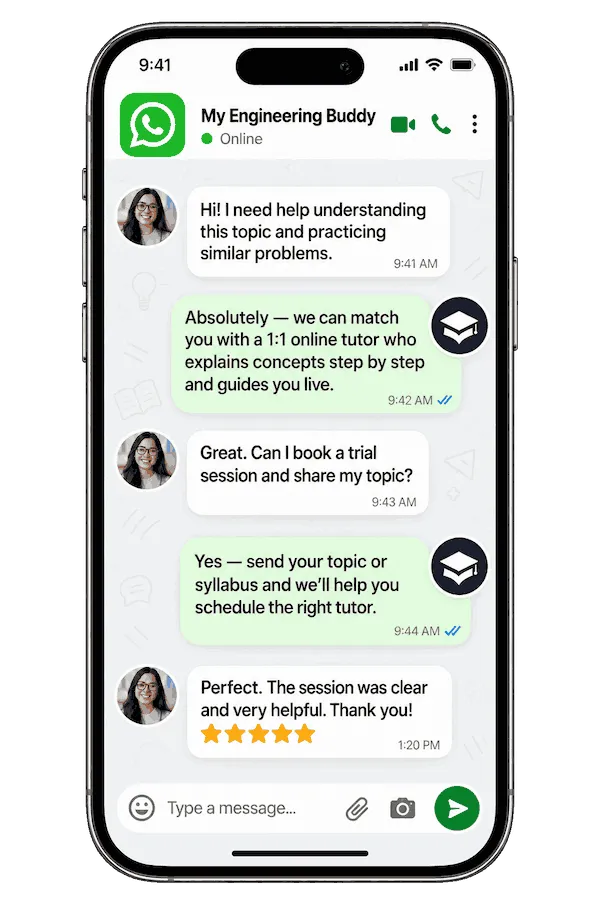
Tutor availability tightens significantly during semester finals and dissertation submission windows. WhatsApp MEB for a quick quote — average response time under 1 minute.
Who This Applied Statistics Tutoring Is For
Applied Statistics tutoring at MEB serves students at multiple levels — from second-year undergraduates taking their first methods course to PhD candidates running multivariate models for their thesis. If the subject is blocking your progress, this is the right place.
- Undergraduates in psychology, economics, public health, or engineering struggling with inferential methods
- Graduate students working through regression, ANOVA, or design of experiments for the first time
- Students retaking after a failed first attempt who need to close specific conceptual gaps
- Students with a conditional university offer depending on this grade — the margin is slim and the timeline is real
- Dissertation and thesis students who need help structuring their analysis chapters and selecting the right tests
- Students at institutions including Penn State, University of Edinburgh, University of Toronto, University of Melbourne, KU Leuven, Utrecht University, NYU, and Imperial College London
The $1 trial is the lowest-risk way to see whether a tutor matches your level and your course. No forms, no delay.
1:1 Tutoring vs Self-Study vs AI vs YouTube vs Online Courses
Self-study works if you’re disciplined — but Applied Statistics has a way of looking logical until you’re actually trying to choose between a paired t-test and a Wilcoxon signed-rank test at midnight. AI tools give fast answers but can’t watch you set up a hypothesis incorrectly and stop you before you lose the marks. YouTube covers concepts well; it stops the moment you need to ask why your residuals aren’t behaving. Online courses are structured but move at a fixed pace, with no one to tell you where your specific reasoning broke down. 1:1 tutoring with MEB is live, calibrated to your exact course and dataset, and corrects errors in the moment — which in Applied Statistics is often the difference between a passing and a failing output.
Outcomes: What You’ll Be Able To Do in Applied Statistics
After working with an MEB Applied Statistics tutor, students can apply the correct hypothesis test to a real dataset, explain their reasoning, and defend their choice. You’ll be able to analyse residuals in a regression model and identify violations of key assumptions. You’ll model relationships using linear and logistic regression, interpret output tables from R, SPSS, or Minitab, and write up findings that meet the standards of an academic methods section. You’ll present probability distributions and confidence intervals clearly — not just compute them. Students also consistently gain the ability to design a study from scratch: choosing appropriate sampling methods, determining sample size, and anticipating sources of bias before data collection begins.
Based on feedback from 40,000+ sessions collected by MEB from 2022 to 2025, 58% of students improved by one full grade after approximately 20 hours of 1:1 tutoring in subjects like Applied Statistics. A further 23% achieved at least a half-grade improvement.
Source: MEB session feedback data, 2022–2025.
Supporting a student through Applied Statistics? MEB works directly with parents to set up sessions, track progress, and keep coursework on schedule. WhatsApp MEB — average response time is under a minute, 24/7.
What We Cover in Applied Statistics (Syllabus / Topics)

Core Statistical Methods
- Descriptive statistics: measures of central tendency, spread, and shape
- Probability foundations and probability distribution types (normal, binomial, Poisson, t, chi-square, F)
- Confidence intervals and margin of error
- Hypothesis testing: one-sample, two-sample, paired tests, type I and II errors
- ANOVA and post-hoc comparisons — get help with ANOVA tutoring
- Non-parametric tests: Mann-Whitney, Kruskal-Wallis, Spearman correlation
- Chi-square tests for independence and goodness of fit
Core texts: Montgomery & Runger, Applied Statistics and Probability for Engineers; Wackerly, Mendenhall & Scheaffer, Mathematical Statistics with Applications.
Regression and Modelling
- Simple and multiple linear regression — assumptions, diagnostics, and interpretation
- Logistic regression for binary outcomes — work with a logistic regression tutor
- Model selection: AIC, BIC, stepwise methods, cross-validation
- Residual analysis: homoscedasticity, normality, leverage, Cook’s distance
- Multicollinearity detection and remedies (VIF, ridge regression)
- Introduction to predictive modelling and out-of-sample validation
Core texts: Kutner et al., Applied Linear Statistical Models; James et al., An Introduction to Statistical Learning.
Design, Sampling, and Applied Analysis
- Experimental design principles: randomisation, blocking, factorial designs — see our design of experiments tutoring
- Survey sampling methods including stratified sampling and cluster sampling
- Time series fundamentals: trend, seasonality, autocorrelation — get support with time series analysis
- Survival analysis concepts and Kaplan-Meier estimation
- Bayesian reasoning and prior/posterior updating — explore Bayesian statistics tutoring
- Data wrangling, cleaning, and exploratory analysis using R or SPSS
Core texts: Cochran, Sampling Techniques; Gelman et al., Bayesian Data Analysis; Diggle & Chetwynd, Statistics and Scientific Method.
At MEB, we’ve found that the students who struggle most in Applied Statistics aren’t bad at maths — they’re working from a flawed mental model of what a p-value actually tells you. Fix that one concept early, and the rest of hypothesis testing starts to make sense.
Platforms, Tools & Textbooks We Support
Applied Statistics is heavily software-dependent, and which tool your course uses changes what help looks like. MEB tutors support sessions using R and RStudio (tidyverse, ggplot2, lm(), glm()), SPSS for social science coursework, Minitab for engineering and quality statistics, and Excel for introductory-level analysis. Tutors share screens and walk through output interpretation in real time.
What a Typical Applied Statistics Session Looks Like
The tutor opens by checking the previous session’s topic — usually something like confidence interval construction or checking regression assumptions — and asks you to walk through one problem from your practice set. From there, you move into the current session’s focus: say, setting up a two-way ANOVA in R, interpreting the interaction term, and writing the conclusion correctly. The tutor uses a digital pen-pad to annotate output tables and annotate the decision tree for test selection. You replicate the logic on a second dataset while the tutor watches. The session closes with a concrete practice task — two or three problems from your problem set or past paper — and a note of exactly where next session picks up. Nothing is left vague.
How MEB Tutors Help You with Applied Statistics (The Learning Loop)
Diagnose: In the first session, the tutor identifies where your understanding actually breaks down — not where you think it does. For most Applied Statistics students, it’s the gap between running a test and interpreting what the output means in context.
Explain: The tutor works through live examples on a digital pen-pad — annotating output tables, drawing sampling distributions, marking up residual plots. Nothing is abstract. Every concept is tied to a real dataset or question type.
Practice: You attempt the next problem while the tutor watches. This is the step most self-study approaches skip entirely. Errors surface here, not after the assignment is submitted.
Feedback: The tutor gives step-by-step correction — not just “that’s wrong,” but “here’s where your reasoning broke, here’s what the marker will penalise, and here’s how to write it correctly.”
Plan: After each session, the tutor notes which topics are solid and which need another pass. The sequence adjusts as you progress. No repeating topics you’ve already mastered.
Sessions run over Google Meet with a digital pen-pad or iPad and Apple Pencil for annotation. Before your first session, share your course outline or syllabus, a recent homework attempt you struggled with, and your exam or submission date. The first session is the diagnostic — the tutor handles everything else from there. Start with the $1 trial — 30 minutes of live tutoring that also serves as your first diagnostic.
Students consistently tell us that the biggest shift in Applied Statistics happens when they stop memorising test names and start understanding which question each test is designed to answer. That shift usually happens in session two or three.
Source: MEB tutor observation across 40,000+ sessions, 2022–2025.
Try your first session for $1 — 30 minutes of live 1:1 tutoring or one homework question explained in full. No registration. No commitment. WhatsApp MEB now and get matched within the hour.
Tutor Match Criteria (How We Pick Your Tutor)
Not every statistics tutor can help with every Applied Statistics course. MEB matches on four criteria:
Subject depth: The tutor must have worked through the specific methods your course covers — whether that’s inferential statistics at an introductory undergraduate level or multivariate modelling at a research methods level.
Tools: Matched to the software your course uses — R, SPSS, Minitab, or Excel. The tutor runs the same environment you do.
Time zone: Matched to your region — US, UK, Gulf, Canada, or Australia. No one is staying up until 3 am to make a session work.
Goals: Whether your goal is passing a specific exam, completing a dissertation analysis chapter, or developing deeper conceptual understanding, the tutor’s approach is calibrated to that target.
Unlike platforms where you fill out a form and wait, MEB responds in under a minute, 24/7. Tutor match takes under an hour. The $1 trial means you test before you commit. Everything runs over WhatsApp — no logins, no intake forms.
Study Plans (Pick One That Matches Your Goal)
After the diagnostic session, your tutor builds a sequence based on your situation. Three common tracks: a Catch-up plan (1–3 weeks) for students with specific gaps to close before an exam or submission; an Exam prep plan (4–8 weeks) for structured revision across the full syllabus with past paper practice built in; and Weekly support aligned to your semester schedule and coursework deadlines. The tutor adjusts the plan after each session — nothing is set in stone after the first week.
Pricing Guide
Applied Statistics tutoring runs $20–$40/hr for most undergraduate levels. Graduate-level work — survival analysis, Bayesian modelling, multivariate methods — typically runs $50–$100/hr depending on tutor experience and topic complexity. Rate factors include your level, the complexity of the methods involved, your timeline, and tutor availability in your time zone.
For students targeting research programmes, competitive graduate schools, or roles in data-intensive industries, tutors with professional backgrounds in statistical consulting or academic research are available at higher rates. Share your specific goal and MEB matches the tier to your situation.
Availability tightens in the four weeks before semester finals. Book early if you have a fixed deadline. Start with the $1 trial — 30 minutes, no registration, no commitment. WhatsApp MEB for a quick quote.
A common pattern our tutors observe is that students who book one session before a deadline often wish they’d started three weeks earlier. The $1 trial exists precisely so there’s no reason to delay — try it once and decide from there.
FAQ
Is Applied Statistics hard?
It depends on your background. Students with solid algebra and some exposure to probability find the conceptual side manageable. The difficulty usually comes from connecting abstract theory — like sampling distributions — to real data interpretation and software output. That gap is exactly what 1:1 tutoring closes fastest.
How many sessions are needed?
Most students see a meaningful improvement in 6–10 sessions. Students with a full syllabus to cover for finals, or those working on dissertation analysis, typically need 15–25 sessions spread over 6–8 weeks. The first session diagnostic gives a clearer estimate based on your specific gaps.
Can you help with homework and assignments?
Yes — through guided explanation. MEB tutoring is guided learning — you understand the work, then submit it yourself. See our Academic Integrity policy and Why MEB page for full details on what we help with and what we don’t. Your tutor explains the method; you apply it and submit your own work.
Will the tutor match my exact syllabus or exam board?
Yes. Before matching, MEB asks for your course name, institution, and the specific methods or exam components you’re working on. Tutors are matched to your syllabus — not a generic Applied Statistics outline. If your course uses a specific textbook, the tutor will work from it.
What happens in the first session?
The first session is a diagnostic. The tutor asks you to attempt one or two problems while they observe — this reveals exactly where your reasoning breaks down. From there, the tutor maps a session plan targeting your actual gaps, not assumed ones. The diagnostic itself is a working session, not an interview.
Is online tutoring as effective as in-person?
For Applied Statistics, yes — and in some ways more so. Tutors share screens, annotate output tables and residual plots in real time using a digital pen-pad, and run R or SPSS alongside you. Students report that seeing the tutor work through the software in real time is clearer than watching over a shoulder in person.
R vs SPSS — which should I learn for Applied Statistics?
It depends on your field. Psychology and social science courses typically use SPSS; data science, biostatistics, and research methods courses lean toward R. Engineering statistics often uses Minitab. MEB tutors work in all three — tell us your course software and the tutor matches it exactly.
Can I get Applied Statistics help at short notice or late at night?
Yes. MEB operates 24/7 via WhatsApp. Tutors span multiple time zones, so late-night requests in the US, UK, or Gulf are consistently covered. Average response time is under a minute. For very urgent requests — same-day homework deadlines — mention the deadline when you message.
What if I don’t understand my tutor’s explanation?
You say so, and they try a different approach. MEB tutors are matched and rated after every session. If after two sessions you feel the match isn’t right, MEB reassigns you. The $1 trial exists for exactly this reason — you evaluate the tutor before committing to a paid schedule.
How do I get started?
Three steps: WhatsApp MEB, share your course details and hardest topic, and get matched within the hour. Your first session is the $1 trial — 30 minutes of live 1:1 tutoring or one full question explained. No registration, no commitment beyond that first dollar.
What’s the difference between Applied Statistics and Mathematical Statistics?
Mathematical statistics focuses on derivation and proof — showing why estimators work and deriving distributions from first principles. Applied statistics takes those tools and uses them on real data — choosing tests, interpreting software output, and drawing conclusions. Most undergraduate programmes teach applied methods; mathematical statistics tutoring is a separate track for students who need the theory behind the methods.
Can MEB help with a dissertation or thesis that uses applied statistical methods?
Yes — this is one of the most common requests MEB receives. Tutors help students select appropriate tests for their research questions, check that assumptions are met before running models, interpret output correctly, and write up the analysis section in the right academic language. Get support with research methodology and statistical analysis in the same programme.
Trust & Quality at My Engineering Buddy
Every MEB tutor goes through subject-specific screening before taking a single session. That means a live demonstration of their ability to explain Applied Statistics concepts clearly — not just a CV review. Tutors hold degrees in statistics, mathematics, data science, economics, or a closely related applied field, and many have professional experience in statistical consulting, biomedical research, or quantitative analysis. Ongoing session feedback is reviewed; tutors with consistently low ratings are removed. Rated 4.8/5 across 40,000+ verified reviews on Google.
MEB tutoring is guided learning — you understand the work, then submit it yourself. For full details on what we help with and what we don’t, read our Academic Integrity policy and Why MEB.
MEB has been serving students since 2008 across the US, UK, Canada, Australia, the Gulf, and Europe — in 2,800+ subjects. Within Statistics, that includes Applied Statistics, Biostatistics tutoring, Business Statistics help, and Advanced Statistics tutoring. See our tutoring methodology for how sessions are structured across all subjects.
Our experience across thousands of sessions shows that Applied Statistics students who share their actual homework output — not just the question — in the first session make faster progress. The tutor can see exactly where the reasoning went wrong, not just where the answer landed.
Explore Related Subjects
Students studying Applied Statistics often also need support in:
- Hypothesis Testing
- Regression Analysis
- Descriptive Statistics
- Computational Statistics
- Multivariate Statistics
- Causal Inference
- Data Visualisation
- Survey Sampling
Next Steps
When you message MEB, share your exam board or course name, the topic giving you the most trouble, your current timeline, and your time zone. MEB matches you with a verified Applied Statistics tutor — usually within 24 hours, often within the hour.
Before your first session, have ready:
- Your syllabus or course outline (or the name of your textbook)
- A recent homework attempt or past paper question you struggled with
- Your exam date or assignment submission deadline
The tutor handles the rest. The first session starts with a diagnostic — so every minute from the first one is used well.
Visit www.myengineeringbuddy.com for more on how MEB works.
WhatsApp to get started or email [email protected].
Reviewed by Subject Expert
This page has been carefully reviewed and validated by our subject expert to ensure accuracy and relevance.




