




~1 min
Average Reply Time
~1 hour
To Be Matched With A Tutor
30 Min Trial
75% Find Their Tutor On The 1st Trial
$20-35+/hr
Premium Yet Affordable Learning
Hire The Best Engineering Statistics Tutor

Most students who fail Engineering Statistics don’t fail because they’re bad at math — they fail because nobody ever showed them when to use which test.
Engineering Statistics Tutor Online
Engineering Statistics applies probability theory and statistical methods to engineering problems — covering hypothesis testing, regression, probability distributions, and quality control. It equips students to analyze experimental data, model uncertainty, and make evidence-based engineering decisions.
If you’ve searched for an Engineering Statistics tutor near me, you’re likely staring at a hypothesis test that doesn’t make sense, a regression output you can’t interpret, or an exam in weeks with half the syllabus still unclear. MEB connects you with a 1:1 Statistics tutor who knows your exact course — whether that’s a first-year engineering module, an upper-division probability course, or a graduate-level design of experiments unit. One session often clears up what weeks of lectures left murky.
- 1:1 online sessions tailored to your exact course and university syllabus
- Expert-verified tutors with engineering and statistics subject-specific knowledge
- Flexible time zones — US, UK, Canada, Australia, Gulf
- Structured learning plan built after a diagnostic session
- Ethical homework and assignment guidance — you understand before you submit
52,000+ students across the US, UK, Canada, Australia, and the Gulf have used MEB since 2008 — including students in Statistics subjects like Engineering Statistics, hypothesis testing, and design of experiments.
Source: My Engineering Buddy, 2008–2025.
How Much Does an Engineering Statistics Tutor Cost?
Most Engineering Statistics sessions run $20–$40/hr depending on level and topic complexity. Graduate-level work and niche areas like Bayesian inference or Monte Carlo simulation can reach $100/hr. The $1 trial gets you 30 minutes of live 1:1 tutoring or one homework question explained in full — no registration required.
| Level / Need | Typical Rate | What’s Included |
|---|---|---|
| Standard (undergraduate) | $20–$35/hr | 1:1 sessions, homework guidance |
| Advanced / Graduate-level | $35–$100/hr | Expert tutor, niche depth |
| $1 Trial | $1 flat | 30 min live session or 1 homework question |
Tutor availability tightens in the weeks before finals and semester-end project deadlines. Book early if your exam or submission is within four weeks.
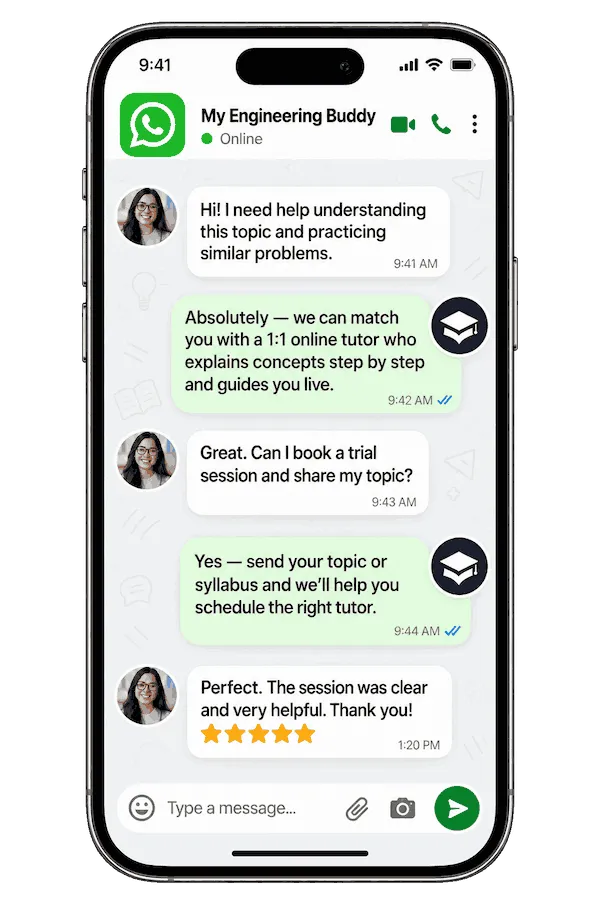
WhatsApp MEB for a quick quote — average response time under 1 minute.
Who This Engineering Statistics Tutoring Is For
Engineering Statistics trips up students who are confident in calculus but have never had to think probabilistically about real-world data. If the lecture makes sense in the room but falls apart when you open the homework, that’s the gap a 1:1 tutor closes.
- First and second-year engineering undergraduates hitting their first statistics module
- Students retaking after a failed first attempt — with an exam date already booked
- Students with a university conditional offer depending on this grade
- Graduate students using statistical methods in research without a strong undergraduate base
- Students struggling with software output — interpreting MINITAB, R, or MATLAB results
- Students 4–6 weeks from an exam with significant gaps in hypothesis testing or regression still to close
Students from programs at institutions including MIT, Georgia Tech, University of Michigan, Imperial College London, University of Toronto, UNSW Sydney, and TU Delft have used MEB for Engineering Statistics support. The tutor adjusts to your department’s notation, your professor’s preferred methods, and your specific textbook.
Not sure if MEB is the right fit? The $1 trial answers that question faster than any FAQ.
1:1 Tutoring vs Self-Study vs AI vs YouTube vs Online Courses
Self-study works if you’re disciplined — but Engineering Statistics has too many decision points (which test? which assumption? which correction?) where you need immediate feedback. AI tools explain fast but can’t watch you misread a p-value and stop you mid-calculation. YouTube is solid for concept overviews, but stops cold when you’re stuck on your specific dataset. Online courses move at a fixed pace that doesn’t care about your exam date. 1:1 tutoring with MEB is live, calibrated to your exact course, and corrects the specific error you keep making — not a generic version of it.
Outcomes: What You’ll Be Able To Do in Engineering Statistics
After working with an MEB Engineering Statistics tutor, you’ll be able to select the correct hypothesis test for a given engineering scenario — not just run one blindly. You’ll analyze residual plots to validate regression assumptions, apply probability distributions like Weibull or exponential to reliability data, model and interpret the results of a designed experiment using ANOVA, and explain your statistical reasoning clearly in a lab report or exam answer. These are the exact skills that separate a pass from a distinction in most engineering statistics assessments.
Based on feedback from 40,000+ sessions collected by MEB from 2022 to 2025, 58% of students improved by one full grade after approximately 20 hours of 1:1 tutoring in subjects like Engineering Statistics. A further 23% achieved at least a half-grade improvement.
Source: MEB session feedback data, 2022–2025.
At MEB, we’ve found that Engineering Statistics students spend the most time on the wrong problems — practicing procedures they already understand while avoiding the conceptual gaps that actually cost marks. A tutor’s first job is to find those gaps before the student walks into the exam not knowing they exist.
What We Cover in Engineering Statistics (Syllabus / Topics)

Track 1: Probability Foundations and Distributions
- Sample spaces, events, and axioms of probability
- Conditional probability and independence
- Discrete distributions: Binomial, Poisson, Geometric
- Continuous distributions: Normal, Exponential, Weibull, Gamma
- Central Limit Theorem and its engineering applications
- Reliability functions and failure rate modeling
- Get probability distribution tutoring alongside Engineering Statistics for faster progress on this track.
Core texts: Montgomery & Runger Applied Statistics and Probability for Engineers; Walpole, Myers & Myers Probability and Statistics for Engineers and Scientists.
Track 2: Statistical Inference and Hypothesis Testing
- Point and interval estimation; confidence intervals
- One-sample and two-sample hypothesis tests (z, t, F, chi-square)
- p-values, Type I and Type II errors, and statistical power
- Goodness-of-fit tests and distribution fitting
- Non-parametric tests: Wilcoxon, Mann-Whitney, Kruskal-Wallis
- Multiple comparisons and Bonferroni correction
- Students who also need inferential statistics help will find this track directly transferable.
Core texts: DeGroot & Schervish Probability and Statistics; Casella & Berger Statistical Inference.
Track 3: Regression, ANOVA, and Design of Experiments
- Simple and multiple linear regression tutoring topics: model fitting, R-squared, residual diagnostics
- Logistic regression for binary engineering outcomes
- One-way and two-way ANOVA; interaction effects
- Factorial designs, 2k designs, and fractional factorials
- Response surface methods and optimization
- Statistical process control: control charts, Cp, Cpk indices
Core texts: Montgomery Design and Analysis of Experiments; Kutner et al. Applied Linear Statistical Models. Students needing deeper ANOVA work can also get ANOVA tutoring as a standalone subject.
What a Typical Engineering Statistics Session Looks Like
The tutor opens by checking where the previous session’s topic — say, two-sample t-tests — actually landed. Did you try the practice problem set? Where did you get stuck? From there, the session moves into active problem-solving: the tutor shares screen, works through a hypothesis test or ANOVA table using a digital pen-pad, then hands the problem back to you. You replicate the steps. The tutor watches for the moment you pick the wrong rejection region or misread the MINITAB output — and stops you there, not at the end. The session closes with a specific task: two regression problems from your textbook, with a note on what the next session will cover.
How MEB Tutors Help You with Engineering Statistics (The Learning Loop)
Diagnose: In the first session, the tutor identifies exactly which concepts have gaps — not based on what you say you find hard, but on how you actually attempt a problem. Most Engineering Statistics students know they struggle, but don’t know precisely where the logic breaks down.
Explain: The tutor works through live examples using a digital pen-pad — showing the reasoning behind choosing a Weibull distribution over an exponential, or why your regression residuals matter more than your R-squared value. You watch the thinking, not just the answer.
Practice: You attempt a parallel problem with the tutor present. No waiting until homework to discover you misunderstood. The tutor adjusts in real time.
Feedback: Every error gets a named cause — wrong assumption, wrong test selection, misread table, arithmetic slip. Students consistently tell us that this step is what finally makes marks stick, because they stop repeating the same mistake without knowing why.
Plan: At the end of each session, the tutor sets the next topic and a realistic completion target. If your exam is eight weeks out, the plan covers all testable content with buffer for weak spots.
Sessions run on Google Meet. The tutor uses a digital pen-pad or iPad with Apple Pencil to write out solutions in real time. Before your first session, share your course syllabus, a recent assignment or past exam you struggled with, and your exam date. The first session runs as a diagnostic and a first proper lesson — no time wasted on admin. Start with the $1 trial — 30 minutes of live tutoring that also serves as your first diagnostic.
Try your first session for $1 — 30 minutes of live 1:1 tutoring or one homework question explained in full. No registration. No commitment. WhatsApp MEB now and get matched within the hour.
Tutor Match Criteria (How We Pick Your Tutor)
Not every statistician can teach an engineering student. MEB matches on four criteria.
Subject depth: The tutor must know your specific course level — first-year engineering probability, upper-division regression and DOE, or graduate-level applied statistics. Syllabus fit is checked before the match is confirmed.
Tools: All tutors work on Google Meet with a digital pen-pad or iPad plus Apple Pencil. If your course uses MINITAB, R, or MATLAB, the tutor is matched for that software too — get Minitab tutoring or R programming help as part of the same session if needed.
Time zone: Matched to your region — US, UK, Gulf, Canada, or Australia. No scheduling across 12-hour gaps.
Goals: Exam pass, grade improvement, homework completion, or research support — the match reflects what you actually need.
Unlike platforms where you fill out a form and wait, MEB responds in under a minute, 24/7. Tutor match takes under an hour. The $1 trial means you test before you commit. Everything runs over WhatsApp — no logins, no intake forms.
Study Plans (Pick One That Matches Your Goal)
After the diagnostic session, the tutor builds a specific sequence. Three common structures: Catch-up (1–3 weeks) — rapid triage of the topics most likely to appear on your exam, with daily practice tasks; Exam prep (4–8 weeks) — full syllabus coverage with past-paper practice and timed problem sets built into the final two weeks; Weekly support — ongoing sessions aligned to your semester schedule, covering new material as your course delivers it and reinforcing anything that didn’t land in lecture.
Pricing Guide
Engineering Statistics tutoring starts at $20/hr for standard undergraduate coursework. Graduate-level topics — Bayesian methods, advanced regression, experimental design at research level — run $35–$100/hr depending on tutor background and topic complexity. Rate factors include your level, the specific topic, your timeline, and tutor availability.
Availability tightens sharply in the four weeks before finals. If your exam is close, don’t wait.
For students targeting top engineering programs or research positions requiring strong quantitative credentials, tutors with industry or research backgrounds in statistical quality control, reliability engineering, or data science are available at higher rates — share your specific goal and MEB will match the tier to your ambition.
Start with the $1 trial — 30 minutes, no registration, no commitment. WhatsApp MEB for a quick quote.
MEB has served 52,000+ students across 2,800+ subjects since 2008, with Engineering Statistics among the most consistently requested quantitative engineering modules — alongside applied statistics tutoring and regression analysis help.
Source: My Engineering Buddy, 2008–2025.
Students consistently tell us that Engineering Statistics felt abstract until a tutor connected it to something physical — a manufacturing process, a load distribution, a failure rate. That’s the shift most university lectures don’t have time to make. Our tutors make it in the first session.
FAQ
Is Engineering Statistics hard?
It’s hard for most engineering students because it combines probability reasoning with statistical software output and real data interpretation — three different skills that lectures treat as one. Students who struggle with calculus rarely struggle here; students strong in calculus often find the probabilistic thinking unfamiliar.
How many sessions are needed?
Most students see a meaningful difference in 4–6 sessions targeting specific weak areas. A full-syllabus exam-prep plan typically runs 10–20 sessions across 6–8 weeks. The tutor gives a realistic estimate after the first diagnostic session.
Can you help with Engineering Statistics homework and assignments?
Yes. MEB tutoring is guided learning — you understand the work, then submit it yourself. The tutor explains the method, works through a comparable example, and checks that your reasoning is sound. See our Academic Integrity policy and Why MEB page for full details on what we help with and what we don’t.
Will the tutor match my exact syllabus or exam board?
Yes. Before the match is confirmed, MEB checks your university, course code, and textbook where possible. Whether your course follows Montgomery, Walpole, or a custom departmental syllabus, the tutor works within your specific framework — not a generic version of Engineering Statistics.
What happens in the first session?
The tutor runs a short diagnostic — you attempt two or three problems live while the tutor observes where the reasoning breaks. From that, the tutor maps the gap between where you are and what your exam or assignment requires, then begins working on the highest-priority topic immediately.
Is online tutoring as effective as in-person for Engineering Statistics?
For a mathematical subject taught through worked examples and software output, online is often better — the tutor can share screen, annotate directly over your MINITAB or R output, and record worked solutions for you to review. Most MEB Engineering Statistics students report that the screen-based format is more practical than a whiteboard session.
Can I get Engineering Statistics help at midnight or on weekends?
Yes. MEB tutors work across time zones and outside standard business hours. If you’re in the US and need a session at 11pm before a morning exam, WhatsApp MEB and request an urgent match. Weekend sessions are standard, not an exception.
What’s the difference between Engineering Statistics and a standard Statistics course?
Engineering Statistics applies statistical methods specifically to engineering contexts — reliability testing, manufacturing quality control, designed experiments, and failure analysis. The mathematical content overlaps with general statistics, but the applications, software tools, and exam problems are calibrated for engineering students and their degree programs.
Do you support MINITAB, R, and MATLAB for Engineering Statistics coursework?
Yes. Many Engineering Statistics courses require statistical output from MINITAB, R, or MATLAB. MEB tutors cover interpretation of software output — reading ANOVA tables, regression diagnostics, control charts — as part of the session. If your course is heavily software-based, specify this when you WhatsApp MEB so the tutor is matched accordingly.
What if my Engineering Statistics course covers Six Sigma or statistical quality control?
Both Six Sigma methodology and statistical process control — control charts, process capability indices, acceptance sampling — fall within what MEB tutors cover for Engineering Statistics. Students on engineering management or industrial engineering tracks frequently need this material alongside core inference topics.
How do I get started?
WhatsApp MEB, share your course details and your hardest current topic. MEB matches you with a verified tutor — usually within an hour. Your first session is the $1 trial: 30 minutes of live tutoring or one full homework question explained step by step. No forms, no waiting.
Trust & Quality at My Engineering Buddy
Every MEB tutor goes through subject-specific screening before taking a session. That means a live demo evaluation in Engineering Statistics topics, a review of their academic and professional background, and ongoing feedback monitoring after sessions begin. Rated 4.8/5 across 40,000+ verified reviews on Google. Tutors hold degrees in statistics, mathematics, engineering, or directly adjacent fields — and most have taught or worked in quantitative roles before tutoring.
MEB tutoring is guided learning — you understand the work, then submit it yourself. For full details on what we help with and what we don’t, read our Academic Integrity policy and Why MEB.
MEB has been serving students in the US, UK, Canada, Australia, the Gulf, and Europe since 2008 — across 2,800+ subjects. Statistics is one of MEB’s strongest subject families, with tutors covering Engineering Statistics, Bayesian statistics tutoring, and design of experiments help at undergraduate and graduate level. See our tutoring methodology for how sessions are structured and how tutor quality is maintained.
A common pattern our tutors observe is that Engineering Statistics students arrive thinking they have a statistics problem when they actually have a probability foundations problem. Getting the diagnosis right in session one saves weeks of working on the wrong material.
Biometrika — one of the longest-running statistical journals — has published foundational work in the inference and estimation methods that sit at the core of most Engineering Statistics curricula. See Biometrika for reference.
Source: Oxford University Press / Biometrika.
Explore Related Subjects
Students studying Engineering Statistics often also need support in:
- Advanced Statistics
- Computational Statistics
- Descriptive Statistics
- Forecasting
- Mathematical Statistics
- Monte Carlo Simulation
- Multivariate Statistics
- Time Series Analysis
Next Steps
When you WhatsApp MEB, share three things: your exam board or university course name, the topic or exam component where you’re losing the most marks, and your exam date or assignment deadline. MEB matches you with a verified Engineering Statistics tutor — usually within 24 hours, often faster.
Before your first session, have ready:
- Your syllabus or course outline (or the textbook your professor uses)
- A recent past paper attempt, homework, or lab report you struggled with
- Your exam date or submission deadline
The tutor handles everything from there. First session is diagnostic and instructional — no time wasted on setup.
Visit www.myengineeringbuddy.com for more on how MEB works.
WhatsApp to get started or email [email protected].
Reviewed by Subject Expert
This page has been carefully reviewed and validated by our subject expert to ensure accuracy and relevance.




