
ADVANCED SUBJECTS · LIVE 1:1 TUTORING
Nastran Tutoring Online
Personalized instruction for demanding courses and technical subjects. Learn with a tutor selected for your topic, level, and learning goals.
University · Master’s & PhD · Professional Upskilling
Request tutor availability and a quote. Or email [email protected].

Since 2008
Established Tutoring Service
~1 min
Average First Response
Specialist Match
For Your Subject & Level
30-Min Trial
Try Tutoring Before a Longer Plan
Hire The Best Nastran Tutor

Most Nastran models run. Few of them tell you what you actually need to know — and that gap costs marks.
Nastran Tutor Online
Nastran is a finite element analysis software originally developed by NASA, widely used in aerospace, automotive, and structural engineering to simulate stress, vibration, buckling, and thermal loads on complex mechanical assemblies.
If you’re searching for a Nastran tutor near me, MEB offers 1:1 online tutoring and project help across Mechanical Engineering — including Nastran at undergraduate, graduate, and professional levels. Our tutors have worked with MSC Nastran, NX Nastran, and OptiStruct. They know where students get stuck: poorly constrained models, misread stress plots, incorrect element type selection. One focused session often fixes what hours of trial-and-error couldn’t.
- 1:1 online sessions tailored to your course, project brief, or industry workflow
- Expert verified tutors with hands-on Nastran and FEA experience
- Flexible time zones — US, UK, Canada, Australia, Gulf
- Structured learning plan built after a diagnostic session
- Guided project support — we explain the method, you build the model
52,000+ students across the US, UK, Canada, Australia, and the Gulf have used MEB since 2008 — including students working in Mechanical Engineering software tools like Nastran, COMSOL Multiphysics, and LS-DYNA.
Source: My Engineering Buddy, 2008–2025.
How Much Does a Nastran Tutor Cost?
Rates run $20–$40/hr for most undergraduate-level Nastran work. Graduate-level structural dynamics, nonlinear analysis, or aeroelastic simulation can reach $60–$100/hr depending on tutor specialisation. The $1 trial gets you 30 minutes of live 1:1 help or a full explanation of one project problem — no registration needed.
| Level / Need | Typical Rate | What’s Included |
|---|---|---|
| Undergraduate / Standard | $20–$40/hr | 1:1 sessions, model review, project guidance |
| Graduate / Specialist | $40–$100/hr | Expert tutor, nonlinear/aeroelastic depth |
| $1 Trial | $1 flat | 30 min live session or 1 project question explained |
Tutor availability tightens around end-of-semester submission deadlines — particularly in May and December for US universities.
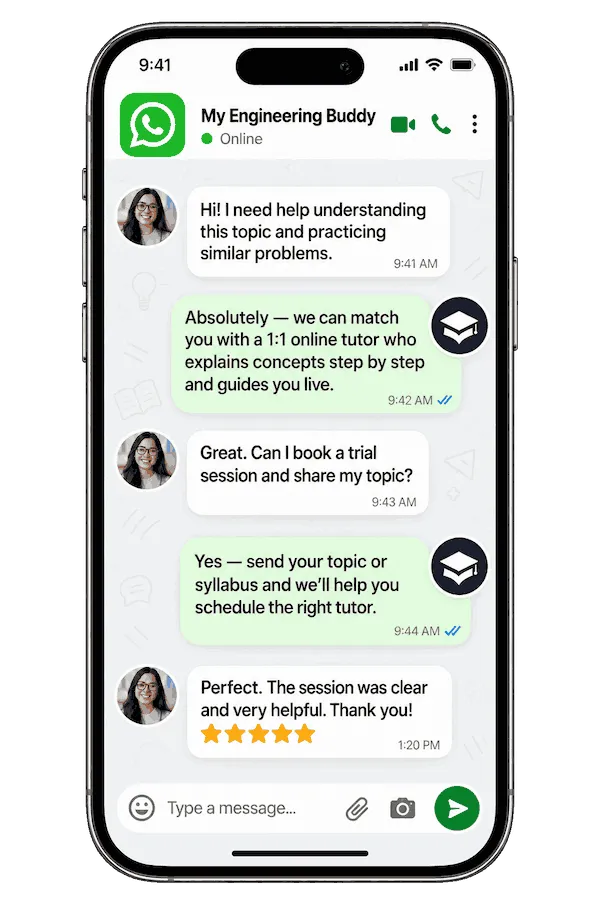
WhatsApp MEB for a quick quote — average response time under 1 minute.
Who This Nastran Tutoring Is For
Nastran isn’t a subject you absorb from lecture slides. It’s a tool that demands hands-on iteration — and most university courses give you the software but not nearly enough time to understand what it’s actually doing. MEB works with students at every stage of that learning curve.
- Undergraduate mechanical, aerospace, or civil engineering students completing FEA coursework or capstone projects
- Graduate students whose thesis involves structural simulation, crash analysis, or fatigue modelling
- Students who have submitted a model, received feedback they don’t understand, and have a revision deadline approaching
- Working engineers transitioning from ANSYS or Abaqus who need to get productive in Nastran quickly
- Students with a university conditional offer in Mechanical Engineering depending on this year’s project grade
- Parents supporting an engineering student whose project confidence has visibly dropped in the last few weeks
Students at universities including MIT, Georgia Tech, Imperial College London, TU Delft, the University of Michigan, and RMIT have used MEB for Nastran project support. The $1 trial is the lowest-risk way to test whether it’s right for you.
At MEB, we’ve found that Nastran students often know the theory — stress-strain relationships, boundary condition logic, mesh convergence — but struggle to translate that knowledge into a model that produces defensible results. The first session almost always surfaces exactly where that translation breaks down.
1:1 Tutoring vs Self-Study vs AI vs YouTube vs Online Courses
Self-study works if you’re disciplined, but Nastran error messages are notoriously opaque and self-study offers no feedback on whether your mesh or constraints are actually valid. AI tools can explain FEA concepts quickly but cannot review your .bdf file or diagnose why your displacement plot looks wrong. YouTube covers pre-processing workflows well but stops the moment your specific model throws an unexpected result. Online courses are structured but move at a fixed pace — no help when you’re stuck on element selection at 11pm. A 1:1 Nastran tutor from MEB reviews your actual model, corrects errors in real time, and explains the reasoning so the next model you run is stronger.
Outcomes: What You’ll Be Able To Do in Nastran
After working with a Nastran tutor, you will be able to build and validate linear static models with appropriate boundary conditions and load cases. You will analyze von Mises stress distributions and identify failure-critical regions with confidence. You will apply correct element types — CQUAD4, CTRIA3, CBEAM, CHEXA — without trial-and-error. You will interpret normal mode and frequency response results to diagnose resonance risks. You will present simulation results in reports with proper methodology justification, not just screenshots.
Based on feedback from 40,000+ sessions collected by MEB from 2022 to 2025, 58% of students improved by one full grade after approximately 20 hours of 1:1 tutoring in subjects like Nastran. A further 23% achieved at least a half-grade improvement.
Source: MEB session feedback data, 2022–2025.
Try your first session for $1 — 30 minutes of live 1:1 tutoring or one project problem explained in full. No registration. No commitment. WhatsApp MEB now and get matched within the hour.
What We Cover in Nastran (Syllabus / Topics)

Linear Static and Structural Analysis
- Setting up SOL 101 (Linear Statics) solution sequences
- Defining constraints (SPCs) and loads (forces, pressures, moments)
- Element selection: CQUAD4, CTRIA3, CBAR, CBEAM, CHEXA, CPENTA
- Mesh quality checks — aspect ratio, skewness, Jacobian review
- Interpreting stress tensors, von Mises output, and displacement fields
- Mesh convergence studies and h-refinement strategies
Core references: A First Course in the Numerical Analysis of Differential Equations (Iserles), Concepts and Applications of Finite Element Analysis (Cook et al.), MSC Nastran Quick Reference Guide.
Normal Modes, Buckling, and Dynamic Analysis
- SOL 103 normal modes — extracting natural frequencies and mode shapes
- SOL 105 linear buckling — identifying critical load factors
- SOL 108/111 frequency response — direct and modal approaches
- Damping models: PARAM KDAMP, structural vs viscous damping definitions
- Interpreting Campbell diagrams and resonance avoidance strategies
- Mass matrix formulation and lumped vs consistent mass options
Core references: Mechanical Vibrations (Rao), Dynamics of Structures (Chopra), NX Nastran User’s Guide (Siemens).
Nonlinear Analysis and Optimisation
- SOL 106 nonlinear statics — large displacement and material nonlinearity
- Contact definitions: glued, sliding, and separation conditions
- PARAM LGDISP for geometric nonlinearity control
- Topology and size optimisation using OptiStruct within the Nastran ecosystem
- Fatigue analysis setup: S-N curves, mean stress correction, cycle counting
- Subcase sequencing and load stepping for convergence control
Core references: Nonlinear Finite Element Analysis of Solids and Structures (Crisfield), Introduction to Nonlinear Finite Element Analysis (Reddy), OptiStruct Reference Guide (Altair).
What a Typical Nastran Session Looks Like
The tutor opens by checking where you left off — usually your last solution run, whether that was a SOL 101 static analysis or a SOL 103 modal extraction. If there were errors in the .f06 output file, the tutor walks through them line by line. From there, the session moves into the current problem: you share your screen and the tutor reviews your model tree, element assignments, and boundary condition setup in real time. Specific focus areas — say, why your stress singularity is showing at a constrained node, or how to correctly define a PLOAD4 pressure distribution — are worked through using a digital pen-pad so every step is drawn out, not just described. By the end, you have a concrete task: run the corrected model, compare results against the previous output, and note the change in peak stress. Next topic — usually mesh convergence or modal validation — is agreed before you leave.
How MEB Tutors Help You with Nastran (The Learning Loop)
Diagnose: In the first session, the tutor reviews your current model or project brief, asks what the course or supervisor has flagged, and identifies the actual knowledge gap — whether that’s element type logic, solution sequence selection, or result interpretation. This is not a generic assessment; it’s specific to your Nastran files.
Explain: The tutor works through the correct approach live — building or correcting the model on screen, annotating with a digital pen-pad, and narrating every decision. For Nastran, this typically means walking through the BDF deck structure, PARAM card settings, and output request syntax in real time.
Practice: You attempt the next step yourself — applying the constraint correctly, modifying the PARAM card, running the solution — with the tutor present to catch errors before they propagate into the results.
Feedback: The tutor reviews your output: stress contours, displacement magnitude, .f06 warning messages. Every error is explained in terms of what caused it and what it costs you in result accuracy or marks.
Plan: Each session closes with a clear next step — a specific model to run, a concept to review, or a past project section to revisit — so progress continues between sessions, not just during them.
Sessions run over Google Meet with a shared screen and digital pen-pad. Before your first session, have your .bdf or .dat file ready alongside your project brief or course rubric. Start with the $1 trial — 30 minutes of live tutoring that also serves as your first diagnostic. Whether you need a quick fix before a submission deadline, structured support over 4–8 weeks, or ongoing help through the semester, the tutor maps the plan after session one.
Students consistently tell us that the biggest Nastran breakthroughs come not from running more models, but from understanding why the last one gave the wrong answer. One corrected mental model saves ten failed solve attempts.
Tutor Match Criteria (How We Pick Your Tutor)
Not every FEA tutor is a Nastran tutor. MEB matches on specifics.
Subject depth: Tutors are matched by solution type — SOL 101/103/105/106 — and by variant: MSC Nastran, NX Nastran, or OptiStruct. A tutor covering linear statics is not automatically the right match for nonlinear contact analysis. We check before assigning.
Tools: All sessions run on Google Meet with a digital pen-pad or iPad and Apple Pencil — so model annotations, BDF edits, and result overlays can be shown, not just described.
Time zone: Matched to your region. US, UK, Gulf, Canada, and Australia are all covered without asking you to compromise on session timing.
Goals: Whether you need to pass a project submission, build deeper understanding for a thesis, or get productive quickly for industry work, the tutor is briefed on your actual goal before session one.
Unlike platforms where you fill out a form and wait, MEB responds in under a minute, 24/7. Tutor match takes under an hour. The $1 trial means you test before you commit. Everything runs over WhatsApp — no logins, no intake forms.
Pricing Guide
Nastran tutoring runs $20–$40/hr for most undergraduate-level work. Graduate-level nonlinear analysis, aeroelastic simulation, or OptiStruct topology optimisation typically reaches $60–$100/hr. Rate factors include topic complexity, solution type, timeline urgency, and tutor availability.
Submission deadlines compress availability fast — especially in April–May and November–December. For students targeting roles at aerospace or automotive firms, or working toward professional engineering certification, tutors with industry simulation backgrounds are available at higher rates — share your goal and MEB matches the right tier.
Start with the $1 trial — 30 minutes, no registration, no commitment. WhatsApp MEB for a quick quote.
FAQ
Is Nastran hard to learn?
Nastran has a steep learning curve compared to GUI-heavy tools like ANSYS Workbench. The BDF deck format, solution sequence logic, and output file interpretation all require specific training. Most students reach functional competence within 15–25 hours of guided practice.
How many sessions are needed?
For a specific project submission with identified gaps, 3–6 sessions of 1–2 hours each is typical. For broader proficiency across multiple solution types — linear, modal, nonlinear — 12–20 hours gives a solid foundation. The diagnostic session determines the right plan.
Can you help with projects and portfolio work?
Yes. MEB provides guided project support — the tutor explains the method, reviews your approach, and helps you understand why each modelling decision matters. You build the model and submit the work. See our Academic Integrity policy and Why MEB page for full details on what we help with and what we don’t.
Will the tutor match my exact syllabus or project requirements?
Yes. MEB matches by solution type (SOL 101, 103, 105, 106), Nastran variant (MSC, NX, OptiStruct), and your specific course or project brief. Share your course outline or project spec on WhatsApp and the match is made before the first session.
What happens in the first session?
The tutor reviews your model files, project brief, or course syllabus. Key gaps are identified — element selection, boundary condition logic, result interpretation — and the session addresses the most pressing one immediately. A session plan for subsequent sessions is outlined before you end.
Are online Nastran sessions as effective as in-person?
For software-based subjects like Nastran, online is often better. Screen sharing lets the tutor see your exact model, error messages, and output files — more direct than looking over a shoulder. The digital pen-pad adds annotation. Most students notice no meaningful difference after session one.
Can I get Nastran help at midnight or on weekends?
Yes. MEB operates 24/7 across time zones. WhatsApp response time averages under a minute. Tutor availability varies by region and specialisation, but submission-deadline sessions are regularly scheduled outside standard business hours for students across the US, UK, Gulf, and Australia.
What if I don’t like my assigned tutor?
Contact MEB on WhatsApp and a replacement is arranged — usually within the hour. The $1 trial exists partly for this reason: you test the match before committing to a full session block. No explanation is required to request a switch.
What is the difference between MSC Nastran and NX Nastran?
Both use the same core BDF input format and solution sequences, but NX Nastran (Siemens) integrates more tightly with NX CAD and has some proprietary solver enhancements. MSC Nastran is more common in aerospace and defence. Most tutor knowledge transfers between both — confirm your variant when booking.
Can a Nastran tutor help with OptiStruct topology optimisation?
Yes. OptiStruct is part of the Altair HyperWorks ecosystem and uses Nastran-compatible BDF syntax. MEB tutors familiar with OptiStruct cover topology, topography, and size optimisation setups, as well as interpreting density-based results and manufacturing constraints.
How do I get started?
WhatsApp MEB, share your Nastran version, project brief or course details, and your timeline. You’re matched with a verified tutor — usually within the hour. The first session starts with a diagnostic so no time is wasted. Start with the $1 trial: 30 minutes live or one problem fully explained.
Trust & Quality at My Engineering Buddy
Every MEB tutor goes through subject-specific screening before their first session — not a general competency test but a live demo evaluation in their claimed area. For Nastran, that means demonstrating proficiency in BDF file structure, solution sequence selection, and output interpretation under review. Tutors are matched by Nastran variant and solution type, not just “FEA experience.” Ongoing session feedback is monitored and tutors are re-evaluated if ratings drop. Rated 4.8/5 across 40,000+ verified reviews on Google.
MEB tutoring is guided learning — you understand the work, then submit it yourself. For full details on what we help with and what we don’t, read our Academic Integrity policy and Why MEB.
MEB has served 52,000+ students across the US, UK, Canada, Australia, Gulf, and Europe in 2,800+ subjects since 2008. Within Mechanical Engineering, that includes students working on Finite Element Analysis, Computational Mechanics, and Solid Mechanics — subjects that share significant conceptual overlap with Nastran and are regularly combined in the same course or thesis.
MEB tutors have supported structural simulation work across aerospace, automotive, and civil engineering programmes at universities in the US, UK, Canada, Australia, and the Gulf — consistently matching students by solver type, solution sequence, and project deadline.
Source: My Engineering Buddy, 2008–2025.
A common pattern our tutors observe is that Nastran students spend far too long debugging syntax when the real issue is a conceptual misunderstanding of what the boundary condition is physically doing. Fixing the concept fixes the model.
Explore Related Subjects
Students studying Nastran often also need support in:
- Finite Element Method
- Nonlinear Finite Element Analysis
- Mechanics of Materials
- Mechanical Vibrations
- Engineering Dynamics
- Continuum Mechanics
- Strength of Materials
Next Steps
Share your Nastran variant (MSC, NX, or OptiStruct), the solution type you’re working with, your project brief or course outline, and your submission or exam deadline. Share your time zone and availability — sessions are available 24/7 across US, UK, Gulf, Canada, and Australia. MEB matches you with a verified tutor, usually within the hour.
Before your first session, have ready:
- Your .bdf or .dat model file and project brief (or course syllabus)
- Your most recent .f06 output file or error log if you have one
- Your submission or exam deadline date
The tutor handles the rest. First session starts with a diagnostic — every minute is used on your actual gaps, not a generic overview.
Visit www.myengineeringbuddy.com for more on how MEB works.
WhatsApp to get started or email [email protected].
Reviewed by Subject Expert
This page has been carefully reviewed and validated by our subject expert to ensure accuracy and relevance.



