

Contact MEB Today To Get The Best
Partial Differential Equations Tutoring Online
Email: [email protected]



~1 min
Average Reply Time
~1 hour
To Be Matched With A Tutor
30 Min Trial
75% Find Their Tutor On The 1st Trial
$20-35+/hr
Premium Yet Affordable Learning
Most students don’t fail PDEs because they lack ability. They fail because nobody showed them which method to use — and when.
Partial Differential Equations Tutor Online
Partial Differential Equations (PDEs) is an advanced mathematics subject covering equations involving unknown multivariable functions and their partial derivatives, used to model heat, wave, fluid, and quantum phenomena across engineering and physics courses.
If you’re searching for a Partial Differential Equations tutor near me, MEB connects you with verified expert tutors for mathematics subjects including PDEs — 1:1 online tutoring and homework help, starting from $20/hr. Sessions are built around your exact course, your stuck points, and your deadline. No generic explanations. No wasted time.
- 1:1 online sessions tailored to your university course and syllabus
- Expert-verified tutors with advanced degrees in mathematics and engineering
- Flexible time zones — US, UK, Canada, Australia, Gulf regions covered
- Structured learning plan built after a first diagnostic session
- Ethical homework and assignment guidance — you understand the work, then submit it yourself
How Much Does a Partial Differential Equations Tutor Cost?
Most PDE tutoring sessions run $20–$40/hr. Graduate-level or highly specialised topics — such as Sobolev spaces, semigroup methods, or numerical PDE solvers — can reach $60–$100/hr depending on tutor expertise and timeline. New students can start with the $1 trial before committing to a plan.
| Level / Need | Typical Rate | What’s Included |
|---|---|---|
| Undergraduate (standard) | $20–$35/hr | 1:1 sessions, homework guidance |
| Advanced / Graduate Level | $35–$100/hr | Expert tutor, niche PDE depth |
| $1 Trial | $1 flat | 30 min live session or 1 homework question explained |
Tutor availability tightens significantly during end-of-semester exam periods. Book early if you’re within six weeks of finals.
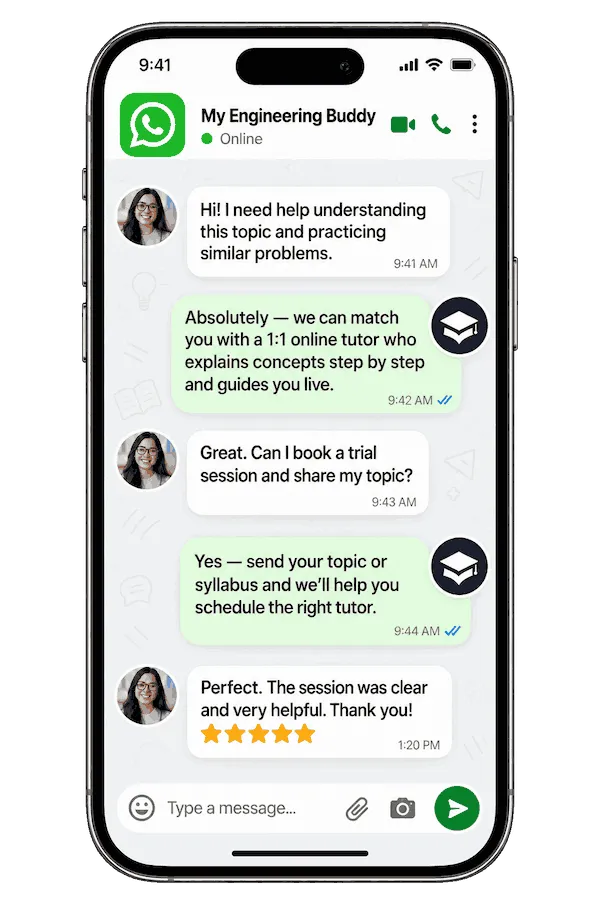
WhatsApp MEB for a quick quote — average response time under 1 minute.
52,000+ students across the US, UK, Canada, Australia, and the Gulf have used MEB since 2008 — including students in Mathematics subjects like Partial Differential Equations, Fourier Analysis, and Real Analysis.
Source: My Engineering Buddy, 2008–2025.
Who This Partial Differential Equations Tutoring Is For
PDE courses are taken by undergraduate and graduate students in mathematics, physics, mechanical engineering, electrical engineering, and applied sciences. This tutoring is built for students who are keeping up in lectures but falling apart on problem sets — or who stopped keeping up weeks ago.
- Undergraduate students stuck on classification, boundary conditions, or solution methods like separation of variables
- Graduate students working through Green’s functions, Sobolev spaces, or weak formulations
- Students 4–6 weeks from a final exam with significant gaps still to close
- Students retaking after a failed first attempt who need to approach the subject differently this time
- Engineering students applying PDEs to heat transfer, fluid dynamics, or electromagnetics coursework
- Parents watching a student’s confidence drop as the course accelerates past ODEs into multivariable territory
Students have come to MEB from universities including MIT, Caltech, Imperial College London, ETH Zurich, University of Toronto, University of Melbourne, and TU Delft — among many others across the US, UK, Canada, Australia, and Europe.
At MEB, we’ve found that PDE students most often struggle not with the mathematics itself but with choosing the right method for a given problem. Once a tutor has worked through two or three classification and method-selection problems with a student, the rest of the course tends to unlock quickly.
1:1 Tutoring vs Self-Study vs AI vs YouTube vs Online Courses
Self-study works if you’re disciplined — but PDEs have too many branching method choices for most students to self-diagnose their errors. AI tools give fast answers but can’t watch you apply the wrong boundary condition and stop you mid-step. YouTube is solid for watching separation of variables once, but it stops when your specific problem has a non-standard domain. Online courses move at a fixed pace that doesn’t pause when you’re stuck on eigenfunction expansions. With a 1:1 PDE tutor from MEB, the session is live, calibrated to your exact course syllabus, and corrects errors in the moment — including the conceptual ones that AI misses entirely.
Outcomes: What You’ll Be Able To Do in Partial Differential Equations
After working with an online Partial Differential Equations tutor through MEB, students consistently report being able to classify second-order PDEs as elliptic, parabolic, or hyperbolic and select the correct solution strategy without prompting. You’ll solve heat equation and wave equation problems using separation of variables and apply Fourier series expansions correctly. You’ll model physical systems — temperature distribution, vibrating membranes, electromagnetic fields — and write up solutions with the rigour your course requires. You’ll explain why a boundary condition changes the solution structure, not just repeat a method by rote.
Supporting a student through Partial Differential Equations? MEB works directly with parents to set up sessions, track progress, and keep coursework on schedule. WhatsApp MEB — average response time is under a minute, 24/7.
Based on feedback from 40,000+ sessions collected by MEB from 2022 to 2025, 58% of students improved by one full grade after approximately 20 hours of 1:1 tutoring in subjects like Partial Differential Equations. A further 23% achieved at least a half-grade improvement.
Source: MEB session feedback data, 2022–2025.
What We Cover in Partial Differential Equations (Syllabus / Topics)

Track 1: Foundations and Classical PDEs
- Classification of PDEs: elliptic, parabolic, hyperbolic
- First-order PDEs and the method of characteristics
- The heat equation: derivation, separation of variables, Fourier series solutions
- The wave equation: d’Alembert’s solution, standing waves, vibrating strings
- Laplace’s equation and harmonic functions
- Boundary value problems: Dirichlet, Neumann, and Robin conditions
- Sturm-Liouville theory and eigenfunction expansions
Core texts for this track include Strauss Partial Differential Equations: An Introduction, Evans Partial Differential Equations, and Haberman Applied Partial Differential Equations.
Track 2: Transform Methods and Special Functions
- Fourier transforms and their application to PDEs on unbounded domains
- Laplace transform methods for time-dependent problems
- Green’s functions: construction and physical interpretation
- Bessel functions and Legendre polynomials for radially symmetric problems
- PDEs in polar, cylindrical, and spherical coordinates
- Integral transform techniques for heat and wave problems
Supporting texts include Arfken, Weber & Harris Mathematical Methods for Physicists, and Duffy Green’s Functions with Applications.
Track 3: Numerical and Advanced Methods
- Finite difference methods for elliptic, parabolic, and hyperbolic PDEs
- Finite element method (FEM) basics and weak formulations
- Numerical solutions of PDEs using MATLAB, Python, or SciPy
- Stability, consistency, and convergence of numerical schemes
- Sobolev spaces and distributions (graduate-level)
- Nonlinear PDEs: shock waves, conservation laws, Burgers’ equation
Key references include LeVeque Finite Difference Methods for Ordinary and Partial Differential Equations and Brenner & Scott The Mathematical Theory of Finite Element Methods.
What a Typical Partial Differential Equations Session Looks Like
The tutor opens by checking your previous topic — usually the point where your last session ended, such as a Fourier series expansion or a boundary condition setup you found unclear. From there, you and the tutor work through problems on screen together: the tutor uses a digital pen-pad to write out the classification of a new PDE, shows you how to apply separation of variables step by step, then hands the next problem to you. You replicate the reasoning aloud or in writing — not just copy the answer. If you make an error applying a Neumann boundary condition or miss a term when expanding an eigenfunction series, the tutor catches it in the moment and explains exactly why the logic broke down. The session closes with a concrete practice problem set — two or three questions covering the same method — and the next topic is noted so you can look ahead before your next booking.
Students consistently tell us that working a problem wrong in front of a tutor — and having that error caught live — does more for their understanding than reading a correct solution five times over. Real-time correction is the mechanism. Everything else is just reading.
How MEB Tutors Help You with Partial Differential Equations (The Learning Loop)
Diagnose: In the first session, your tutor identifies exactly where your understanding breaks down — not just “I don’t understand PDEs” but whether you’re misclassifying equation types, applying the wrong boundary condition, or losing marks on the Fourier coefficient integrals. That distinction matters. It determines what the next five sessions cover.
Explain: The tutor works through a live problem on the digital pen-pad — writing out every step, naming every decision, and explaining why this method applies here and not another. For PDE work, this often means walking through the full separation of variables process or constructing a Green’s function from scratch, not just presenting the result.
Practice: You attempt the next problem with the tutor present. Not after the session. During it. This is where applied mathematics tutoring actually works — the tutor watches your reasoning process, not just your final answer.
Feedback: Every error gets a specific correction: which step broke down, why it lost marks, and what the correct logic is. “That’s wrong” is never the response. “Here’s where your reasoning diverged and why” is.
Plan: At the end of each session, the tutor maps the next topic in sequence — moving from classical methods to transform techniques to numerical approaches as your course demands. Progress check-ins are built into the plan, not added as an afterthought.
Sessions run on Google Meet. Tutors use a digital pen-pad or iPad with Apple Pencil to write out working in real time. Before your first session, share your course syllabus or textbook chapter, a recent problem set or past exam question you struggled with, and your exam or assignment deadline date. The first session covers a diagnostic and at least one fully worked problem. Start with the $1 trial — 30 minutes of live tutoring that also serves as your first diagnostic.
Tutor Match Criteria (How We Pick Your Tutor)
Not every mathematician can teach PDEs at graduate level. MEB matches on specifics, not general subject competence.
Subject depth: Tutors are matched to your exact level and track — whether that’s an undergraduate heat equation course or a graduate seminar on Sobolev spaces and weak solutions. Differential equations expertise alone is not sufficient; PDE-specific depth is required.
Tools: Every tutor uses Google Meet with a digital pen-pad or iPad and Apple Pencil. Written working, not verbal description.
Time zone: Matched to your region — US, UK, Gulf, Canada, or Australia — so sessions fit your schedule, not a tutor’s inconvenient availability window.
Goals: Whether you need to pass a resit, hit a grade threshold for a conditional offer, or build research-level fluency for a PhD programme, the tutor match reflects that goal from day one.
Unlike platforms where you fill out a form and wait, MEB responds in under a minute, 24/7. Tutor match takes under an hour. The $1 trial means you test before you commit. Everything runs over WhatsApp — no logins, no intake forms.
Study Plans (Pick One That Matches Your Goal)
Catch-up (1–3 weeks): for students significantly behind, covering the highest-priority topics before a test or assignment deadline. Exam prep (4–8 weeks): structured revision across all syllabus tracks, with past paper practice built into later sessions. Weekly support: ongoing sessions aligned to your semester schedule, keeping pace with lectures and problem sets. In every case, your tutor builds the specific session sequence after the diagnostic — not from a fixed template.
Pricing Guide
Standard undergraduate PDE tutoring runs $20–$40/hr. Graduate-level work — functional analysis methods, numerical PDE implementations, research-adjacent topics — is priced $60–$100/hr depending on tutor background and topic complexity. Rate factors include level, topic specificity, your timeline, and tutor availability.
For students targeting top graduate programmes or working on PhD-qualifying exam preparation, tutors with research backgrounds in analysis, applied mathematics, or mathematical physics are available at higher rates. Share your specific goal and MEB matches the tier to what you actually need.
Availability is limited during end-of-semester crunch periods — particularly April–May and November–December. Earlier bookings get more scheduling flexibility.
Start with the $1 trial — 30 minutes, no registration, no commitment. WhatsApp MEB for a quick quote.
MEB has covered Numerical Analysis, Functional Analysis, and the full spectrum of advanced mathematics since 2008 — with verified tutors matched to your exact course level and exam board.
Source: My Engineering Buddy, 2008–2025.
Try your first session for $1 — 30 minutes of live 1:1 tutoring or one homework question explained in full. No registration. No commitment. WhatsApp MEB now and get matched within the hour.
FAQ
Is Partial Differential Equations hard?
PDEs are considered one of the harder undergraduate mathematics courses. The difficulty is not just computational — it’s the volume of distinct solution methods and knowing which applies when. With targeted 1:1 PDE tutoring, most students find the subject becomes tractable once method selection is clear.
How many sessions are needed?
Most students working toward an end-of-semester exam need 8–15 sessions over four to eight weeks. Students with a specific assignment gap can often resolve it in two to four sessions. Your tutor maps the plan after the diagnostic.
Can you help with homework and assignments?
Yes — MEB tutoring is guided learning. The tutor explains the method and works through an example; you apply it to your assignment and submit your own work. See our Academic Integrity policy and Why MEB page for full details on what we help with and what we don’t.
Will the tutor match my exact syllabus or exam board?
Yes. Before matching, MEB confirms your university, course code if available, and which topics you’ve covered. Tutors are matched on that basis — not just “knows PDEs” but knows your specific track and assessment structure.
What happens in the first session?
The tutor runs a short diagnostic: a few targeted questions covering classification, boundary condition setup, and your most recent problem set. From there, the session moves into at least one fully worked problem in your weakest area. No introductory fluff.
Is online tutoring as effective as in-person?
For mathematics subjects, yes — often more so. Google Meet combined with a digital pen-pad replicates a whiteboard session exactly. Students in the US, UK, and Australia consistently report that the live written working is clearer than most in-person tutors deliver.
What’s the difference between separation of variables and transform methods — and when should I use each?
Separation of variables works best on bounded domains with simple geometry and homogeneous boundary conditions. Transform methods — Fourier and Laplace — suit unbounded domains or problems with non-homogeneous forcing. A tutor will work through both with concrete examples until the distinction is automatic.
Can you help with numerical PDE methods, including MATLAB or Python implementations?
Yes. MEB tutors cover finite difference and finite element methods alongside the underlying mathematics. If your course requires coding up a PDE solver in MATLAB or Python, tutors can help with both the numerical scheme and the SciPy or equivalent implementation.
Can I get Partial Differential Equations help at midnight?
Yes. MEB operates 24/7 via WhatsApp. If you message at midnight with a problem set due at 9am, you’ll get a response within minutes and can often be matched with an available tutor for the same night.
Do you offer group Partial Differential Equations sessions?
MEB specialises in 1:1 sessions — that’s the model. If two students from the same course want to book together, contact MEB via WhatsApp and the team will discuss what’s possible for your specific situation.
How do I get started?
Three steps: WhatsApp MEB with your course level and the topic you’re stuck on. MEB matches you with a verified PDE tutor — usually within the hour. Your first session is the $1 trial: 30 minutes live or one homework question fully explained. No forms. No waiting.
What if I don’t like my assigned tutor?
Tell MEB via WhatsApp and you’ll be rematched at no additional cost. Tutor fit matters — the trial exists precisely so you can confirm the match before committing to a session block.
Trust & Quality at My Engineering Buddy
Every MEB tutor goes through subject-specific vetting: academic qualifications are checked, a live demo session is evaluated, and ongoing student feedback determines whether they stay on the platform. For PDEs, that means tutors hold at minimum a strong undergraduate degree in mathematics, physics, or engineering — most have postgraduate qualifications or professional research experience. Rated 4.8/5 across 40,000+ verified reviews on Google. MEB has been running since 2008 and has served 52,000+ students across the US, UK, Canada, Australia, the Gulf, and Europe.
MEB tutoring is guided learning — you understand the work, then submit it yourself. For full details on what we help with and what we don’t, read our Academic Integrity policy and Why MEB.
MEB covers 2,800+ subjects, with particular depth in Mathematical Methods, Mathematical Modeling, and the full Mathematics category. Whether you need Complex Analysis tutoring alongside your PDEs course or support across an entire mathematics programme, tutors are available and vetted at every level. For an independent reference on PDE topics and notation, Wolfram MathWorld is a reliable open resource.
From Calculus tutoring through to graduate-level PDE analysis, MEB has matched students with the right tutor at every level of mathematics since 2008 — across 52,000+ students in more than 30 countries.
Source: My Engineering Buddy, 2008–2025.
A common pattern our tutors observe is that students arrive having memorised a solution method from a lecture but having no idea why that method was chosen over another. The diagnostic session exists specifically to identify that — before it costs marks in an exam.
Explore Related Subjects
Students studying Partial Differential Equations often also need support in:
- Fourier Analysis
- Real Analysis
- Dynamical Systems
- Measure Theory
- Harmonic Analysis
- Wavelet Transform
- Integral Equations
Next Steps
Ready to get started? Here’s what to do:
- Share your course level, university, and the specific PDE topics or methods you’re stuck on
- Share your availability and time zone so MEB can match you with a tutor in your region
- MEB matches you with a verified Partial Differential Equations tutor — usually within 24 hours, often within the hour
- Your first session opens with a diagnostic so every minute counts from the start
Before your first session, have ready:
- Your course syllabus or textbook chapter list
- A recent problem set or past exam question you struggled with
- Your exam or assignment deadline date
The tutor handles the rest.
Visit www.myengineeringbuddy.com for more on how MEB works.
WhatsApp to get started or email [email protected].
Reviewed by Subject Expert
This page has been carefully reviewed and validated by our subject expert to ensure accuracy and relevance.




