

Contact MEB Today To Get The Best
Nonlinear Finite Element Analysis Tutoring Online
Email: [email protected]



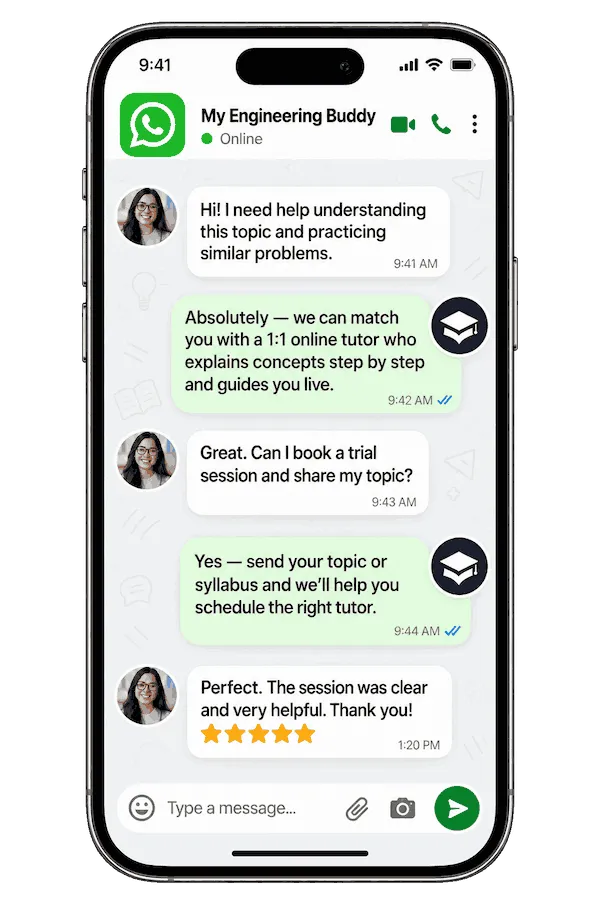
~1 min
Average Reply Time
~1 hour
To Be Matched With A Tutor
30 Min Trial
75% Find Their Tutor On The 1st Trial
$20-35+/hr
Premium Yet Affordable Learning
Hire The Best Nonlinear Finite Element Analysis Tutor






Most students who struggle with Nonlinear FEA aren’t bad at maths — they’ve never seen geometric nonlinearity and material nonlinearity explained side by side.
Nonlinear Finite Element Analysis Tutor Online
Nonlinear Finite Element Analysis (NFEA) is an advanced computational method extending standard FEA to problems involving large deformations, material plasticity, and contact mechanics, equipping engineers to simulate real-world structural behaviour where linear assumptions break down.
If you’ve searched for a Nonlinear Finite Element Analysis tutor near me, MEB gives you something a local search rarely delivers: a verified specialist who knows your exact course, software stack, and assignment brief. Our Mechanical Engineering tutoring network covers every level from undergraduate electives to PhD simulation projects — and a 1:1 Nonlinear Finite Element Analysis tutor from MEB will diagnose exactly where your model is diverging or your theory is shaky, session one.
- 1:1 online sessions mapped to your course syllabus and software environment
- Expert-verified tutors with simulation, research, or industry FEA backgrounds
- Flexible time zones — US, UK, Canada, Australia, Gulf covered 24/7
- Structured learning plan built after a diagnostic session
- Ethical academic guidance — you understand the work, then submit it yourself
52,000+ students across the US, UK, Canada, Australia, and the Gulf have used MEB since 2008 — including students in Mechanical Engineering subjects like Nonlinear Finite Element Analysis, Finite Element Analysis, and Computational Mechanics.
Source: My Engineering Buddy, 2008–2025.
How Much Does a Nonlinear Finite Element Analysis Tutor Cost?
Rates start at $20–$40/hr for most undergraduate Nonlinear FEA modules. Graduate and specialist research-level sessions run higher. You can test everything with the $1 trial before committing to any package.
| Level / Need | Typical Rate | What’s Included |
|---|---|---|
| Undergraduate (most courses) | $20–$40/hr | 1:1 sessions, homework guidance |
| Graduate / Research Level | $40–$100/hr | Expert tutor, PhD-level depth, simulation review |
| $1 Trial | $1 flat | 30 min live session or one full homework question explained |
Tutor availability tightens significantly around semester-end project deadlines and final exam periods — book early if your submission is within four weeks.
WhatsApp MEB for a quick quote — average response time under 1 minute.
Who This Nonlinear Finite Element Analysis Tutoring Is For
Nonlinear FEA sits at the intersection of advanced mechanics, numerical methods, and software competence. Most students hit a wall when convergence fails and they don’t know whether the problem is in their mesh, their material model, or their boundary conditions.
- Undergraduate engineering students taking an advanced FEA or simulation elective
- Masters students with a thesis or project involving ABAQUS, ANSYS, or LS-DYNA
- PhD students who need to validate nonlinear simulation results for publication
- Students who failed or barely passed a first attempt at an FEA course and need to resit
- Students at universities including MIT, Georgia Tech, Delft, ETH Zurich, Imperial College, and the University of Michigan where advanced simulation courses carry significant course weight
- Engineers in industry upskilling their simulation capability for crashworthiness, forming, or structural collapse analysis
The $1 trial is the lowest-risk way to check whether MEB’s tutors match your course level and software environment.
1:1 Tutoring vs Self-Study vs AI vs YouTube vs Online Courses
Self-study works if you’re disciplined — but nonlinear FEA requires immediate feedback when your solver diverges. AI tools give fast theory explanations, but they cannot debug your ABAQUS input file live or spot that your contact pair definition is wrong. YouTube covers Newton-Raphson iteration at a conceptual level and stops there. Online courses are structured but move at a fixed pace with no one to ask when your specific model fails to converge. 1:1 tutoring with MEB is live, calibrated to your exact assignment or thesis chapter, and corrects errors in the moment — in Nonlinear FEA, that difference is often one convergence criterion between a passing and a failing submission.
Outcomes: What You’ll Be Able To Do in Nonlinear Finite Element Analysis
Students who work through Nonlinear FEA with a dedicated 1:1 tutor consistently move from confusion to competence in concrete ways. You will solve convergence problems in large-deformation structural models by diagnosing the actual source — mesh distortion, load stepping, or solver tolerances. You will analyze material nonlinearity using appropriate plasticity models, including von Mises yield criteria and isotropic hardening. You will model contact and friction problems in ABAQUS or ANSYS with correct surface-to-surface definitions. You will explain the difference between geometric nonlinearity (large strains, large rotations) and material nonlinearity clearly enough to write it in an exam or thesis. You will apply arc-length methods and incremental loading strategies to problems that a linear solver cannot handle.
“Based on feedback from 40,000+ sessions collected by MEB from 2022 to 2025, 58% of students improved by one full grade after approximately 20 hours of 1:1 tutoring in subjects like Nonlinear Finite Element Analysis. A further 23% achieved at least a half-grade improvement.”
Source: MEB session feedback data, 2022–2025.
Try your first session for $1 — 30 minutes of live 1:1 tutoring or one homework question explained in full. No registration. No commitment. WhatsApp MEB now and get matched within the hour.
What We Cover in Nonlinear Finite Element Analysis (Syllabus / Topics)

Track 1: Theoretical Foundations of Nonlinear FEA
- Sources of nonlinearity: geometric, material, and boundary condition nonlinearity
- Total Lagrangian vs Updated Lagrangian formulations
- Incremental and iterative solution procedures: Newton-Raphson and modified Newton-Raphson
- Arc-length methods for tracing post-buckling load-displacement paths
- Convergence criteria: force residual, displacement, and energy norms
- Finite strain kinematics: Green-Lagrange strain tensor, Cauchy stress, and their rate forms
Recommended texts: Bathe, Finite Element Procedures (2nd ed.); Belytschko, Liu & Moran, Nonlinear Finite Elements for Continua and Structures; de Souza Neto, Perić & Owen, Computational Methods for Plasticity.
Track 2: Material Models and Plasticity
- Elastic-perfectly-plastic and isotropic/kinematic hardening models
- Von Mises yield criterion and associated flow rule
- Return-mapping algorithms for stress integration
- Hyperelastic models for rubber and soft tissue: Neo-Hookean, Mooney-Rivlin
- Creep and viscoplasticity fundamentals
- Damage mechanics and failure criteria in structural models
Recommended texts: Simo & Hughes, Computational Inelasticity; Lubliner, Plasticity Theory; Bonet & Wood, Nonlinear Continuum Mechanics for Finite Element Analysis.
Track 3: Software Application — ABAQUS, ANSYS, and LS-DYNA
- Setting up nonlinear static and dynamic steps in Finite Element Method software environments
- Defining contact pairs: surface-to-surface, node-to-surface, friction models
- Mesh sensitivity studies and element selection for large-deformation problems
- Load stepping strategies, automatic increment control (NLGEOM flag in ABAQUS)
- Post-processing: reading PEEQ, S, U output for plastic strain and deformation
- Running explicit dynamic analysis in LS-DYNA for crash and impact simulations
- Using COMSOL Multiphysics for coupled nonlinear thermal-structural problems
Recommended texts: ABAQUS Documentation (Dassault Systèmes); Hallquist, LS-DYNA Theory Manual; ANSYS Mechanical User Guide.
Platforms, Tools & Textbooks We Support
Nonlinear FEA is software-intensive. MEB tutors work directly inside your simulation environment during sessions — they do not teach theory in isolation from the tool you’re graded on.
- ABAQUS/Standard and ABAQUS/Explicit (Dassault Systèmes)
- ANSYS Mechanical (static nonlinear, transient, and contact)
- LS-DYNA (explicit dynamics, crashworthiness, sheet metal forming)
- COMSOL Multiphysics (coupled structural-thermal nonlinear problems)
- NASTRAN (nonlinear SOL 400 and SOL 106)
- Python and MATLAB scripting for pre/post-processing and parameter studies
What a Typical Nonlinear Finite Element Analysis Session Looks Like
The tutor opens by checking the previous session’s topic — usually a specific convergence issue you were asked to resolve, or a plasticity model you needed to implement. You share your screen or your ABAQUS .inp file. The tutor walks through the problem with a digital pen-pad: annotating your load-displacement curve, marking where the Newton-Raphson iterations are diverging, and explaining exactly which parameter to adjust and why. You replicate the correction yourself — not the tutor. The session closes with a concrete practice task: rebuild the contact model from scratch using the correct surface definitions, or run a mesh sensitivity study on a specific geometry. Next topic is noted — often moving from material nonlinearity into geometric nonlinearity, or from static to dynamic analysis.
How MEB Tutors Help You with Nonlinear Finite Element Analysis (The Learning Loop)
Diagnose: In the first session, the tutor identifies whether your difficulty is theoretical (you don’t understand total vs updated Lagrangian), procedural (your load steps are too coarse), or software-specific (your contact definitions are wrong). These are three very different problems with three very different fixes.
Explain: The tutor works through live examples on a digital pen-pad — drawing the load-displacement path, sketching the yield surface in stress space, or annotating your solver output line by line. Theory and software are always taught together, not in separate sessions.
Practice: You attempt the next problem while the tutor watches. For Nonlinear FEA this typically means setting up a new model from scratch, running it, and interpreting the output — not just reading about it.
At MEB, we’ve found that students who struggle with nonlinear FEA convergence almost always have a gap in one of three places: incremental load strategy, element selection, or contact definition. Fix the gap — the solver starts behaving. We’ve seen this pattern across thousands of simulation-based sessions since 2008.
Feedback: The tutor explains step by step where marks were lost in your last assignment — whether it was an unconverged solution submitted without explanation, an incorrect hardening model, or missing validation against an analytical solution.
Plan: Each session ends with a clear next topic and a specific task. Whether you need a quick catch-up before an exam, structured revision over 4–8 weeks, or ongoing weekly support through the semester, the tutor maps the session plan after the first diagnostic.
Sessions run on Google Meet with a digital pen-pad or iPad + Apple Pencil for real-time annotation. Before your first session, share your course syllabus or assignment brief, a recent homework you struggled with, and your exam or project deadline. The tutor handles the rest. Start with the $1 trial — 30 minutes of live tutoring that also serves as your first diagnostic.
Tutor Match Criteria (How We Pick Your Tutor)
Not every engineer who knows FEA can teach Nonlinear FEA at PhD level. Here’s what MEB checks before matching you.
Subject depth: Tutors are vetted specifically for the level and software environment you need — undergraduate ABAQUS coursework and doctoral crashworthiness research require different tutors, and MEB treats them differently.
Tools: Every tutor uses Google Meet plus a digital pen-pad or iPad + Apple Pencil. No static PDFs, no slides-only sessions.
Time zone: Tutors are matched to your region — US, UK, Gulf, Canada, or Australia — so session times are practical, not 2 a.m. compromises.
Goals: Whether you need exam-focused theory revision, assignment-level software debugging, or research-grade model validation, the tutor is matched to that specific goal.
Unlike platforms where you fill out a form and wait, MEB responds in under a minute, 24/7. Tutor match takes under an hour. The $1 trial means you test before you commit. Everything runs over WhatsApp — no logins, no intake forms.
Nonlinear FEA convergence failures are almost never random — they trace back to a specific modelling decision. A good tutor finds it in the first session. MEB tutors have been doing exactly that since 2008.
Source: My Engineering Buddy internal tutoring records, 2008–2025.
Study Plans (Pick One That Matches Your Goal)
After the diagnostic session, your tutor builds a specific sequence. Catch-up (1–3 weeks): close the critical gaps — convergence, material models, contact setup — before your submission deadline. Exam prep (4–8 weeks): structured revision covering theory, worked problems, and past exam questions on geometric and material nonlinearity. Weekly support: ongoing sessions aligned to your semester schedule, covering each new topic as your course progresses. The tutor adjusts the plan after every session based on what actually happened in the previous one.
Pricing Guide
Nonlinear FEA tutoring starts at $20–$40/hr for most undergraduate and taught-masters modules. Research-level or highly specialised simulation work — crashworthiness, biomechanics, forming simulation — runs up to $100/hr. Rate factors include your level, topic complexity, timeline urgency, and tutor availability.
Availability tightens sharply in the four weeks before semester-end project submissions. Book early if your deadline is approaching.
For students targeting roles at aerospace firms, automotive OEMs, or defence contractors, tutors with direct industry simulation experience are available at higher rates — share your specific goal and MEB will match the tier to your ambition.
Start with the $1 trial — 30 minutes, no registration, no commitment. WhatsApp MEB for a quick quote.
FAQ
Is Nonlinear Finite Element Analysis hard?
Yes — it’s one of the most demanding engineering simulation topics. The difficulty comes from combining advanced continuum mechanics theory with software-specific implementation. Most students struggle with convergence failures because the gap between theory and practice is rarely bridged in lectures.
How many sessions are needed?
Students with specific assignment gaps often see real progress in 3–5 sessions. Building solid nonlinear FEA competence from scratch — theory through software — typically takes 15–25 hours of 1:1 work spread over 6–10 weeks, depending on starting level.
Can you help with practice exercises?
MEB tutoring is guided learning — you understand the work, then submit it yourself. The tutor explains the theory, walks through analogous examples, and helps you debug your thinking. See our Academic Integrity policy and Why MEB page for full details on what we help with and what we don’t.
Will the tutor match my exact syllabus or exam board?
Yes. Before matching, MEB checks your university, course code, textbook, and software environment. A tutor for an ABAQUS-based undergraduate module is different from one supporting ANSYS-based graduate research — and MEB treats them as different roles.
What happens in the first session?
The tutor runs a diagnostic: reviewing your syllabus, a recent homework or assignment, and your current software setup. By the end of the first session, you’ll have a clear picture of your specific gaps and a session plan to close them efficiently.
Is online tutoring as effective as in-person?
For simulation-heavy subjects like Nonlinear FEA, online is often better. The tutor can annotate directly on your model output, share their screen to demonstrate solver settings, and review your .inp or .dat files in real time — none of which works easily face to face.
What’s the difference between linear FEA and Nonlinear FEA, and do I need to know linear FEA first?
Linear FEA assumes small displacements, linear material behaviour, and fixed boundary conditions. Nonlinear FEA drops all three assumptions. You do need a working understanding of linear FEA first — the tutor will assess this in session one and fill gaps if needed before moving into nonlinear territory.
My ABAQUS model won’t converge — can a tutor help me debug it in the session?
That’s one of the most common reasons students contact MEB. Share your .inp file or job log before the session, and the tutor will diagnose the source — load stepping, contact definition, element type, or solver tolerance — and walk you through the fix live on screen.
Do you cover geometric nonlinearity as well as material nonlinearity?
Both are covered, including the interaction between them. Geometric nonlinearity (large deformations, large rotations, buckling) and material nonlinearity (plasticity, hyperelasticity, damage) are often present in the same model and need to be understood together to set up the analysis correctly.
Can you help with group Nonlinear FEA sessions?
MEB’s model is 1:1. Group sessions are not offered. For Nonlinear FEA specifically, 1:1 matters — convergence failures and modelling errors are almost always specific to the individual student’s setup, not a generic class problem.
How do I get started?
WhatsApp MEB with your course name, software environment, and your exam or project deadline. You’ll be matched with a verified tutor, usually within the hour. The first session is the $1 trial — 30 minutes live or one full question explained. Three steps: WhatsApp, matched, start trial.
Can MEB tutors help if I’m using NASTRAN or LS-DYNA instead of ABAQUS?
Yes. MEB has tutors covering NASTRAN nonlinear solutions (SOL 400 and SOL 106) and LS-DYNA explicit dynamics alongside ABAQUS and ANSYS. Share your software stack when you WhatsApp and MEB will match accordingly.
Trust & Quality at My Engineering Buddy
Every MEB tutor goes through subject-specific screening before taking a session — not just a general interview. For Nonlinear FEA, that means demonstrating working knowledge of at least one major solver (ABAQUS, ANSYS, LS-DYNA), familiarity with plasticity theory, and the ability to explain convergence failures clearly. Tutors complete a live demo evaluation before being matched with students, and session feedback is reviewed continuously. Rated 4.8/5 across 40,000+ verified reviews on Google.
MEB tutoring is guided learning — you understand the work, then submit it yourself. For full details on what we help with and what we don’t, read our Academic Integrity policy and Why MEB.
MEB has served 52,000+ students in 2,800+ subjects since 2008, across the US, UK, Canada, Australia, the Gulf, and Europe. Within Mechanical Engineering, that includes solid mechanics tutoring, Continuum Mechanics help, and Mechanics of Materials tutoring alongside Nonlinear FEA. See our tutoring methodology for how sessions are structured from diagnostic through to final review.
MEB has been running engineering simulation sessions since 2008. The tutors who work on Nonlinear FEA understand that the hardest part is rarely the theory — it’s knowing which modelling decision caused your solver to stop.
Source: My Engineering Buddy, 2008–2025.
Students consistently tell us that the moment their ABAQUS model finally converges — after sessions spent understanding why it wasn’t — is when Nonlinear FEA stops feeling like a black box. That shift usually happens within the first three or four sessions. At MEB, we’ve built the entire learning loop around reaching that moment as efficiently as possible.
Explore Related Subjects
Students studying Nonlinear Finite Element Analysis often also need support in:
- Solid Edge
- Engineering Mechanics
- Mechanical Vibrations
- Strength of Materials
- Engineering Dynamics
- Simulink
- Theory of Machines
Next Steps
Getting started takes under five minutes.
- Share your course name, exam board or university, software environment (ABAQUS, ANSYS, LS-DYNA), and your hardest topic or current assignment
- Share your availability and time zone
- MEB matches you with a verified Nonlinear FEA tutor — usually within 24 hours, often within the hour
Before your first session, have ready: your course syllabus or assignment brief, a recent homework or model output you struggled with, and your exam or project deadline date. The tutor handles the rest.
Visit www.myengineeringbuddy.com for more on how MEB works.
WhatsApp to get started or email [email protected].
Reviewed by Subject Expert
This page has been carefully reviewed and validated by our subject expert to ensure accuracy and relevance.




