




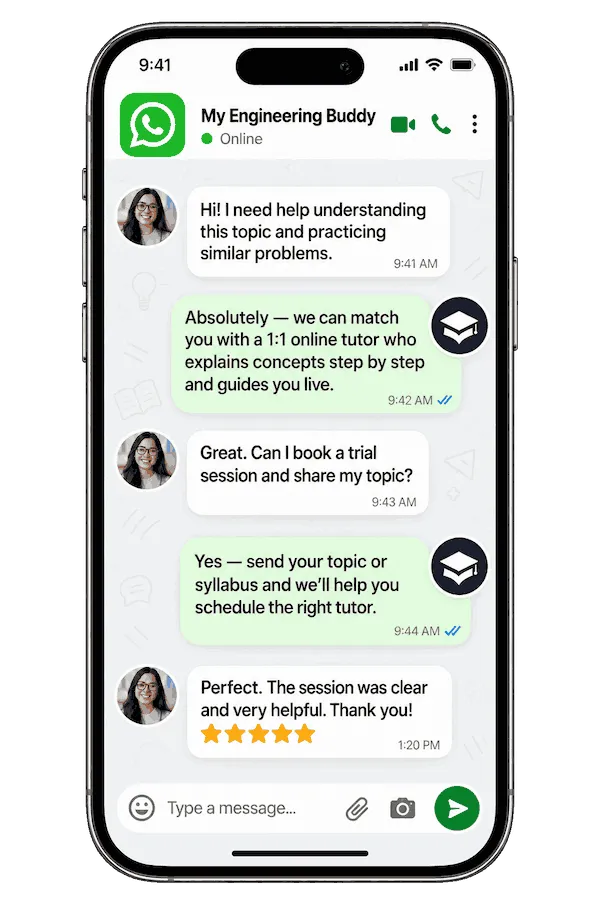
~1 min
Average Reply Time
~1 hour
To Be Matched With A Tutor
30 Min Trial
75% Find Their Tutor On The 1st Trial
$20-35+/hr
Premium Yet Affordable Learning
Most students who struggle with plant physiology or crop science aren’t missing intelligence — they’re missing someone who can explain auxin transport or soil pH buffering at the exact level their course demands.
Horticulture Tutor Online
Horticulture is the science and practice of growing fruits, vegetables, ornamental plants, and turf. Covering plant physiology, soil science, pest management, and crop production, it equips students to manage plant systems in agricultural, commercial, and environmental contexts.
MEB offers 1:1 online Horticulture tutoring and academic guidance — matched to your exact course, module, or exam board. If you’ve searched for a Horticulture tutor near me and found generic results, MEB connects you directly with a tutor who knows plant science at your level, in your time zone, for as little as $20/hr.
- 1:1 online sessions tailored to your specific course or syllabus
- Expert verified tutors with subject-specific knowledge in plant science
- Flexible time zones — US, UK, Canada, Australia, Gulf
- Structured learning plan built after a diagnostic session
- Ethical academic guidance — you understand before you submit
52,000+ students across the US, UK, Canada, Australia, and the Gulf have used MEB since 2008 — across 2,800+ subjects, from AP Calculus to A Level Music Technology to Data Science.
Source: My Engineering Buddy, 2008–2025.
How Much Does a Horticulture Tutor Cost?
Online Horticulture tutoring at MEB starts at $20/hr for most undergraduate and school-level modules. Advanced plant science, graduate-level coursework, or specialist crop management topics run $35–$70/hr. The $1 trial gives you 30 minutes of live 1:1 tutoring or one homework question explained in full — before you commit to anything.
| Level / Need | Typical Rate | What’s Included |
|---|---|---|
| Standard (most levels) | $20–$35/hr | 1:1 sessions, homework guidance |
| Advanced / Specialist | $35–$70/hr | Expert tutor, niche depth in crop science or plant pathology |
| $1 Trial | $1 flat | 30 min live session or 1 homework question explained |
Tutor availability tightens during spring exam periods. Book early if your deadline is within six weeks.
WhatsApp MEB for a quick quote — average response time under 1 minute.
Who This Horticulture Tutoring Is For
This service is built for students who need more than a textbook. Whether you’re working through plant physiology at college level, completing a horticulture diploma, or pushing through a botany-heavy undergraduate module, a 1:1 Horticulture tutor online gives you the feedback loop that reading alone cannot.
- Undergraduate students struggling with plant physiology, soil science, or pest management modules
- Students with a university conditional offer depending on their final horticulture grade this semester
- Students completing diplomas in horticulture through RHS, NZQA, or similar bodies
- Graduate students working through advanced crop science or plant breeding coursework
- Students needing structured academic guidance across plant pathology tutoring, agronomy, or related plant science modules
- Parents supporting a student whose confidence has dropped alongside their marks
Students who’ve used MEB for horticulture support have come from programs at universities including Cornell, UC Davis, Wageningen, Reading, Melbourne, and Queensland — institutions with demanding plant science programs that expect independent analytical work from early in the degree.
1:1 Tutoring vs Self-Study vs AI Tools
Self-study works for motivated students — but without feedback, you can spend three hours on plant hormone pathways and still answer the exam question incorrectly, with no idea why. AI tools are fast at generating explanations of transpiration pull or soil nutrient cycles, but they cannot look at your specific lab report, spot where your reasoning broke down, or walk you through a worked diagram of stomatal regulation in real time. In Horticulture, where questions often ask you to apply mechanisms to novel crop scenarios, live human instruction is what closes the gap between knowing the theory and using it under exam conditions. MEB combines online flexibility with a structured feedback loop calibrated to your exact course — not a generic plant biology syllabus.
Outcomes: What You’ll Be Able To Do in Horticulture
After working with a MEB Horticulture tutor online, students report being able to explain how auxin and cytokinin ratios regulate shoot-to-root development in propagation contexts, analyze soil pH data to recommend amendment strategies for specific crop types, apply integrated pest management frameworks to case studies involving ornamental and edible plant systems, write structured lab reports on photosynthesis efficiency or tissue culture protocols, and present reasoned arguments on sustainable crop production that satisfy degree-level assessment criteria.
Supporting a student through Horticulture? MEB works directly with parents to set up sessions, track progress, and keep coursework on schedule. WhatsApp MEB — average response time is under a minute, 24/7.
Based on feedback from 40,000+ sessions collected by MEB from 2022 to 2025, 58% of students improved by one full grade after approximately 20 hours of 1:1 tutoring in a single subject. A further 23% achieved at least a half-grade improvement.
Source: MEB session feedback data, 2022–2025.
What We Cover in Horticulture (Syllabus / Topics)

Plant Science Foundations
- Plant cell biology: organelle function, cell wall composition, turgor pressure
- Photosynthesis and respiration: light reactions, Calvin cycle, C3/C4/CAM pathways
- Plant hormones: auxin, gibberellins, ethylene, cytokinins, abscisic acid
- Water relations: osmosis, transpiration, stomatal control, xylem transport
- Nutrient cycles: nitrogen fixation, mineral uptake, deficiency symptoms
- Seed germination, dormancy, and propagation techniques
Recommended texts: Plant Physiology and Development (Taiz et al.) and Introduction to Plant Biology (Stern et al.).
Soil Science and Crop Management
- Soil formation, texture, structure, and classification systems
- Soil pH, buffering capacity, and amendment strategies for horticultural crops
- Fertilizer types, nutrient availability, and application timing
- Irrigation systems: drip, sprinkler, subsurface — efficiency and scheduling
- Integrated pest management: biological, chemical, and cultural control methods
- Crop rotation principles and cover cropping in sustainable production systems
- Post-harvest physiology: respiration rates, ethylene management, storage conditions
Recommended texts: Soil Science Simplified (Helmut Kohnke) and Horticulture: Principles and Practices (Acquaah).
Ornamental Horticulture and Landscape Design
- Classification and identification of ornamental plants by family and genus
- Pruning techniques, growth habit management, and topiary principles
- Turf management: establishment, mowing regimes, thatch control, overseeding
- Greenhouse production: climate control, growing media, hydroponic systems
- Landscape design principles: hardscape, planting plans, seasonal interest
- Plant propagation: cuttings, grafting, layering, tissue culture
Recommended texts: Ornamental Horticulture (Laurie et al.) and The American Horticultural Society Encyclopedia of Plants and Flowers.
At MEB, we’ve found that students who can’t explain why a crop is underperforming usually haven’t connected the soil chemistry to the plant physiology. That’s the link most course materials skip over — and it’s exactly where 1:1 sessions make the biggest difference.
What a Typical Horticulture Session Looks Like
The tutor opens by checking where you left off — usually a specific topic like stomatal regulation or soil cation exchange capacity. You share your screen or upload the homework question you’ve been stuck on. The tutor works through it live using a digital pen-pad, annotating diagrams of hormone pathways or drawing nutrient uptake curves while explaining each step. You replicate the reasoning or answer a related question while the tutor watches. If you hesitate on why calcium deficiency shows up in new growth rather than old, the tutor catches it and corrects it before it becomes a habit. The session closes with a specific practice task — two soil pH interpretation questions, say — and the next topic is noted so no time is wasted at the start of session two.
How MEB Tutors Help You with Horticulture (The Learning Loop)
Diagnose: In the first session, the tutor works through a short set of questions covering your weakest areas — often plant hormone interactions, soil science calculations, or pest identification — and maps exactly where your understanding breaks down.
Explain: The tutor works through the problem live, using a digital pen-pad to annotate transpiration diagrams or sketch nutrient cycle flows. You see the reasoning built step by step, not just the answer.
Practice: You attempt a similar question with the tutor present. No moving on until you can reproduce the method independently — whether that’s calculating fertilizer application rates or identifying fungal disease symptoms from a case description.
Feedback: The tutor reviews your attempt step by step, showing exactly where marks were lost and why. This is where most self-study fails — you get the red pen, not just the mark.
Plan: Each session ends with a clear next topic and a short practice task. The tutor tracks your progress across sessions and adjusts the sequence if a new gap appears.
Sessions run over Google Meet. The tutor uses a digital pen-pad or iPad with Apple Pencil. Before your first session, share your course outline or module guide and one piece of work — a homework question or lab report — that you found difficult. The first session uses that as the diagnostic so every minute counts. Start with the $1 trial — 30 minutes of live tutoring that also serves as your first diagnostic.
Students consistently tell us that the moment things click in Horticulture is when someone finally shows them how soil chemistry, plant biology, and crop management connect to the same underlying system — not as three separate topics to memorise, but as one.
Tutor Match Criteria (How We Pick Your Tutor)
Every Horticulture tutor at MEB is matched to you on the following criteria before the first session.
Subject depth: Tutors hold degrees in horticulture, plant science, agronomy, or a closely related field. Where your course covers specialist areas — tissue culture, turfgrass management, or protected crop production — MEB matches to that sub-discipline specifically.
Tools: All sessions use Google Meet. Tutors work with a digital pen-pad or iPad and Apple Pencil for annotating diagrams, sketching root architecture, or walking through soil profile calculations in real time.
Time zone: MEB covers New York, Los Angeles, Chicago, London, Dubai, Toronto, Sydney, Melbourne, and all standard US, UK, Gulf, Canadian, Australian, and European time zones — evenings and weekends included.
Learning style: Calibrated from the first session. Some students need more worked examples; others need to talk through the logic before attempting questions. The tutor adjusts from session one.
Communication: Clear English, adapted to your level. No unnecessary jargon when plain language does the job — and precise terminology when it’s what your assessor expects.
Goals: Whether you need to pass an end-of-semester exam, get a coursework submission back on track, or build enough depth for postgraduate study, the tutor calibrates the session plan to that specific target.
Unlike platforms where you fill out a form and wait, MEB responds in under a minute, 24/7. Tutor match takes under an hour. The $1 trial means you test before you commit. Everything runs over WhatsApp — no logins, no intake forms.
Study Plans (Pick One That Matches Your Goal)
A catch-up plan runs 1–3 weeks and targets the specific gaps stopping you from passing — soil calculations, hormone pathways, pest management frameworks. An exam prep plan covers 4–8 weeks and builds structured revision around your paper date, working through past questions and mark schemes. Weekly ongoing support aligns to your semester schedule and keeps coursework and lab reports on track throughout term. The tutor builds the specific session sequence after the first diagnostic — not before, because the gaps vary more than most students expect.
Pricing Guide
Horticulture tutoring at MEB runs $20–$40/hr for most school-level and undergraduate modules. Graduate-level or highly specialist topics — plant breeding, advanced soil microbiology, protected environment agriculture — run up to $100/hr depending on tutor background and topic depth.
Rate factors include your course level, the complexity of the topic, how soon you need sessions, and tutor availability at your preferred time. Availability drops noticeably in April and May across US and UK exam periods.
For students targeting programs at institutions with competitive horticulture or plant science departments, tutors with active research or industry backgrounds in crop science are available at higher rates — share your specific goal and MEB will match the tier to what you’re aiming for.
Start with the $1 trial — 30 minutes, no registration, no commitment. WhatsApp MEB for a quick quote.
FAQ
Is Horticulture hard?
It depends on your background. Students with limited chemistry or biology find soil science and plant physiology the steepest parts. The subject is manageable with 1:1 support that connects the underlying science to practical crop applications rather than treating them as separate topics.
How many sessions are needed?
Most students working through a specific module gap need 6–10 sessions. Exam preparation over 4–8 weeks typically runs one to two sessions per week. The tutor gives a clearer estimate after the first diagnostic session.
Can you help with practice exercises?
Yes — MEB tutors explain the method, work through the reasoning with you, and help you understand the material so you can complete and submit the work yourself. For full details, read our Academic Integrity policy and Why MEB.
Will the tutor match my exact syllabus or exam board?
Yes. When you contact MEB, share your course outline, institution, and any specific modules or exam components you’re focusing on. Tutors are matched to your syllabus — not just the general subject area.
What happens in the first session?
The tutor runs a short diagnostic using a question or piece of work you bring. This identifies where your understanding breaks down and what to cover first. The session plan is built from that, not from a generic horticulture template.
Is online tutoring as effective as in-person?
For Horticulture, yes — especially for theory-heavy topics. Google Meet with a digital pen-pad replicates the whiteboard interaction of in-person tutoring. Most MEB students report no meaningful difference once they’ve completed their first session.
Can I get Horticulture help late at night?
MEB operates 24/7. Tutors are available across time zones, which means evening and late-night sessions are standard for students in the US, Gulf, and Australia. WhatsApp MEB any time and you’ll typically hear back within a minute.
What if I don’t like my assigned tutor?
Tell MEB over WhatsApp and a replacement is matched within the hour. The $1 trial is specifically designed so you evaluate the tutor before committing to a regular schedule — no awkward conversations, no lost money.
How do I find a Horticulture tutor in my city?
You don’t need to. MEB tutors work entirely online via Google Meet, which means location is irrelevant. Students in London, Toronto, Dubai, Sydney, and across the US access the same tutor pool with the same response times.
How do I get started?
WhatsApp MEB with your course level and the topic or assignment you need help with. You’ll be matched with a verified Horticulture tutor — typically within the hour. The first session is the $1 trial: 30 minutes live or one question explained in full, no registration required.
Our World in Data shows that global demand for sustainable food production has accelerated since 2010 — making plant science and horticulture skills increasingly relevant across agriculture, environmental management, and research careers.
Source: Our World in Data.
Trust & Quality at My Engineering Buddy
Every MEB Horticulture tutor goes through a structured screening process: subject knowledge assessment, live demo evaluation, and ongoing review based on session feedback. Tutors hold relevant degrees in plant science, agronomy, horticulture, or adjacent fields — and many have professional or research backgrounds in crop production, landscape management, or plant pathology. Rated 4.8/5 across 40,000+ verified reviews on Google, MEB’s tutor quality is not self-reported — it comes from 52,000+ students who’ve been through the process. Read more about how tutors are selected at MEB’s tutoring methodology page.
MEB tutoring is guided learning — you understand the work, then submit it yourself. For full details on what we help with and what we don’t, read our Academic Integrity policy and Why MEB.
MEB has served students across the US, UK, Canada, Australia, the Gulf, and Europe since 2008 — in 2,800+ subjects. Students studying plant-related disciplines often work with us across connected areas: get agronomy tutoring, find a plant anatomy tutor, or access plant taxonomy tutoring — all through the same platform, same response time, same $1 trial entry point.
A common pattern our tutors observe is that students who arrive thinking they’re bad at Horticulture are usually missing one foundational concept — often soil chemistry or hormone signalling — that makes everything else harder than it needs to be. One session fixes the root. The rest follows.
Explore Related Subjects
Students studying Horticulture often also need support in:
MEB tutors have helped students work through plant hormone mechanisms, soil texture classification, and IPM case studies — the exact content that separates a passing grade from a strong one in most horticulture programs.
Source: My Engineering Buddy, internal session data, 2022–2025.
Next Steps
Ready to get started? Here’s what to do:
- Share your course outline or exam board, the topic you’re stuck on, and your deadline or exam date
- Share your time zone and availability — evenings and weekends are fully covered
- MEB matches you with a verified Horticulture tutor, usually within 24 hours
Before your first session, have ready: your syllabus or course outline, a recent assignment or past paper question you struggled with, and your exam or coursework deadline date. The tutor handles the rest.
Visit www.myengineeringbuddy.com for more on how the MEB process works.
WhatsApp to get started or email [email protected].
Try your first session for $1 — 30 minutes of live 1:1 tutoring or one homework question explained in full. No registration. No commitment. WhatsApp MEB now and get matched within the hour.
Reviewed by Subject Expert
This page has been carefully reviewed and validated by our subject expert to ensure accuracy and relevance.




