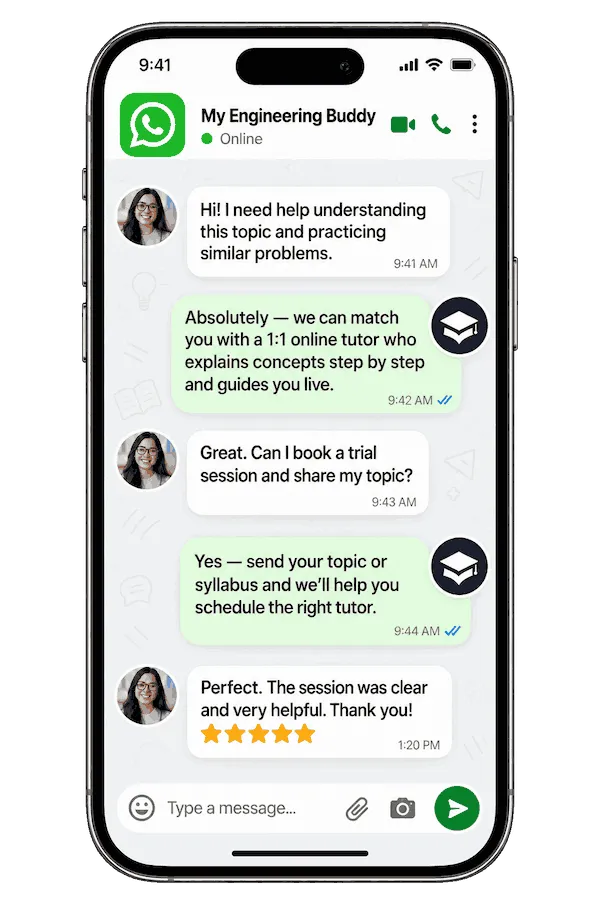
~1 min
Average Reply Time
~1 hour
To Be Matched With A Tutor
30 Min Trial
75% Find Their Tutor On The 1st Trial
$20-35+/hr
Premium Yet Affordable Learning
Your autonomous systems project keeps failing at the path planning stage — and your tutor on that other platform has never touched ROS or SLAM.
Autonomous Systems Tutor Online
Autonomous Systems is an engineering discipline covering self-operating machines and software — integrating control theory, sensor fusion, path planning, and decision-making to enable robots and vehicles to perceive, reason, and act without direct human input.
Finding a qualified Autonomous Systems tutor near me who genuinely knows ROS, Kalman filters, and motion planning is hard. MEB’s 1:1 online mechatronics tutoring network includes specialists who have worked in robotics research and industrial automation — available to students across the US, UK, Canada, Australia, and the Gulf. One session often closes gaps that weeks of lecture slides left open.
- 1:1 online sessions tailored to your exact course or university module
- Expert-verified tutors with hands-on autonomous systems and robotics backgrounds
- Flexible scheduling across US, UK, Canada, Australia, and Gulf time zones
- Structured learning plan built after a first-session diagnostic
- Ethical homework and assignment guidance — you understand the work, then submit it yourself
52,000+ students across the US, UK, Canada, Australia, and the Gulf have used MEB since 2008 — including students in Mechatronics subjects like Autonomous Systems, Robotics Engineering, and Real-Time Systems (RTOS).
Source: My Engineering Buddy, 2008–2025.
How Much Does an Autonomous Systems Tutor Cost?
Most Autonomous Systems tutoring sessions run $20–$40/hr. Graduate-level or highly specialised topics — such as model predictive control or multi-agent coordination — can reach $100/hr. The $1 trial gets you 30 minutes of live tutoring or one full homework question explained in detail.
| Level / Need | Typical Rate | What’s Included |
|---|---|---|
| Undergraduate (most modules) | $20–$35/hr | 1:1 sessions, homework guidance |
| Advanced / Graduate-level | $35–$100/hr | Research-experienced tutor, niche depth |
| $1 Trial | $1 flat | 30 min live session or 1 homework question |
Availability tightens significantly in the weeks before end-of-semester submissions and spring robotics competition deadlines. Book early.
WhatsApp MEB for a quick quote — average response time under 1 minute.
Who This Autonomous Systems Tutoring Is For
This is not a general engineering service. MEB’s Autonomous Systems tutoring is built for students whose coursework regularly involves implementing algorithms, not just reading about them.
- Undergraduate and graduate students in robotics, electrical engineering, computer engineering, or mechatronics taking a dedicated autonomous systems or mobile robotics module
- Students whose simulation results in MATLAB, Simulink, or ROS don’t match theoretical expectations — and who can’t figure out why
- Students retaking after a failed first attempt on a control systems or autonomous systems unit, needing structured gap-closing before the resit
- Students with a project or thesis submission deadline approaching and gaps in sensor fusion or state estimation
- Parents watching a high-achieving student suddenly struggle when coursework shifts from classical control to probabilistic robotics
- Faculty looking for supplemental support for students who need more hands-on time with ROS or path planning implementations than office hours allow
Students come to MEB from universities including MIT, Georgia Tech, ETH Zurich, University of Michigan, Imperial College London, TU Delft, University of Toronto, and Carnegie Mellon. The tutor is matched to your exact module level and assessment format.
At MEB, we’ve found that Autonomous Systems students fall into one of two camps: those who understand the theory but can’t implement it, and those who can run the code but can’t explain what it’s doing. Both gaps are fixable in 1:1 sessions — but they need different fixes. That’s why the first session is always diagnostic.
1:1 Tutoring vs Self-Study vs AI vs YouTube vs Online Courses
Self-study works if you’re disciplined — but Autonomous Systems has too many interdependent concepts for pure self-direction to catch every gap. AI tools give fast answers and can’t tell you why your EKF is diverging on your specific dataset. YouTube is excellent for conceptual overviews of SLAM or PID control, but stops when you need to debug your ROS node. Online courses are structured but fixed-pace with no room for your actual assignment constraints. 1:1 tutoring with MEB is live, calibrated to your exact syllabus and current implementation, and corrects reasoning errors in the moment — before they compound into a failed submission.
Outcomes: What You’ll Be Able To Do in Autonomous Systems
After consistent sessions with an MEB Autonomous Systems tutor, students report concrete shifts in what they can do independently. You’ll be able to model a mobile robot’s kinematics and apply the right motion model for your specific platform. You’ll be able to analyze sensor noise characteristics and choose between an Extended Kalman Filter and a Particle Filter with clear justification. You’ll be able to implement and tune a PID or LQR controller in simulation, explain why it behaves as it does, and present your design choices in a viva or written report. You’ll be able to apply A*, Dijkstra, or RRT path planning algorithms to constrained environments and evaluate trade-offs. These are not general engineering skills — they are the specific capabilities your examiners and project supervisors are assessing.
Based on feedback from 40,000+ sessions collected by MEB from 2022 to 2025, 58% of students improved by one full grade after approximately 20 hours of 1:1 tutoring in subjects like Autonomous Systems. A further 23% achieved at least a half-grade improvement.
Source: MEB session feedback data, 2022–2025.
Start with the $1 trial — 30 minutes of live tutoring that also serves as your first diagnostic, at no real cost or commitment.
Try your first session for $1 — 30 minutes of live 1:1 tutoring or one homework question explained in full. No registration. No commitment. WhatsApp MEB now and get matched within the hour.
What We Cover in Autonomous Systems (Syllabus / Topics)

Track 1: Perception and State Estimation
- Sensor modalities: LiDAR, cameras, IMU, GPS — characteristics and failure modes
- Probabilistic state estimation: Bayes filter, Kalman filter, Extended Kalman Filter (EKF)
- Particle filters and Monte Carlo localisation
- Sensor fusion — combining heterogeneous data streams
- Simultaneous Localisation and Mapping (SLAM): EKF-SLAM, FastSLAM, graph-based SLAM
- Point cloud processing and occupancy grid mapping
Key texts: Probabilistic Robotics (Thrun, Burgard, Fox); State Estimation for Robotics (Barfoot).
Track 2: Planning, Control, and Decision-Making
- Configuration space and motion planning fundamentals
- Graph-based planners: Dijkstra, A*, D* Lite
- Sampling-based planners: RRT, RRT*, PRM
- Classical control: PID tuning, state-space representation, LQR
- Model Predictive Control (MPC) — formulation and constraints
- Finite state machines and behaviour trees for autonomous decision-making
- Reinforcement learning basics applied to robot control
Key texts: Planning Algorithms (LaValle); Modern Control Engineering (Ogata).
Track 3: Systems Integration and Implementation
- Robot Operating System (ROS/ROS2): nodes, topics, services, launch files
- Simulation environments: Gazebo, Webots, CARLA for autonomous vehicles
- Hardware-in-the-loop testing and real-time constraints
- Embedded systems integration — from algorithm to deployment on Raspberry Pi or STM32
- Safety, verification, and validation in autonomous systems
- Ethics and regulation in autonomous vehicle and drone deployment
Key texts: A Gentle Introduction to ROS (O’Kane); Autonomous Mobile Robots (Siegwart, Nourbakhsh, Scaramuzza). See also MIT OpenCourseWare — Feedback Systems for foundational control theory materials.
What a Typical Autonomous Systems Session Looks Like
The tutor opens by checking where the previous topic — say, EKF implementation for a 2D localisation problem — broke down. If the covariance matrix was blowing up, that’s the starting point. Student and tutor work through the Jacobian derivation together on a shared digital pen-pad, with the tutor annotating live while the student follows the algebra step by step. Then the student replicates the calculation independently while the tutor watches for where the reasoning slips. If the session is implementation-focused, you share your screen with your ROS workspace open and walk through the node structure together. By the final ten minutes, the tutor sets a concrete task — re-run the filter with adjusted process noise parameters and note the effect on the estimated trajectory — and flags the next topic to cover before the following session.
How MEB Tutors Help You with Autonomous Systems (The Learning Loop)
Diagnose: In the first session, the tutor identifies whether the gap is mathematical (linear algebra, probability, calculus), conceptual (misunderstanding what a filter is actually doing), or implementation (correct theory, broken code). Most students have all three to some degree. The tutor notes which is blocking progress most.
Explain: The tutor works through a live example — not a textbook derivation, but a problem structured like your actual assignment or exam question. Digital pen-pad annotation makes the steps visible. You see the reasoning, not just the answer.
Practice: You attempt the next problem with the tutor present. Not after the session. During it. This is where the real learning happens — and where errors surface before they become habits.
Feedback: The tutor steps through exactly where your reasoning diverged and why it costs marks. “You computed the innovation correctly but forgot to normalise the weight — that’s why your particle filter collapsed.” Specific. Actionable. Not general encouragement.
Plan: Each session ends with a clear next topic and a specific task to attempt before the following session. Progress is tracked. If you’re three weeks from a submission, the tutor works backwards from the deadline.
Sessions run on Google Meet with a digital pen-pad or iPad and Apple Pencil. Before your first session, share your course outline or module descriptor, any past assignment feedback, and your submission or exam date. The first session handles the diagnostic and usually gets into the first real concept the same day.
Whether you need a quick catch-up before a submission, structured revision over four to eight weeks, or ongoing weekly support through the semester, the tutor maps the session plan after the first diagnostic.
Students consistently tell us that the moment things click in Autonomous Systems is when they stop treating the Kalman filter as a formula and start treating it as a reasoning process. That shift usually takes one good session. Everything after that builds faster.
Tutor Match Criteria (How We Pick Your Tutor)
Not every engineer can tutor Autonomous Systems at graduate level. MEB matches on four criteria.
Subject depth: The tutor must have worked directly with the topics your module covers — SLAM, MPC, ROS, or autonomous vehicle stacks — not just studied them. Undergraduate and postgraduate levels are matched separately.
Tools: Every MEB tutor uses Google Meet plus a digital pen-pad or iPad and Apple Pencil. No whiteboards held up to webcams.
Time zone: Matched to your region — US, UK, Gulf, Canada, or Australia. Late-night sessions are available; tutors are not asked to work hours that compromise session quality.
Goals: Whether you need exam preparation, conceptual depth, help with a specific System Dynamics or controls component, or research-level support for a thesis, the match reflects that specific goal.
Unlike platforms where you fill out a form and wait, MEB responds in under a minute, 24/7. Tutor match takes under an hour. The $1 trial means you test before you commit. Everything runs over WhatsApp — no logins, no intake forms.
Pricing Guide
Autonomous Systems tutoring starts at $20/hr for standard undergraduate modules. Graduate-level topics — MPC, multi-robot coordination, deep learning for perception — run $35–$100/hr depending on tutor specialisation and session complexity.
Rate factors: your course level, the specific topic area, how close your deadline is, and tutor availability. Rates for urgent bookings during end-of-semester periods may reflect tighter availability.
For students targeting top robotics or autonomous vehicle programmes at institutions like Carnegie Mellon, MIT, or ETH Zurich, tutors with active research or industry backgrounds in autonomous systems are available at higher rates — share your specific goal and MEB will match the tier to your timeline.
Start with the $1 trial — 30 minutes, no registration, no commitment. WhatsApp MEB for a quick quote.
MEB has been operating since 2008. Across 52,000+ students and 40,000+ verified reviews, the pattern is consistent: students who stick with 1:1 sessions across three to four weeks close the gaps that months of self-study left open.
Source: My Engineering Buddy, 2008–2025.
FAQ
Is Autonomous Systems hard?
Yes — it draws on probability, linear algebra, control theory, and software implementation simultaneously. Most students find that one of these foundations is weaker than the others, and that’s usually where things break down. A diagnostic session identifies it quickly.
How many sessions are needed?
For a specific assignment or exam gap, three to five sessions often make a measurable difference. For a full module with multiple assessment components, ten to twenty hours over a semester is a more realistic target for sustained improvement.
Can you help with homework and assignments?
Yes. MEB tutoring is guided learning — you understand the work, then submit it yourself. The tutor explains the method, works through a similar example, and you apply it. See our Academic Integrity policy and Why MEB page for full details on what we help with and what we don’t.
Will the tutor match my exact syllabus or exam board?
Yes. Before matching, MEB asks for your course outline or module descriptor. Tutors are selected based on familiarity with your specific syllabus — whether that’s a university robotics module, an autonomous vehicles course, or a control systems unit with a defined assessment structure.
What happens in the first session?
The first session is a diagnostic. The tutor reviews what you’ve covered, where marks were lost previously, and what your next submission or exam requires. By the end, you have a clear topic sequence and a task to attempt before the next session.
Is online tutoring as effective as in-person?
For Autonomous Systems specifically, online is often better — screen sharing lets you work through live ROS environments, Simulink models, or Python scripts together. The digital pen-pad replicates whiteboard derivations without requiring physical proximity. Most students adapt within the first session.
Do you cover both ROS1 and ROS2?
Yes. MEB tutors work with both ROS1 (Noetic, Melodic) and ROS2 (Humble, Foxy). If your university module is transitioning between the two or using a specific distribution, mention it when you make contact and the tutor will be matched accordingly.
Can I get Autonomous Systems help at midnight?
Yes. MEB operates 24/7. WhatsApp response time averages under a minute regardless of the hour. Tutor availability across multiple time zones means late-night sessions — especially useful for students in the Gulf or Asia-Pacific — are regularly scheduled and not an exception.
What if my course uses a simulation environment I’m not sure MEB covers?
Common environments — Gazebo, CARLA, Webots, MATLAB/Simulink, CoppeliaSim — are all supported. If yours is unusual, share the name via WhatsApp and MEB will confirm tutor availability before you book. No guessing.
How do I get started?
Three steps: WhatsApp MEB, share your module name and current challenge, and get matched with a tutor. Your first session is the $1 trial — 30 minutes of live tutoring or one full question explained. No forms, no registration.
Is there a difference between an autonomous systems module at undergraduate vs master’s level?
Significantly. Undergraduate modules typically focus on classical control, introductory SLAM, and ROS basics. Master’s level adds research-grade state estimation, learned perception, MPC, and often a substantial independent project. MEB matches tutor depth to your level — the approach in each session differs accordingly.
What if I don’t get on with my assigned tutor?
Request a switch via WhatsApp. MEB will match you with a different tutor, usually within the same day. There is no penalty, no paperwork. The goal is a working match, not a fixed assignment.
Trust & Quality at My Engineering Buddy
Every MEB tutor goes through subject-specific vetting before taking sessions. This means a live demo evaluation in their declared subject area, verification of their academic or professional background, and ongoing review based on session feedback. Tutors covering Autonomous Systems are assessed on their ability to explain SLAM, control theory, and ROS implementation — not just general engineering. Rated 4.8/5 across 40,000+ verified reviews on Google.
MEB tutoring is guided learning — you understand the work, then submit it yourself. For full details on what we help with and what we don’t, read our Academic Integrity policy and Why MEB.
MEB has served 52,000+ students across the US, UK, Canada, Australia, the Gulf, and Europe in 2,800+ subjects since 2008. Within Mechatronics and related disciplines, this includes students working on Automation Engineering tutoring, PLC tutoring, and Electromechanical Systems help — alongside Autonomous Systems as one of the most-requested advanced subjects in the category. See MEB’s tutoring methodology for details on how sessions are structured.
A common pattern our tutors observe is that students come in thinking their Autonomous Systems problem is about the code. Within twenty minutes, it’s clear the issue is a misunderstood probability model or a linearisation they didn’t realise they were assuming. Fixing the concept fixes the code.
Explore Related Subjects
Students studying Autonomous Systems often also need support in:
- Arduino Uno
- Avionics
- Microelectromechanical Systems (MEMS)
- SCADA
- STM32
- FluidSIM
- 3D Printing & Additive Manufacturing
Next Steps
When you contact MEB, have these ready:
- Your module name, university, and course level
- Your submission or exam date
- A specific topic or assignment question you’re currently stuck on
Before your first session, also prepare: your course outline or syllabus, a recent assignment attempt or problem you struggled with, and any past feedback from your supervisor or lecturer. The tutor handles the diagnostic and session plan from there.
MEB matches you with a verified tutor — usually within 24 hours, often faster. The first session starts with a diagnostic so every minute is used on what actually matters for your grade or submission.
Visit www.myengineeringbuddy.com for more on how MEB works.
WhatsApp to get started or email [email protected].
Reviewed by Subject Expert
This page has been carefully reviewed and validated by our subject expert to ensure accuracy and relevance.