




~1 min
Average Reply Time
~1 hour
To Be Matched With A Tutor
30 Min Trial
75% Find Their Tutor On The 1st Trial
$20-35+/hr
Premium Yet Affordable Learning
Hire The Best Engineering Tutor










You’ve read the textbook three times. You still can’t solve the problem. That’s not a effort problem — that’s a feedback problem.
Engineering Tutor Online
Engineering is the application of mathematics, science, and systematic design principles to build structures, machines, systems, and processes. It spans disciplines from civil and mechanical to electrical and chemical, preparing graduates to solve real-world technical problems across industry and research.
MEB offers 1:1 online tutoring and homework help across the full range of engineering disciplines — from first-year statics and thermodynamics through to graduate-level systems design and research methods. If you’ve searched for an engineering tutor near me and found mostly generalist platforms, MEB is different: every tutor is matched to your specific course, level, and exam board. One outcome students report consistently — understanding that previously took days clicks in a single session.
- 1:1 online sessions tailored to your exact engineering course and syllabus
- Expert-verified tutors with undergraduate, graduate, or professional engineering backgrounds
- Flexible scheduling across US, UK, Canada, Australia, and Gulf time zones
- Structured learning plan built after a diagnostic session in your first hour
- Ethical homework and assignment guidance — you understand the work before you submit it
52,000+ students across the US, UK, Canada, Australia, and the Gulf have used MEB since 2008 — including students in Engineering subjects like mechanical engineering tutoring, electrical engineering help, and civil engineering tutoring.
Source: My Engineering Buddy, 2008–2025.
How Much Does an Engineering Tutor Cost?
Most engineering tutoring sessions run $20–$40/hr depending on level and topic complexity. Graduate and specialist subjects can run up to $100/hr. The $1 trial gives you 30 minutes of live 1:1 tutoring or a full explanation of one homework question — before you commit to anything.
| Level / Need | Typical Rate | What’s Included |
|---|---|---|
| Standard (most undergrad levels) | $20–$35/hr | 1:1 sessions, homework guidance |
| Advanced / Graduate / Specialist | $35–$100/hr | Expert tutor, niche depth, research support |
| $1 Trial | $1 flat | 30 min live session or 1 full homework explanation |
Tutor availability tightens significantly in the weeks before finals and major submission deadlines. Book early if you’re within six weeks of an assessment.
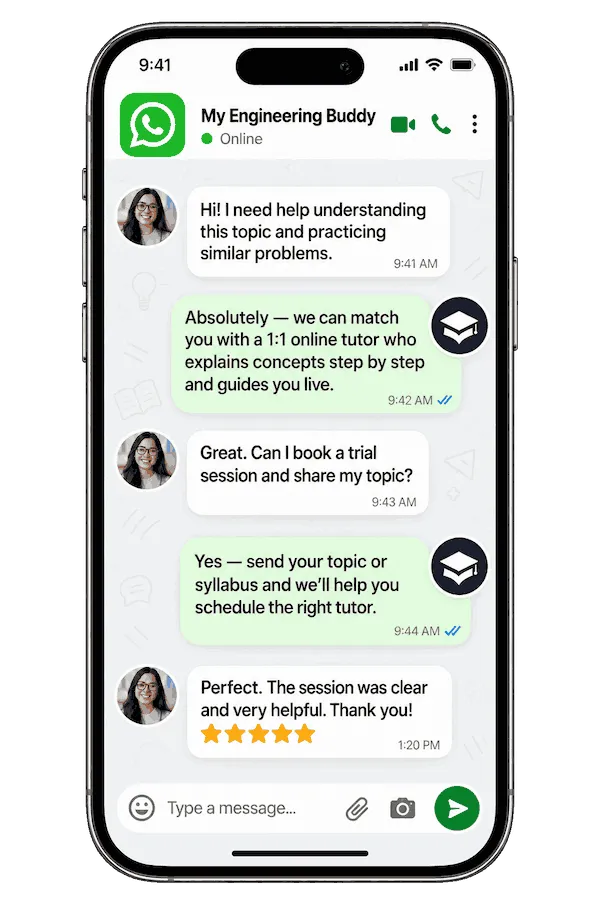
WhatsApp MEB for a quick quote — average response time under 1 minute.
Who This Engineering Tutoring Is For
Engineering is one of the most technically demanding degree programmes in higher education. Most students hit a wall somewhere — usually in the gap between lecture content and applying it under exam conditions.
- First and second year undergraduates struggling with core modules like thermodynamics, mechanics of materials, or circuit analysis
- Students retaking after a failed first attempt who need to identify exactly where marks were lost
- Students with a university conditional offer depending on a specific grade this semester
- Graduate students working through advanced coursework in systems engineering, finite element analysis, or control theory
- Students 4–6 weeks from finals with significant topic gaps still to close
- Parents watching a child’s confidence drop alongside their grades in a first-year engineering programme
- Students needing structured homework and assignment guidance — to understand the method, not just get an answer
MEB has worked with engineering students at institutions including MIT, Georgia Tech, Imperial College London, the University of Toronto, ETH Zurich, UNSW Sydney, and Purdue University — across every year level from freshman to PhD.
1:1 Tutoring vs Self-Study vs AI vs YouTube vs Online Courses
Self-study works if you’re disciplined — but engineering problems compound, and a gap in week 3 derails week 8. AI tools explain concepts fast but can’t watch you set up a free body diagram and tell you exactly where your sign convention broke. YouTube covers derivations well; it stops when your specific boundary condition doesn’t match the example. Online courses are structured but fixed-pace — no adjustment when statics clicks but dynamics doesn’t. With MEB, a live tutor sees your working in real time, corrects the error at the point it occurs, and adjusts the session to your actual course — not a generic engineering curriculum.
Outcomes: What You’ll Be Able To Do in Engineering
After working with an MEB engineering tutor, students consistently report being able to solve multi-step structural and circuit problems without stalling on method selection. They can analyze load distributions, apply equilibrium equations, and model heat transfer scenarios with confidence. Students learn to explain their reasoning step by step — which is exactly what examiners and lab reports require. Apply thermodynamic cycles to real system design. Write clear, technically accurate engineering reports under deadline pressure. These aren’t vague promises — they’re the specific skills tutors build toward from the first diagnostic session.
Based on feedback from 40,000+ sessions collected by MEB from 2022 to 2025, 58% of students improved by one full grade after approximately 20 hours of 1:1 tutoring in subjects like Engineering. A further 23% achieved at least a half-grade improvement.
Source: MEB session feedback data, 2022–2025.
Supporting a student through Engineering? MEB works directly with parents to set up sessions, track progress, and keep coursework on schedule. WhatsApp MEB — average response time is under a minute, 24/7.
Try your first session for $1 — 30 minutes of live 1:1 tutoring or one homework question explained in full. No registration. No commitment. WhatsApp MEB now and get matched within the hour.
What We Cover in Engineering (Syllabus / Topics)

Core Engineering Fundamentals
- Statics and dynamics — equilibrium, free body diagrams, Newton’s laws applied to rigid bodies
- Mechanics of materials — stress, strain, beam bending, torsion, and failure criteria
- Thermodynamics — first and second law applications, Carnot cycles, entropy, and heat engines
- Fluid mechanics — Bernoulli’s equation, pipe flow, viscosity, and Reynolds number applications
- Circuit analysis — Kirchhoff’s laws, AC/DC circuits, Thevenin and Norton equivalents
- Engineering mathematics — differential equations, linear algebra, Laplace transforms, and Fourier series
Core textbooks for this track include Hibbeler’s Engineering Mechanics, Cengel and Boles’s Thermodynamics: An Engineering Approach, and Munson’s Fundamentals of Fluid Mechanics.
Specialist Disciplines
- Chemical engineering help — reaction kinetics, mass transfer, process design, and unit operations
- Aerospace engineering tutoring — aerodynamics, propulsion, orbital mechanics, and structural analysis
- Biomedical engineering tutoring — biomechanics, medical device design, and physiological systems modelling
- Materials science and engineering help — crystal structures, phase diagrams, mechanical properties, and failure analysis
- Industrial engineering tutoring — operations research, supply chain, quality control, and ergonomics
- Nuclear engineering help — reactor physics, neutron transport, radiation shielding, and safety systems
Discipline-specific references include Fogler’s Elements of Chemical Reaction Engineering, Anderson’s Introduction to Flight, and Shigley’s Mechanical Engineering Design.
Advanced and Graduate-Level Topics
- Systems engineering tutoring — requirements analysis, model-based design, and lifecycle management
- Finite element analysis — mesh generation, boundary conditions, and result interpretation
- Control systems — PID tuning, state-space representation, Bode plots, and stability analysis
- Engineering research methods — literature review, experimental design, data analysis, and thesis structure
- Computer-aided design help — parametric modelling, tolerancing, and simulation workflows
Graduate-level resources include Ogata’s Modern Control Engineering, Logan’s A First Course in the Finite Element Method, and Bathe’s Finite Element Procedures.
What a Typical Engineering Session Looks Like
The tutor opens by revisiting the previous topic — say, whether the student correctly applied the moment-area method for beam deflection or identified the correct control volume in a fluid mechanics problem. From there, the session moves into the current challenge. Student and tutor work through problems together on screen: the tutor uses a digital pen-pad to annotate free body diagrams or circuit schematics in real time, walking through each step as they write it. The student then replicates the method on a new problem and explains their reasoning aloud — this is where most errors surface and get fixed. The session closes with two or three targeted practice problems assigned for before the next session, and the next topic is flagged in advance so the student can review relevant lecture notes first.
How MEB Tutors Help You with Engineering (The Learning Loop)
Diagnose: In the first session, the tutor asks the student to attempt one or two representative problems without help. This reveals exactly which concepts are missing — not just which topics feel hard. A student who struggles with beam deflection might actually be missing the moment-area theorem, not beam theory overall.
Explain: The tutor works through a fully annotated solution on screen using a digital pen-pad. Every step is spoken aloud — not just shown. The student sees why each decision is made, not just what the answer is.
Practice: The student attempts a parallel problem while the tutor watches. Silence is useful here. If the student stalls, the tutor asks a targeted question rather than jumping in with the answer.
Feedback: The tutor marks up the student’s work step by step — not just the final answer. Where marks would be lost in an exam, the tutor explains why and what the examiner expected instead.
Plan: Each session ends with a clear next step: two or three practice problems, a topic to review, and a note on what the next session will cover. Progress is tracked across sessions.
Sessions run over Google Meet. The tutor uses a digital pen-pad or iPad with Apple Pencil to annotate live. Before your first session, have your course syllabus or module outline ready, along with a recent assignment or past paper attempt where you lost marks. The first session covers the diagnostic and typically resolves one major conceptual gap entirely. Start with the $1 trial — 30 minutes of live tutoring that also serves as your first diagnostic.
At MEB, we’ve found that engineering students who struggle on exams rarely have a knowledge gap across the board. More often, it’s one or two foundational misconceptions — a sign convention applied inconsistently, a boundary condition misread — that cascade into errors across every related problem. One session targeting that root cause changes everything.
Tutor Match Criteria (How We Pick Your Tutor)
Not every engineering tutor is right for every student. MEB matches on four criteria.
Subject depth: Tutors are matched to your specific discipline and level — a mechanical engineering student in year two gets a different match than a PhD candidate in nuclear systems. Specialisation matters. The NIST Engineering Laboratory publishes standards that define how narrow engineering sub-fields can be; MEB’s tutor pool reflects that depth.
Tools: Every tutor uses Google Meet with a digital pen-pad or iPad and Apple Pencil. Engineering tutoring without live annotation is slower and less effective.
Time zone: Matched to your region — US, UK, Gulf, Canada, or Australia. Late-night sessions are available; your tutor will be awake and focused.
Goals: Exam score improvement, specific module pass, thesis support, or ongoing weekly cover — the match accounts for your timeline, not a generic one.
Unlike platforms where you fill out a form and wait, MEB responds in under a minute, 24/7. Tutor match takes under an hour. The $1 trial means you test before you commit. Everything runs over WhatsApp — no logins, no intake forms.
Study Plans (Pick One That Matches Your Goal)
After the first diagnostic, your tutor builds the session sequence around your specific gap and deadline. Three common structures: Catch-up (1–3 weeks) — intensive sessions targeting the specific topics causing the most exam risk, often two to three sessions per week; Exam prep (4–8 weeks) — structured revision moving through the syllabus systematically, with past paper practice built in from week two; Weekly support — one or two sessions per week aligned to your lecture timetable, keeping pace with coursework and assignment deadlines throughout the semester.
Pricing Guide
Most engineering tutoring runs $20–$40/hr. Graduate-level, niche specialisms, or thesis support can reach $100/hr. Rate factors include your specific discipline, the complexity of the topics, your timeline, and tutor availability at your preferred hours.
For students targeting graduate programmes at institutions like MIT, ETH Zurich, or Imperial College London, tutors with active research or professional engineering backgrounds are available at higher rates — share your specific goal and MEB will match the tier to your ambition.
Availability is tightest in the four weeks before semester finals and major coursework deadlines. If your exam is coming up, don’t wait.
Start with the $1 trial — 30 minutes, no registration, no commitment. WhatsApp MEB for a quick quote.
MEB has been matching engineering students with verified subject-specialist tutors since 2008. 18 years. 52,000+ students. Every session backed by a structured approach and a tutor who has genuinely worked in or studied the discipline.
Source: My Engineering Buddy, 2008–2025.
FAQ
Is engineering hard?
Yes — intentionally. Engineering programmes are designed to filter on mathematical rigour, problem-solving under time pressure, and the ability to apply abstract theory to physical systems. Most students find the gap between lectures and exams larger than expected. That gap is exactly what 1:1 tutoring closes.
How many sessions do I need?
Students with a specific exam in four to six weeks typically need eight to twelve sessions. Students with an ongoing module struggle benefit most from weekly sessions aligned to their lecture timetable. The diagnostic session in your first hour gives a clearer estimate specific to your gaps.
Can you help with homework and assignments?
MEB tutoring is guided learning — you understand the work, then submit it yourself. The tutor walks through the method, explains where your current approach breaks down, and helps you arrive at the correct solution independently. See our Academic Integrity policy and Why MEB page for full details on what we help with and what we don’t.
Will the tutor match my exact syllabus or exam board?
Yes. When you contact MEB, share your university, module code, and textbook if you have one. Tutors are matched on discipline and level — not assigned generically. A student in a Purdue ME programme and one at Imperial get different tutor profiles.
What happens in the first session?
The tutor asks you to attempt one or two problems without help — this surfaces the real gaps, not just the topics that feel hard. From there, the session targets the most urgent gap first. You leave with a clear picture of what to work on before the next session.
Is online tutoring as effective as in-person?
For engineering, yes — often more so. A tutor with a digital pen-pad can annotate free body diagrams and circuit schematics in real time on your screen, which is frequently clearer than a whiteboard across a table. Students in the US, UK, and Gulf consistently report the same quality as in-person sessions.
Can I get engineering help at midnight?
Yes. MEB operates across time zones and has tutors available for late-night and early-morning sessions. WhatsApp MEB at any hour — average response time is under a minute, and tutor matching typically completes within the hour regardless of when you message.
What if I don’t like my assigned tutor?
Tell MEB and you’ll be rematched — no friction, no justification required. The $1 trial is specifically designed for this: you test the tutor before any ongoing commitment. If the match isn’t right, MEB finds a better one.
Do you cover both theoretical concepts and practical problem-solving?
Both. Engineering exams test derivation and application. MEB tutors work through the theory so you can follow the logic, then shift immediately to exam-style problems. Lab report structure, project methodology, and coursework analysis are also covered where relevant.
What’s the difference between a civil engineering tutor and a mechanical engineering tutor at MEB?
Specialisation. A 1:1 mechanical engineering tutor focuses on thermodynamics, machine design, and dynamics. A civil specialist covers structural analysis, geotechnics, and hydraulics. MEB does not assign a single “engineering tutor” to all disciplines — the match is discipline-specific.
How do I get started?
WhatsApp MEB, share your discipline, current topic, and exam date. MEB matches you with a verified tutor — usually within the hour. Your first session is the $1 trial: 30 minutes of live tutoring or a full explanation of one homework question. Three steps: message, match, start.
Do engineers from professional practice tutor at MEB, or only academics?
Both. For undergraduate coursework, tutors are typically graduate-level subject specialists. For applied topics — project management, CAD, systems design, or industry-facing content — MEB can match students with tutors who have professional engineering backgrounds. Share your specific goal when you message.
Trust & Quality at My Engineering Buddy
Every MEB tutor goes through subject-specific screening before taking a session: degree and qualification verification, a live demo session evaluated by an MEB assessor, and ongoing review based on student feedback after each session. Tutors are not accepted based on a CV alone. For engineering, this means the tutor matched to a student in petroleum engineering help or mechatronics tutoring has demonstrable subject depth — not just a general science background. Rated 4.8/5 across 40,000+ verified reviews on Google.
MEB tutoring is guided learning — you understand the work, then submit it yourself. For full details on what we help with and what we don’t, read our Academic Integrity policy and Why MEB.
MEB has served 52,000+ students across the US, UK, Canada, Australia, the Gulf, and Europe in 2,800+ subjects since 2008. Engineering is one of MEB’s largest categories — with tutors covering everything from broad undergraduate fundamentals to narrow specialist subjects like acoustical engineering tutoring and marine engineering help. The platform’s tutoring methodology is built on diagnostic-first sessions and structured feedback loops — not passive explainer videos.
Students consistently tell us that the biggest shift happens not when they finally understand a concept, but when they can explain their working to the tutor without prompting. That moment — usually around session three or four — is when exam confidence follows. We build every session plan toward it.
Explore Related Subjects
Students studying Engineering often also need support in:
- Architectural Engineering
- Automotive Engineering
- Bioengineering
- Engineering Management
- Geomatics
- Metallurgical Engineering
- Power Plant Engineering
- Mining Engineering
Next Steps
Getting started takes less than two minutes. Here’s what to have ready:
- Your engineering discipline, university, and module name or code
- Your exam date or assignment deadline
- A recent past paper attempt or homework problem where you lost marks — the tutor uses this in the first session
MEB matches you with a verified engineering tutor — usually within 24 hours, often faster. The first session starts with a diagnostic so every minute is used on the problems that matter most.
Visit www.myengineeringbuddy.com for more on how MEB works.
WhatsApp to get started or email [email protected].
Reviewed by Subject Expert
This page has been carefully reviewed and validated by our subject expert to ensure accuracy and relevance.



