~1 min
Average Reply Time
~1 hour
To Be Matched With A Tutor
30 Min Trial
75% Find Their Tutor On The 1st Trial
$20-35+/hr
Premium Yet Affordable Learning
Biochemical engineering is hard enough without staring at a reactor design problem at midnight — alone. Most students hit a wall around bioreactor modelling or enzyme kinetics. That wall doesn’t move on its own.
Biochemical Engineering Tutor Online
Biochemical engineering applies chemical engineering principles to biological systems — including fermentation, enzyme catalysis, and bioreactor design — equipping students to scale bioprocesses from laboratory to industrial production.
MEB connects you with a 1:1 online biochemical engineering tutor who knows your course, your exam board, and exactly where students lose marks. Whether you’re wrestling with mass transfer in a bioreactor or struggling to balance stoichiometry in a metabolic pathway, an expert biotechnology and biochemical engineering specialist is ready to work through it with you. Searching for a biochemical engineering tutor near me? MEB operates across every major time zone — US, UK, Canada, Australia, and the Gulf — so sessions fit your schedule, not ours.
- 1:1 online sessions tailored to your specific course and syllabus
- Expert-verified tutors with subject-specific knowledge in biochemical engineering
- Flexible time zones — US, UK, Canada, Australia, Gulf
- Structured learning plan built after a diagnostic session
- Ethical academic guidance — you understand before you submit
52,000+ students across the US, UK, Canada, Australia, and the Gulf have used MEB since 2008 — including students in Biotechnology subjects like Biochemical Engineering, Fermentation Technology, and Protein Engineering.
Source: My Engineering Buddy, 2008–2025.
How Much Does a Biochemical Engineering Tutor Cost?
Most biochemical engineering tutoring sessions run $20–$40/hr. Graduate-level or highly specialised topics — such as upstream bioprocess optimisation or metabolic flux analysis — may reach up to $100/hr. The $1 trial gets you 30 minutes of live 1:1 tutoring or a full explanation of one homework question.
| Level / Need | Typical Rate | What’s Included |
|---|---|---|
| Standard (most undergrad levels) | $20–$35/hr | 1:1 sessions, homework guidance |
| Advanced / Graduate / Specialist | $35–$100/hr | Expert tutor, niche depth, research support |
| $1 Trial | $1 flat | 30 min live session or 1 homework question explained |
Tutor availability tightens sharply around end-of-semester assessment periods and dissertation submission windows. Book early if you’re approaching a deadline.
WhatsApp MEB for a quick quote — average response time under 1 minute.
Who This Biochemical Engineering Tutoring Is For
This isn’t a catch-all science tutoring service. MEB’s biochemical engineering tutors work specifically with students at undergrad, Masters, and PhD level who need targeted help — not a general review of chemistry basics.
- Undergraduate students stuck on bioreactor design, enzyme kinetics, or heat and mass transfer in biological systems
- Graduate students working through bioprocess scale-up, downstream processing unit operations, or thesis-level modelling
- Students retaking after a failed first attempt in a core biochemical engineering module
- Students with a university conditional offer depending on their grade in this subject
- PhD candidates needing structured support for quantitative methods in metabolic engineering or systems biology
- Students looking for ethical academic guidance — the kind that builds understanding, not just answers
Students come from programmes at universities including MIT, Imperial College London, University of Toronto, UNSW Sydney, ETH Zurich, TU Delft, and the University of Queensland. The subject is the same whether you’re in the US or the UAE — the tutor matches to your specific course.
At MEB, we’ve found that biochemical engineering students who struggle aren’t usually weak on the biology or the chemistry separately — the gap is in applying transport phenomena and reaction engineering logic to living systems at the same time. That’s a specific skill. It’s trainable.
1:1 Tutoring vs Self-Study vs AI vs YouTube vs Online Courses
Self-study works if you’re disciplined, but there’s no one to catch a flawed assumption in your bioreactor mass balance. AI tools give fast answers — they can’t tell you why your specific derivation went wrong. YouTube covers the basics of Michaelis-Menten well; it stops when you need to apply it to a fed-batch fermentation problem on your actual problem sheet. Online courses are structured but fixed-pace, with no adjustment for where you personally are stuck. 1:1 tutoring with MEB is live, calibrated to your exact syllabus, and corrects errors in the moment — especially in biochemical engineering, where a small conceptual error compounds across an entire reactor design calculation.
Outcomes: What You’ll Be Able To Do in Biochemical Engineering
After working with an MEB biochemical engineering tutor, students can solve bioreactor design problems including CSTR and plug-flow configurations with confidence. They can analyse enzyme kinetics data, fit Michaelis-Menten parameters, and explain inhibition mechanisms. Students apply mass and energy balance principles to fermentation systems, including fed-batch and continuous culture. They can model cell growth using Monod kinetics, interpret yield coefficients, and present their reasoning clearly under exam conditions. For graduate students, the gains extend into downstream processing design and bioprocess optimisation frameworks.
Based on feedback from 40,000+ sessions collected by MEB from 2022 to 2025, 58% of students improved by one full grade after approximately 20 hours of 1:1 tutoring in subjects like Biochemical Engineering. A further 23% achieved at least a half-grade improvement.
Source: MEB session feedback data, 2022–2025.
Start with the $1 trial — 30 minutes of live tutoring that doubles as your first diagnostic.
Try your first session for $1 — 30 minutes of live 1:1 tutoring or one homework question explained in full. No registration. No commitment. WhatsApp MEB now and get matched within the hour.
What We Cover in Biochemical Engineering (Syllabus / Topics)

Track 1: Bioreactor Design and Analysis
- Ideal reactor types: batch, CSTR, plug-flow, and fed-batch configurations
- Mass balances for cell growth, substrate consumption, and product formation
- Oxygen transfer rate and kLa determination in aerobic fermentation
- Heat generation and temperature control in large-scale bioreactors
- Residence time distribution and mixing analysis
- Scale-up strategies from laboratory to pilot to industrial scale
Core texts: Blanch & Clark, Biochemical Engineering; Bailey & Ollis, Biochemical Engineering Fundamentals; Doran, Bioprocess Engineering Principles.
Track 2: Enzyme Kinetics and Microbial Growth
- Michaelis-Menten kinetics: derivation, linearisation, and parameter estimation
- Enzyme inhibition: competitive, non-competitive, and uncompetitive mechanisms
- Monod growth kinetics and structured growth models
- Yield coefficients, maintenance energy, and product formation kinetics
- Immobilised enzyme systems and diffusion-reaction coupling
- Metabolic flux analysis and stoichiometric modelling
Core texts: Shuler & Kargi, Bioprocess Engineering: Basic Concepts; Stouthamer et al. for metabolic stoichiometry references; Lehninger, Biochemistry for enzyme fundamentals.
Track 3: Downstream Processing and Bioseparations
- Cell disruption methods: mechanical, chemical, and enzymatic approaches
- Centrifugation theory and industrial centrifuge design
- Filtration: microfiltration, ultrafiltration, and diafiltration
- Chromatography: ion exchange, size exclusion, affinity, and HIC
- Precipitation and crystallisation for protein recovery
- Process economics and yield calculations across multi-step purification trains
Core texts: Harrison et al., Bioseparations Science and Engineering; Doran, Bioprocess Engineering Principles (downstream chapters); Lydersen, Bioprocess Engineering.
The UK Engineering Council sets the professional competency framework that shapes how biochemical engineering is taught and assessed at accredited UK universities — worth understanding if you’re working toward a chartered engineering pathway.
What a Typical Biochemical Engineering Session Looks Like
The tutor opens by checking where you finished last time — usually a bioreactor mass balance or enzyme kinetics problem set. They ask you to walk through your attempt before they touch anything. That reveals where the logic broke down, not just where the number went wrong. Then you work through one or two problems together on screen — the tutor uses a digital pen-pad to annotate equations in real time while you follow and ask questions. Topics like oxygen transfer rate calculation or Monod parameter fitting get broken into steps until the method is clear, not just the answer. At the end, you get a specific practice task — two to three problems targeting the exact component that still needs work — and the next topic is noted so the following session doesn’t repeat ground already covered.
How MEB Tutors Help You with Biochemical Engineering (The Learning Loop)
Diagnose: In the first session, the tutor identifies exactly where your understanding breaks down — whether that’s the stoichiometry of aerobic growth, the physical interpretation of the Damköhler number, or how to set up a fed-batch balance correctly. They don’t guess. They ask.
Explain: The tutor works through problems live using a digital pen-pad. You see every step written out, with reasoning — not just a final answer. For biochemical engineering, this often means drawing reactor diagrams, annotating kinetic curves, and showing what each term in an equation physically represents.
Practice: You attempt the next problem yourself, with the tutor present. This is where most online courses fail — there’s no one to catch the moment you make a wrong assumption about steady-state conditions or forget to account for cell maintenance in your substrate balance.
Feedback: The tutor goes through your working step by step. They explain why a particular approach loses marks under exam conditions — not just that it’s wrong. This is how exam technique improves alongside conceptual understanding.
Plan: Each session ends with a clear next step — specific topics, specific problems, a timeline tied to your exam or submission date.
Sessions run on Google Meet. The tutor uses a digital pen-pad or iPad with Apple Pencil for live annotation. Before your first session, share your course outline or problem sheet and your exam date. The first session covers a diagnostic review and sets the initial topic sequence.
Start with the $1 trial — 30 minutes of live tutoring that also serves as your first diagnostic. No registration, no forms.
Students consistently tell us that the moment things clicked in biochemical engineering was when they stopped treating it as biology with maths added on, and started treating it as engineering applied to living systems. The tutor’s job is to make that mental shift happen faster than it would on its own.
Tutor Match Criteria (How We Pick Your Tutor)
Not every biochemical engineer makes a good tutor. MEB’s matching goes beyond subject knowledge.
Subject depth: Tutors are matched to your exact level — first-year undergraduate fundamentals, advanced bioprocess design, or graduate research methods. Exam board and syllabus fit matter; a tutor who knows Doran’s textbook doesn’t automatically know your university’s assessment structure.
Tools: All tutors use Google Meet with digital pen-pad or iPad and Apple Pencil. No static PDFs, no screen-sharing without annotation.
Time zone: Matched to your region — US, UK, Gulf, Canada, Australia. No unsociable session times unless you request them.
Goals: Tutors are briefed on whether you need exam preparation, conceptual depth on a specific topic, assignment guidance, or ongoing weekly support through a semester.
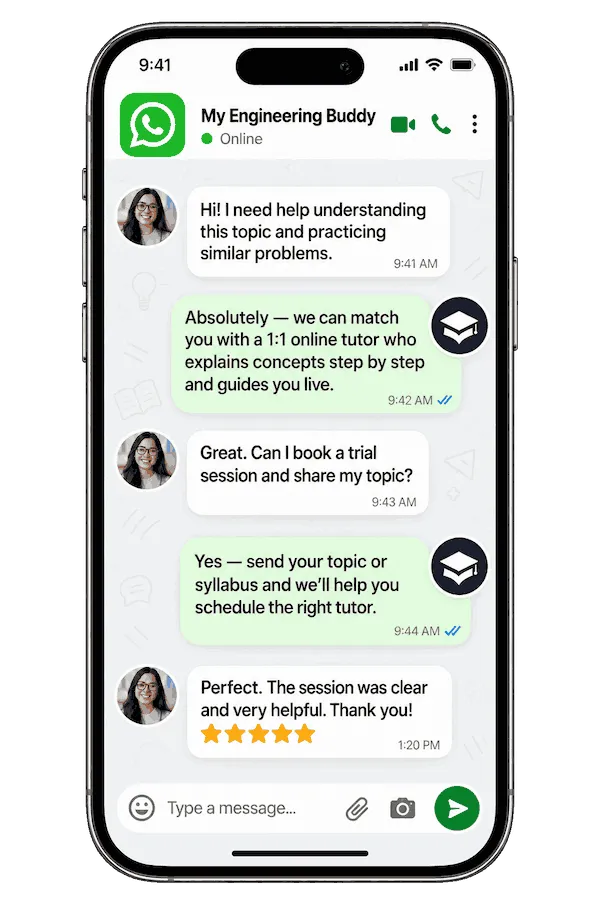
Unlike platforms where you fill out a form and wait, MEB responds in under a minute, 24/7. Tutor match takes under an hour. The $1 trial means you test before you commit. Everything runs over WhatsApp — no logins, no intake forms.
Study Plans (Pick One That Matches Your Goal)
After the first diagnostic session, your tutor builds a specific sequence. The three most common plans: a catch-up sprint (1–3 weeks, closing specific gaps before an exam or submission), structured exam preparation (4–8 weeks, working systematically through all assessed topics with mock questions and feedback), and weekly semester support (ongoing, aligned to your lecture schedule and assignment deadlines). The plan is yours — the tutor adjusts it as you progress.
Pricing Guide
Biochemical engineering tutoring starts at $20/hr for standard undergraduate content. Graduate-level support, thesis-level modelling, and specialist bioprocess topics run higher — up to $100/hr for tutors with industrial or research backgrounds. Rate factors include your level, topic complexity, how quickly you need to start, and tutor availability.
Availability tightens around end-of-semester exams and dissertation submission windows. If you’re two weeks from a deadline, book sooner rather than later.
For students targeting positions in biopharma, bioprocess R&D, or doctoral programmes at leading research universities, tutors with direct industry or postdoctoral research backgrounds are available at higher rates — share your specific goal and MEB will match the tier to your ambition.
Start with the $1 trial — 30 minutes, no registration, no commitment. WhatsApp MEB for a quick quote.
FAQ
Is biochemical engineering hard?
Yes, genuinely. It sits at the intersection of chemical engineering, microbiology, and biochemistry — students who are strong in one area often hit walls in another. The hardest concepts for most students are oxygen transfer, metabolic flux modelling, and downstream process design.
How many sessions are needed?
For closing a specific gap before an exam, 4–8 sessions is typical. For ongoing semester support or graduate-level work, students usually book weekly. The tutor maps this out after the first diagnostic session based on your timeline and starting point.
Can you help with practice exercises?
MEB tutoring is guided learning — you understand the work, then submit it yourself. The tutor explains the method and walks through similar problems; the work you submit is your own. See our Academic Integrity policy and Why MEB page for full details on what we help with and what we don’t.
Will the tutor match my exact syllabus or exam board?
Yes. When you contact MEB, share your university, course code, and textbook if you have one. Tutors are matched on syllabus fit — not just subject area. A tutor familiar with Doran’s Bioprocess Engineering Principles and your university’s assessment style is a very different match to a general chemistry tutor.
What happens in the first session?
The first session is a diagnostic. The tutor reviews your current understanding, identifies where the gaps actually are, and sets the initial topic sequence. Come with a recent problem sheet or past exam question you found difficult — that gives the tutor the fastest read on where to start.
Is online tutoring as effective as in-person?
For biochemical engineering, yes — because the subject is equation-heavy and diagram-heavy, which suits annotated screen work well. Google Meet with a digital pen-pad replicates a whiteboard session closely. Students working through bioreactor calculations or kinetic derivations online report no meaningful difference from face-to-face.
What’s the difference between biochemical engineering and biomedical engineering — do your tutors cover both?
Biochemical engineering focuses on bioprocesses — fermentation, enzyme reactions, bioreactor design, and bioseparations. Biomedical engineering is primarily about medical devices and clinical applications. MEB has specialist tutors in both. When you contact us, specify your course title so we match you to the right tutor.
Can a tutor help me with bioreactor scale-up calculations for my thesis or dissertation project?
Yes. MEB works with Masters and PhD students on research-level problems including scale-up modelling, kLa determination, metabolic flux analysis, and downstream process design. Share your project brief and the tutor will be matched on research background, not just teaching experience.
Do you offer help with biochemical engineering at midnight or in other time zones?
Yes. MEB tutors cover all major time zones — US Eastern through Gulf Standard Time and beyond. Late-night sessions are available and regularly booked by students in Australia, the UAE, and North America. WhatsApp MEB and availability for your time slot is confirmed within minutes.
What if I don’t like my assigned tutor?
Tell MEB on WhatsApp. A replacement tutor is matched immediately — no forms, no waiting period. The $1 trial exists precisely so you test the fit before committing to a longer plan. If it’s not right, you don’t pay more to find out.
How do I get started?
Three steps: WhatsApp MEB, get matched with a verified biochemical engineering tutor (usually within the hour), and start the $1 trial — 30 minutes of live tutoring or one homework question explained in full. No registration required.
Trust & Quality at My Engineering Buddy
Every MEB tutor passes a subject-knowledge screening and a live demo evaluation before working with students. Ongoing session feedback is reviewed — tutors with consistently poor ratings are removed from the platform. Tutors hold degrees in biochemical engineering or closely related fields, and many have postgraduate or professional industry experience in bioprocess development, fermentation, or biopharma. Rated 4.8/5 across 40,000+ verified reviews on Google.
MEB tutoring is guided learning — you understand the work, then submit it yourself. For full details on what we help with and what we don’t, read our Academic Integrity policy and Why MEB.
MEB has served 52,000+ students across the US, UK, Canada, Australia, the Gulf, and Europe since 2008, across 2,800+ subjects. In Biotechnology and related disciplines, that includes students working on protein engineering tutoring, bioremediation help, and downstream processing tutoring alongside biochemical engineering. Learn more about how sessions are structured at MEB’s tutoring methodology page.
Explore Related Subjects
Students studying biochemical engineering often also need support in:
A common pattern our tutors observe is that biochemical engineering students who invest in even four to six targeted sessions before a major assessment recover ground that months of re-reading lecture notes didn’t move. The difference is corrective feedback on live problems, not more passive review.
Next Steps
Ready to get started? Here’s what to do:
- Share your university, course name, and the specific topics or problems giving you trouble
- Share your availability and time zone
- MEB matches you with a verified biochemical engineering tutor — usually within 24 hours, often faster
- Your first session starts with a diagnostic so every minute is used well
Before your first session, have ready: your course outline or syllabus, a recent problem sheet or past exam question you struggled with, and your exam or submission deadline. The tutor handles the rest.
Visit www.myengineeringbuddy.com for more on how MEB works.
WhatsApp to get started or email [email protected].
Reviewed by Subject Expert
This page has been carefully reviewed and validated by our subject expert to ensure accuracy and relevance.