




~1 min
Average Reply Time
~1 hour
To Be Matched With A Tutor
30 Min Trial
75% Find Their Tutor On The 1st Trial
$20-35+/hr
Premium Yet Affordable Learning
Most students who struggle with protein engineering don’t lack intelligence. They lack a tutor who’s actually worked with directed evolution, rational design, or computational modelling — not just read about it.
Protein Engineering Tutor Online
Protein engineering is an applied branch of biotechnology in which proteins are modified or designed from scratch to enhance function, stability, or specificity, using techniques such as directed evolution, rational design, and computational modelling.
Finding a protein engineering tutor near me who genuinely understands this subject — at graduate level — is harder than it sounds. MEB’s biotechnology tutoring network includes specialists in protein structure, enzyme engineering, and synthetic biology who work 1:1 with you on your exact course. Whether you’re in the US, UK, Canada, Australia, or the Gulf, an online protein engineering tutor from MEB meets you where you are. One outcome you can count on: a clearer, more usable understanding of the material — built session by session.
- 1:1 online sessions tailored to your university module or research programme
- Expert-verified tutors with postgraduate credentials in biochemistry, bioengineering, or structural biology
- Flexible time zones — US, UK, Canada, Australia, Gulf
- Structured learning plan built after a first diagnostic session
- Ethical academic guidance — you understand the work before you submit
52,000+ students across the US, UK, Canada, Australia, and the Gulf have used MEB since 2008 — including students in Biotechnology subjects like protein engineering, biochemical engineering, and fermentation technology.
Source: My Engineering Buddy, 2008–2025.
How Much Does a Protein Engineering Tutor Cost?
Most protein engineering tutoring sessions run $20–$40/hr at standard undergraduate level, and up to $100/hr for graduate research support or highly specialised topics like de novo protein design or cryo-EM interpretation. Not sure yet? Start with the $1 trial — 30 minutes of live 1:1 tutoring or one full homework question explained.
| Level / Need | Typical Rate | What’s Included |
|---|---|---|
| Undergraduate (most modules) | $20–$40/hr | 1:1 sessions, homework guidance |
| Graduate / Research Level | $40–$100/hr | Expert tutor, niche depth, thesis support |
| $1 Trial | $1 flat | 30 min live session or 1 homework question |
Tutor availability tightens significantly during end-of-semester assessment periods. Book early if you’re approaching a submission window.
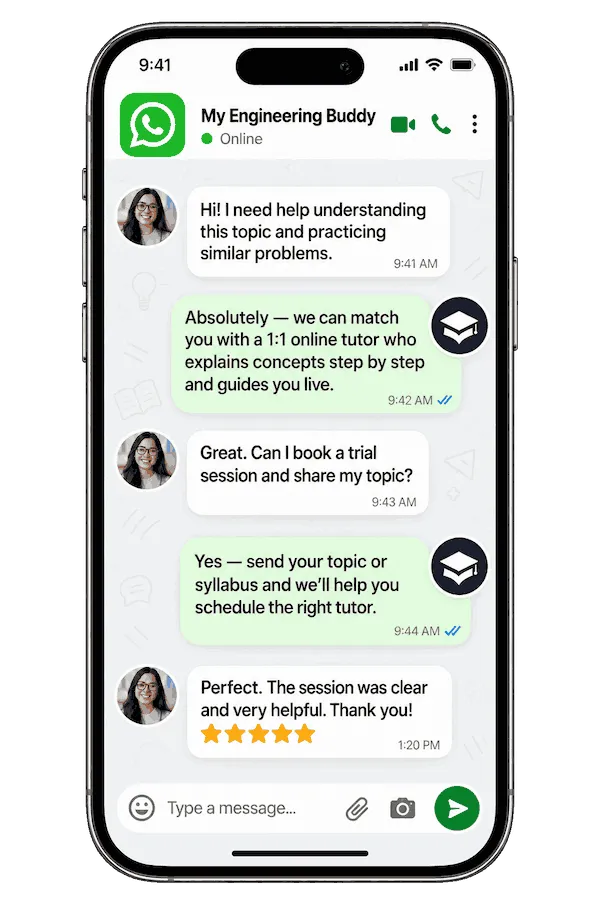
WhatsApp MEB for a quick quote — average response time under 1 minute.
Who This Protein Engineering Tutoring Is For
Protein engineering sits at the intersection of biochemistry, structural biology, and computation. It’s not a subject you can coast through by memorising facts — you need to reason through mechanisms. Most students who come to MEB are stuck on one of three things: protein folding logic, experimental design for mutagenesis studies, or interpreting assay data correctly.
- Undergraduate biochemistry or bioengineering students covering protein structure and function modules
- Masters students in biotechnology, chemical biology, or drug discovery pipelines
- PhD candidates needing to sharpen their understanding of directed evolution or computational docking before a supervisor meeting
- Students retaking after a failed first attempt — especially those who lost marks on mechanism-based exam questions
- Students with a dissertation or lab report submission deadline approaching in the next 2–4 weeks
- Parents of undergraduates watching grades slip in a module that carries significant weight toward a degree classification
MEB tutors have helped students at Cornell, Imperial College London, ETH Zurich, the University of Toronto, and Melbourne — across both taught postgraduate programmes and final-year undergraduate research projects.
1:1 Tutoring vs Self-Study vs AI vs YouTube vs Online Courses
Self-study: works if you already have a strong biochemistry base — breaks down fast when you hit directed evolution libraries or Rosetta outputs. AI tools: can explain protein folding concepts broadly, but can’t spot where your specific reasoning on a mutagenesis question breaks down. YouTube: useful for visualising secondary structure — stops dead when you need to interpret your own lab data. Online courses: structured, but fixed pace and no one corrects your mistakes in real time. 1:1 tutoring with MEB: a tutor who knows protein engineering works through your actual module content with you — correcting errors the moment they appear, not after the exam.
Outcomes: What You’ll Be Able To Do in Protein Engineering
After working with an MEB protein engineering tutor online, you’ll be able to apply rational design principles to identify which amino acid substitutions are likely to improve enzyme thermostability, analyse directed evolution experimental data and interpret selection pressure outcomes, explain the structural basis of protein-ligand binding and model how mutations shift affinity, write up a mutagenesis strategy for a coursework question with clear mechanistic justification, and present computational docking results in a way that connects structure to function — the link most students miss.
“Based on feedback from 40,000+ sessions collected by MEB from 2022 to 2025, 58% of students improved by one full grade after approximately 20 hours of 1:1 tutoring in subjects like protein engineering. A further 23% achieved at least a half-grade improvement.”
Source: MEB session feedback data, 2022–2025.
Try your first session for $1 — 30 minutes of live 1:1 tutoring or one homework question explained in full. No registration. No commitment. WhatsApp MEB now and get matched within the hour.
What We Cover in Protein Engineering (Syllabus / Topics)

Protein Structure, Folding, and Stability
- Primary, secondary, tertiary, and quaternary structure — with emphasis on how each level affects function
- Thermodynamic principles of protein folding: ΔG, hydrophobic collapse, and entropy contributions
- Chaperone-assisted folding and misfolding diseases
- Disulfide bond formation, glycosylation, and post-translational modifications
- Techniques for assessing stability: circular dichroism, differential scanning calorimetry, thermal shift assays
- Structural databases — PDB, UniProt — and how to extract relevant data for engineering decisions
Recommended texts: Proteins: Structures and Molecular Properties (Creighton); Introduction to Protein Structure (Branden & Tooze).
Rational Design and Directed Evolution
- Site-directed mutagenesis: PCR-based methods, overlap extension, and QuikChange protocols
- Rational design logic — identifying target residues using structure-activity relationships
- Directed evolution: error-prone PCR, DNA shuffling, and phage display library construction
- Selection and screening strategies — FACS, ELISA, colorimetric assays
- Computational tools: Rosetta, FoldX, PyMOL for mutation modelling
- Case studies: evolving enzymes for industrial catalysis, antibody affinity maturation
Recommended texts: Directed Evolution Library Creation (Arnold & Georgiou); Protein Engineering Handbook (Lutz & Bornscheuer). Students also benefit from exploring PLOS Medicine for open-access applied research examples in therapeutic protein development.
Computational Protein Engineering and Applications
- Homology modelling and ab initio structure prediction — including AlphaFold2 interpretation
- Molecular dynamics simulations: GROMACS, AMBER — setup and output analysis
- Protein-ligand docking: AutoDock Vina, Glide — scoring functions explained
- De novo protein design principles and applications in biosensors and therapeutics
- Enzyme engineering for biocatalysis: substrate scope, enantioselectivity, and solvent tolerance
- Antibody engineering: CDR grafting, humanisation strategies, bispecific formats
Recommended texts: Introduction to Computational Biochemistry (Tsai); Bioinformatics and Functional Genomics (Pevsner). Students working with downstream processing problems will find the overlap with purification and expression optimisation directly applicable here.
At MEB, we’ve found that students who struggle most with protein engineering are usually missing one thing: a clear mental model connecting amino acid sequence to three-dimensional function. Once that link clicks — usually in the second or third session — the rest of the module becomes significantly more manageable.
What a Typical Protein Engineering Session Looks Like
The tutor opens by checking what happened with directed evolution library design from the previous session — where the student got stuck, what they tried. From there, the session moves into live problem-solving: the student and tutor work through a mutagenesis strategy question on screen, with the tutor using a digital pen-pad to annotate protein structures and walk through the mechanistic logic step by step. The student then replicates the reasoning on a similar question — out loud, with the tutor listening for gaps. The session closes with a specific practice task: two or three mechanism questions drawn from past papers or coursework topics, and a note on which computational tool to revisit before the next session.
How MEB Tutors Help You with Protein Engineering (The Learning Loop)
Diagnose: In the first session, the tutor works through a short set of targeted questions to find exactly where your understanding breaks down — whether that’s thermodynamic reasoning, experimental design, or interpreting bioinformatics output. This isn’t a generic quiz. It’s built around your actual course content.
Explain: The tutor works through problems live, using a digital pen-pad or iPad and Apple Pencil to draw out protein structures, annotate reaction mechanisms, and show — not just tell — how a mutation shifts function. Text alone doesn’t work for this subject.
Practice: You attempt the next problem with the tutor present. Not after the session. Right there. The moment you drift into a misunderstanding, it gets caught and fixed immediately — not a week later when you’re reviewing notes.
Feedback: The tutor explains exactly where marks were lost in your draft answers and why — tracing the error back to the underlying concept, not just marking it wrong. This is what turns a 58 into a 72.
Plan: Each session ends with a clear sequence: what to consolidate, what comes next, and when to check back in. If your exam date or submission deadline shifts, the plan shifts with it.
Sessions run on Google Meet. Share your lecture slides, past paper attempts, or lab reports before the first session — the tutor reviews them in advance. The first session covers your diagnostic and the first real content gap, so no time is wasted on introductions. Start with the $1 trial — 30 minutes of live tutoring that also serves as your first diagnostic. Whether you need a two-week catch-up, structured revision over six weeks, or ongoing weekly support through the semester, the tutor maps the session plan after that first session.
MEB tutors cover protein engineering from undergraduate module level through to PhD-adjacent research support — including directed evolution, AlphaFold2 interpretation, and enzyme engineering for industrial applications. Sessions are live, structured, and built around your specific course material.
Source: My Engineering Buddy, 2008–2025.
Tutor Match Criteria (How We Pick Your Tutor)
Not every biochemistry tutor can cover protein engineering at graduate depth. MEB screens specifically for this.
Subject depth: Tutors hold postgraduate degrees in biochemistry, bioengineering, structural biology, or computational chemistry — and have demonstrable experience with the techniques on your syllabus, not just the theory. Tools: Every tutor uses Google Meet plus a digital pen-pad or iPad and Apple Pencil — essential for annotating protein structures in real time. Time zone: Matched to your region, whether you’re in North America, the UK, Europe, the Gulf, or Australia. Goals: Whether you need to pass a resit, deepen conceptual understanding for a research project, or get animal biotechnology and protein expression questions under control alongside your main module — the match accounts for all of it.
Unlike platforms where you fill out a form and wait, MEB responds in under a minute, 24/7. Tutor match takes under an hour. The $1 trial means you test before you commit. Everything runs over WhatsApp — no logins, no intake forms.
Students consistently tell us that the biggest difference between MEB and other platforms isn’t the tutors’ credentials — it’s the speed. Matched within an hour, diagnostic done in the first session, real content covered from session two. No warm-up period. No filler weeks.
Study Plans (Pick One That Matches Your Goal)
Once the diagnostic is done, your tutor builds a plan around your timeline. Catch-up (1–3 weeks): for students who have fallen behind on a specific topic cluster — protein folding, mutagenesis strategy, or computational tools — and need to close the gap before an exam or submission. Exam prep (4–8 weeks): structured revision tied to your exam date, working through past papers with targeted feedback on mechanism questions and data interpretation. Weekly support: ongoing through the semester, aligned to lecture pace and assessed coursework deadlines. The tutor sequences sessions so that each one builds directly on the last.
Pricing Guide
Standard protein engineering tutoring runs $20–$40/hr at undergraduate level. Graduate, research-facing, or highly specialised support — AlphaFold2 analysis, Rosetta-based design problems, antibody engineering — is available up to $100/hr depending on tutor background and topic depth.
Rate factors: academic level, topic complexity, your timeline, and tutor availability. Availability tightens sharply at end-of-semester. If you have a deadline coming up, don’t wait.
For students targeting competitive graduate programmes, industry research roles, or pharmaceutical industry positions, tutors with professional research backgrounds in therapeutic protein development or industrial enzyme engineering are available at specialist rates — share your specific goal and MEB will match the right tier.
Start with the $1 trial — 30 minutes, no registration, no commitment. WhatsApp MEB for a quick quote.
FAQ
Is protein engineering hard?
Yes — it combines structural biology, thermodynamics, molecular biology techniques, and increasingly, computational tools. Students who struggle usually have gaps in one of these foundations. A targeted diagnostic session identifies exactly which gap is causing the most damage to your marks.
How many sessions are needed?
Most students working with MEB see a clear grade improvement after 8–12 hours of focused 1:1 work. The exact number depends on how many topics need covering, how soon your exam or submission is, and how much independent practice you do between sessions.
Can you help with practice exercises?
MEB tutoring is guided learning — you understand the work, then submit it yourself. Your tutor walks through the reasoning, explains the mechanism, and checks your approach. See our Academic Integrity policy and Why MEB page for full details on what we help with and what we don’t.
Will the tutor match my exact syllabus or exam board?
Yes. Before matching, MEB confirms your university, module name, and assessment format. Tutors are selected based on familiarity with your specific course content — not just the subject area in general. If your module uses a specific textbook, share it before the first session.
What happens in the first session?
The tutor runs a short diagnostic to find where your understanding currently breaks down. Then the session moves directly into the first real content area. You leave with a clear topic map and a specific task to work on before the next session — no wasted time.
Is online tutoring as effective as in-person?
For protein engineering, yes — the digital pen-pad and screen-sharing tools replicate what a whiteboard does in person, and in many cases work better for annotating 3D protein structure diagrams. MEB tutors have used this format across thousands of sessions since 2008.
Can I get protein engineering help at midnight or on weekends?
Yes. MEB operates 24/7 across time zones. WhatsApp response time is typically under one minute, any time of day or night. Session availability varies by tutor, but there is almost always cover available for urgent turnaround requests.
What if I don’t connect with my assigned tutor?
Tell MEB immediately. A replacement match happens within the hour. The $1 trial exists precisely so you can test the fit before committing to ongoing sessions — no awkward conversations, no wasted money.
Do you offer group protein engineering sessions?
MEB’s format is 1:1 — that’s the whole model. Group sessions compromise the diagnostic precision and live correction that make 1:1 tutoring effective. If you’re studying with a classmate, both of you can book separately and often be matched with the same tutor.
What’s the difference between directed evolution and rational design, and which should I focus on?
Directed evolution uses random mutation and selection to improve proteins without needing structural knowledge. Rational design uses known structure-function relationships to make targeted changes. Most university modules assess both — your tutor will identify which one your course weights more heavily and structure sessions accordingly.
Does AlphaFold2 change what I need to know for protein engineering exams?
It changes what you’re asked to interpret, not the underlying principles. Examiners increasingly include AlphaFold2 outputs in data questions, expecting students to critically evaluate predicted structures rather than just describe them. MEB tutors cover this — including the known limitations of AlphaFold2 that often appear as exam traps.
How do I get started?
Start with the $1 trial — 30 minutes of live tutoring or one homework question fully explained. Three steps: WhatsApp MEB, get matched with a protein engineering tutor within the hour, and begin your trial session. No forms, no waiting.
Trust & Quality at My Engineering Buddy
Every MEB tutor goes through a structured vetting process: subject-specific application screening, a live demo evaluation, and ongoing review based on student feedback after sessions. Tutors covering protein engineering hold postgraduate qualifications in biochemistry, bioengineering, structural biology, or related fields — and many have active or recent research experience. Rated 4.8/5 across 40,000+ verified reviews on Google.
MEB tutoring is guided learning — you understand the work, then submit it yourself. For full details on what we help with and what we don’t, read our Academic Integrity policy and Why MEB.
MEB has been serving students in the US, UK, Canada, Australia, the Gulf, and Europe since 2008 — across 2,800+ subjects. In Biotechnology specifically, that includes students needing help with bioremediation tutoring, phytoremediation help, and protein engineering at every level from second-year undergraduate through to doctoral research preparation. Tutor quality is reviewed continuously — a tutor who gets poor feedback doesn’t stay on the platform. See our tutoring methodology for how we build and maintain that standard.
MEB has been operating since 2008 — 18 years of verified tutoring across 2,800+ subjects. In Biotechnology, the platform covers everything from foundational biochemistry through to graduate-level protein engineering and computational design.
Source: My Engineering Buddy, 2008–2025.
Explore Related Subjects
Students studying protein engineering often also need support in:
- Animal biotechnology
- Biochemical engineering
- Fermentation technology
- Bioremediation
- Downstream processing
- Phytoremediation
Next Steps
Before your first session, have ready: your module guide or course outline, a recent past paper attempt or assignment question you struggled with, and your exam or submission date. The tutor handles the rest.
- Share your exam board or university module name, your hardest topic, and your current timeline
- Share your availability and time zone — MEB covers all major regions
- MEB matches you with a verified protein engineering tutor — usually within the hour
First session starts with a diagnostic so every minute of your time is used well. Visit www.myengineeringbuddy.com for more on how MEB works.
WhatsApp to get started or email [email protected].
Reviewed by Subject Expert
This page has been carefully reviewed and validated by our subject expert to ensure accuracy and relevance.




