




~1 min
Average Reply Time
~1 hour
To Be Matched With A Tutor
30 Min Trial
75% Find Their Tutor On The 1st Trial
$20-35+/hr
Premium Yet Affordable Learning
Stuck on a PIPE-FLO simulation that keeps throwing pressure errors at 2 a.m.? That’s exactly when MEB tutors are available.
PIPE-FLO Tutor Online
PIPE-FLO is a professional piping system design and fluid flow simulation software used in civil and mechanical engineering to model pressure, flow rates, pump performance, and pipe network behaviour under steady-state and dynamic conditions.
If you’ve searched for a PIPE-FLO tutor near me, you’ve likely already spent hours fighting convergence errors, mismatched pump curves, or a network model that simply won’t balance. MEB connects you with a verified civil engineering tutor who knows PIPE-FLO’s interface, its quirks, and the hydraulic theory underneath it. Sessions run 1:1, online, and are built around your specific project or course — not a generic curriculum. You won’t just fix the model. You’ll understand why it failed.
- 1:1 online sessions tailored to your PIPE-FLO version and project requirements
- Expert-verified tutors with hydraulic engineering and fluid simulation backgrounds
- Flexible time zones — US, UK, Canada, Australia, Gulf covered 24/7
- Structured learning plan built after an initial diagnostic session
- Ethical homework and assignment guidance — you understand the work, then submit it yourself
52,000+ students across the US, UK, Canada, Australia, and the Gulf have used MEB since 2008 — including students working in civil engineering software subjects like PIPE-FLO, EPANET tutoring, and WaterCAD/WaterGEMS help.
Source: My Engineering Buddy, 2008–2025.
How Much Does a PIPE-FLO Tutor Cost?
Most PIPE-FLO tutoring sessions run between $20 and $40 per hour. Graduate-level or specialist industrial piping projects can reach up to $100/hr depending on tutor depth and turnaround urgency. The $1 trial gets you 30 minutes of live 1:1 tutoring or a full explanation of one problem — no registration required.
| Level / Need | Typical Rate | What’s Included |
|---|---|---|
| Standard (undergraduate projects) | $20–$35/hr | 1:1 sessions, homework guidance |
| Advanced / Graduate / Industrial | $35–$100/hr | Expert tutor, complex network modelling |
| $1 Trial | $1 flat | 30 min live session or 1 homework question |
Tutor availability tightens around semester project deadlines and capstone submission periods. Book early if your deadline is within two weeks.
WhatsApp MEB for a quick quote — average response time under 1 minute.
Who This PIPE-FLO Tutoring Is For
PIPE-FLO sits at the intersection of hydraulic theory and software application. Most students struggle not because they lack engineering sense, but because the software demands very specific model-building habits that nobody taught them explicitly.
- Undergraduate civil or mechanical engineering students with a piping systems project due
- Graduate students using PIPE-FLO for pump selection, network analysis, or thesis modelling
- Students retaking a fluid mechanics or hydraulics course after a failed first attempt
- Students with a capstone or design project deadline approaching in the next few weeks
- Working engineers new to PIPE-FLO who need to get productive fast without formal training
- Students at universities including MIT, Georgia Tech, University of Toronto, Imperial College London, TU Delft, and UNSW who use PIPE-FLO within hydraulics or water systems modules
If your piping network model won’t converge, your pump curve data looks right but the software disagrees, or you’re unsure how to set boundary conditions — this is the right session to book.
1:1 Tutoring vs Self-Study vs AI vs YouTube vs Online Courses
Self-study works if you already understand fluid mechanics and just need to learn the interface — most students don’t. AI tools like ChatGPT can explain Bernoulli’s equation but can’t open your PIPE-FLO file and tell you why node 14 is causing the divergence. YouTube covers software walkthroughs at a surface level; the moment your specific network throws an error, the video stops being useful. Online courses give you a fixed workflow that may not match your actual project setup. With MEB’s 1:1 PIPE-FLO tutoring, the tutor works directly inside your model, diagnoses the specific failure, and corrects it while explaining the hydraulic reasoning — live, in your session.
Outcomes: What You’ll Be Able To Do in PIPE-FLO
After working with an MEB online PIPE-FLO tutor, you’ll be able to build a complete pipe network from scratch, set appropriate boundary conditions for both open and closed systems, and run steady-state simulations without convergence errors. You’ll analyze pressure drops across specific components — valves, fittings, reducers — and interpret where energy losses are occurring. You’ll apply pump affinity laws to select the right pump from a performance curve, model parallel and series pump configurations, and produce output reports that meet typical university submission requirements. Confidence with the software grows fast once the underlying hydraulics clicks.
Based on feedback from 40,000+ sessions collected by MEB from 2022 to 2025, 58% of students improved by one full grade after approximately 20 hours of 1:1 tutoring in subjects like PIPE-FLO. A further 23% achieved at least a half-grade improvement.
Source: MEB session feedback data, 2022–2025.
At MEB, we’ve found that PIPE-FLO errors almost always trace back to one of three root causes: wrong boundary condition type, incorrect fluid property input, or a pump curve entered in the wrong units. Tutors check all three in the first ten minutes — and that alone saves most students hours of dead-end troubleshooting.
What We Cover in PIPE-FLO (Syllabus / Topics)

Track 1: Pipe Network Fundamentals and Model Setup
- Understanding PIPE-FLO’s interface: design sheets, components, and fluid systems
- Defining fluid properties: viscosity, density, temperature, and fluid libraries
- Building pipe segments: length, diameter, material roughness, and fittings
- Setting boundary conditions: pressure sources, flow demands, and reservoir nodes
- Running steady-state simulations and interpreting flow/pressure output tables
- Identifying and fixing common convergence errors and iteration failures
- Generating professional output reports for submission or client delivery
Textbooks referenced: Fluid Mechanics by Frank White; Introduction to Fluid Mechanics by Fox, McDonald & Pritchard; Piping Systems Manual by Brian Silowash.
Track 2: Pump Systems and Performance Modelling
- Reading and importing pump performance curves into PIPE-FLO
- Selecting operating points: intersection of system curve and pump curve
- Modelling series and parallel pump configurations
- Applying pump affinity laws for speed and impeller diameter changes
- Net positive suction head (NPSH) calculations and cavitation risk assessment
- Variable speed drives and part-load performance modelling
- Comparing centrifugal vs. positive displacement pump behaviour in network models
Textbooks referenced: Pump Handbook by Karassik et al.; Centrifugal Pumps by Johann Gülich; manufacturer pump data sheets used alongside software.
Track 3: Advanced Network Analysis and Industrial Applications
- Modelling complex looped and branched networks with multiple supply points
- Fire protection system hydraulics: sprinkler demand, hose streams, and residual pressure
- Water distribution system analysis and pressure zone modelling
- HVAC chilled water and hot water loop design in PIPE-FLO
- Control valve sizing and modelling: Cv, pressure drop, and flow regulation
- Integrating water resources engineering concepts into industrial piping models
- Scenario comparison: design alternatives, what-if analyses, and system optimisation
Textbooks referenced: Water Supply Engineering by Bhave & Gupta; Fire Protection Hydraulics and Water Supply by Pat Brock; PIPE-FLO Professional User Guide (Engineered Software).
What a Typical PIPE-FLO Session Looks Like
The tutor opens by checking where you left off — usually the pump curve selection or a network that wouldn’t converge in the last session. You share your screen and pull up the PIPE-FLO model together. The tutor walks through your boundary conditions first, checks the fluid properties panel, then traces the problem through the network node by node. When an error turns up — wrong pressure reference, unit mismatch in the pump data table, missing fitting loss — the tutor explains the hydraulic reason before touching the fix, so you understand it, not just copy it. You then rebuild that section yourself while the tutor watches. Session closes with one specific task: re-run the full simulation, check the pressure profile at the critical node, and note any new flags for next time.
How MEB Tutors Help You with PIPE-FLO (The Learning Loop)
Diagnose: In the first session, the tutor reviews your model file or project brief. They identify the exact failure point — whether it’s a conceptual gap in fluid mechanics, a data entry error, or a misunderstanding of how PIPE-FLO handles closed-loop vs. open systems.
Explain: The tutor works through a corrected version of your problem on screen using a digital pen-pad, annotating the hydraulic gradient, marking where head loss accumulates, and showing the pump operating point shift in real time. Nothing is assumed — every step is shown.
Practice: You take over. The tutor gives you a parallel problem — same network topology, different pipe sizes or pump data — and watches you build it. Errors get caught immediately, not after you’ve submitted.
Feedback: Step-by-step correction follows. The tutor explains not just what was wrong but why it costs marks or causes real-world system failure. That distinction matters for both exams and professional work.
Plan: Each session ends with a written next-step list: which PIPE-FLO module to tackle next, which theory chapter to read, and what to prepare before the following session. Progress is visible.
Sessions run over Google Meet with a digital pen-pad or iPad and Apple Pencil for annotation. Before your first session, have your project brief or course outline ready, plus any PIPE-FLO files you’ve already started. Start with the $1 trial — 30 minutes of live tutoring that also serves as your first diagnostic. Whether you need a quick fix before a submission deadline or structured support over 4–8 weeks, the tutor maps the plan after that first session.
Students consistently tell us that the moment PIPE-FLO clicks is when they stop treating it as a drawing tool and start treating it as a hydraulic solver. The software is doing real fluid mechanics — it just needs accurate inputs and correct boundary logic to give you accurate outputs.
Tutor Match Criteria (How We Pick Your Tutor)
Not every fluid mechanics engineer is the right fit for PIPE-FLO specifically. Here’s what MEB checks before matching.
Subject depth: The tutor must have hands-on PIPE-FLO experience — not just hydraulics theory. MEB verifies version familiarity (PIPE-FLO Professional, Std, or industry-specific builds) and checks whether the tutor has worked on the type of system you’re modelling: water distribution, HVAC loops, fire protection, or industrial process piping.
Tools: Every tutor uses Google Meet with a digital pen-pad or iPad and Apple Pencil. Screen annotation is standard — not optional.
Time zone: Matched to your region. US, UK, Gulf, Canada, and Australia all have tutor availability within the hour for most requests.
Goals: Whether you need to pass a module, complete a capstone project, prepare for a viva, or get faster at the software for professional use — the tutor selection reflects that specific goal.
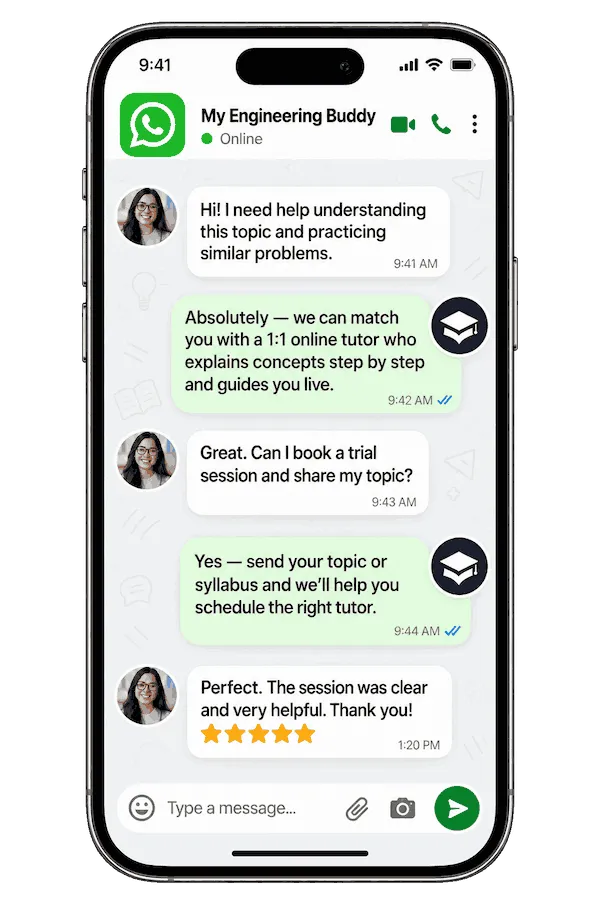
Unlike platforms where you fill out a form and wait days, MEB responds in under a minute, 24/7. Tutor match takes under an hour. The $1 trial means you test before you commit. Everything runs over WhatsApp — no logins, no intake forms.
Pricing Guide
PIPE-FLO tutoring starts at $20/hr for standard undergraduate project support. Graduate-level work, industrial piping systems, or sessions requiring specialist knowledge of fire protection hydraulics or HVAC loop design typically run $50–$100/hr. Rate depends on the complexity of your network, your timeline, and tutor availability.
Peak demand hits hard around semester project deadlines — particularly in April, November, and late August. If you’re within three weeks of a submission, book now rather than later.
For students targeting positions at engineering consultancies, water utilities, or firms that use PIPE-FLO in production environments, tutors with professional industrial piping backgrounds are available at higher rates. Share your specific goal and MEB will match the tier to your ambition.
Start with the $1 trial — 30 minutes, no registration, no commitment. WhatsApp MEB for a quick quote.
MEB covers 2,800+ engineering and technical subjects — from niche simulation tools to core civil engineering modules. If your course involves specialist software alongside PIPE-FLO, there’s almost certainly a matched tutor available.
Source: My Engineering Buddy, 2008–2025.
FAQ
Is PIPE-FLO hard to learn?
The interface is learnable in a few hours. The hard part is understanding why your model behaves the way it does — which requires solid hydraulics fundamentals. Students with gaps in fluid mechanics find PIPE-FLO frustrating quickly. A tutor closes both gaps simultaneously.
How many sessions will I need?
For a single project fix or convergence error, one to two sessions is usually enough. For building full competence across pump selection, network analysis, and report generation, most students need six to ten hours spread over two to three weeks.
Can you help with homework and assignments?
Yes — MEB tutoring is guided learning. You understand the work, then submit it yourself. Our tutors explain the method, walk through similar examples, and help you apply the logic to your own assignment. See our Academic Integrity policy and Why MEB page for full details on what we help with and what we don’t.
Will the tutor match my exact syllabus or exam board?
Yes. Before the first session, share your course outline, project brief, or university module descriptor. The tutor reviews it beforehand and aligns the session to your specific requirements — not a generic PIPE-FLO curriculum.
What happens in the first session?
The tutor runs a short diagnostic: reviews your current model or project brief, asks about your hydraulics background, and identifies the most critical gap. The rest of the session goes straight into fixing it. No time wasted on basics you already know.
Is online tutoring as effective as in-person for software like PIPE-FLO?
For software tutoring specifically, online is often better. Screen sharing lets the tutor see your exact model, annotate directly over it, and demonstrate fixes in real time — something an in-person whiteboard session cannot replicate. Most students find it faster and more precise.
Can I get PIPE-FLO help late at night or on weekends?
Yes. MEB operates 24/7 across time zones. Students in the US, UK, Gulf, Canada, and Australia regularly book evening and weekend sessions. WhatsApp response time is typically under a minute regardless of when you message.
What if I don’t like my assigned tutor?
Tell MEB via WhatsApp and a replacement is arranged immediately — no forms, no delay. The $1 trial exists partly for this reason: you test the tutor before committing to a full package.
Do you offer group PIPE-FLO sessions?
MEB specialises in 1:1 sessions. Group sessions are not offered. The 1:1 format is deliberate — your model, your errors, your pace. Group sessions tend to slow down the students who need to move fastest.
What’s the difference between PIPE-FLO Professional and PIPE-FLO Standard, and does my tutor know both?
PIPE-FLO Professional includes advanced modules for fire protection, HVAC, and multi-fluid systems. Standard covers core piping and pump analysis. When you contact MEB, specify your version — tutors are matched accordingly and familiar with both editions’ specific interface differences.
Can a PIPE-FLO tutor help me if I’m also using EPANET or WaterCAD for the same project?
Yes. Many water infrastructure projects use multiple tools simultaneously. MEB has tutors experienced in WaterCAD and WaterGEMS tutoring and EPANET help alongside PIPE-FLO. Mention the full software stack when you message, and MEB will match a tutor who covers all of them.
How do I get started?
Message MEB on WhatsApp — you’ll get a response in under a minute. Share your subject, software version, and deadline. You’ll be matched with a tutor within the hour and can start the $1 trial immediately: 30 minutes live or one full problem explained.
Trust & Quality at My Engineering Buddy
Every MEB tutor goes through subject-specific screening before their first session. For PIPE-FLO, that means verifying hands-on software experience — not just a fluid mechanics degree. Tutors complete a live demo evaluation, and ongoing session feedback is reviewed regularly. Rated 4.8/5 across 40,000+ verified reviews on Google. MEB has been running since 2008, serving 52,000+ students across the US, UK, Canada, Australia, the Gulf, and Europe.
MEB tutoring is guided learning — you understand the work, then submit it yourself. For full details on what we help with and what we don’t, read our Academic Integrity policy and Why MEB.
MEB covers 2,800+ subjects across civil engineering, structural engineering, and engineering software. Students working in PIPE-FLO often also need support in water supply engineering tutoring, hydrology help, and environmental engineering tutoring — and MEB covers all of them through the same platform, the same WhatsApp contact, and the same $1 trial entry point.
MEB tutors bring real engineering experience to PIPE-FLO sessions — not just textbook knowledge. Tutors have backgrounds in hydraulics and water infrastructure consulting, which means the advice you get is grounded in how these systems actually behave in practice.
Source: My Engineering Buddy tutor profiles, 2008–2025.
Our experience across thousands of sessions shows that students who share their project file before the session starts make better use of every minute. The tutor arrives already knowing your network structure, your fluid parameters, and your most likely error — so the session starts solving, not orienting.
Explore Related Subjects
Students studying PIPE-FLO often also need support in:
- Open Channel Flow
- Groundwater Engineering
- Irrigation Engineering
- InfoWater Pro (Autodesk)
- HEC-RAS
- Coastal Engineering
- Dam Engineering
Next Steps
Ready to fix your PIPE-FLO model or build the skills to work through it independently? Here’s how to start:
- Share your PIPE-FLO version, project type (water distribution, HVAC loop, fire protection, industrial piping), and your deadline
- Share your time zone and preferred session times
- MEB matches you with a verified tutor — usually within the hour
- First session starts with a diagnostic so every minute is used on your actual problem
Before your first session, have ready: your course outline or project brief, any PIPE-FLO files you’ve already started (even broken ones — especially broken ones), and your submission or exam date. The tutor handles the rest.
Visit www.myengineeringbuddy.com for more on how MEB works.
WhatsApp to get started or email [email protected].
Reviewed by Subject Expert
This page has been carefully reviewed and validated by our subject expert to ensure accuracy and relevance.




