




~1 min
Average Reply Time
~1 hour
To Be Matched With A Tutor
30 Min Trial
75% Find Their Tutor On The 1st Trial
$20-35+/hr
Premium Yet Affordable Learning
Hire The Best EPANET Tutor



Your EPANET model runs — but the pressure results make no sense. That’s exactly where a 1:1 tutor changes everything.
EPANET Tutor Online
EPANET is a free, open-source hydraulic and water quality simulation software developed by the US EPA, used to model pressure, flow, and constituent transport in pressurised pipe network systems.
If you’re searching for an EPANET tutor near me, MEB connects you with verified civil and environmental engineering tutors who work inside EPANET daily — not just engineers who’ve opened it once. As part of MEB’s broader civil engineering tutoring service, EPANET project help is available 1:1, online, matched to your exact assignment or course requirement. One session can turn a failing model into one you understand and can defend.
- 1:1 online sessions tailored to your specific EPANET project or course module
- Expert-verified tutors with hands-on hydraulic modelling and water systems experience
- Flexible time zones — US, UK, Canada, Australia, Gulf
- Structured session plan built after an initial diagnostic
- Guided project support — the tutor explains the method, you build and submit the model yourself
52,000+ students across the US, UK, Canada, Australia, and the Gulf have used MEB since 2008 — including students in Civil Engineering subjects like EPANET, WaterCAD/WaterGEMS, and water supply engineering.
Source: My Engineering Buddy, 2008–2025.
How Much Does an EPANET Tutor Cost?
Most EPANET tutoring sessions cost $20–$40/hr. Advanced hydraulic modelling work — multi-zone networks, water quality calibration, graduate-level projects — runs up to $100/hr. Your first session is available for $1 flat: 30 minutes of live 1:1 tutor time or one project question explained in full.
| Level / Need | Typical Rate | What’s Included |
|---|---|---|
| Undergraduate coursework | $20–$35/hr | 1:1 sessions, model-building guidance |
| Graduate / specialist modelling | $35–$70/hr | Expert tutor, calibration & scenario work |
| $1 Trial | $1 flat | 30 min live session or 1 project question |
Tutor availability tightens around semester submission deadlines. Book early if your hand-in is within three weeks.
WhatsApp MEB for a quick quote — average response time under 1 minute.
Who This EPANET Tutoring Is For
Most students come to MEB with a working EPANET file that produces wrong answers — or no answers at all. Some are building their first network from a set of pipe data. Others need to understand what their pressure zones and head loss results actually mean before they write up their report.
- Undergraduate civil and environmental engineering students with an EPANET project or coursework submission
- Graduate students using EPANET for water distribution modelling, demand allocation, or water age analysis
- Students 2–4 weeks from a submission deadline with significant gaps in their model setup
- Students retaking a failed water systems or hydraulics module and needing to rebuild from scratch
- Students whose university requires them to link EPANET outputs to design standards or regulatory compliance reports
- Students at programmes including Georgia Tech, University of Texas Austin, University of Toronto, Imperial College London, University of Melbourne, TU Delft, and King Abdullah University of Science and Technology who use EPANET as a core modelling tool
MEB also supports students working with InfoWater Pro and HEC-RAS — related hydraulic modelling tools where EPANET skills transfer directly.
1:1 Tutoring vs Self-Study vs AI vs YouTube vs Online Courses
Self-study works if you already understand hydraulic principles — but EPANET error messages are cryptic without a guide. AI tools can explain what a node is; they can’t debug your specific .net file in real time. YouTube covers the basics well and stops the moment your demand pattern won’t converge. Online courses walk through generic examples at a fixed pace, not your actual assignment network. 1:1 EPANET tutoring with MEB puts a tutor inside your model, watching where you set the wrong emitter coefficient or why your pump curve is clipping — and fixing it in the session.
Outcomes: What You’ll Be Able To Do in EPANET
After targeted 1:1 sessions, you’ll be able to model a full water distribution network — pipes, junctions, reservoirs, and tanks — and run extended period simulations with demand patterns you’ve built yourself. You’ll be able to analyse pressure at every node and explain where head loss becomes a design problem. You’ll apply water quality simulations to trace chlorine residuals or contaminant propagation through a system. You’ll present your EPANET results in a written report, matching model outputs to real design criteria and explaining deviations. And you’ll troubleshoot convergence errors, mass balance failures, and pump curve mismatches without starting over.
Try your first session for $1 — 30 minutes of live 1:1 tutoring or one homework question explained in full. No registration. No commitment. WhatsApp MEB now and get matched within the hour.
Based on feedback from 40,000+ sessions collected by MEB from 2022 to 2025, 58% of students improved by one full grade after approximately 20 hours of 1:1 tutoring in subjects like EPANET. A further 23% achieved at least a half-grade improvement.
Source: MEB session feedback data, 2022–2025.
What We Cover in EPANET (Topics)
Track 1: Network Setup and Hydraulic Modelling
- Drawing pipe networks: junctions, pipes, reservoirs, and tanks
- Assigning pipe diameters, lengths, roughness coefficients (Hazen-Williams, Darcy-Weisbach)
- Setting demand patterns and base demands at nodes
- Configuring pump curves and pump operating points
- Running steady-state and extended period simulations
- Interpreting pressure, velocity, and head loss results
- Troubleshooting common errors: mass balance failures, negative pressures, disconnected nodes
Core reference: Water Supply and Pollution Control by Viessman, Hammer, Perez, and Chadik; Introduction to Environmental Engineering by Davis and Masten.
Track 2: Water Quality Simulation
- Setting up water age, chemical constituent, and source tracing analyses
- Configuring reaction rate coefficients (bulk and wall reactions)
- Interpreting chlorine decay and disinfection by-product formation trends
- Validating model outputs against field measurement data
- Linking water quality results to regulatory standards (EPA, WHO)
- Writing up water quality simulation findings for coursework reports
Core reference: EPANET 2 Users Manual (US EPA); Water Quality Engineering by Benjamin and Lawler.
Track 3: Advanced Applications and Integration
- Calibrating network models against field pressure and flow data
- Designing pressure management zones and isolation valve placement
- Using the EPANET Programmer’s Toolkit for scripted batch runs
- Connecting EPANET outputs to water resources engineering design workflows
- Exporting results to GIS or spreadsheet formats for further analysis
- Integrating EPANET modelling with environmental engineering project requirements
Core reference: Urban Water Distribution Networks by Savic and Walters; US EPA EPANET documentation.

Platforms, Tools & Textbooks We Support
EPANET runs as a standalone Windows application and is also available via the EPANET Python Toolkit (WNTR) and OpenWaterAnalytics libraries. MEB tutors support the standard EPANET 2.2 GUI, command-line batch execution, and Python-based scripting workflows for students whose courses use WNTR or demand scripted sensitivity analysis. Related tools covered include WaterCAD/WaterGEMS tutoring, Pipe-Flo, and GIS integration for network import.
What a Typical EPANET Session Looks Like
The tutor opens by checking where you left off — usually reviewing the pressure results or water quality outputs from your previous run. You share your screen on Google Meet and walk through your current network file together. The tutor spots the issue: maybe your Hazen-Williams C values are inconsistent across pipe materials, or your tank float valve isn’t closing during peak demand. They explain the principle on a digital pen-pad, show you the correction, then step back and ask you to replicate it on a different pipe group. The session closes with a specific task — recalibrate the pump curve for the second pressure zone and check velocities — so the next session picks up with real work already done.
How MEB Tutors Help You with EPANET (The Learning Loop)
Diagnose: In the first session the tutor reviews your existing model file or project brief — identifying whether the gap is conceptual (you don’t understand head loss) or procedural (you set the wrong unit system and every result is off by a factor).
Explain: The tutor works through the problem on a digital pen-pad in real time — drawing a schematic of the network, walking through the energy equation at a specific junction, or showing why a pump operating outside its curve causes instability.
Practice: You rebuild or extend the model yourself while the tutor watches. Not a demonstration. You do the work.
Feedback: The tutor flags exactly where your demand allocation method breaks down or why your water age results plateau — and explains what mark that error costs in a typical graded submission.
Plan: Each session ends with a clear next topic. If your deadline is in three weeks, the tutor maps the remaining sessions against your submission requirements so nothing is left to chance.
Sessions run on Google Meet with a digital pen-pad or iPad and Apple Pencil for annotated working. Before your first session, have your project brief, any existing .net or .inp files, and your submission date ready. The tutor does the rest. Start with the $1 trial — 30 minutes of live tutoring that also serves as your first diagnostic. Whether you need a quick catch-up before a deadline, structured sessions over four to six weeks, or ongoing support through a full water systems module, the tutor maps the plan after that first session.
At MEB, we’ve found that the most common EPANET mistake isn’t a software error — it’s students running simulations before they’ve checked whether their unit system, pipe roughness values, and demand base all belong to the same model. Getting that right in session one saves hours of confusion later.
Students working with MEB on hydraulic modelling software like EPANET consistently move from producing models that run but give wrong results to models they can fully explain, defend, and submit with confidence.
Source: My Engineering Buddy tutor observation, 2008–2025.
Tutor Match Criteria (How We Pick Your Tutor)
Not every civil engineer knows EPANET well. MEB matches you with a tutor whose background fits your specific need.
Subject depth: Tutors hold degrees in civil, environmental, or water resources engineering and have built working EPANET models — not just demonstrated them. Tools: All tutors work on Google Meet with a digital pen-pad or iPad and Apple Pencil. Time zone: Matched to your region — US Eastern, UK, Gulf standard time, AEST, or Canadian time zones. Goals: Whether you’re trying to pass a module, complete a graduate research project, or prepare for professional practice involving water distribution design, the tutor is matched to that specific goal.
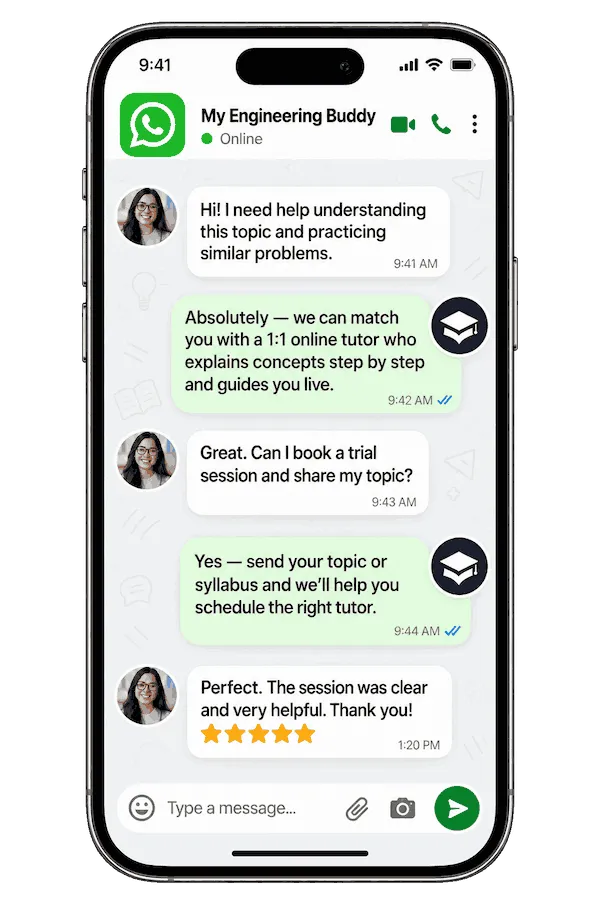
Unlike platforms where you fill out a form and wait, MEB responds in under a minute, 24/7. Tutor match takes under an hour. The $1 trial means you test before you commit. Everything runs over WhatsApp — no logins, no intake forms.
Pricing Guide
EPANET tutoring starts at $20/hr for undergraduate coursework. Graduate-level network calibration, multi-scenario modelling, and research support run $35–$70/hr. Highly specialised work — PhD-level water distribution optimisation or professional consulting prep — is available up to $100/hr.
Rate factors: your academic level, the complexity of the network you’re modelling, your timeline, and tutor availability in your time zone. Availability drops significantly in the four weeks before major semester submission dates.
For students targeting roles at engineering consultancies, municipal water authorities, or graduate programmes with a strong water systems component, MEB can match you with tutors who have active professional or research backgrounds in hydraulic modelling — share your goal and MEB will find the right fit.
Start with the $1 trial — 30 minutes, no registration, no commitment. WhatsApp MEB for a quick quote.
FAQ
Is EPANET hard to learn?
The interface is straightforward, but getting correct results requires solid understanding of hydraulic principles — pipe friction, pressure zones, pump curves, and demand patterns. Most students struggle not with the software itself but with interpreting what the outputs mean and why their model diverges from expected values.
How many sessions are needed?
Students with a single project assignment typically need two to four sessions. Those covering a full water systems or hydraulic modelling module benefit from six to ten sessions spread across the semester. The tutor sets a specific plan after the first diagnostic.
Can you help with my EPANET project and coursework?
MEB tutoring is guided learning — the tutor explains the method, walks through the principles, and shows you how to approach the problem. You build the model and submit the work yourself. See our Academic Integrity policy and Why MEB page for full details on what we help with and what we don’t.
Will the tutor match my exact syllabus or course requirements?
Yes. Before your first session, share your course outline, project brief, or assignment specification. The tutor aligns the session directly to what your module requires — whether that’s steady-state hydraulic analysis, extended period simulation, or water quality modelling with specific EPA or WHO compliance targets.
What happens in the first session?
The tutor reviews your existing model file or project brief, identifies your specific gaps — conceptual or procedural — and begins working through the most urgent issue. You leave the first session with a corrected approach and a clear plan for the remaining work before your deadline.
Is online EPANET tutoring as effective as in-person?
For software-based subjects like EPANET, online tutoring is often more effective. The tutor sees your actual screen, annotates directly over your model, and works through your specific file in real time. There’s no commute, no scheduling friction, and sessions can happen the same day you hit a problem.
Can I get EPANET help at short notice — even late at night?
Yes. MEB operates 24/7 across all major time zones. WhatsApp MEB and you’ll typically have a tutor confirmed within the hour. Many students use same-day sessions the night before a submission when a model isn’t converging.
What’s the difference between EPANET and WaterGEMS — and can you help with both?
EPANET is free, open-source, and widely used in academic settings. WaterGEMS is a commercial platform with a more advanced interface, used more in professional practice. MEB tutors cover both. If your course uses WaterGEMS, see the dedicated WaterCAD/WaterGEMS help page.
Do you offer group EPANET sessions?
No. All MEB sessions are 1:1. Group sessions reduce the ability to calibrate pace and depth to one student’s exact model and understanding. For EPANET specifically, most issues are unique to each student’s network file — group sessions would waste the majority of the time for most participants.
How does EPANET connect to the US EPA’s drinking water regulations?
EPANET was developed by the US EPA specifically to support Safe Drinking Water Act compliance analysis. Tutors can help you understand how water age, chlorine residual, and pressure targets in your model relate to regulatory requirements. The ASTM International standards for water system design are also referenced in some course contexts.
How do I get started?
WhatsApp MEB with your project brief or assignment details. You’ll be matched with a tutor — usually within the hour. The first session is the $1 trial: 30 minutes of live tutoring or one full project question explained. No registration. No forms. Three steps: WhatsApp, match, start.
Trust & Quality at My Engineering Buddy
Every MEB tutor goes through subject-specific vetting — not just a CV check. Candidates complete a live demo session evaluated against real EPANET modelling tasks. Ongoing session feedback from students feeds back into tutor performance reviews. MEB tutors in hydraulic modelling hold degrees in civil, environmental, or water resources engineering, and many have professional consulting or research backgrounds in water distribution systems. Rated 4.8/5 across 40,000+ verified reviews on Google.
MEB tutoring is guided learning — you understand the work, then submit it yourself. For full details on what we help with and what we don’t, read our Academic Integrity policy and Why MEB.
MEB has served 52,000+ students across 2,800+ subjects since 2008 — across the US, UK, Canada, Australia, Gulf, and Europe. Within Civil Engineering, subjects covered include EPANET, groundwater engineering tutoring, water and wastewater treatment help, and hydrology tutoring — making MEB one of the deepest resources for water systems engineering support available online. See how the approach works on the MEB tutoring methodology page.
Explore Related Subjects
Students studying EPANET often also need support in:
- Water Supply Engineering
- Open Channel Flow
- Dam Engineering
- Irrigation Engineering
- Coastal Engineering
- Solid Waste Management
- Air Pollution Control
Students consistently tell us that the turning point in their EPANET work isn’t learning a new feature — it’s finally understanding why the hydraulic grade line drops the way it does across their network. Once that clicks, the software becomes straightforward.
Next Steps
Before your first session, have ready: your course outline or project brief, any existing EPANET .net or .inp files you’ve already built, and your submission or exam date.
- Share your project brief, current model status, and deadline
- Share your availability and time zone
- MEB matches you with a verified EPANET tutor — usually within the hour
The first session starts with a diagnostic so every minute is used on the right problem. The tutor handles the session structure from there.
Visit www.myengineeringbuddy.com for more on how MEB works.
Our experience across thousands of sessions shows that students who arrive with their project file, their brief, and a specific question get three times more done in the first session than students who show up to “learn EPANET generally.” Be specific. The tutor will handle the rest.
WhatsApp to get started or email [email protected].
Reviewed by Subject Expert
This page has been carefully reviewed and validated by our subject expert to ensure accuracy and relevance.




