~1 min
Average Reply Time
~1 hour
To Be Matched With A Tutor
30 Min Trial
75% Find Their Tutor On The 1st Trial
$20-35+/hr
Premium Yet Affordable Learning
Hire The Best HEC-RAS Tutor






Your HEC-RAS model runs — but the results make no sense. That’s exactly where most students get stuck.
HEC-RAS Tutor Online
HEC-RAS (Hydrologic Engineering Center’s River Analysis System) is a hydraulic modelling software developed by the US Army Corps of Engineers for simulating one-dimensional and two-dimensional river and floodplain flow, used in water resources and civil engineering projects.
MEB connects you with a HEC-RAS tutor online who has used the software on real infrastructure projects — not just taught from a manual. Whether you’re a civil engineering undergraduate puzzling over geometry errors or a graduate student building a 2D unsteady flow model for a dam-break scenario, MEB matches you to a tutor who knows exactly where the model breaks down. If you’ve searched for a HEC-RAS tutor near me, the good news is that every session runs live over Google Meet — time zone matched to your location, no commute needed. Start with the $1 trial and see the difference one focused session makes. MEB covers civil engineering across 2,800+ subjects at every level.
- 1:1 online sessions tailored to your course syllabus or project brief
- Tutors with real-world HEC-RAS project experience, not just textbook knowledge
- Flexible time zones — US, UK, Canada, Australia, Gulf
- Structured learning plan built after a diagnostic session
- Guided project support — we explain the hydraulics and modelling logic, you build and submit the work
52,000+ students across the US, UK, Canada, Australia, and the Gulf have used MEB since 2008 — including students in Civil Engineering subjects like HEC-RAS, hydrology tutoring, and water resources engineering help.
Source: My Engineering Buddy, 2008–2025.
How Much Does a HEC-RAS Tutor Cost?
Most HEC-RAS tutoring sessions run at $20–$40/hr. Advanced modelling work — 2D unsteady flow, sediment transport, dam-breach analysis — or graduate-level project support can reach $60–$100/hr depending on tutor depth and timeline. The $1 trial gets you 30 minutes of live 1:1 tutoring or a full walkthrough of one project problem — no registration required.
| Level / Need | Typical Rate | What’s Included |
|---|---|---|
| Undergraduate (most levels) | $20–$40/hr | 1:1 sessions, geometry setup, project guidance |
| Graduate / Advanced Modelling | $40–$100/hr | 2D unsteady flow, sediment, dam-breach scenarios |
| $1 Trial | $1 flat | 30 min live session or one project question explained |
Tutor availability tightens around end-of-semester project deadlines — particularly in April–May and November–December. Book early if your submission date is within three weeks.
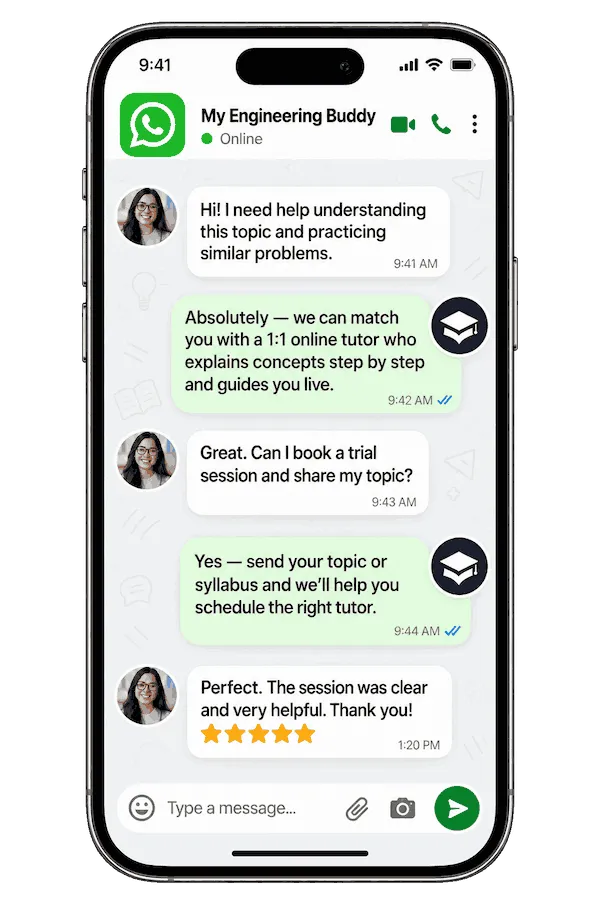
WhatsApp MEB for a quick quote — average response time under 1 minute.
Who This HEC-RAS Tutoring Is For
Most students who reach out to MEB aren’t beginners — they’ve already watched the tutorials, read the manual, and still can’t get a stable water surface profile. The gap is usually somewhere between understanding the hydraulics theory and correctly translating it into the software interface.
- Undergraduate civil engineering students working through open channel flow and 1D steady-state models for the first time
- Graduate students building 2D unsteady flow models for thesis research or capstone projects
- Students with a project submission deadline approaching and a geometry or Manning’s n calibration problem they can’t resolve
- Students retaking after a failed first attempt at a hydraulics or water resources module
- Working engineers upskilling into HEC-RAS 6.x or moving from 1D to 2D modelling for the first time
- Students at institutions including MIT, University of Texas at Austin, University of California Davis, TU Delft, University of Melbourne, and Imperial College London where HEC-RAS features in water resources and hydraulic engineering coursework
If a floodplain delineation assignment is sitting open on your screen right now, MEB has a tutor who has done this before — on real projects, not just practice runs.
1:1 Tutoring vs Self-Study vs AI vs YouTube vs Online Courses
Self-study: works if you’re disciplined, but HEC-RAS errors are often silent — the model runs and gives wrong answers without flagging why. AI tools: useful for quick syntax questions; cannot diagnose why your cross-sections are producing negative areas or your unsteady run is crashing at hour 6. YouTube: solid for basic geometry input; stops short the moment your specific terrain data or boundary condition differs from the demo. Online courses: structured but filmed against a fixed dataset — your real project geometry never matches. 1:1 tutoring with MEB: a tutor screens your actual model file, spots the error live, and explains the hydraulic principle behind it so it doesn’t happen again.
Outcomes: What You’ll Be Able To Do in HEC-RAS
After working through HEC-RAS with an MEB tutor, you’ll be able to set up and run a complete 1D steady-flow profile from scratch — including cross-section geometry, Manning’s roughness coefficients, and boundary conditions — without relying on guesswork. You’ll be able to analyse floodplain extents and interpret water surface profile outputs for FEMA-style flood mapping reports. You’ll be able to model bridge and culvert structures correctly, including low-flow and pressure flow regimes. You’ll be able to transition from 1D to 2D modelling in HEC-RAS 6.x, setting up a computational mesh and running an unsteady simulation over a realistic storm event. You’ll be able to present and defend your modelling assumptions to a project supervisor or committee.
Based on feedback from 40,000+ sessions collected by MEB from 2022 to 2025, 58% of students improved by one full grade after approximately 20 hours of 1:1 tutoring in subjects like HEC-RAS. A further 23% achieved at least a half-grade improvement.
Source: MEB session feedback data, 2022–2025.
What We Cover in HEC-RAS (Syllabus / Topics)

Track 1: 1D Steady and Unsteady Flow Modelling
- Geometric data entry: cross-sections, reach lengths, bank stations
- Manning’s n selection and roughness calibration
- Boundary condition setup: normal depth, known water surface, rating curves
- Steady-flow water surface profile computation (subcritical, supercritical, mixed)
- Unsteady flow simulation: hydrograph routing, stability criteria, time-step selection
- Bridge and culvert modelling: low flow, pressure flow, weir flow
- Profile output interpretation: energy grade line, hydraulic grade line, velocity
Core references: HEC-RAS River Analysis System Hydraulic Reference Manual (USACE); Open Channel Hydraulics by Chaudhry; Hydraulics in Civil and Environmental Engineering by Chadwick, Morfett & Borthwick.
Track 2: 2D Modelling and Floodplain Analysis
- Creating and refining 2D computational mesh in RAS Mapper
- Terrain data import: LiDAR DEM processing and breakline addition
- 2D unsteady flow run setup: diffusion wave vs full momentum equations
- Inline and lateral structures in 2D domains
- Floodplain inundation mapping: depth, velocity, and WSE grids
- Comparison of 1D/2D coupled vs fully 2D approaches
- Output animation and GIS export for flood risk reports
Core references: HEC-RAS 2D User’s Manual (USACE); Computational Fluid Dynamics for Engineers by Andersson et al.; Flood Risk Science and Management by Pender & Faulkner.
Track 3: Sediment Transport and Dam-Breach Analysis
- Quasi-unsteady vs fully unsteady sediment transport setup
- Sediment gradation input and bed change computation
- Transport potential equations: Meyer-Peter & Müller, Engelund-Hansen, Yang
- Dam-breach parameter estimation: breach width, formation time, failure mode
- Breach hydrograph routing and downstream flood wave analysis
- Uncertainty analysis in dam-breach scenarios
Core references: HEC-RAS Sediment Transport User’s Manual (USACE); Sedimentation Engineering (ASCE Manual 54) by Garcia; Dam Breach Modelling Technology by Fread.
At MEB, we’ve found that the biggest time-sink in HEC-RAS isn’t learning the hydraulics — it’s understanding why the software is rejecting your input or producing an unstable run. A tutor who has debugged these models on live projects cuts that time from days to a single session.
Platforms, Tools & Textbooks We Support
HEC-RAS is a standalone software environment with its own geometry editor, RAS Mapper, and post-processing tools. MEB tutors work directly inside the software with you over screen share, covering all versions including HEC-RAS 5.0.7, 6.3, and 6.5. We also support the common workflows that connect HEC-RAS to adjacent tools:
- HEC-RAS 5.0.7, 6.3, 6.5 (Windows)
- RAS Mapper (built-in GIS and terrain integration)
- Civil 3D for terrain and cross-section extraction (linked to Civil 3D tutoring)
- ArcGIS / QGIS for pre- and post-processing
- HEC-HMS for rainfall-runoff input hydrographs (linked to hydrology project help)
- ERDAS IMAGINE for DEM and LiDAR processing
- Microsoft Excel for boundary condition data preparation
What a Typical HEC-RAS Session Looks Like
The tutor opens by reviewing what you worked on since the last session — usually a specific issue: a water surface profile that won’t converge, a bridge scour result that looks too high, or a 2D mesh that’s generating velocity spikes near a structure. You share your screen or upload the project file beforehand. The tutor walks through your geometry data first — checking cross-section spacing, bank station placement, and Manning’s n assignments — because most instability errors trace back there. You then work through the specific problem together: the tutor uses a digital pen-pad to annotate the hydraulic principles behind each step while you control the software. Before the session ends, the tutor sets a clear task for your next attempt — usually a specific run to execute and a set of output plots to review — and confirms what the next session will cover.
How MEB Tutors Help You with HEC-RAS (The Learning Loop)
Diagnose: In the first session, the tutor asks you to walk through your current model — what it’s meant to do, what’s going wrong, and what you’ve already tried. Within 15 minutes, the specific failure point is usually clear: incorrect boundary condition type, inappropriate Manning’s n for the channel type, or a mesh resolution problem in the 2D domain.
Explain: The tutor works through the corrected approach on screen using a digital pen-pad, annotating the energy equation or the momentum terms directly on your output plots. You see the fix and understand why it works — not just what to click.
Practice: You replicate the correction in your own model with the tutor present. If it breaks, the tutor catches the error immediately. This is faster than trial-and-error alone by a significant margin.
Feedback: The tutor reviews your output — water surface profiles, velocity distributions, inundation maps — and points out exactly which results would raise a red flag in a peer review or project assessment, and why.
Plan: Every session ends with a confirmed next step: a specific run, a calibration target, or a section of the report to draft. Progress is tracked across sessions so nothing is repeated unnecessarily.
All sessions run over Google Meet with screen share. Tutors use a digital pen-pad or iPad with Apple Pencil to annotate hydraulic diagrams in real time. Before your first session, send the tutor your project file or assignment brief, your current HEC-RAS version, and a description of the specific problem. The first session begins with a diagnostic — no time wasted on background you don’t need. Start with the $1 trial — 30 minutes of live tutoring that also serves as your diagnostic session.
Students consistently tell us that one HEC-RAS session with a tutor who has run real floodplain studies saves more time than three days of manual troubleshooting. The difference is knowing which parameter to check first.
Source: My Engineering Buddy, 2008–2025.
Try your first session for $1 — 30 minutes of live 1:1 tutoring or one project question explained in full. No registration. No commitment. WhatsApp MEB now and get matched within the hour.
Tutor Match Criteria (How We Pick Your Tutor)
MEB doesn’t assign the first available tutor. The match is based on four criteria:
Subject depth: The tutor must have applied HEC-RAS at the level you need — undergraduate 1D steady flow, graduate 2D modelling, or professional-grade sediment and dam-breach work.
Tools: All HEC-RAS tutors work on Google Meet with a digital pen-pad or iPad and Apple Pencil. Sessions are interactive, not passive screen shares.
Time zone: Matched to your region — US, UK, Gulf, Canada, or Australia — so your preferred study hours are covered without compromise.
Goals: Whether you need to fix one model this week or build a full 2D floodplain study over a semester, the tutor’s availability and approach are matched to that scope. Get groundwater engineering help or dam engineering tutoring through the same matching process if your project spans multiple areas.
Unlike platforms where you fill out a form and wait, MEB responds in under a minute, 24/7. Tutor match takes under an hour. The $1 trial means you test before you commit. Everything runs over WhatsApp — no logins, no intake forms.
Study Plans (Pick One That Matches Your Goal)
After the first diagnostic session, the tutor proposes a specific plan. For a student three weeks from a project submission: a targeted catch-up focused on the blocking problem first, then a review of outputs and report framing. For a graduate student building a semester-long 2D model: weekly sessions aligned to each phase — terrain setup, mesh refinement, calibration, and final output production. For ongoing support through a water resources module: sessions timed to coursework deadlines, covering each new topic as it appears in the syllabus. The tutor builds the sequence — you don’t have to figure out what to prioritise.
Pricing Guide
HEC-RAS tutoring starts at $20/hr for standard undergraduate-level sessions. Graduate-level work — 2D unsteady modelling, sediment transport calibration, dam-breach analysis — runs $40–$100/hr depending on tutor expertise and project complexity.
Rate factors: your current level, the specific HEC-RAS version and model type, how quickly you need results, and tutor availability at your preferred times.
Availability tightens in April–May and November–December when end-of-semester projects cluster. If your deadline is within four weeks, book sooner rather than later.
For students targeting positions at engineering consultancies, federal agencies (USACE, FEMA, NOAA), or graduate research programmes with a hydraulics focus, MEB can match you with tutors who have professional project backgrounds at higher rates — share your specific goal and MEB will match the tier to your ambition.
Start with the $1 trial — 30 minutes, no registration, no commitment. WhatsApp MEB for a quick quote.
A common pattern our tutors observe is that students spend hours adjusting Manning’s n values when the real issue is incorrect cross-section spacing or a boundary condition set at the wrong reach end. Knowing which to check first is the whole difference.
FAQ
Is HEC-RAS hard to learn?
The 1D steady-flow interface is manageable with a solid open-channel hydraulics background. The difficulty jumps sharply with 2D modelling, unsteady flow, and sediment transport — where model instability, mesh quality, and calibration decisions require experience, not just software familiarity.
How many sessions will I need?
A single focused problem — geometry error, unstable unsteady run — often resolves in one or two sessions. A full 2D floodplain model built from scratch for a graduate project typically runs six to twelve sessions over four to eight weeks, depending on complexity and your prior background in hydraulics.
Can you help with projects and portfolio work?
Yes. MEB provides guided project support — the tutor explains the hydraulic principles and modelling decisions, and you build and submit the work. MEB provides guided learning support. All project work is produced and submitted by the student. See our Policies page for details.
Will the tutor match my exact syllabus or exam board?
Yes. Before matching, MEB confirms your course level, institution, and the specific HEC-RAS tasks your module or project requires. The tutor covers your exact scope — not a generic HEC-RAS curriculum that may not match your assessor’s expectations.
What happens in the first session?
The tutor runs a diagnostic: reviews your current model or project brief, identifies the specific blocking point, and establishes a session plan from there. No time is spent on background you already know. Send your project file or assignment brief before the session starts.
Are online sessions as effective as in-person?
For software-based subjects like HEC-RAS, online is often more effective. Screen share means the tutor sees exactly what you see — the same model, the same error, the same output. Digital pen annotation on hydraulic diagrams works as well as a whiteboard, and session recordings are available for review.
Can I get HEC-RAS help at midnight or on weekends?
Yes. MEB tutors operate across multiple time zones and cover evening and weekend slots in the US, UK, Gulf, and Australia. WhatsApp MEB any time — response times are typically under a minute, including outside standard business hours.
What if I don’t get on with my assigned tutor?
Request a switch through WhatsApp. MEB will match you with a different tutor, usually within the same day. There is no penalty, no form to complete, and no explanation required beyond “this isn’t the right fit.”
What is the difference between HEC-RAS 1D and 2D modelling, and which should I learn first?
1D modelling solves the energy equation along a single channel reach — fast and reliable for rivers with well-defined cross-sections. 2D modelling solves momentum equations across a terrain mesh — needed for wide floodplains, complex flow splits, or urban inundation. Learn 1D first; 2D builds on the same boundary condition and geometry logic.
How do I get HEC-RAS help for a dam-breach or flood mapping assignment?
Send the project brief to MEB via WhatsApp. MEB will match you with a tutor who has specific dam-breach or floodplain delineation experience — not a general hydraulics tutor. Share your HEC-RAS version and any existing model files at the same time.
How do I get started?
Start with the $1 trial — 30 minutes of live 1:1 tutoring or one project question explained in full. Three steps: WhatsApp MEB, get matched within the hour, start your trial session. No registration, no upfront commitment.
Do HEC-RAS tutors also support EPANET or WaterCAD projects?
Yes. MEB covers pressure-pipe hydraulics alongside open-channel work. If your project spans both — for example, a combined floodplain and distribution system study — MEB can arrange tutors for EPANET project help and WaterCAD/WaterGEMS tutoring separately or in a coordinated sequence.
Trust & Quality at My Engineering Buddy
Every MEB tutor goes through a multi-stage vetting process: subject knowledge screening, a live demo session evaluated by an MEB assessor, and ongoing review based on student feedback after every session. HEC-RAS tutors are required to demonstrate applied modelling experience — not just familiarity with the software interface. Rated 4.8/5 across 40,000+ verified reviews on Google, MEB has built its reputation on subject-specific match quality, not volume. For water supply engineering tutoring or environmental engineering help, the same vetting standard applies. Read more about how we select and evaluate tutors at MEB’s tutoring methodology.
MEB provides guided learning support. All project work is produced and submitted by the student. See our Policies page for details.
MEB has served 52,000+ students across the US, UK, Canada, Australia, the Gulf, and Europe in 2,800+ subjects since 2008. Civil Engineering is one of the platform’s strongest subject areas, with tutors covering HEC-RAS, structural engineering tutoring, and geotechnical engineering help at undergraduate and graduate level. The platform also covers adjacent software including Autodesk InfraWorks tutoring and PLAXIS 2D/3D project help for students whose coursework spans multiple tools.
The US Army Corps of Engineers developed HEC-RAS specifically for professional infrastructure analysis. MEB matches you with tutors who have used it in that context — not just in a classroom setting.
Source: My Engineering Buddy, 2008–2025.
Explore Related Subjects
Students studying HEC-RAS often also need support in:
- Open Channel Flow
- Irrigation Engineering
- Coastal Engineering
- Slope Stability Analysis
- InfoWater Pro (Autodesk)
- Pipe Flo
- Soil Mechanics
Next Steps
Getting started with MEB takes less than five minutes. Here’s what to do:
- Share your HEC-RAS version, the specific problem you’re stuck on, and your project or submission deadline
- Share your availability and time zone — MEB will match you with a tutor who covers your hours
- MEB matches you with a verified, subject-specific tutor — usually within 24 hours, often much faster
Before your first session, have ready: your course outline or project brief, your current HEC-RAS model file or a description of what you’ve built so far, and your deadline date. The tutor handles the rest.
Visit www.myengineeringbuddy.com for more on how MEB works.
WhatsApp to get started or email [email protected].
Reviewed by Subject Expert
This page has been carefully reviewed and validated by our subject expert to ensure accuracy and relevance.