~1 min
Average Reply Time
~1 hour
To Be Matched With A Tutor
30 Min Trial
75% Find Their Tutor On The 1st Trial
$20-35+/hr
Premium Yet Affordable Learning
Most dental students don’t fail because they’re not trying. They fail because nobody ever walked them through the spatial logic of tooth morphology in real time.
Dental Anatomy Tutor Online
Dental anatomy is the study of the structure, morphology, and spatial relationships of human teeth and surrounding oral tissues, equipping dental students to identify, carve, and clinically apply tooth form across all dentition classes.
If you’re searching for a dental anatomy tutor near me, MEB connects you with a 1:1 online dental anatomy tutor who knows the exact tooth carving rubrics, the Bennett movement questions, and the cusp-ridge naming conventions your course tests. Part of our broader dentistry tutoring programme, these sessions go straight to the topics where marks are actually lost. One tutor, your syllabus, no distractions.
- 1:1 online sessions mapped to your dental school’s specific curriculum
- Expert-verified tutors with clinical dental science backgrounds
- Flexible time zones — US, UK, Canada, Australia, Gulf
- Structured learning plan built after a diagnostic session
- Ethical homework and assignment guidance — you understand before you submit
How Much Does a Dental Anatomy Tutor Cost?
Most dental anatomy tutoring sessions run at $20–$40/hr. Graduate-level or highly specialised topics can reach $100/hr. Start with the $1 trial — 30 minutes of live 1:1 tutoring or one full homework question explained — before committing to anything.
| Level / Need | Typical Rate | What’s Included |
|---|---|---|
| Standard (most levels) | $20–$35/hr | 1:1 sessions, homework guidance |
| Advanced / Specialist | $35–$70/hr | Expert tutor, clinical depth |
| $1 Trial | $1 flat | 30 min live session or 1 HW question |
Tutor availability tightens in October–November and February–March when dental school practical exams and OSCE assessments cluster. Book early.
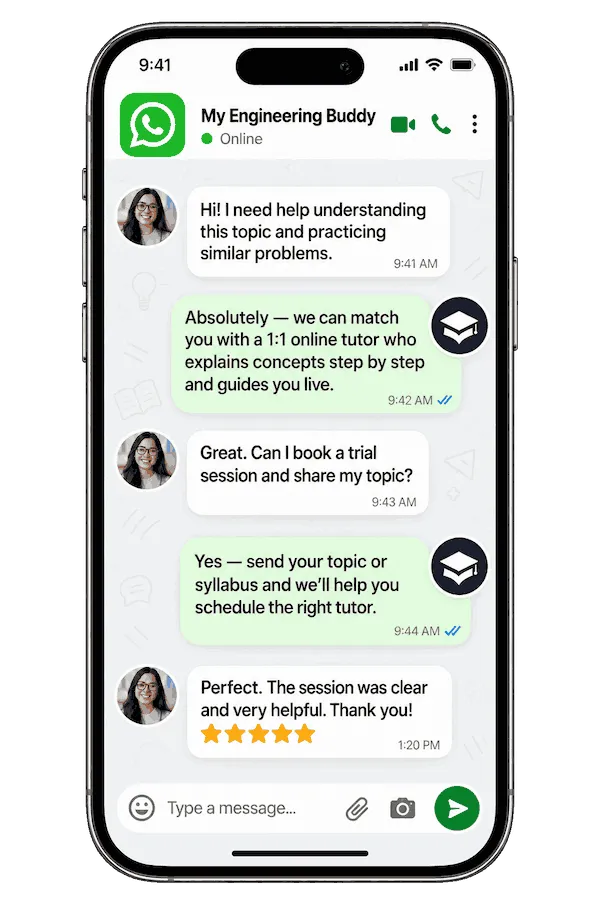
WhatsApp MEB for a quick quote — average response time under 1 minute.
52,000+ students across the US, UK, Canada, Australia, and the Gulf have used MEB since 2008 — including students in dentistry subjects like dental anatomy, oral histology, and dental occlusion.
Source: My Engineering Buddy, 2008–2025.
Who This Dental Anatomy Tutoring Is For
Dental anatomy trips up students who can memorise names but freeze when asked to draw a mandibular first molar from the mesial aspect, or explain why the oblique ridge matters clinically. This tutoring is built for exactly that gap.
- First- and second-year BDS or DMD students struggling with tooth morphology and wax carving
- Students retaking after a failed practical or written dental anatomy exam
- Students with a university conditional offer depending on passing this module
- Students 4–6 weeks from OSCEs or end-of-year exams with significant gaps still to close
- Parents watching a child’s confidence drop alongside their dental school grades
- Students who need homework and assignment guidance — explained, not done for them
MEB has worked with dental students at King’s College London, the University of Manchester, New York University College of Dentistry, University of Toronto Faculty of Dentistry, and the University of Queensland School of Dentistry, among others.
1:1 Tutoring vs Self-Study vs AI vs YouTube vs Online Courses
Self-study works if you’re disciplined, but dental anatomy has a spatial reasoning component that notes alone don’t fix. AI tools can name a cusp but can’t watch you draw a crown outline and tell you where you went wrong. YouTube covers the overview of tooth classes well — it stops when your question gets specific to your module’s carving rubric. Online courses are structured but paced for everyone, not for you. With a 1:1 dental anatomy tutor from MEB, the session is calibrated to your exact practical assessment criteria, catches the spatial errors in real time, and moves at your pace.
Outcomes: What You’ll Be Able To Do in Dental Anatomy
After targeted 1:1 dental anatomy tutoring, students can explain the functional significance of each cusp on a maxillary first molar without prompting. They can apply Bennett movement and condylar guidance principles to occlusion questions they haven’t seen before. They can analyze tooth form from every surface aspect and present a coherent answer in a viva. They solve wax carving rubric questions by understanding morphological logic — not rote recall. They write exam answers that connect tooth structure to clinical relevance, which is exactly what dental school examiners award marks for.
Based on feedback from 40,000+ sessions collected by MEB from 2022 to 2025, 58% of students improved by one full grade after approximately 20 hours of 1:1 tutoring in subjects like dental anatomy. A further 23% achieved at least a half-grade improvement.
Source: MEB session feedback data, 2022–2025.
Supporting a student through dental anatomy? MEB works directly with parents to set up sessions, track progress, and keep coursework on schedule. WhatsApp MEB — average response time is under a minute, 24/7.
At MEB, we’ve found that dental anatomy students who struggle most are rarely lazy — they’re trying to memorise isolated facts when what they actually need is a mental model of how tooth form, function, and occlusion connect. One session spent building that model is worth more than five sessions drilling names.

What We Cover in Dental Anatomy (Syllabus / Topics)
Tooth Morphology and Carving
- Crown and root morphology of all 32 permanent teeth
- Primary (deciduous) dentition: form, size differences, and clinical relevance
- Surface anatomy: cusps, ridges, fossae, marginal ridges, and contact areas
- Tooth carving technique and assessment rubric criteria
- Proximal, facial, lingual, occlusal, and incisal aspect drawings
- Class I, II, and III tooth relationships and identification
Core texts: Wheeler’s Dental Anatomy, Physiology, and Occlusion (Nelson) and Illustrated Dental Embryology, Histology, and Anatomy (Bath-Balogh & Fehrenbach).
Dental Occlusion and Temporomandibular Biomechanics
- Angle’s classification of malocclusion (Class I, II, III)
- Centric relation, centric occlusion, and lateral excursions
- Bennett movement, condylar guidance, and the Christensen phenomenon
- Curve of Spee, curve of Wilson, and the sphere of Monson
- Functional and parafunctional occlusal forces
- Articulator use and facebow transfer concepts
Core texts: Dental Occlusion: A Clinical Guide (Ash & Ramfjord) and Fundamentals of Occlusion and Temporomandibular Disorders (Okeson).
Oral Embryology and Tissue Structure
- Tooth development: initiation, morphodifferentiation, histodifferentiation, apposition
- Enamel, dentin, cementum, and pulp: formation and structural properties
- Periodontium: alveolar bone, periodontal ligament, gingiva
- Eruption sequences and chronology for primary and permanent dentitions
- Developmental anomalies: fusion, gemination, taurodontism, dens invaginatus
Core texts: Ten Cate’s Oral Histology (Nanci) and Orban’s Oral Histology and Embryology.
What a Typical Dental Anatomy Session Looks Like
The tutor opens by checking your last topic — usually the occlusal surface anatomy of posterior teeth or a Bennett movement calculation you didn’t finish. From there, you and the tutor work through the specific tooth or concept on screen. The tutor draws the crown form using a digital pen-pad, labels each cusp and ridge while explaining the functional logic, and then you replicate the drawing and explain it back. For occlusion topics, the tutor works through condylar guidance scenarios step by step, asking you to identify errors in sample answers. The session closes with a specific carving exercise or past-paper question to attempt before the next session, and the next topic — typically a second tooth class or a cross-topic occlusion problem — is noted.
How MEB Tutors Help You with Dental Anatomy (The Learning Loop)
Diagnose: In the first session, the tutor identifies exactly where your understanding breaks down — whether that’s spatial reasoning around proximal contact areas, confusion between centric relation and centric occlusion, or weak recall of developmental anomaly names.
Explain: The tutor works through the concept live, using a digital pen-pad to draw tooth surfaces, label anatomy, and annotate occlusal diagrams in real time. No static slides. No pre-recorded clips.
Practice: You attempt the question or drawing while the tutor watches. This is where most online self-study fails — there’s no one to catch a wrong cusp placement before it becomes a habit.
Feedback: The tutor goes through your attempt step by step, identifies which marks would have been lost and exactly why, and re-explains the logic that connects tooth morphology to function.
Plan: Each session ends with a clear next topic, a practice task, and a realistic timeline to your exam or practical assessment.
Sessions run on Google Meet with a digital pen-pad or iPad and Apple Pencil. Before your first session, have your course syllabus or module guide ready, bring a tooth carving you’ve already attempted or a past-paper question you got wrong, and note your practical exam date. The first session functions as a diagnostic — every minute is used to map the gaps, not to cover general content.
Start with the $1 trial — 30 minutes of live tutoring that also serves as your first diagnostic.
Students consistently tell us that dental anatomy felt abstract until they saw a tutor draw a mandibular second premolar from the distal aspect in real time, name every landmark as they went, and then ask them to do it back. That one exercise reframes the whole subject.
MEB tutors cover the full dental anatomy curriculum — from dental occlusion tutoring and cusp morphology through to developmental anomalies and eruption chronology — in a single, consistent 1:1 format.
Source: My Engineering Buddy, 2008–2025.
Tutor Match Criteria (How We Pick Your Tutor)
Not every dental science tutor is right for every student. MEB matches on four criteria.
Subject depth: Tutors hold dental science degrees or clinical dental qualifications and are matched to your specific course level — first-year BDS, DMD, or graduate dental programme.
Tools: Every tutor uses Google Meet with a digital pen-pad or iPad and Apple Pencil — the only setup that works for drawing tooth surfaces and annotating occlusal diagrams live.
Time zone: Matched to your region — US, UK, Gulf, Canada, or Australia — so scheduling doesn’t require you to study at 2am.
Goals: Whether you need to pass a practical carving assessment, close gaps before OSCEs, or get operative dentistry help alongside anatomy, the tutor is matched to that specific outcome.
Unlike platforms where you fill out a form and wait, MEB responds in under a minute, 24/7. Tutor match takes under an hour. The $1 trial means you test before you commit. Everything runs over WhatsApp — no logins, no intake forms.
Study Plans (Pick One That Matches Your Goal)
After the diagnostic session, your tutor builds a specific sequence. Most students fall into one of three plans: a catch-up plan (1–3 weeks) for students behind on tooth morphology or occlusion with an assessment approaching; an exam prep plan (4–8 weeks) with structured revision across all dentition classes, occlusion, and embryology for a specific exam date; or weekly semester support aligned to your dental school’s module schedule and coursework deadlines. The tutor decides the sequence after seeing your diagnostic results — not before.
Pricing Guide
Standard dental anatomy tutoring runs at $20–$40/hr. Niche topics — temporomandibular biomechanics at graduate level, specialist occlusion for prosthodontics pathways, or pre-OSCE intensive preparation — can reach $100/hr. Rate depends on level, topic complexity, your timeline, and tutor availability.
For students targeting top dental schools or specialist programmes, tutors with clinical and research backgrounds in dental morphology and occlusion are available at higher rates — share your specific goal and MEB will match the tier to your ambition.
Availability tightens in the weeks before practical assessments and end-of-year exams. Book early if your timeline is short.
Start with the $1 trial — 30 minutes, no registration, no commitment. WhatsApp MEB for a quick quote.
FAQ
Is dental anatomy hard?
It is harder than most first-year dental students expect. The naming conventions are dense, and the spatial reasoning required for tooth carving and occlusion problems is genuinely different from anything in pre-dental coursework. Most students improve significantly once they get live feedback on their drawings.
How many sessions are needed?
Students with one specific gap — a tooth class or a single occlusion concept — often close it in 3–5 sessions. Students needing full-module support typically see clear improvement within 10–15 hours, with the diagnostic session shaping exactly where time is spent.
Can you help with homework and assignments?
MEB tutoring is guided learning — you understand the work, then submit it yourself. See our Academic Integrity policy and Why MEB page for full details on what we help with and what we don’t. The tutor explains, you produce the work.
Will the tutor match my exact syllabus or exam board?
Yes. When you WhatsApp MEB, share your dental school, module name, and any course guide you have. The tutor is matched to that specific curriculum — not a generic dental anatomy overview. BDS, DMD, and dental hygiene programme syllabuses all differ in emphasis.
What happens in the first session?
The first session is a diagnostic. The tutor asks targeted questions, reviews a piece of work you’ve already attempted, and identifies your two or three biggest gaps. No time is wasted on content you already know. The session plan for subsequent sessions is built from this.
Is online tutoring as effective as in-person?
For dental anatomy specifically, the digital pen-pad format is often more effective than in-person. The tutor can draw, annotate, overlay labels, and let you replicate on screen in a way that’s harder to do clearly with pen and paper across a table.
What’s the difference between tooth morphology and dental occlusion, and do I need both?
Tooth morphology covers the physical structure of each tooth. Dental occlusion covers how teeth relate and function together during jaw movement. Most dental anatomy courses test both — and occlusion questions are where students most commonly lose marks in written exams.
My dental school uses wax carving as the main practical assessment. Can a tutor actually help with that online?
Yes. The tutor uses a digital pen-pad to demonstrate crown form from every aspect, talks through the carving logic, and gives you a clear reference to work from. Students report that seeing the morphology drawn in real time — with live explanation — significantly improves their carving accuracy and speed.
Can I get dental anatomy help at midnight or on weekends?
MEB operates 24/7 across time zones. WhatsApp MEB at any hour and you’ll typically receive a response within a minute. Session availability varies by tutor, but late-night and weekend slots are routinely filled for students in the US, Gulf, and Australia.
What if I don’t like my assigned tutor?
The $1 trial is specifically designed for this. If the tutor match isn’t right after the first session, WhatsApp MEB and a replacement is arranged — no cost, no delay. Fit matters more than speed of assignment.
How do I get started?
Start with the $1 trial: 30 minutes of live 1:1 dental anatomy tutoring or one full question explained. Three steps — WhatsApp MEB, get matched within the hour, start your trial session. No registration required.
Trust & Quality at My Engineering Buddy
Every MEB tutor goes through subject-specific screening: a live demo evaluation, degree and credential verification, and ongoing performance review based on student feedback. Tutors covering dental anatomy hold dental science or clinical dental qualifications and are assessed specifically on their ability to teach tooth morphology, occlusion, and oral embryology — not just on general biology knowledge. Rated 4.8/5 across 40,000+ verified reviews on Google.
MEB tutoring is guided learning — you understand the work, then submit it yourself. For full details on what we help with and what we don’t, read our Academic Integrity policy and Why MEB.
MEB has been running since 2008, serving 52,000+ students across the US, UK, Canada, Australia, the Gulf, and Europe in 2,800+ subjects. In dentistry specifically, that includes students needing oral pathology tutoring, periodontology help, and orthodontics tutoring alongside dental anatomy. See our tutoring methodology for how sessions are structured.
A common pattern our tutors observe is that dental anatomy students spend too long on flashcard-based memorisation and not enough time on the spatial and functional logic that exam questions actually test. The students who improve fastest are the ones who stop trying to memorise and start trying to understand why each tooth is shaped the way it is.
Explore Related Subjects
Students studying dental anatomy often also need support in:
Try your first session for $1 — 30 minutes of live 1:1 tutoring or one homework question explained in full. No registration. No commitment. WhatsApp MEB now and get matched within the hour.
Next Steps
Getting started takes less than a minute.
- Share your dental school, module name, and exact assessment type (written exam, practical carving, OSCE, or coursework)
- Share your availability and time zone
- MEB matches you with a verified dental anatomy tutor — usually within an hour
- Your first session starts with a diagnostic so every minute is used on the gaps that matter
Before your first session, have ready: your module syllabus or course outline, a wax carving you’ve attempted or a past paper question you got wrong, and your practical exam or assessment date. The tutor handles the rest.
Visit www.myengineeringbuddy.com for more on how MEB works.
WhatsApp to get started or email [email protected].
Reviewed by Subject Expert
This page has been carefully reviewed and validated by our subject expert to ensure accuracy and relevance.