~1 min
Average Reply Time
~1 hour
To Be Matched With A Tutor
30 Min Trial
75% Find Their Tutor On The 1st Trial
$20-35+/hr
Premium Yet Affordable Learning
Occlusion concepts feel abstract until they cost you marks — here’s how 1:1 dental occlusion tutoring changes that.
Dental Occlusion Tutor Online
Dental occlusion is the study of how upper and lower teeth contact during jaw closure and movement, covering static and dynamic bite relationships, occlusal schemes, and their clinical implications in restorative, prosthetic, and orthodontic dentistry.
If you’re searching for a Dental Occlusion tutor near me, MEB matches you with a specialist tutor who knows the exact clinical frameworks your programme uses — whether that’s Angle’s classification, Dawson’s centric relation principles, or the gnathological approach. Our dentistry tutoring platform has served 52,000+ students across the US, UK, Canada, Australia, and the Gulf since 2008. One good session on occlusal stability can shift how you approach every restorative case you see.
- 1:1 online sessions tailored to your dental school syllabus and clinical year
- Expert-verified tutors with dental degree backgrounds and clinical experience
- Flexible time zones — US, UK, Canada, Australia, Gulf covered
- Structured learning plan built after a diagnostic session
- Ethical homework and assignment guidance — you understand the work, then submit it yourself
52,000+ students across the US, UK, Canada, Australia, and the Gulf have used MEB since 2008 — including students in Dentistry subjects like Dental Occlusion, Prosthodontics, and Orthodontics.
Source: My Engineering Buddy, 2008–2025.
How Much Does a Dental Occlusion Tutor Cost?
Most Dental Occlusion tutoring sessions run at $20–$40/hr. Advanced clinical-year or graduate-level work can reach $70–$100/hr depending on the tutor’s background. The $1 trial gives you 30 minutes of live 1:1 tutoring or a full explanation of one question — before you commit to anything.
| Level / Need | Typical Rate | What’s Included |
|---|---|---|
| Undergraduate (BDS / DMD) | $20–$40/hr | 1:1 sessions, assignment guidance |
| Advanced / Graduate / Specialist | $40–$100/hr | Expert tutor, clinical-depth focus |
| $1 Trial | $1 flat | 30 min live session or 1 question answered |
Tutor availability tightens around end-of-year OSCE periods and pre-clinical assessments. Book early if your exam window is within six weeks.
WhatsApp MEB for a quick quote — average response time under 1 minute.
Who This Dental Occlusion Tutoring Is For
Dental occlusion sits in an awkward place in most BDS and DMD programmes. It’s heavily theoretical in year two, then suddenly expected at a clinical level in year four. The gap between those two points is where students get lost.
- BDS and DMD students preparing for OSCE stations on bite analysis and jaw registration
- Students retaking after a failed first attempt in restorative or prosthetic modules
- Students with a university conditional offer depending on this grade
- Postgraduate students in prosthodontics or orthodontics needing advanced occlusal theory
- Students struggling to connect the theory of centric relation to clinical case work
- Parents watching a child’s confidence drop alongside their grades in pre-clinical year
Students at dental schools including King’s College London, University of Melbourne, University of Toronto, New York University College of Dentistry, University of Michigan School of Dentistry, University of Sydney, and King Abdulaziz University have worked with MEB tutors on occlusion and related modules. The $1 trial lets you test the fit before any commitment.
At MEB, we’ve found that students who struggle with dental occlusion usually hit the same wall: they can define centric relation but can’t explain why it matters clinically. The fix isn’t more reading — it’s a tutor who works through real cases with you until the connection clicks.
1:1 Tutoring vs Self-Study vs AI vs YouTube vs Online Courses
Self-study works if you’re disciplined, but occlusion requires someone to challenge your reasoning — not just let you re-read the same chapter. AI tools explain terms quickly but can’t probe your understanding of a specific jaw registration technique. YouTube covers Angle’s classification well and stops there. Online courses move at a fixed pace with no space for the clinical questions your examiner will actually ask. With MEB, a 1:1 online Dental Occlusion tutor works through your exact module content, corrects errors in your bite analysis reasoning as they happen, and calibrates every session to where you actually are.
Outcomes: What You’ll Be Able To Do in Dental Occlusion
After working with a 1:1 Dental Occlusion tutor, you’ll be able to analyze occlusal contacts in static and dynamic jaw positions with clinical precision. You’ll explain the differences between centric relation, centric occlusion, and maximum intercuspation clearly — the kind of clarity examiners test directly. You’ll apply occlusal schemes including balanced occlusion, canine-guided occlusion, and group function to clinical case scenarios. You’ll solve articulator-based problems and present a logical treatment rationale for occlusal rehabilitation cases. Presenting your reasoning on OSCE stations becomes less guesswork, more method.
Based on feedback from 40,000+ sessions collected by MEB from 2022 to 2025, 58% of students improved by one full grade after approximately 20 hours of 1:1 tutoring in subjects like Dental Occlusion. A further 23% achieved at least a half-grade improvement.
Source: MEB session feedback data, 2022–2025.

What We Cover in Dental Occlusion (Syllabus / Topics)
Track 1: Occlusal Concepts and Classification
- Angle’s classification of malocclusion (Class I, II, III) and clinical relevance
- Centric relation vs centric occlusion vs maximum intercuspation — definitions and distinctions
- Intercuspal position, retruded contact position, and anterior guidance
- Canine-guided occlusion, group function, and balanced occlusion schemes
- Occlusal vertical dimension — concepts and clinical implications
- Fremitus, occlusal interferences, and premature contacts
- Dynamic occlusion: protrusive and lateral excursive movements
Core texts for this track include Okeson’s Management of Temporomandibular Disorders and Occlusion and Ash and Ramfjord’s Occlusion.
Track 2: Articulators and Jaw Registration
- Types of articulators: simple hinge, semi-adjustable, fully adjustable
- Face-bow transfer and articulator mounting procedures
- Jaw registration materials and techniques: wax, polyvinyl siloxane, ZOE paste
- Recording centric relation in clinical practice
- Condylar guidance and incisal guidance angles
- Errors in jaw registration and their clinical consequences
Recommended reference: Shillingburg’s Fundamentals of Fixed Prosthodontics covers articulator use and jaw registration in detail for BDS and DMD programmes.
Track 3: Occlusion in Clinical Practice
- Occlusion in restorative dentistry: crown and bridge design principles
- Occlusal adjustments: selective grinding — indications and technique
- Temporomandibular disorders (TMD) — occlusal aetiology and management debate
- Occlusion in complete denture construction — balanced occlusion requirements
- Occlusion and orthodontic treatment planning — finishing and retention occlusal goals
- Occlusal splints — types, indications, and design logic
- Implant-supported restoration occlusion — distinct considerations
Key references: Dawson’s Functional Occlusion: From TMJ to Smile Design and the British Dental Journal series on evidence-based occlusion.
Students consistently tell us that occlusion clicks when they see it as a system rather than a list of definitions. Once the jaw registration connects to the articulator, and the articulator connects to the restoration, the whole module makes sense. That’s the moment our tutors work toward.
What a Typical Dental Occlusion Session Looks Like
The tutor opens by checking the previous topic — usually where the student got stuck on centric relation recording or articulator mounting. From there, you work through specific problems on screen: the tutor annotates a diagram of occlusal contacts using a digital pen-pad, walks through the logic of canine guidance versus group function, and asks you to explain your reasoning out loud. You replicate the analysis on a new case. Errors get corrected immediately — not at the end. The session closes with a clear task: a specific past paper OSCE station to attempt, a jaw registration technique to revise, or a set of case notes to annotate before next time.
How MEB Tutors Help You with Dental Occlusion (The Learning Loop)
Diagnose: In the first session, the tutor identifies exactly where your understanding breaks down — whether that’s the conceptual distinction between centric relation and centric occlusion, the mechanics of face-bow transfer, or applying occlusal schemes to a clinical case. No assumption is made about what you know.
Explain: The tutor works through live examples on screen using a digital pen-pad. Bite contact diagrams, articulator schematics, and case-based walkthroughs make the abstract concrete. You’re not watching a lecture — you’re working through it together.
Practice: You attempt problems with the tutor present. OSCE-style case analysis, articulator mounting steps, occlusal adjustment rationale — you work through it in real time, not after the session ends.
Feedback: Every error is traced to its root. If you misidentified a premature contact, the tutor shows you exactly which step in your reasoning failed — and why that error would cost marks on an OSCE station or written assessment.
Plan: At the end of each session, the tutor sets the next topic and any preparation task. Progress is tracked across sessions. Nothing is left to drift.
Sessions run on Google Meet. The tutor uses a digital pen-pad or iPad with Apple Pencil for diagrams and annotations. Before your first session, share your module outline, a recent assessment you struggled with, and your exam or OSCE date. The first session covers diagnosis and starts on the highest-priority gap. Start with the $1 trial — 30 minutes of live tutoring that also serves as your first diagnostic. Whether you need a quick catch-up before an OSCE, structured revision over four to eight weeks, or ongoing weekly support through the semester, the tutor maps the session plan after that first diagnostic.
Most students who come to MEB for occlusion help arrive knowing the vocabulary but unable to apply it. After four to six targeted sessions, the same students are working through clinical cases without prompting. The gap between theory and application closes faster than they expect.
Source: My Engineering Buddy, 2008–2025.
Tutor Match Criteria (How We Pick Your Tutor)
Not every dentistry graduate is equipped to teach occlusion at clinical depth. Here’s what MEB checks before a match.
Subject depth: Tutors are matched to your year level, module focus (restorative, prosthetic, orthodontic), and the specific occlusal frameworks your programme uses — Dawson, gnathological, or evidence-based approaches.
Tools: All tutors use Google Meet with a digital pen-pad or iPad and Apple Pencil for real-time annotation of occlusal diagrams and case notes.
Time zone: Tutors are matched to your region — US, UK, Gulf, Canada, or Australia — so sessions don’t require either party to be awake at 3 a.m.
Goals: Whether you need OSCE preparation, written exam revision, or ongoing support through a restorative clinical module, the tutor is briefed on your specific target before session one.
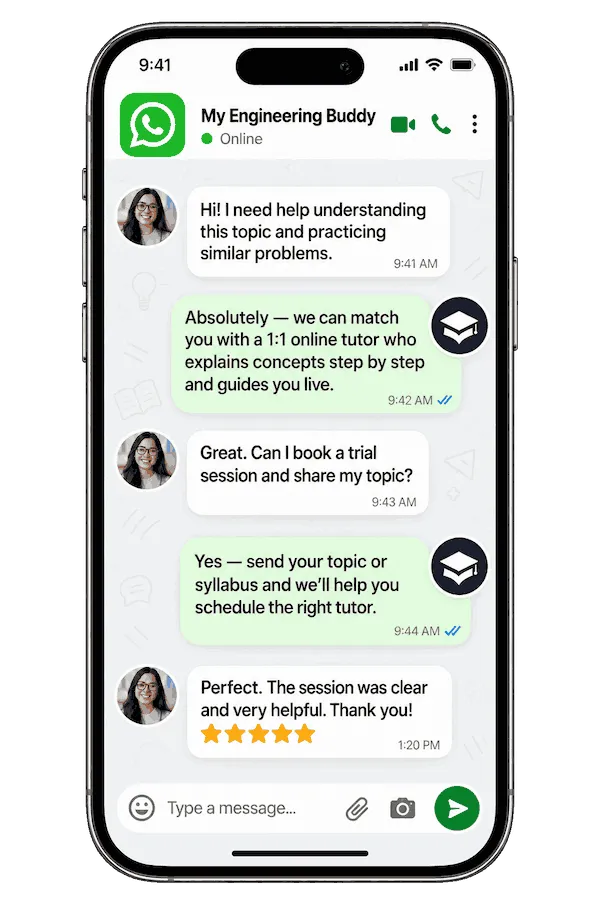
Unlike platforms where you fill out a form and wait, MEB responds in under a minute, 24/7. Tutor match takes under an hour. The $1 trial means you test before you commit. Everything runs over WhatsApp — no logins, no intake forms.
Pricing Guide
Dental Occlusion tutoring runs at $20–$40/hr for most undergraduate levels. Postgraduate and specialist-level sessions — covering advanced TMD management, implant occlusion, or full-mouth rehabilitation planning — are available at rates up to $100/hr depending on tutor expertise and session complexity.
Rate factors include your year level, how close your exam or OSCE date is, topic complexity, and tutor availability. Availability tightens significantly in the six weeks before OSCE assessment windows at major dental schools.
For students targeting specialist dental programmes, restorative postgraduate diplomas, or competitive residency positions, tutors with clinical and research backgrounds in occlusion and TMD are available at higher rates — share your specific goal and MEB will match the tier to your ambition.
Start with the $1 trial — 30 minutes, no registration, no commitment. WhatsApp MEB for a quick quote.
FAQ
Is Dental Occlusion hard?
It’s conceptually demanding because it asks you to hold theory and clinical application together at the same time. Most students find the terminology manageable but struggle to apply occlusal schemes to real cases. That gap is exactly what targeted 1:1 tutoring addresses.
How many sessions are needed?
Students with a specific OSCE station to prepare often see meaningful improvement in four to six sessions. Those building a full foundation in occlusal theory across a semester benefit from eight to twelve sessions scheduled weekly or fortnightly.
Can you help with homework and assignments?
Yes. MEB tutoring is guided learning — you understand the work, then submit it yourself. See our Academic Integrity policy and Why MEB page for full details on what we help with and what we don’t.
Will the tutor match my exact syllabus or exam board?
Yes. Before the first session, share your module outline and dental school. MEB matches tutors who know whether your programme follows a gnathological, Dawson, or evidence-based occlusion framework — not a generic dentistry background.
What happens in the first session?
The tutor runs a short diagnostic — asking you to explain a concept, work through a case, or talk through a past answer. From that, they identify the highest-priority gap and start on it immediately. No time is spent on topics you already understand.
Is online tutoring as effective as in-person?
For occlusion theory, yes. Diagrams, articulator schematics, bite analysis charts, and OSCE case walkthroughs all translate cleanly to screen-sharing and digital pen annotation. Several students tell us the annotated session recordings are more useful than in-person notes.
What is the difference between centric relation and centric occlusion — and why does it matter for exams?
Centric relation is a reproducible jaw position independent of tooth contact. Centric occlusion is maximum intercuspation. The gap between them — the slide — is clinically significant in restorative planning. Examiners at most dental schools test this distinction directly in written and OSCE assessments.
Can a tutor help me understand occlusion for complete denture construction specifically?
Yes. Complete denture occlusion — balanced bilateral occlusion, balanced occlusion on articulators, and lingualized occlusion options — is a distinct clinical topic. MEB can match tutors with specific prosthodontics tutoring experience who cover this in depth.
Can I get Dental Occlusion help at midnight?
Yes. MEB operates 24/7 over WhatsApp. Tutors span multiple time zones, so a session at midnight in the US, UK, or Gulf is typically available with under an hour’s notice — particularly outside peak exam windows.
Do you offer group Dental Occlusion sessions?
No. MEB is built entirely around 1:1 sessions. Occlusion requires the tutor to probe your specific reasoning errors — that only works one-to-one, not in a group where questions get averaged out.
How do I find a Dental Occlusion tutor if I’m not near a major city?
Location is irrelevant. Every session is online over Google Meet. Students in rural Australia, Gulf cities, Canadian provinces without a dental school nearby, and smaller US cities all access the same pool of expert tutors.
How do I get started?
Start with the $1 trial — 30 minutes of live tutoring or one question explained in full. Three steps: WhatsApp MEB, get matched with a verified tutor, start your trial session. Most matches happen within an hour.
Trust & Quality at My Engineering Buddy
Every MEB tutor goes through subject-specific screening: a live demo evaluation, a review of their academic and clinical background, and ongoing feedback monitoring from student sessions. Rated 4.8/5 across 40,000+ verified reviews on Google. Tutors covering dental anatomy and dental materials alongside occlusion hold degrees in dentistry and, in many cases, postgraduate clinical qualifications.
MEB tutoring is guided learning — you understand the work, then submit it yourself. For full details on what we help with and what we don’t, read our Academic Integrity policy and Why MEB.
MEB has served 52,000+ students across the US, UK, Canada, Australia, the Gulf, and Europe in 2,800+ subjects since 2008. Within Dentistry, subjects like endodontics tutoring, periodontology help, and operative dentistry tutoring are covered by the same pool of verified tutors. The platform operates on WhatsApp — fast, direct, with no intake forms or login friction.
A common pattern our tutors observe is that dental students treat occlusion as a memorisation subject until an OSCE proves otherwise. The students who do best approach it the other way — learn the clinical logic first, then the definitions follow naturally. That’s the shift a good tutor accelerates.
Explore Related Subjects
Students studying Dental Occlusion often also need support in:
Next Steps
When you contact MEB, share your dental school, your module or OSCE focus, your current biggest gap in occlusion, and your exam or assessment date. Share your time zone and when you’re free. MEB matches you with a verified tutor — usually within 24 hours, often faster.
Before your first session, have ready:
- Your module outline or course syllabus
- A recent past paper attempt, OSCE case, or assignment you struggled with
- Your exam or OSCE date
The tutor handles the rest. First session starts with a diagnostic so every minute is used well.
Visit www.myengineeringbuddy.com for more on how MEB works.
WhatsApp to get started or email [email protected].
Try your first session for $1 — 30 minutes of live 1:1 tutoring or one homework question explained in full. No registration. No commitment. WhatsApp MEB now and get matched within the hour.
18 years. 52,000+ students. 2,800+ subjects. MEB has been the 1:1 online tutoring platform for serious dental students since 2008 — and the $1 trial exists because we’re confident the first session speaks for itself.
Source: My Engineering Buddy, 2008–2025.
Reviewed by Subject Expert
This page has been carefully reviewed and validated by our subject expert to ensure accuracy and relevance.