~1 min
Average Reply Time
~1 hour
To Be Matched With A Tutor
30 Min Trial
75% Find Their Tutor On The 1st Trial
$20-35+/hr
Premium Yet Affordable Learning
Struggling with cephalometric analysis or can’t tell your ANB angle from your Wits appraisal? Most orthodontics students hit that wall — where textbook diagrams make sense but patient case interpretation doesn’t. That’s exactly where a 1:1 tutor changes the outcome.
Orthodontics Tutor Online
Orthodontics is the dental specialty focused on diagnosing, preventing, and correcting malocclusions and dentofacial irregularities. It equips students to plan and manage tooth movement using fixed appliances, removable devices, and functional orthopaedic techniques.
MEB connects you with a verified orthodontics tutor online who knows your programme — whether you’re in a BDS, MDS, or postgraduate orthodontics residency. Looking for an Orthodontics tutor near me? Online 1:1 sessions deliver the same depth as in-person, with more flexibility. Our dentistry tutoring platform has served 52,000+ students since 2008 — you get a tutor who has worked through these exact cases, not a generalist.
- 1:1 online sessions tailored to your BDS, MDS, or postgraduate orthodontics syllabus
- Expert verified tutors with hands-on orthodontics and dental science backgrounds
- Flexible time zones — US, UK, Canada, Australia, Gulf
- Structured learning plan built after a diagnostic session
- Ethical homework and assignment guidance — you understand before you submit
52,000+ students across the US, UK, Canada, Australia, and the Gulf have used MEB since 2008 — including students in Dentistry subjects like Orthodontics, Dental Occlusion, and Periodontology.
Source: My Engineering Buddy, 2008–2025.
How Much Does an Orthodontics Tutor Cost?
Most orthodontics sessions run $20–$40/hr. Postgraduate MDS-level or specialist case-based tutoring can reach up to $100/hr depending on complexity. New students can start with the $1 trial — 30 minutes of live 1:1 tutoring or one full homework question explained.
| Level / Need | Typical Rate | What’s Included |
|---|---|---|
| BDS / Undergraduate Orthodontics | $20–$35/hr | 1:1 sessions, assignment guidance |
| MDS / Postgraduate / Residency | $40–$100/hr | Expert tutor, case-based depth |
| $1 Trial | $1 flat | 30 min live session or 1 homework question |
Tutor availability tightens during pre-exam periods and dissertation submission windows. Book early.
WhatsApp MEB for a quick quote — average response time under 1 minute.
Who This Orthodontics Tutoring Is For
Orthodontics pulls together embryology, biomechanics, growth theory, and clinical case planning. Most students don’t struggle with one thing — they struggle with how it all connects under exam pressure.
- BDS students facing their orthodontics theory paper or clinical viva
- MDS candidates working through cephalometric analysis, appliance design, or treatment planning case studies
- Students retaking after a failed first attempt who need targeted gap-filling, not a full course repeat
- Students with a university conditional offer depending on their orthodontics module grade
- Parents watching a child’s confidence drop alongside their dental school grades
- Postgraduate residents needing support with the academic side of their programme at universities such as King’s College London, University of Toronto, NYU College of Dentistry, University of Sydney, and the University of Michigan School of Dentistry
If you need dental anatomy tutoring alongside orthodontics, MEB handles both — same platform, consistent support.
At MEB, we’ve found that orthodontics students who book their first session within the week they identify a gap close it roughly three times faster than those who wait until two weeks before the exam. The subject rewards early diagnosis — of gaps, not just malocclusions.
1:1 Tutoring vs Self-Study vs AI vs YouTube vs Online Courses
Self-study works if you’re disciplined, but orthodontics case interpretation needs a feedback loop. AI tools give fast definitions — they can’t read your cephalometric tracing and tell you where your analysis went wrong. YouTube covers appliance overviews well, but stops when you hit a patient-specific question. Online courses are structured but move at a fixed pace with no adjustment for your weakest topic. 1:1 tutoring with MEB is live, calibrated to your exact university syllabus, and corrects your reasoning in real time — which matters in orthodontics, where one wrong landmark shifts your entire treatment plan.
Outcomes: What You’ll Be Able To Do in Orthodontics
After focused 1:1 sessions, you’ll be able to analyze a lateral cephalogram and calculate ANB, Wits, and SNA/SNB values with confidence. You’ll apply growth modification principles to case selection and explain why a functional appliance works differently in a growing versus a non-growing patient. You’ll present a structured treatment plan — anchorage considerations included — for Class I, II, and III cases. Solve biomechanics problems involving force systems, moments, and bracket prescription. Write clear case summaries that hold up under viva questioning.
Supporting a student through Orthodontics? MEB works directly with parents to set up sessions, track progress, and keep coursework on schedule. WhatsApp MEB — average response time is under a minute, 24/7.
Based on feedback from 40,000+ sessions collected by MEB from 2022 to 2025, 58% of students improved by one full grade after approximately 20 hours of 1:1 tutoring in subjects like Orthodontics. A further 23% achieved at least a half-grade improvement.
Source: MEB session feedback data, 2022–2025.
What We Cover in Orthodontics (Syllabus / Topics)

Growth, Development, and Diagnosis
- Craniofacial growth theories — Moss, Enlow, Björk
- Skeletal and dental maturity assessment: hand-wrist radiographs, cervical vertebral maturation
- Cephalometric analysis: landmarks, planes, ANB, Wits, SNA/SNB, FMPA
- Study model analysis: arch width, Bolton discrepancy, space analysis
- Angle classification and malocclusion types: Class I, II div 1, II div 2, Class III
- Soft tissue analysis and facial aesthetics
- Treatment timing: early intervention vs comprehensive treatment
Key references: Orthodontics: Current Principles and Techniques — Graber, Vanarsdall & Vig; A Textbook of Orthodontics — Sharma.
Biomechanics and Appliance Systems
- Force systems: moments, couples, centre of resistance, centre of rotation
- Wire mechanics: NiTi, stainless steel, TMA — properties and clinical selection
- Bracket prescription: MBT, Andrews, Roth systems
- Fixed appliance mechanics: space closure, torque, tipping, bodily movement
- Anchorage planning: intraoral, extraoral, TADs (temporary anchorage devices)
- Removable appliances: active plates, functional appliances (Twin Block, Frankel, Activator)
- Clear aligner mechanics: staging, attachments, refinement
Key references: Biomechanics and Esthetic Strategies in Clinical Orthodontics — Nanda; Current Orthodontic Concepts and Techniques — Graber.
Treatment Planning and Interdisciplinary Cases
- Extraction vs non-extraction decision criteria
- Surgical orthodontics: indications, presurgical and postsurgical planning
- Orthognathic surgery coordination: Le Fort I, BSSO, genioplasty
- Interdisciplinary cases: periodontal compromise, missing teeth, restorative interface
- Retention protocols: Hawley, fixed, Essix retainers — evidence base
- Relapse prevention and long-term stability
Key references: Proffit’s Contemporary Orthodontics — Proffit, Fields & Sarver; Orthodontic Treatment of Impacted Teeth — Becker.
What a Typical Orthodontics Session Looks Like
The tutor opens by checking where you left off — usually a cephalometric tracing or a biomechanics calculation from the previous session. You bring a past paper question or a case study printout. The tutor works through it on a digital pen-pad: drawing landmarks, plotting planes, calculating ANB values step by step while talking through the reasoning. You replicate the process on your own, and the tutor catches errors in real time — a misplaced nasion, a wrong Frankfort plane orientation. By the end, you have a specific practice task: trace two lateral cephalograms independently, or write a structured treatment plan for a Class II div 1 case. Next session’s topic is confirmed before you log off. Need help with oral medicine and radiology tutoring alongside your orthodontics work? The tutor flags natural connection points.
How MEB Tutors Help You with Orthodontics (The Learning Loop)
Diagnose. In the first session, the tutor runs a short diagnostic: a cephalometric landmark exercise, a biomechanics question, or a case classification task. This pinpoints exactly where understanding breaks down — whether that’s force couple concepts, growth timing decisions, or simply reading a Björk polygon.
Explain. The tutor works through live problems on a digital pen-pad — annotating lateral cephalograms, building force diagrams, labelling appliance components. You see the thinking, not just the answer.
Practice. You attempt the next problem with the tutor present. No waiting until you’re alone and stuck. Real-time support while your working memory is still engaged with the concept.
Feedback. Every error gets a step-by-step explanation — not just “that’s wrong,” but why it costs marks and how the examiner expects the reasoning to be structured. This is especially useful for viva preparation.
Plan. The session closes with a concrete next-step task and a topic sequence. Whether you need a rapid catch-up before exams, structured revision over 4–8 weeks, or steady weekly support through the semester, the tutor maps the plan after that first diagnostic. Start with the $1 trial — 30 minutes of live tutoring that also serves as your first diagnostic.
Sessions run over Google Meet. The tutor uses a digital pen-pad or iPad with Apple Pencil. Before your first session, share your syllabus or exam board, the most recent assignment or past paper attempt you struggled with, and your exam or submission date.
Students consistently tell us that orthodontics biomechanics — force couples, moments, centre of resistance — feels abstract until someone draws it live in front of them. One session with a pen-pad changes that. The concept clicks and it stays clicked.
Tutor Match Criteria (How We Pick Your Tutor)
Not every orthodontics tutor fits every student. Here’s what MEB checks before the match.
Subject depth: The tutor’s background is verified against your specific level — BDS module, MDS programme, or postgraduate residency — and the relevant exam board or university framework.
Tools: All tutors use Google Meet with a digital pen-pad or iPad and Apple Pencil. Non-negotiable for a subject this diagram-heavy.
Time zone: Matched to your region — US, UK, Gulf, Canada, or Australia — so session times work without compromise.
Goals: Exam score improvement, conceptual depth, homework completion, viva preparation, or dissertation chapter support. The tutor is briefed on your specific goal before session one.
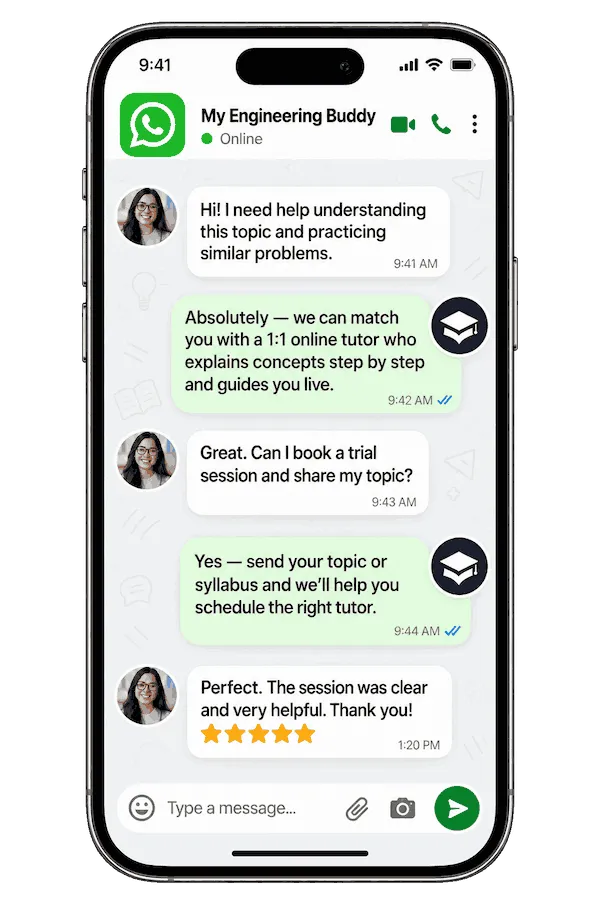
Unlike platforms where you fill out a form and wait, MEB responds in under a minute, 24/7. Tutor match takes under an hour. The $1 trial means you test before you commit. Everything runs over WhatsApp — no logins, no intake forms.
Study Plans (Pick One That Matches Your Goal)
Orthodontics has clear exam cycles and submission windows, so the plan structure matters. A catch-up plan (1–3 weeks) targets students who are behind and need rapid gap-filling before an exam or viva. An exam prep plan (4–8 weeks) builds structured revision across cephalometrics, biomechanics, and case planning with past paper integration. Weekly ongoing support aligns sessions to your semester timetable and coursework deadlines, keeping progress steady rather than reactive. The tutor builds the specific sequence after the diagnostic in your first session.
MEB tutors bring postgraduate-level subject knowledge to every session — not general science graduates filling a gap. For orthodontics, that means tutors who have worked through the same cephalometric analyses, appliance prescriptions, and viva formats your programme uses.
Source: My Engineering Buddy, 2008–2025.
Pricing Guide
Standard orthodontics tutoring runs $20–$40/hr for BDS and most postgraduate levels. Specialist or niche case-based tutoring — complex surgical planning, research methodology support — reaches up to $100/hr. Rate factors include level, topic complexity, timeline urgency, and tutor availability.
Availability tightens before MDS qualifying exams and BDS finals. If your exam is within four weeks, book immediately.
For students targeting top orthodontics postgraduate programmes or specialist board certification, tutors with active clinical or academic orthodontics backgrounds are available at higher rates. Share your specific goal and MEB will match the tier to your ambition.
Start with the $1 trial — 30 minutes, no registration, no commitment. WhatsApp MEB for a quick quote.
FAQ
Is Orthodontics hard?
Yes — it demands strong spatial reasoning, an understanding of biomechanics, and the ability to integrate growth science with clinical decision-making. Students who struggle most usually lack a clear mental model of force systems. That’s fixable with the right guidance.
How many sessions are needed?
For a specific gap — one cephalometric analysis method, one biomechanics concept — two to four sessions often suffice. For full exam preparation or a systematic MDS revision programme, 15–25 hours across 6–8 weeks is a realistic range.
Can you help with homework and assignments?
Yes. MEB tutoring is guided learning — you understand the work, then submit it yourself. The tutor explains the reasoning, walks through the method, and helps you build the answer independently. See our Academic Integrity policy and Why MEB page for full details on what we help with and what we don’t.
Will the tutor match my exact syllabus or exam board?
Yes. Before matching, MEB asks for your university, programme level, and specific syllabus or course outline. Your tutor is briefed on these before session one — you won’t spend time explaining your curriculum to someone unfamiliar with it.
What happens in the first session?
The first session is a diagnostic. The tutor identifies your specific gaps — a cephalometric landmark you’re misplacing, a force couple you’re confusing, a case classification you’re applying inconsistently — then builds the session plan from that. No guessing, no generic starting point.
Is online tutoring as effective as in-person for Orthodontics?
For theoretical, analytical, and case-planning work, yes — fully. The digital pen-pad replicates whiteboard teaching for cephalometric tracing and force diagrams. Clinical hands-on technique is the one area that genuinely requires physical presence, but that’s not what tutoring covers.
Can I get Orthodontics help at short notice — even late at night?
Yes. MEB operates 24/7 via WhatsApp. If you message at midnight before a morning viva, someone responds. Tutor availability varies, but same-day matching is common outside peak exam windows.
What’s the difference between cephalometric analysis methods, and which does my exam use?
Common methods include Steiner, Tweed, Ricketts, and Downs analyses — each using different planes and reference points. Which one your exam uses depends on your university syllabus. Share your course outline and the tutor will focus exactly there, not across all methods simultaneously.
Do you cover orthodontics for postgraduate MDS and specialist board exams?
Yes. MEB supports students at MDS level, postgraduate residency programmes, and those preparing for specialist board examinations. Tutors at this level bring academic and clinical background specific to postgraduate orthodontics, including research methodology support where needed. Get prosthodontics help alongside MDS orthodontics if your programme requires it.
How do I tell which appliance is right for a case — a common exam question?
Appliance selection questions are structured around patient age, skeletal pattern, growth status, compliance, and treatment goals. The tutor walks you through a decision framework — not a memorised list — so you can apply it to any case the examiner puts in front of you.
How do I get started?
Message MEB on WhatsApp — share your programme, your current difficulty, and your exam or submission date. You’ll be matched with a verified orthodontics tutor, usually within the hour. The $1 trial covers 30 minutes of live tutoring or one question explained in full. Three steps: WhatsApp, match, start.
Trust & Quality at My Engineering Buddy
Every MEB tutor goes through a subject-specific screening process: academic background check, live demo session evaluation, and ongoing review against student feedback. Tutors holding clinical or postgraduate orthodontics qualifications are verified at that level — not accepted simply because they have a general dental science degree. Rated 4.8/5 across 40,000+ verified reviews on Google.
MEB tutoring is guided learning — you understand the work, then submit it yourself. For full details on what we help with and what we don’t, read our Academic Integrity policy and Why MEB.
MEB has served 52,000+ students across the US, UK, Canada, Australia, Gulf, and Europe since 2008 — in 2,800+ subjects. Within Dentistry, the platform covers Orthodontics alongside subjects including endodontics tutoring and oral pathology tutoring. Tutor matching methodology is described in detail on our tutoring methodology page.
Try your first session for $1 — 30 minutes of live 1:1 tutoring or one homework question explained in full. No registration. No commitment. WhatsApp MEB now and get matched within the hour.
The NICE guidelines on dental referral pathways and the standards bodies that govern orthodontic specialist practice set a high clinical bar. MEB tutors understand that bar — and train students to meet it academically.
Source: NICE — National Institute for Health and Care Excellence.
Explore Related Subjects
Students studying Orthodontics often also need support in:
Next Steps
Here’s what to do right now:
- Share your exam board or university programme, your hardest topic, and your current timeline
- Share your availability and time zone
- MEB matches you with a verified orthodontics tutor — usually within 24 hours
- Your first session opens with a diagnostic so every minute is used well
Before your first session, have ready:
- Your syllabus or course outline (BDS module guide, MDS programme handbook, or exam board spec)
- A recent past paper attempt or assignment you struggled with
- Your exam or submission deadline date — the tutor handles the rest
Visit www.myengineeringbuddy.com for more on how MEB works.
WhatsApp to get started or email [email protected].
Reviewed by Subject Expert
This page has been carefully reviewed and validated by our subject expert to ensure accuracy and relevance.