~1 min
Average Reply Time
~1 hour
To Be Matched With A Tutor
30 Min Trial
75% Find Their Tutor On The 1st Trial
$20-35+/hr
Premium Yet Affordable Learning
Hire The Best Mechanical Vibrations Tutor










Most students hit a wall at damped systems or modal analysis — and no amount of re-reading the textbook moves them past it.
Mechanical Vibrations Tutor Online
Mechanical Vibrations is an undergraduate and graduate engineering course covering the oscillatory motion of mechanical systems — free, forced, and damped — equipping students to model, analyze, and control vibration in structures and machines.
MEB provides 1:1 online tutoring and academic guidance across 2,800+ advanced subjects, including a full mechanical engineering tutor service. If you’ve searched for a Mechanical Vibrations tutor near me and found only generic platforms, you’re in the right place. Our tutors know the subject at the level your course demands — SDOF and MDOF systems, frequency response, eigenvalue problems — and they work through your actual problem sets, not a generic syllabus.
- 1:1 online sessions matched to your exact course and syllabus
- Expert-verified tutors with subject-specific knowledge in vibrations theory and applications
- Flexible time zones — US, UK, Canada, Australia, Gulf
- Structured learning plan built after a diagnostic session
- Ethical academic guidance — you understand the work, then submit it yourself
52,000+ students across the US, UK, Canada, Australia, and the Gulf have used MEB since 2008 — including students in Mechanical Engineering subjects like Mechanical Vibrations, Dynamics of Machines, and Engineering Dynamics.
Source: My Engineering Buddy, 2008–2025.
How Much Does a Mechanical Vibrations Tutor Cost?
Rates start at $20–$40/hr for undergraduate-level Mechanical Vibrations. Graduate or research-level sessions with specialist tutors run higher. Before committing to a package, you can test MEB with the $1 trial — 30 minutes of live 1:1 tutoring or one full homework question explained.
| Level / Need | Typical Rate | What’s Included |
|---|---|---|
| Standard (undergraduate) | $20–$40/hr | 1:1 sessions, homework guidance |
| Advanced / Graduate / Specialist | $40–$100/hr | Expert tutor, FEA/modal analysis depth |
| $1 Trial | $1 flat | 30 min live session or 1 homework question |
Tutor availability tightens sharply during end-of-semester exam periods. Book early if your finals or project submission is within six weeks.
WhatsApp MEB for a quick quote — average response time under 1 minute.
Who This Mechanical Vibrations Tutoring Is For
Mechanical Vibrations sits at the intersection of mathematics, physics, and engineering design. Students who struggle often do so not because the topic is beyond them, but because the jump from static systems to dynamic ones is steeper than any prerequisite course makes it look.
- Second and third-year mechanical engineering undergraduates hitting their first MDOF system
- Graduate students working on vibration isolation, rotor dynamics, or structural dynamics research
- Students retaking after a failed first attempt — and needing the gaps closed properly this time
- Students with a final-year project or thesis chapter involving vibration analysis or FEA
- Students at Georgia Tech, University of Michigan, ETH Zurich, Imperial College London, University of Toronto, UNSW Sydney, or TU Delft who need course-specific help
- Parents watching a child’s confidence drop alongside their grades in a course they need to progress in the programme
At MEB, we’ve found that Mechanical Vibrations students usually don’t struggle with the physics — they struggle the moment differential equations meet boundary conditions. Catching that specific gap in session one changes everything that follows.
1:1 Tutoring vs Self-Study vs AI vs YouTube vs Online Courses
Self-study works if you’re disciplined, but Mechanical Vibrations problems require step-by-step feedback — a wrong sign in a transfer function propagates through ten lines. AI tools explain concepts quickly but can’t watch you misapply Lagrange’s equations in real time and correct you. YouTube covers free vibration well but stops short when your assignment involves damped forced response with specific boundary conditions. Online courses are structured but move at a fixed pace that doesn’t wait for you. With 1:1 MEB tutoring, the session is calibrated to your exact week of the course — whether you’re on natural frequencies today or numerically solving mode shapes tomorrow.
Outcomes: What You’ll Be Able To Do in Mechanical Vibrations
After targeted sessions with an MEB tutor, you’ll be able to solve free and forced vibration problems for single and multi-degree-of-freedom systems with confidence. You’ll analyze frequency response functions and interpret Bode plots in the context of your design problem. You’ll model damped systems using viscous, Coulomb, or structural damping assumptions and explain the physical meaning of each. You’ll apply the Lagrangian approach to derive equations of motion for complex mechanical systems. You’ll present modal analysis results — natural frequencies, mode shapes, orthogonality conditions — in problem sets, reports, and oral examinations.
Based on feedback from 40,000+ sessions collected by MEB from 2022 to 2025, 58% of students improved by one full grade after approximately 20 hours of 1:1 tutoring in subjects like Mechanical Vibrations. A further 23% achieved at least a half-grade improvement.
Source: MEB session feedback data, 2022–2025.
Try your first session for $1 — 30 minutes of live 1:1 tutoring or one homework question explained in full. No registration. No commitment. WhatsApp MEB now and get matched within the hour.
What We Cover in Mechanical Vibrations (Syllabus / Topics)
MEB tutors cover the full standard curriculum for Mechanical Vibrations at undergraduate and graduate level. The three tracks below reflect how the subject is structured at most North American, European, and Australian engineering schools.
Track 1: Fundamentals — Single Degree of Freedom (SDOF) Systems
- Free undamped vibration: natural frequency, period, amplitude
- Damped free vibration: underdamped, critically damped, overdamped responses
- Forced harmonic vibration: steady-state and transient responses
- Resonance, magnification factor, and phase angle
- Base excitation and rotating imbalance problems
- Vibration isolation: transmissibility ratio and isolator design
- Viscous, Coulomb, and structural (hysteretic) damping models
Primary texts: Rao’s Mechanical Vibrations (6th ed.), Thomson & Dahleh’s Theory of Vibrations with Applications.
Track 2: Multi-Degree of Freedom (MDOF) Systems and Modal Analysis
- Equations of motion for 2-DOF and n-DOF systems: matrix formulation
- Eigenvalue problems: natural frequencies and mode shapes
- Orthogonality of mode shapes, modal mass and stiffness matrices
- Modal superposition and decoupling of equations
- Forced response of MDOF systems: frequency response matrix
- Dynamic vibration absorbers (undamped and damped)
- Introduction to experimental modal analysis and frequency response functions (FRFs)
Primary texts: Inman’s Engineering Vibration (4th ed.), Meirovitch’s Fundamentals of Vibrations.
Track 3: Continuous Systems, Numerical Methods, and Applications
- Vibration of strings, rods, and beams: wave equation and boundary conditions
- Assumed modes method and Rayleigh-Ritz approach
- Finite element method applied to vibration problems
- Rotor dynamics: critical speeds, whirl, and balancing
- Random vibrations: power spectral density, mean square response
- Vibration measurement: accelerometers, FFT analyzers, signal processing basics
- Case studies: automotive NVH, aerospace structural dynamics, rotating machinery
Primary texts: Newland’s An Introduction to Random Vibrations, Spectral and Wavelet Analysis, Shabana’s Theory of Vibration. Students using Finite Element Analysis tools like ANSYS or Nastran for vibration problems get targeted support with those environments as well.

What a Typical Mechanical Vibrations Session Looks Like
The tutor opens by checking where you landed on the previous topic — say, the response of a damped SDOF system under harmonic excitation. Any unresolved confusion there gets cleared first. Then you move into the day’s problem: the tutor walks through a representative example on the digital pen-pad, showing the full derivation — setting up the equation of motion, non-dimensionalizing, identifying the damping ratio, and plotting the frequency response. You replicate the process on a new problem while the tutor watches. When you make an error — misidentifying the effective stiffness in a two-spring system, for example — the tutor stops you at that line, not at the end. The session closes with two assigned practice problems and a clear note on which topic opens next time.
How MEB Tutors Help You with Mechanical Vibrations (The Learning Loop)
Diagnose: In the first session, the tutor identifies exactly where your understanding breaks down — whether that’s the physical interpretation of damping, the mechanics of setting up a Lagrangian, or reading a mode shape from an eigenvalue solution. Generic revision doesn’t help here; targeted diagnosis does.
Explain: The tutor works through problems live using a digital pen-pad. Every step is visible and narrated. Nothing is skipped because “it’s obvious.” Derivations that your lecturer covered in two lines get the full treatment.
Practice: You attempt problems with the tutor present. This is where most students realise how much they thought they understood versus what they can actually execute under exam conditions.
Feedback: The tutor corrects errors at the step where they occur — not at the end of a page. You learn why the sign was wrong, why the boundary condition was misapplied, why the mode shapes aren’t orthogonal in your solution. That’s the difference between fixing one answer and understanding a class of problems.
Plan: After each session, the tutor notes what’s solid and what needs reinforcement. You get a clear next-topic sequence, not an open-ended “keep revising.”
Sessions run on Google Meet. The tutor uses a digital pen-pad or iPad with Apple Pencil for all worked solutions. Before your first session, share your course syllabus or problem set and your exam date. The first session doubles as your diagnostic — start with the $1 trial and the tutor maps your full plan from there.
Students consistently tell us that the moment they stop copying solutions and start explaining their reasoning out loud to the tutor, their exam performance shifts. Mechanical Vibrations is a subject where that transition happens quickly when the sessions are structured right.
Tutor Match Criteria (How We Pick Your Tutor)
Not every mechanical engineer knows vibrations at the depth a graduate-level course requires. Here’s what MEB screens for:
Subject depth: Tutors are matched by the specific level — undergraduate SDOF/MDOF coursework, graduate modal analysis and FEA-based vibration, or research support in rotor dynamics or structural dynamics. Get Solid Mechanics tutoring and Continuum Mechanics help from the same verified pool.
Tools: Google Meet and a digital pen-pad or iPad with Apple Pencil — standard for every session. Tutors supporting MATLAB-based vibration analysis or ANSYS modal simulations are available on request.
Time zone: Matched to your region — US, UK, Gulf, Canada, Australia. Late-night sessions are available.
Goals: Exam preparation, weekly academic guidance, project guidance, or thesis-chapter review — the tutor’s approach is calibrated to your specific objective.
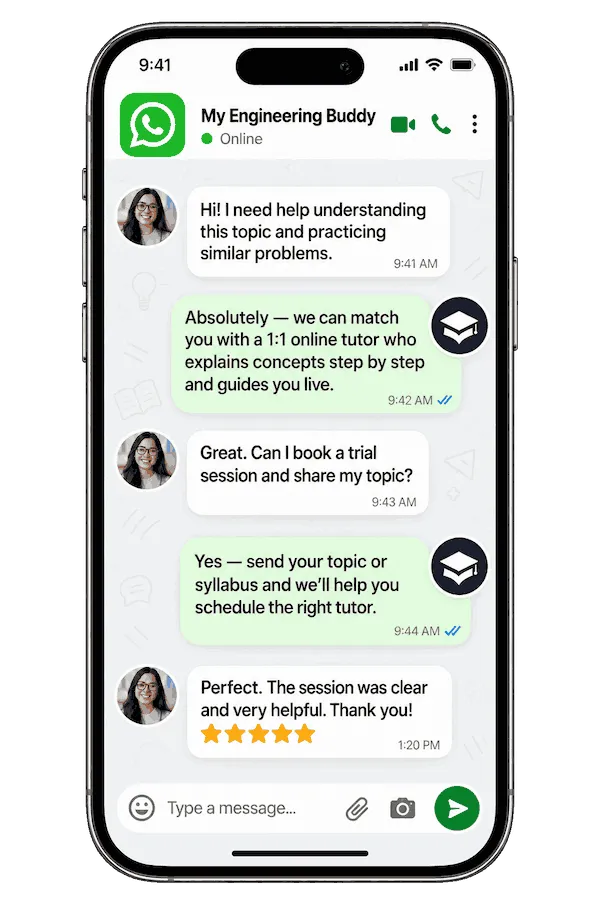
Unlike platforms where you fill out a form and wait, MEB responds in under a minute, 24/7. Tutor match takes under an hour. The $1 trial means you test before you commit. Everything runs over WhatsApp — no logins, no intake forms.
Study Plans (Pick One That Matches Your Goal)
Students come to MEB at different points in their course. A catch-up plan (1–3 weeks) targets students who are behind on core topics — damping models, frequency response, MDOF setup — and need to close the gap before an upcoming midterm or final. An exam prep plan (4–8 weeks) builds a structured revision sequence across all examinable topics, with mock problems and timed practice. Weekly support aligns to your semester schedule, covering new material as it’s taught and keeping homework submission on track. The tutor sets the specific sequence after the first diagnostic session.
Pricing Guide
Undergraduate Mechanical Vibrations tutoring runs $20–$40/hr. Graduate-level work — modal analysis, random vibrations, FEA-based vibration, rotor dynamics — runs $40–$100/hr depending on topic depth and tutor specialisation. Rate factors include your level, how niche the topic is, your timeline, and tutor availability.
Exam and project submission periods push demand up fast. If your deadline is within six weeks, book early.
For students targeting positions in aerospace structures, automotive NVH, or precision machinery design, tutors with professional industry or research backgrounds in those areas are available at higher rates — share your specific goal and MEB will match the tier to your ambition.
Start with the $1 trial — 30 minutes, no registration, no commitment. WhatsApp MEB for a quick quote.
MEB has been running since 2008. Every tutor goes through a live demo evaluation before taking sessions. That’s not standard on most platforms — it’s why the 4.8/5 rating has held across 40,000+ reviews.
Source: My Engineering Buddy internal data, 2008–2025.
FAQ
Is Mechanical Vibrations hard?
It’s one of the more mathematically demanding undergraduate mechanical engineering courses. The jump from statics and dynamics to vibration analysis — especially MDOF systems and modal decomposition — trips up students who are solid in earlier courses. Targeted 1:1 sessions close that gap faster than solo revision.
How many sessions are needed?
Most undergraduate students see a clear improvement within 8–12 sessions. Graduate students working on specific research topics often need 4–6 focused sessions. The first diagnostic session gives the tutor enough to map a realistic plan for your timeline.
Can you help with homework and assignments?
Yes — MEB tutoring is guided learning. The tutor explains the method and works through the reasoning with you; you understand the work, then submit it yourself. See our Academic Integrity policy and Why MEB page for full details on what we help with and what we don’t.
Will the tutor match my exact syllabus or exam board?
Yes. Share your course outline and the tutor is matched to your institution’s specific coverage — whether that’s a North American semester course, a European university module, or an Australian curriculum. The tutor doesn’t work from a generic template.
What happens in the first session?
The tutor reviews what you’ve shared — a past paper attempt, a problem set, or your syllabus — and identifies your biggest gaps. You work through at least one representative problem together. The session closes with a clear plan for subsequent sessions.
Is online tutoring as effective as in-person?
For Mechanical Vibrations specifically, yes. The digital pen-pad replicates whiteboard working in full. Students report that screen-sharing their own MATLAB outputs or ANSYS results for live critique is often more useful than in-person sessions where that’s harder to set up.
What’s the difference between SDOF and MDOF support — do I need to specify?
Just share your current topic and week of semester when you WhatsApp MEB. Tutors are matched by level — SDOF fundamentals, MDOF matrix methods, continuous systems, or FEA-based vibration — so you don’t need to pre-diagnose yourself.
Can MEB help with MATLAB or Python simulations for vibration assignments?
Yes. Many Mechanical Vibrations courses require numerical simulation — ODE solvers, FFT analysis, mode shape plotting. MEB tutors who specialise in Simulink and computational methods are available for these assignments alongside the theory sessions.
Can I get Mechanical Vibrations help at midnight?
Yes. MEB operates 24/7 across time zones. WhatsApp response time is under a minute at any hour. Tutors are available for late-night sessions in the US, Gulf, and Australian time zones — send your first message and you’ll have a match within the hour.
Do you offer group Mechanical Vibrations sessions?
MEB is structured around 1:1 sessions only. Group sessions would mean the tutor can’t adapt to your specific error in real time — which is the core of what makes the sessions effective for a subject as calculation-heavy as this one.
How do I get started?
WhatsApp MEB, share your topic and exam date, and you’re matched with a verified tutor — usually within the hour. The first session is the $1 trial: 30 minutes of live tutoring or one homework question explained in full. Three steps: message, match, start.
Can MEB help if I’m struggling specifically with the frequency response and Bode plot section?
That’s one of the most common sticking points. Tutors address frequency response functions, phase relationships, and Bode plot interpretation as a focused session topic — you don’t have to work through the whole syllabus to get targeted help on one concept.
Trust & Quality at My Engineering Buddy
Every MEB tutor goes through subject-specific screening before taking sessions — a live demo evaluation assessed by experienced reviewers, with ongoing feedback monitoring after each rating is submitted. Tutors covering Mechanical Vibrations hold relevant engineering degrees and many have professional experience in structural dynamics, automotive NVH, or aerospace applications. Rated 4.8/5 across 40,000+ verified reviews on Google.
MEB tutoring is guided learning — you understand the work, then submit it yourself. For full details on what we help with and what we don’t, read our Academic Integrity policy and Why MEB.
MEB has served 52,000+ students in the US, UK, Canada, Australia, the Gulf, and Europe since 2008 — across 2,800+ subjects. Within Mechanical Engineering, the platform covers Mechanical Vibrations alongside related subjects including Theory of Machines tutoring, Mechanics of Materials help, and Computational Mechanics tutoring. Tutors are matched by subject, level, exam board, and time zone — not assigned at random from a general pool. Read more about the approach at MEB’s tutoring methodology.
Explore Related Subjects
Students studying Mechanical Vibrations often also need support in:
- Kinematics of Machines
- Strength of Materials
- Engineering Statics
- Engineering Mechanics
- Nonlinear Finite Element Analysis
- Design of Machine Elements
- Fluid Mechanics
A common pattern our tutors observe is that students who struggle with Mechanical Vibrations have often not fully consolidated their Engineering Dynamics foundation. One or two sessions revisiting that base before moving into MDOF systems cuts the overall time needed significantly.
Next Steps
When you contact MEB, share your exam board or course name, the topic you’re currently stuck on, and your exam or assignment deadline. Include your time zone and preferred session times. MEB matches you with a verified Mechanical Vibrations tutor — usually within 24 hours, often within the hour.
Before your first session, have ready:
- Your course syllabus or problem set you’re working through
- A recent past paper attempt or homework question you got wrong
- Your exam or submission date
The tutor handles the rest. First session is diagnostic — every minute is used well from the start.
Visit www.myengineeringbuddy.com for more on how MEB works.
WhatsApp to get started or email [email protected].
Reviewed by Subject Expert
This page has been carefully reviewed and validated by our subject expert to ensure accuracy and relevance.