




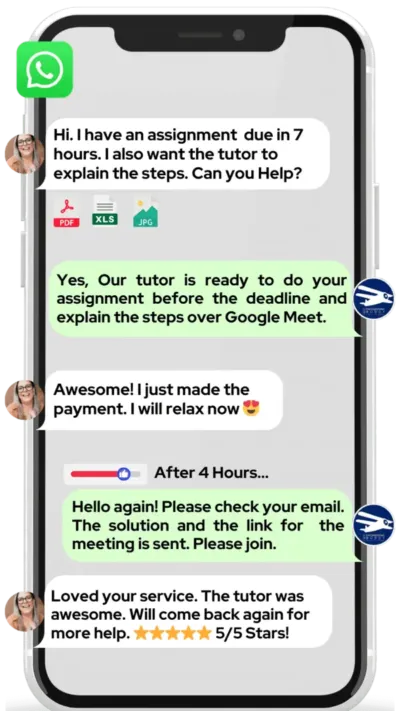
~1 min
Average Reply Time
~1 hour
To Be Matched With A Tutor
1 Trial
75% Find Their Tutor On The 1st Trial
$1
Your First 30 Minutes
Hire The Best Dynamics of Machine Tutor
Top Tutors, Top Grades. Without The Stress!





Related Subjects
Cam profiles, gear trains, and flywheel analysis — the three topics where most mechanical engineering students lose the most marks.
Dynamics of Machine Tutor Online
Dynamics of Machine is an undergraduate mechanical engineering subject covering force analysis of mechanisms, kinematics and kinetics of moving parts, balancing of rotating and reciprocating masses, and vibration fundamentals — equipping students to analyse real mechanical systems.
If you’re searching for a Dynamics of Machine tutor near me, MEB offers 1:1 online tutoring and homework help as part of a broader mechanical engineering tutoring programme. Tutors work directly from your university syllabus — covering everything from free body diagrams of linkages to balancing of multi-cylinder engines. Sessions are live, focused, and structured around what you’re actually stuck on.
- 1:1 online sessions tailored to your exact course and syllabus
- Expert-verified tutors with mechanical engineering degrees and subject-specific knowledge
- Flexible time zones — US, UK, Canada, Australia, Gulf covered
- Structured learning plan built after a diagnostic session
- Ethical homework and assignment guidance — you understand the work, then submit it yourself
52,000+ students across the US, UK, Canada, Australia, and the Gulf have used MEB since 2008 — including students in Mechanical Engineering subjects like Dynamics of Machine, Kinematics of Machines, and Mechanical Vibrations.
Source: My Engineering Buddy, 2008–2025.
How Much Does a Dynamics of Machine Tutor Cost?
Most Dynamics of Machine tutoring sessions are priced at $20–$40/hr. Advanced or graduate-level topics — such as nonlinear vibration analysis or dynamic simulation — may reach up to $100/hr. Not sure where you fall? Start with the $1 trial and the tutor will assess your level in the first 30 minutes.
| Level / Need | Typical Rate | What’s Included |
|---|---|---|
| Standard undergraduate | $20–$35/hr | 1:1 sessions, homework guidance |
| Advanced / graduate-level | $35–$100/hr | Expert tutor, niche depth, research support |
| $1 Trial | $1 flat | 30 min live session or one full homework question |
Tutor availability tightens significantly in the weeks before end-of-semester exams. Book early if your assessment window is approaching.
WhatsApp MEB for a quick quote — average response time under 1 minute.
Who This Dynamics of Machine Tutoring Is For
This subject trips up students who are solid at statics but haven’t yet built intuition for moving systems. If velocity diagrams, inertia forces, or balancing equations feel like a foreign language, you’re exactly who this is for.
- Undergraduate mechanical, automotive, and aerospace engineering students
- Students retaking after a failed first attempt in Dynamics of Machine
- Students with a university conditional offer depending on this module’s grade
- Students 4–6 weeks from an exam with significant topic gaps still to close
- Graduate students revisiting machine dynamics for research or thesis work
- Students at universities including MIT, Georgia Tech, University of Toronto, University of Manchester, TU Delft, RMIT, and Khalifa University who need subject-specific support beyond lecture notes
If you need help with Dynamics of Machine homework or assignment guidance, MEB tutors walk you through the method — you work through the problem and submit it yourself.
1:1 Tutoring vs Self-Study vs AI vs YouTube vs Online Courses
Self-study works if you have discipline, good notes, and no gaps — rare in Dynamics of Machine. AI tools can explain angular velocity in seconds but won’t catch when your free body diagram is fundamentally wrong. YouTube is fine for an overview of gear ratios; it can’t debug your balancing calculation. Online courses give structure but move at a fixed pace, regardless of where you’re stuck. With 1:1 engineering dynamics tutoring, a tutor sees your working in real time, identifies the exact error, and corrects it before it becomes a habit — which matters when Dynamics of Machine builds concept on concept from week one.
Outcomes: What You’ll Be Able To Do in Dynamics of Machine
After consistent 1:1 sessions, you’ll be able to solve velocity and acceleration diagrams for four-bar and slider-crank mechanisms without prompting. You’ll analyse inertia forces in reciprocating engines and apply D’Alembert’s principle to complex linkage problems. You’ll model free and forced vibration systems — including damped oscillations — and calculate natural frequencies from first principles. You’ll explain static and dynamic balancing of rotating masses well enough to apply it to multi-cylinder engine design. You’ll present these solutions clearly in assignment format, showing working your examiner can follow.
Supporting a student through Dynamics of Machine? MEB works directly with parents to set up sessions, track progress, and keep coursework on schedule. WhatsApp MEB — average response time is under a minute, 24/7.
“Based on feedback from 40,000+ sessions collected by MEB from 2022 to 2025, 58% of students improved by one full grade after approximately 20 hours of 1:1 tutoring in subjects like Dynamics of Machine. A further 23% achieved at least a half-grade improvement.”
Source: MEB session feedback data, 2022–2025.
What We Cover in Dynamics of Machine (Syllabus / Topics)

Mechanisms and Kinematic Analysis
- Types of mechanisms: four-bar linkage, slider-crank, quick-return mechanisms
- Degrees of freedom — Grashof’s law and mobility criteria
- Velocity analysis: graphical (velocity diagrams) and analytical methods
- Acceleration analysis: Coriolis component, Klein’s construction
- Instantaneous centre method for velocity determination
- Equivalent linkage and inversion of mechanisms
Core texts include Rattan’s Theory of Machines, S.S. Rattan, and Theory of Machines by R.S. Khurmi and J.K. Gupta — standard references across most undergraduate programmes worldwide.
Force Analysis, Balancing, and Flywheel
- Static and dynamic force analysis of mechanisms
- D’Alembert’s principle applied to linkages and engine mechanisms
- Turning moment diagrams and fluctuation of energy
- Flywheel design — coefficient of fluctuation of speed and energy
- Static and dynamic balancing of rotating masses
- Balancing of reciprocating masses — primary and secondary forces
- Balancing of multi-cylinder in-line and V-engines
Reference texts: Mechanisms and Dynamics of Machinery by Mabie and Reinholtz, and Machine Dynamics by Erdman, Sandor, and Kota — used across US, UK, and Australian universities.
Vibration Analysis and Governors
- Free vibration of single-degree-of-freedom (SDOF) systems
- Damped free vibration — underdamped, critically damped, overdamped cases
- Forced vibration — response to harmonic excitation, resonance, isolation
- Multi-degree-of-freedom (MDOF) systems and mode shapes
- Critical speed of rotating shafts — Rankine and Dunkerley methods
- Governors: Watt, Porter, Proell — sensitivity, stability, isochronous condition
- Gyroscopic couple and its applications in vehicle dynamics and aircraft
Recommended: Mechanical Vibrations by S.S. Rao — the standard for vibration topics across North American and European mechanical engineering programmes. Also see Mechanical Vibrations tutoring for deeper support in this track.
At MEB, we’ve found that students who struggle with Dynamics of Machine almost always share the same root problem: they can follow a worked example step by step, but freeze when the numbers change. One focused session on rebuilding the method — not the memorised steps — changes that entirely.
What a Typical Dynamics of Machine Session Looks Like
The tutor opens by checking your last topic — usually velocity diagrams or balancing problems from the previous session. You share your attempted working on screen; the tutor uses a digital pen-pad to annotate directly over it. You work through a new problem together: say, finding the angular acceleration of the connecting rod in a slider-crank mechanism. The tutor asks you to explain each step before writing it. When your Coriolis component calculation goes wrong, the tutor pauses, isolates the error, and rebuilds that step with you. The session closes with two specific problems to attempt before next time — one reinforcing today’s method, one previewing the next topic.
How MEB Tutors Help You with Dynamics of Machine (The Learning Loop)
Diagnose: In the first session, the tutor identifies exactly where your understanding breaks down — whether that’s free body diagram setup, sign conventions in force analysis, or setting up the equations of motion for a vibrating system. Generic gaps are separated from subject-specific confusion fast.
Explain: The tutor works through problems live using a digital pen-pad, showing every intermediate step. No skipped algebra. No “you should already know this.” If you need to see the turning moment diagram built from scratch, that’s what happens.
Practice: You attempt the next problem with the tutor present. Not watching. Present — ready to ask the right question when you stall, not just hand you the answer.
Feedback: Every error gets traced back to its source. If you dropped marks on a balancing question, the tutor shows you where the method broke, why that step costs marks, and what the examiner expects to see in the working.
Plan: The session ends with a clear next step — which topic comes next, what to practise, and how the upcoming assignment or exam question type connects to what you just covered.
Sessions run over Google Meet. The tutor uses a digital pen-pad or iPad with Apple Pencil. Before your first session, share your course outline or syllabus, a past paper or assignment you’re stuck on, and your exam date. The first session also serves as your diagnostic. Start with the $1 trial — 30 minutes of live tutoring that costs less than a coffee and tells both you and the tutor exactly where to focus.
Students consistently tell us that the biggest shift in Dynamics of Machine comes when they stop trying to memorise problem types and start understanding what the equations are actually describing physically. That shift usually happens in the second or third session. We build toward it from session one.
Tutor Match Criteria (How We Pick Your Tutor)
Match quality is the single biggest factor in whether tutoring works. Here’s what MEB checks before assigning a tutor for Dynamics of Machine.
Subject depth: The tutor must have covered Dynamics of Machine at or above your level — relevant undergraduate or postgraduate mechanical engineering background, with working knowledge of your syllabus and exam format.
Tools: Every tutor works with Google Meet plus a digital pen-pad or iPad with Apple Pencil. Handwritten working on screen is non-negotiable for this subject.
Time zone: Matched to your region — US, UK, Canada, Australia, and Gulf students are all covered across multiple time slots, including late evenings.
Goals: Whether you need to pass a resit, hit a distinction, or work through a specific topic for a thesis, the tutor match reflects that target — not a one-size-fits-all approach.
Unlike platforms where you fill out a form and wait days, MEB responds in under a minute, 24/7. Tutor match takes under an hour. The $1 trial means you test before you commit. Everything runs over WhatsApp — no logins, no intake forms.
MEB tutors for Dynamics of Machine hold mechanical engineering degrees, have specific experience with mechanism analysis and vibration theory, and are vetted through a live demonstration evaluation — not just a CV screen.
Source: My Engineering Buddy, 2008–2025.
Study Plans (Pick One That Matches Your Goal)
Your tutor maps the exact session sequence after the diagnostic. As a rough guide: a catch-up plan (1–3 weeks) tackles your biggest topic gaps before an imminent exam — typically mechanisms, balancing, or vibration basics. An exam prep plan (4–8 weeks) runs through the full syllabus systematically, with past paper practice built in from week two onward. Weekly ongoing support aligns to your semester timetable, keeping you on top of new material before it compounds into a larger gap. The engineering mechanics tutoring sessions that precede Dynamics of Machine in most programmes are also available if you need to shore up prerequisites.
Pricing Guide
Rates for Dynamics of Machine tutoring start at $20/hr for standard undergraduate-level sessions and go up to $100/hr for specialist topics — nonlinear vibration, advanced rotor dynamics, or research-level support. Factors that affect the rate: your level, topic complexity, how close your exam is, and tutor availability at your preferred time slot.
Availability drops in the final three to four weeks of semester. If you’re inside that window, book now.
For students targeting positions at top aerospace, automotive, or defence engineering firms — or applying to graduate programmes with specific machine dynamics coursework requirements — tutors with professional industry backgrounds are available at higher rates. Share your specific goal and MEB will match the tier to what you need.
Start with the $1 trial — 30 minutes, no registration, no commitment. WhatsApp MEB for a quick quote.
Try your first session for $1 — 30 minutes of live 1:1 tutoring or one homework question explained in full. No registration. No commitment. WhatsApp MEB now and get matched within the hour.
FAQ
Is Dynamics of Machine hard?
It’s consistently rated one of the harder core mechanical engineering modules. The difficulty isn’t the maths — it’s building physical intuition for moving systems. Students who are strong in statics often still struggle with the dynamic force components and vibration topics. Structured 1:1 help closes that gap faster than self-study.
How many sessions are needed?
Most students need 8–15 sessions to work through a full syllabus gap. A targeted pre-exam catch-up can show results in 4–6 sessions if the student has a reasonable foundation. Your tutor will give a realistic estimate after the first diagnostic session.
Can you help with homework and assignments?
Yes. MEB tutoring is guided learning — you understand the work, then submit it yourself. See our Academic Integrity policy and Why MEB page for full details on what we help with and what we don’t. The tutor explains the method; the solution is yours.
Will the tutor match my exact syllabus or exam board?
Yes. Before the first session, share your course outline, university, and any past papers or assignments. Tutors are matched based on your specific syllabus — not a generic Dynamics of Machine curriculum. Coverage varies by university, and your tutor will work to your actual topic list.
What happens in the first session?
The tutor starts with a short diagnostic — asking you to attempt or explain a problem — to identify exactly where understanding breaks down. The remainder of the session addresses the most urgent gap. You leave with a clear topic plan and a practice task. The $1 trial session doubles as this diagnostic.
Is online tutoring as effective as in-person?
For Dynamics of Machine specifically, yes. The digital pen-pad replicates whiteboard working better than most physical tutoring setups. Students share their screen; tutors annotate live. The feedback loop is identical to in-person — and the session record is available to review afterward.
What’s the difference between Dynamics of Machine and Kinematics of Machines?
Kinematics deals with motion — position, velocity, acceleration of mechanisms — without considering forces. Dynamics of Machine extends this to include forces, inertia effects, balancing, vibration, and energy. Dynamics builds directly on kinematics, so gaps in kinematic analysis will show up quickly. MEB covers Kinematics of Machines tutoring as a separate subject if you need to build that foundation first.
How is Dynamics of Machine assessed at most universities?
Assessment typically combines written examinations (covering mechanism analysis, force analysis, balancing, and vibration) with assignments or lab reports. Exam questions usually require full working — method marks are available even for partially correct answers. Your tutor will align session content to your specific assessment format.
Can I get Dynamics of Machine help at midnight or on weekends?
Yes. MEB operates 24/7. Tutors are available across time zones, which means late-night sessions for US and UK students are regularly covered. WhatsApp MEB at any hour — median response time is under a minute. Assignment deadlines don’t keep office hours, and neither do we.
What if I don’t like my assigned tutor?
Request a different tutor via WhatsApp. MEB will rematch you, usually within the same day. There’s no penalty and no awkward process — it happens more than you’d think, and the $1 trial is specifically designed to let you test the match before committing to a longer plan.
Do you help with vibration analysis specifically, or only the mechanics topics?
Both. Vibration analysis — SDOF and MDOF systems, damping ratios, natural frequency calculation, forced response, and resonance — is a core part of what MEB covers in Theory of Machines tutoring and Dynamics of Machine sessions. Many students find vibration the hardest part of the subject. It gets specific attention.
How do I get started?
Start with the $1 trial — 30 minutes of live 1:1 tutoring or one full homework question explained. Three steps: WhatsApp MEB, get matched to a verified tutor (usually within an hour), and start your trial session. No forms. No registration. No waiting.
Trust & Quality at My Engineering Buddy
Every MEB tutor for Dynamics of Machine holds a relevant mechanical engineering qualification and passes a live demonstration evaluation before taking any session. Screening checks subject knowledge, ability to explain under pressure, and comfort with digital pen-pad tools. Student feedback is reviewed after every session, and tutors who receive repeated negative signals are removed — not just flagged. Rated 4.8/5 across 40,000+ verified reviews on Google.
MEB tutoring is guided learning — you understand the work, then submit it yourself. For full details on what we help with and what we don’t, read our Academic Integrity policy and Why MEB.
MEB has been running since 2008 and has served 52,000+ students across the US, UK, Canada, Australia, Gulf, and Europe in 2,800+ subjects. Within Mechanical Engineering, the platform covers everything from engineering statics tutoring and solid mechanics tutoring through to advanced simulation and machine design. The MEB tutoring methodology is built around the same diagnostic-explain-practise-feedback loop used across all subjects on the platform.
APEGA and similar professional engineering bodies set the competency bar for practising engineers. MEB tutors in machine dynamics are matched to that standard — subject knowledge is verified, not assumed.
Source: APEGA — Engineers and Geoscientists Alberta, professional engineering competency standards.
Explore Related Subjects
Students studying Dynamics of Machine often also need support in:
- Continuum Mechanics
- Design of Machine Elements
- Finite Element Analysis (FEA)
- Mechanics of Materials
- Strength of Materials
- Computational Mechanics
- Fluid Mechanics
- Heat Transfer
Next Steps
Getting started takes three minutes. Share your exam board or course outline, the topic or assignment you’re stuck on, your current timeline, and your preferred session times and time zone. MEB matches you with a verified Dynamics of Machine tutor — usually within 24 hours.
Before your first session, have ready:
- Your syllabus or course outline (a module handbook page is enough)
- A past paper attempt or a homework question you couldn’t complete
- Your exam date or assignment deadline
The tutor handles the rest. The first session starts with a short diagnostic so every minute is spent on what actually moves your grade.
Visit www.myengineeringbuddy.com for more on how MEB works.
WhatsApp to get started or email [email protected].
52,000+ Happy Students From Various Universities






Reviewed by Subject Expert
This page has been carefully reviewed and validated by our subject expert to ensure accuracy and relevance.
