





~1 min
Average Reply Time
~1 hour
To Be Matched With A Tutor
1 Trial
75% Find Their Tutor On The 1st Trial
$1
Your First 30 Minutes
Hire The Best Engineering Mechanics Tutor
Top Tutors, Top Grades. Without The Stress!





Related Subjects
Free body diagrams stumping you? Statics problems that looked simple until the numbers hit? An Engineering Mechanics tutor can fix that before your next exam.
Engineering Mechanics Tutor Online
Engineering Mechanics is the foundational engineering course covering statics and dynamics — analyzing forces, moments, equilibrium, and motion of rigid bodies. It equips students to model real physical systems using Newton’s laws and vector methods.
MEB offers 1:1 online tutoring and homework help in 2,800+ advanced subjects, including Engineering Mechanics. If you’ve searched for an Engineering Mechanics tutor near me, MEB connects you with verified tutors who know your exact syllabus — whether that’s Beer & Johnston, Hibbeler, or a university-specific course structure. Sessions are live, one-to-one, and built around what you’re actually stuck on. One full semester of statics and dynamics concepts, covered properly, changes how you approach every engineering subject that follows.
MEB also covers the broader Mechanical Engineering subject area — so if your course spans multiple modules, one platform handles all of it.
- 1:1 online sessions tailored to your course syllabus and exam board
- Expert verified tutors with subject-specific Engineering Mechanics knowledge
- Flexible time zones — US, UK, Canada, Australia, Gulf
- Structured learning plan built after a diagnostic session
- Ethical homework and assignment guidance — you understand the work, then submit it yourself
52,000+ students across the US, UK, Canada, Australia, and the Gulf have used MEB since 2008 — including students in Mechanical Engineering subjects like Engineering Mechanics, Engineering Statics, and Engineering Dynamics.
Source: My Engineering Buddy, 2008–2025.
How Much Does an Engineering Mechanics Tutor Cost?
Most Engineering Mechanics sessions run $20–$40/hr depending on level and topic complexity. Graduate-level or highly specialized areas can reach $100/hr. New students can start with the $1 trial — 30 minutes of live 1:1 tutoring or one homework question explained in full, before committing to anything further.
| Level / Need | Typical Rate | What’s Included |
|---|---|---|
| Standard (undergrad statics/dynamics) | $20–$35/hr | 1:1 sessions, homework guidance |
| Advanced / Graduate Level | $35–$70/hr | Expert tutor, advanced topics |
| $1 Trial | $1 flat | 30 min live session or 1 homework question |
Tutor availability tightens significantly in the 3–4 weeks before end-of-semester exams. Book early if your exam window is approaching.
WhatsApp MEB for a quick quote — average response time under 1 minute.
Who This Engineering Mechanics Tutoring Is For
Engineering Mechanics sits at the base of almost every mechanical, civil, and aerospace engineering degree. Students who struggle here tend to struggle everywhere downstream — in Mechanics of Materials, in dynamics, in structural analysis. This tutoring is for students who need to stop that pattern now.
- First and second-year undergraduates hitting their first real wall in statics or dynamics
- Students retaking Engineering Mechanics after a failed first attempt
- Students with a conditional university offer that depends on passing this course
- Graduate students whose programs assume strong undergraduate mechanics foundations
- Students 4–6 weeks from finals with free body diagrams, moment equations, or kinematics still unclear
- Parents watching a child’s confidence drop alongside their grades in an engineering program
Students from universities including MIT, Georgia Tech, University of Michigan, Imperial College London, University of Toronto, UNSW Sydney, and TU Delft have used MEB for Engineering Mechanics support.
1:1 Tutoring vs Self-Study vs AI vs YouTube vs Online Courses
Self-study works if you’re disciplined, but Engineering Mechanics problems require someone to catch the sign error you keep making on moment arms. AI tools explain concepts fast but can’t watch you draw a free body diagram and tell you what’s wrong. YouTube is solid for overview lectures — it stops the moment you hit a specific problem from your problem set. Online courses are structured but move at a fixed pace with no adjustment for your gaps. With a 1:1 Engineering Mechanics tutor from MEB, the session adapts to exactly where you’re stuck — whether that’s equilibrium equations, Newton-Euler dynamics, or work-energy methods — and errors get corrected in the moment.
Outcomes: What You’ll Be Able To Do in Engineering Mechanics
After working with an MEB tutor, students can solve multi-body static equilibrium problems with distributed loads and moment couples, analyze the kinematics of particles and rigid bodies using both scalar and vector approaches, apply Newton’s second law and the work-energy theorem to dynamic systems including pulleys and linkages, model truss and frame structures to find internal forces and reactions, and explain the physical reasoning behind results — not just the algebraic steps. These are the skills that carry directly into solid mechanics coursework, FEA prep, and senior design projects.
Supporting a student through Engineering Mechanics? MEB works directly with parents to set up sessions, track progress, and keep coursework on schedule. WhatsApp MEB — average response time is under a minute, 24/7.
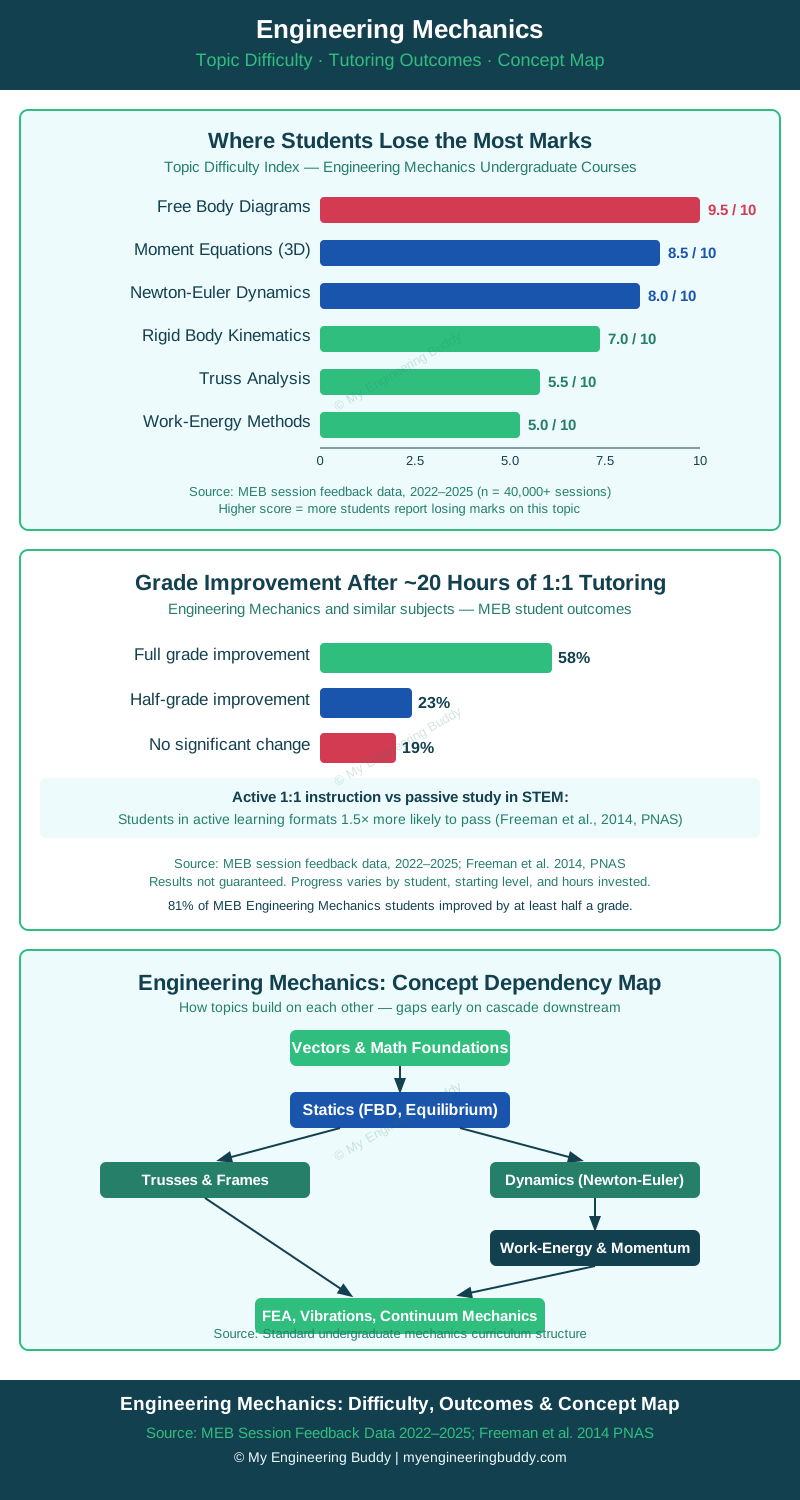
Based on feedback from 40,000+ sessions collected by MEB from 2022 to 2025, 58% of students improved by one full grade after approximately 20 hours of 1:1 tutoring in subjects like Engineering Mechanics. A further 23% achieved at least a half-grade improvement.
Source: MEB session feedback data, 2022–2025.
What We Cover in Engineering Mechanics (Syllabus / Topics)
Track 1: Statics
- Force systems in 2D and 3D — resultants, components, unit vectors
- Free body diagrams (FBDs) — drawing and interpreting correctly
- Equilibrium of particles and rigid bodies
- Moments, couples, and equivalent force-moment systems
- Trusses and frames — method of joints, method of sections
- Friction — dry friction, wedges, belt friction
- Centroids and moments of inertia for area and mass
Key texts: Vector Mechanics for Engineers: Statics (Beer, Johnston, Mazurek); Engineering Mechanics: Statics (Hibbeler).
Track 2: Dynamics
- Kinematics of particles — rectilinear and curvilinear motion, projectile problems
- Kinetics of particles — Newton’s second law, equations of motion
- Work and energy methods — kinetic energy, potential energy, conservative forces
- Impulse and momentum — linear and angular, impact problems
- Planar kinematics of rigid bodies — rotation, general plane motion
- Kinetics of rigid bodies — Newton-Euler equations, D’Alembert’s principle
- Vibrations introduction — free undamped vibration of single-DOF systems
Key texts: Vector Mechanics for Engineers: Dynamics (Beer, Johnston, Cornwell); Engineering Mechanics: Dynamics (Hibbeler).
Track 3: Applied and Computational Mechanics Extensions
- Introduction to continuum mechanics concepts — stress and strain at a point
- Energy methods — virtual work, principle of minimum potential energy
- Introduction to finite element analysis — what FEA assumes about mechanics
- MATLAB-based numerical solutions for dynamics problems
- Dimensional analysis and scaling in mechanical systems
Key texts: Engineering Mechanics: Combined Statics & Dynamics (Meriam, Kraige); Schaum’s Outline of Engineering Mechanics (Nelson, Best, McLean).
At MEB, we’ve found that most Engineering Mechanics students don’t fail because the subject is conceptually overwhelming — they fail because FBD errors at step one corrupt every subsequent calculation. Fixing that one habit in two sessions changes everything that follows.
What a Typical Engineering Mechanics Session Looks Like
The tutor opens by checking the previous session’s topic — usually moment equations or kinematic constraint problems — and reviewing any homework attempted since. The student shares their screen or problem sheet. Together, they work through a specific problem: say, a pulley system with two connected masses requiring Newton-Euler equations for each body separately. The tutor uses a digital pen-pad to annotate the FBD live, step by step, showing where the sign convention applies and why. The student then replicates the method on a similar problem while the tutor watches and interrupts only when an error appears. The session closes with one or two practice problems assigned and the next topic flagged — typically work-energy methods or angular momentum, depending on where the syllabus sits.
How MEB Tutors Help You with Engineering Mechanics (The Learning Loop)
Diagnose: In the first session, the tutor identifies exactly which mechanics concepts are missing — not vaguely weak, but specifically wrong. A student struggling with dynamics often has a statics gap that was never corrected. The tutor surfaces it in the first 15 minutes.
Explain: Live worked problems using a digital pen-pad. The tutor doesn’t lecture — they solve problems alongside the student, narrating the reasoning at every step. Why this sign. Why this reference frame. Why this free body and not another.
Practice: The student attempts a parallel problem with the tutor present. Not after the session — during it. This is where most of the learning actually happens.
Feedback: Errors are corrected step by step, with the tutor identifying not just what went wrong but where in the process the reasoning broke. That’s what distinguishes guided correction from just checking an answer key.
Plan: Each session ends with a specific practice task and a note on the next topic. The tutor tracks topic progression across sessions and adjusts pacing when a concept needs more time.
Sessions run over Google Meet with a digital pen-pad or iPad and Apple Pencil. Before your first session, share your course syllabus or textbook chapter, a recent homework attempt you struggled with, and your exam or assignment date. The first session covers a diagnostic problem set — usually four to six questions spanning statics and dynamics — so the tutor knows exactly where to start. Start with the $1 trial — 30 minutes of live tutoring that also serves as your first diagnostic.
Students consistently tell us that the moment things click in Engineering Mechanics is when they stop memorizing formulas and start understanding what each equation is physically describing. A good tutor makes that shift happen faster than any textbook can.
Tutor Match Criteria (How We Pick Your Tutor)
Not every engineer can teach mechanics well. MEB matches on four specific criteria.
Subject depth: Tutors are matched to your exact level — first-year statics, upper-division dynamics, or graduate-level computational mechanics. Syllabus fit matters more than general engineering credentials.
Tools: Every tutor uses Google Meet plus a digital pen-pad or iPad with Apple Pencil — essential for working through diagrams and vector problems live.
Time zone: Matched to your region — US, UK, Gulf, Canada, or Australia — so session times are practical, not 2am compromises.
Goals: Matched to your actual objective — exam score improvement, homework completion, conceptual depth for a follow-on course, or research-level support.
Unlike platforms where you fill out a form and wait, MEB responds in under a minute, 24/7. Tutor match takes under an hour. The $1 trial means you test before you commit. Everything runs over WhatsApp — no logins, no intake forms.
Study Plans (Pick One That Matches Your Goal)
The tutor builds a specific topic sequence after the first diagnostic session. Three common structures: a catch-up plan (1–3 weeks) for students behind on statics or dynamics with an exam approaching; an exam prep plan (4–8 weeks) working systematically through every major topic with timed problem sets; and weekly ongoing support aligned to your semester schedule, covering each topic as your course introduces it. Students working with a Engineering Dynamics tutor or moving into Mechanical Vibrations often continue weekly sessions across two semesters.
Pricing Guide
Engineering Mechanics tutoring starts at $20/hr for standard undergraduate statics and dynamics. Topics at the intersection of mechanics and computational methods — Computational Mechanics, Nonlinear FEA — typically run $50–$100/hr given the specialist depth required.
Rate factors: course level, topic complexity, timeline urgency, and tutor availability. For students targeting top aerospace or mechanical engineering graduate programs, tutors with research or industry backgrounds in structural mechanics and dynamics are available at higher rates — share your specific goal and MEB will match the tier to your ambition.
Availability tightens 3–4 weeks before final exam periods. Early booking is the only way to guarantee a specific tutor slot.
Start with the $1 trial — 30 minutes, no registration, no commitment. WhatsApp MEB for a quick quote.
Engineering Mechanics sits at the intersection of mathematics and physical intuition. Students who get it right here spend the rest of their degree building on a solid base. Students who don’t tend to patch and struggle, module after module.
Source: MEB tutor observation data, 2008–2025.
Try your first session for $1 — 30 minutes of live 1:1 tutoring or one homework question explained in full. No registration. No commitment.
WhatsApp MEB now
and get matched within the hour.
FAQ
Is Engineering Mechanics hard?
It’s consistently rated one of the hardest first and second-year engineering courses. The math isn’t the issue — most students have the algebra. The difficulty is translating physical situations into correct free body diagrams and vector equations, then executing without sign errors.
How many sessions are needed?
Students with a specific gap — one week until an exam, one chapter causing problems — typically need 3–5 sessions. Students starting from scratch or rebuilding a weak foundation usually benefit from 15–25 hours spread across a semester.
Can you help with homework and assignments?
MEB tutoring is guided learning — you understand the work, then submit it yourself. The tutor works through the method and reasoning with you, not instead of you. See our Academic Integrity policy and Why MEB page for full details on what we help with and what we don’t.
Will the tutor match my exact syllabus or exam board?
Yes. Engineering Mechanics is taught from different textbooks and to different depths depending on your program. Before matching, MEB asks for your course outline, textbook, and current topic. The tutor is then selected based on that specific fit, not just general engineering knowledge.
What happens in the first session?
The tutor runs a diagnostic — usually four to six problems spanning statics and dynamics concepts. This identifies exactly what’s missing. By the end of the first session, you have a topic priority list and a concrete plan for the next two to four weeks.
Is online tutoring as effective as in-person?
For Engineering Mechanics specifically, yes — the digital pen-pad replicates the whiteboard experience accurately. Students share screens, tutors annotate FBDs in real time, and the problem-solving process is fully visible to both parties. Most MEB students report no meaningful difference in learning outcomes.
Can you help with the difference between statics and dynamics — and which one I should focus on first?
Statics is always the prerequisite. If your FBDs and equilibrium equations aren’t clean in statics, dynamics becomes significantly harder. MEB tutors assess both in the first session and prioritize accordingly. Most students need statics shored up before dynamics makes sense.
Do you help with Engineering Mechanics using Hibbeler or Beer & Johnston?
Both are standard MEB textbooks. Tutors are familiar with Hibbeler’s Engineering Mechanics (Statics and Dynamics) and Beer & Johnston’s Vector Mechanics for Engineers, including their specific problem numbering and solution conventions. Share your edition number when you book.
Can I get Engineering Mechanics help at midnight or on weekends?
Yes. MEB tutors cover multiple time zones, and WhatsApp availability runs 24/7. Weekend sessions and late-night bookings are common for students in the Gulf, US East Coast, and Australia. Availability narrows during peak exam periods — book ahead.
What if I don’t get on with my assigned tutor?
Tell MEB via WhatsApp. Tutor reassignment is handled within a few hours. There’s no form, no process, no wait. The $1 trial exists precisely so this doesn’t become a sunk-cost decision — you test the match before spending anything significant.
How do I get started?
Start with the $1 trial — 30 minutes of live 1:1 tutoring or one homework problem explained fully. Step one: WhatsApp MEB. Step two: get matched to a verified Engineering Mechanics tutor within the hour. Step three: start your trial session.
Trust & Quality at My Engineering Buddy
Every MEB tutor is screened with a subject-specific vetting process — not a general aptitude test. For Engineering Mechanics, that means demonstrating ability to work through statics and dynamics problems live, handle FBD construction in real time, and explain vector mechanics clearly. Tutors complete a live demo evaluation before joining the platform, and ongoing feedback from student sessions is reviewed regularly. Rated 4.8/5 across 40,000+ verified reviews on Google.
MEB tutoring is guided learning — you understand the work, then submit it yourself. For full details on what we help with and what we don’t, read our Academic Integrity policy and Why MEB.
MEB has been operating since 2008, serving 52,000+ students across the US, UK, Canada, Australia, the Gulf, and Europe in 2,800+ subjects. In Mechanical Engineering specifically, tutoring covers the full curriculum — from Engineering Mechanics and Fluid Mechanics tutoring through to Heat Transfer help and Finite Element Method tutoring. The platform is built for students who need real subject depth, not generalist support. Find more detail on how sessions are structured at MEB’s tutoring methodology page.
MEB has operated since 2008 — before most tutoring platforms existed. 18 years in, the model is still the same: one tutor, one student, one problem at a time. No group sessions. No recorded content. No substitutes.
Source: My Engineering Buddy, 2008–2025.
A common pattern our tutors observe is that students who struggled with Engineering Mechanics in year one carry that uncertainty into every subsequent course. The earlier a gap is caught and corrected, the less it costs downstream — in grade points, in exam attempts, and in confidence.
Explore Related Subjects
Students studying Engineering Mechanics often also need support in:
- Strength of Materials
- Theory of Machines
- Fluid Dynamics
- Thermodynamics
- Kinematics of Machines
- Dynamics of Machine
- Solid Edge
Next Steps
When you contact MEB, share your exam board or university course code, the specific topic or problem type giving you the most difficulty, and your exam or submission date. Share your time zone and availability — morning, evening, or weekend.
MEB matches you with a verified Engineering Mechanics tutor, usually within a few hours and always within 24 hours.
Before your first session, have ready:
- Your course syllabus or textbook (edition number helps)
- A recent homework attempt or past paper question you struggled with
- Your exam date or assignment deadline
The tutor handles everything from there. First session starts with a diagnostic — every minute is used on the actual gaps, not on general review.
Visit www.myengineeringbuddy.com for more on how MEB works.
WhatsApp to get started or email [email protected].
52,000+ Happy Students From Various Universities






Reviewed by Subject Expert
This page has been carefully reviewed and validated by our subject expert to ensure accuracy and relevance.
