~1 min
Average Reply Time
~1 hour
To Be Matched With A Tutor
30 Min Trial
75% Find Their Tutor On The 1st Trial
$20-35+/hr
Premium Yet Affordable Learning
Failing to tell kelp from coralline algae in your marine botany practical? That gap won’t close by re-reading the same chapter.
Marine Botany Tutor Online
Marine botany is the scientific study of photosynthetic organisms in marine environments — including macroalgae, seagrasses, mangroves, and phytoplankton — equipping students to analyse coastal ecosystems, algal physiology, and marine plant taxonomy.
If you’re searching for a Marine Botany tutor near me, MEB connects you with a verified specialist in botany tutoring who knows exactly where students lose marks — whether that’s algal classification, photosynthetic pigment analysis, or seagrass ecology fieldwork write-ups. MEB has delivered 1:1 online tutoring and academic guidance in 2,800+ advanced subjects since 2008. Your tutor is matched to your exact syllabus, your institution, and your timeline.
- 1:1 online sessions tailored to your course or university module
- Expert-verified tutors with postgraduate-level marine biology or botany backgrounds
- Flexible time zones — US, UK, Canada, Australia, Gulf covered
- Structured learning plan built after a diagnostic session
- Ethical academic guidance — you understand the work before you submit it
52,000+ students across the US, UK, Canada, Australia, and the Gulf have used MEB since 2008 — including students in Botany subjects like Marine Botany, Plant Ecology, and Phycology.
Source: My Engineering Buddy, 2008–2025.
How Much Does a Marine Botany Tutor Cost?
Most Marine Botany tutoring sessions run $20–$40/hr depending on level and topic complexity. Graduate and specialist-level sessions can reach $100/hr. Not sure if it’s worth it? Start with the $1 trial — 30 minutes of live tutoring or one homework question explained in full, no registration required.
| Level / Need | Typical Rate | What’s Included |
|---|---|---|
| Undergraduate (most levels) | $20–$40/hr | 1:1 sessions, homework guidance |
| Advanced / Postgraduate | $40–$100/hr | Expert tutor, thesis and research support |
| $1 Trial | $1 flat | 30 min live session or one homework question |
Tutor availability tightens significantly around end-of-semester submission periods. Book early if you have a lab report or dissertation chapter due.
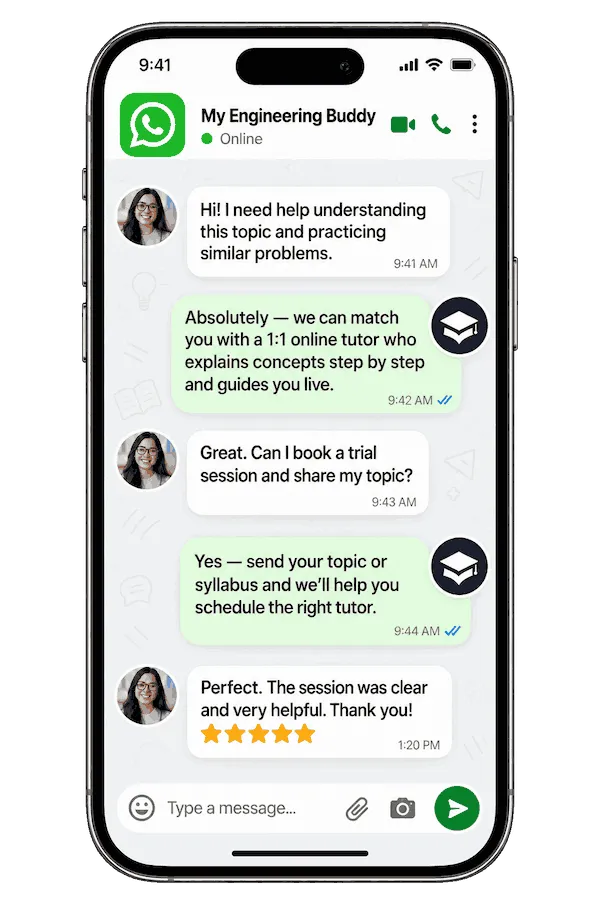
WhatsApp MEB for a quick quote — average response time under 1 minute.
Who This Marine Botany Tutoring Is For
Marine botany sits at the intersection of plant science, oceanography, and ecology — and the workload reflects that. Students come to MEB when their lecture notes stop being enough.
- Undergraduate students struggling with algal systematics or seagrass physiology modules
- Masters and PhD students needing support with literature reviews, methodology design, or thesis chapters on coastal plant communities
- Students whose fieldwork data write-up is due and who don’t know how to structure an ecological assessment
- Students retaking a failed marine botany unit and needing to close specific conceptual gaps before the resit
- Parents supporting a student whose confidence has dropped alongside their practical grades
- Students at institutions including University of California San Diego, University of Southampton, James Cook University, Dalhousie University, and King Abdullah University of Science and Technology who need tutor support outside of contact hours
Whether you need plant anatomy help to underpin your marine work or specialist guidance on mangrove ecology, MEB has a tutor who knows the material.
1:1 Tutoring vs Self-Study vs AI vs YouTube vs Online Courses
Self-study works if you’re disciplined — but marine botany has enough taxonomy and lab methodology to trip up even organised students without feedback. AI tools give fast definitions of Chlorophyta or seagrass rhizome structure but can’t watch you misread a dichotomous key and correct you in the moment. YouTube covers the basics of photosynthesis and coastal ecosystems well, then runs out when you’re trying to interpret your own salinity tolerance data. Online courses are structured but move at one pace regardless of where your gaps actually are. A 1:1 Marine Botany tutor from MEB works through your exact module content, spots where your reasoning breaks down, and corrects it before it costs you marks.
Outcomes: What You’ll Be Able To Do in Marine Botany
After working with an online Marine Botany tutor through MEB, students can analyze macroalgal morphology and correctly place specimens within the three major algal divisions. They apply photosynthetic pigment knowledge to explain depth zonation patterns in marine environments. Students write up fieldwork ecological assessments with accurate methodology and appropriate statistical treatment. They explain seagrass ecosystem functions — carbon sequestration, sediment stabilisation, nursery habitat — with the depth examiners expect at graduate level. They present on marine plant adaptations to salinity and wave exposure using real published datasets.
Supporting a student through Marine Botany? MEB works directly with parents to set up sessions, track progress, and keep coursework on schedule. WhatsApp MEB — average response time is under a minute, 24/7.
Based on feedback from 40,000+ sessions collected by MEB from 2022 to 2025, 58% of students improved by one full grade after approximately 20 hours of 1:1 tutoring in subjects like Marine Botany. A further 23% achieved at least a half-grade improvement.
Source: MEB session feedback data, 2022–2025.
What We Cover in Marine Botany (Syllabus / Topics)

Algae: Diversity, Structure, and Classification
- Green algae (Chlorophyta): morphology, life cycles, freshwater vs marine species
- Red algae (Rhodophyta): pigmentation, coralline forms, commercial relevance (agar, carrageenan)
- Brown algae (Phaeophyta): kelp forest ecology, Fucus reproduction, holdfast structure
- Diatoms and dinoflagellates: cell wall composition, bloom dynamics, ecological impact
- Phytoplankton productivity: primary production measurements, limiting factors
- Dichotomous keys and morphological identification techniques
Core texts include Algae by Graham, Graham & Wilcox and Seaweeds of the British Isles by Maggs & Hommersand for European cohorts.
Seagrasses, Mangroves, and Saltmarsh Plants
- Seagrass taxonomy: Posidonia, Zostera, Thalassia — morphology and distribution
- Seagrass ecosystem services: carbon sequestration, sediment stabilisation, nursery habitat
- Mangrove zonation, prop root adaptations, and pneumatophore function
- Saltmarsh plant communities and salinity tolerance mechanisms
- Decline drivers: eutrophication, light reduction, propeller scarring, climate change
- Plant pathology tutoring for students covering seagrass wasting disease (Labyrinthula)
Key references: Seagrasses: Biology, Ecology and Conservation edited by Larkum, Orth & Duarte; Mangrove Ecology, Silviculture and Conservation by Saenger.
Marine Plant Physiology and Ecology
- Photosynthetic adaptations to low light and blue wavelength dominance at depth
- Accessory pigments: phycoerythrin, fucoxanthin, chlorophyll c — functions and spectra
- Osmotic regulation and ion balance in marine photosynthetic organisms
- Nutrient cycling: nitrogen fixation in cyanobacteria, phosphorus limitation
- Intertidal zonation: physical stress gradients, biological interactions, community structure
- Field methods: quadrat sampling, transect surveys, spectrophotometric pigment analysis
Recommended texts: Marine Biology: Function, Biodiversity, Ecology by Levinton and Biological Oceanography by Miller & Wheeler for physiology and ecological context.
At MEB, we’ve found that marine botany students most often lose marks not on content recall but on applying classification criteria under exam pressure — particularly when an unfamiliar specimen appears. Getting that practice right before the assessment is where a tutor earns their fee.
What a Typical Marine Botany Session Looks Like
The tutor opens by checking the previous session’s topic — usually algal classification or a fieldwork methodology question — and asking the student to explain it back without notes. From there, the session moves into the current problem: often a past-paper question on seagrass ecosystem services, a lab report section on photosynthetic pigment chromatography, or a taxonomy exercise using a dichotomous key for brown algae. The tutor uses a digital pen-pad to annotate diagrams in real time — the student shares their screen or uploads their draft, and the tutor marks directly on it. The student replicates the reasoning for a new specimen. By the end of the session, one concrete task is set — a specific question from their module past papers — and the next topic is confirmed.
How MEB Tutors Help You with Marine Botany (The Learning Loop)
Diagnose: In the first session, the tutor identifies exactly where your understanding breaks down — whether that’s the distinction between Rhodophyta and Phaeophyta life cycles, how to structure an intertidal zonation report, or why your phytoplankton productivity calculations keep going wrong.
Explain: The tutor works through live examples on screen using a digital pen-pad. Seagrass rhizome diagrams, pigment absorption spectra, transect data interpretation — all annotated and built from your actual module materials, not generic slides.
Practice: You attempt the next problem with the tutor present. That matters. Most students only discover their gap when they try to do it alone.
Feedback: The tutor goes through your reasoning step by step — pinpointing where marks would be lost on an examiner’s mark scheme and why. Not just “wrong” — specifically what went wrong and how to fix it.
Plan: Each session ends with a defined task and a note of what’s next. Progress is tracked. Nothing drifts.
Sessions run over Google Meet. The tutor uses a digital pen-pad or iPad with Apple Pencil. Before your first session, send your module syllabus or course outline, a recent assignment or lab report you struggled with, and your submission or exam date. The first session is your diagnostic — the tutor uses it to map exactly what to cover and in what order. Start with the $1 trial — 30 minutes of live tutoring that also serves as your first diagnostic.
MEB tutors have supported students through marine plant ecology fieldwork from the UK to the Gulf — matching the pace, the syllabus, and the deadline pressure each student faces.
Source: My Engineering Buddy, 2008–2025.
Try your first session for $1 — 30 minutes of live 1:1 tutoring or one homework question explained in full. No registration. No commitment. WhatsApp MEB now and get matched within the hour.
Tutor Match Criteria (How We Pick Your Tutor)
Not every biologist can teach marine botany at postgraduate level. MEB matches on four criteria.
Subject depth: Tutors are matched to your specific module — undergraduate algal ecology, seagrass research methods, or graduate-level coastal conservation biology. Syllabus fit, not just broad subject fit.
Tools: Every MEB marine botany session runs on Google Meet with a digital pen-pad or iPad and Apple Pencil for diagram work and lab report annotation.
Time zone: Tutors are available across US, UK, Gulf, Canada, and Australia time zones — you get someone who can meet at 10pm your time if that’s when you work best.
Goals: Whether you need to pass a resit, finish a dissertation chapter on seagrass blue carbon, or build exam technique for a written paper, the tutor is briefed on your goal before session one.
Unlike platforms where you fill out a form and wait, MEB responds in under a minute, 24/7. Tutor match takes under an hour. The $1 trial means you test before you commit. Everything runs over WhatsApp — no logins, no intake forms.
Study Plans (Pick One That Matches Your Goal)
Catch-up (1–3 weeks): for students behind on a specific topic — algal taxonomy, lab methodology, or a fieldwork write-up due soon. Focused sessions on the gap only. Exam prep (4–8 weeks): structured module revision tied to your specific exam or submission date, working through past papers and mark schemes systematically. Weekly support: ongoing sessions aligned to your semester calendar, covering new material as it arrives and consolidating what came before. The tutor maps the exact sequence after your first diagnostic session — nothing is assumed.
Pricing Guide
Marine Botany tutoring starts at $20/hr for most undergraduate modules. Postgraduate, thesis-support, and research-methodology sessions run $40–$100/hr depending on tutor specialisation and topic complexity. Rate factors include your level, the specific topics (algal biochemistry and research design sit at the higher end), your timeline, and tutor availability.
Peak exam and submission periods — typically April to May and November to December — see reduced tutor availability. Book ahead if you’re working to a hard deadline.
For students targeting research positions, conservation roles, or postgraduate programmes at institutions where marine botany expertise is a differentiator, tutors with active research or professional field experience are available at higher rates. Share your goal and MEB will match the tier to your ambition.
Start with the $1 trial — 30 minutes, no registration, no commitment. WhatsApp MEB for a quick quote.
Students consistently tell us that the hardest part of marine botany isn’t the theory — it’s connecting photosynthetic physiology to what they actually observe in a field transect. That link is where a tutor makes the difference between a passing write-up and a strong one.
FAQ
Is Marine Botany hard?
It’s demanding. The subject combines plant physiology, taxonomy, ecology, and field methods — each with its own vocabulary and analytical approach. Students who find it hardest are usually those who lack a solid grounding in general plant biology or who haven’t done much fieldwork before. A tutor closes those gaps directly.
How many sessions are needed?
Most students working on a specific module gap or assignment need 4–8 sessions. Students doing ongoing semester support typically book weekly. The $1 trial first session doubles as a diagnostic, so the tutor can estimate a realistic session count for your situation after session one.
Can you help with practice exercises?
Yes — MEB tutoring is guided learning. The tutor explains the concepts and methods; you do the work and submit it yourself. This covers lab reports, literature reviews, fieldwork write-ups, and essay-style questions. See our Academic Integrity policy and Why MEB page for full details on what we help with and what we don’t.
Will the tutor match my exact syllabus or exam board?
Yes. Before your first session, share your module outline, institution, and any past papers or assignment briefs. The tutor reviews these and builds the session around your specific content — not a generic marine botany curriculum.
What happens in the first session?
The first session is a diagnostic. The tutor works through your current understanding of 2–3 key topics, identifies where your reasoning breaks down, and maps out the session plan from there. Come with your syllabus, a recent piece of work you struggled with, and your deadline or exam date.
Is online tutoring as effective as in-person?
For marine botany — yes, for the conceptual and analytical work. Screen sharing for lab report annotation, digital pen-pad diagram work, and real-time review of field data all transfer well online. The one limitation is hands-on specimen handling, which MEB’s tutors address by working closely from your own lab notes and photographs.
Can I get Marine Botany help late at night or on weekends?
Yes. MEB operates 24/7 across all major time zones. Students in the Gulf, Australia, and the US West Coast regularly book late-evening sessions. WhatsApp MEB at any hour — the average response time is under one minute.
What if I don’t like my assigned tutor?
Request a change via WhatsApp. MEB will rematch you, usually within an hour. The $1 trial exists precisely so you can test the fit before committing to a longer block of sessions.
Do I need prior knowledge of algae or marine biology before starting?
No fixed prerequisite — but some grounding in general plant biology or ecology helps. The tutor will identify any gaps in your foundational knowledge during the diagnostic session and address them before moving into specialist marine botany content.
How do marine botany tutors help with fieldwork and lab report write-ups?
Tutors work through your data with you — helping you choose the right statistical approach, structure your methods and results sections, interpret transect or quadrat findings, and meet the specific criteria your institution uses to mark ecological assessments. This is where most students lose marks, and where tutoring has the most direct impact.
What is the difference between phycology and marine botany?
Phycology is the dedicated study of algae across all environments — freshwater, terrestrial, and marine. Marine botany is broader: it includes algae but also seagrasses, mangroves, saltmarsh plants, and marine phytoplankton. If your module or course is titled either way, MEB tutors cover both.
How do I get started?
Start with the $1 trial — 30 minutes of live tutoring or one homework question explained in full. Three steps: WhatsApp MEB, get matched to a verified Marine Botany tutor, then begin your trial session. No registration, no intake form, no commitment required.
Trust & Quality at My Engineering Buddy
Every MEB tutor goes through subject-specific vetting: a live demo session evaluated against their claimed depth, degree and postgraduate qualification checks, and ongoing feedback review tied to student outcomes. Tutors teaching marine botany hold at minimum a relevant postgraduate qualification in marine biology, botany, oceanography, or ecology — and many have active field research backgrounds. Rated 4.8/5 across 40,000+ verified reviews on Google.
MEB tutoring is guided learning — you understand the work, then submit it yourself. For full details on what we help with and what we don’t, read our Academic Integrity policy and Why MEB.
MEB has served 52,000+ students across the US, UK, Canada, Australia, the Gulf, and Europe since 2008 — across 2,800+ advanced subjects. In Botany and related disciplines, that includes students working on plant taxonomy tutoring, phytochemistry help, and plant evolution tutoring — all supported through the same 1:1 model that underpins every Marine Botany session. Our tutoring methodology is outlined at MEB Tutoring Methodology.
MEB has matched students to verified marine botany tutors across 30+ countries — from undergraduate module support to PhD-level ecological research guidance — since 2008.
Source: My Engineering Buddy, 2008–2025.
Our experience across thousands of sessions shows that marine botany students who bring a specific lab report or past-paper question to their first session make faster progress than those who arrive with a general request to “go over everything.” Specificity accelerates tutoring.
Explore Related Subjects
Students studying Marine Botany often also need support in:
Next Steps
Ready to start? Here’s what to do.
- Share your module name, institution, current gaps, and hardest topics
- Share your availability and time zone — MEB covers all major regions
- MEB matches you with a verified Marine Botany tutor, usually within an hour
- First session begins with a diagnostic so every minute is used on what matters
Before your first session, have ready: your module syllabus or course outline, a recent lab report or assignment you struggled with, and your submission or exam date. The tutor handles the rest.
Visit www.myengineeringbuddy.com for more on how MEB works.
WhatsApp to get started or email [email protected].
Reviewed by Subject Expert
This page has been carefully reviewed and validated by our subject expert to ensure accuracy and relevance.