




~1 min
Average Reply Time
~1 hour
To Be Matched With A Tutor
30 Min Trial
75% Find Their Tutor On The 1st Trial
$20-35+/hr
Premium Yet Affordable Learning
Hire The Best IC Engines Tutor



Most students fail IC Engines not because it’s too hard — because nobody stopped them when they misunderstood the Otto cycle in week two.
IC Engines Tutor Online
IC Engines (Internal Combustion Engines) is a mechanical engineering course covering thermodynamic cycles, fuel-air combustion, engine performance, and emissions analysis. It equips students to design, evaluate, and optimize gasoline, diesel, and alternative-fuel engine systems.
MEB provides 1:1 online tutoring and homework help in 2800+ advanced subjects — including a dedicated mechanical engineering tutoring track that spans every core and elective module. If you’re searching for an IC Engines tutor near me, the sessions are fully online and work across every time zone. Tutors are matched to your syllabus, your exam board, and your specific gaps — not a generic course outline. Students typically see a measurable difference within the first three sessions.
- 1:1 online sessions tailored to your university course or exam syllabus
- Expert-verified tutors with subject-specific IC Engines depth
- Flexible time zones — US, UK, Canada, Australia, Gulf
- Structured learning plan built after a diagnostic session
- Ethical homework and assignment guidance — you understand before you submit
52,000+ students across the US, UK, Canada, Australia, and the Gulf have used MEB since 2008 — including students in Mechanical Engineering subjects like IC Engines, Engineering Thermodynamics, and Heat Transfer.
Source: My Engineering Buddy, 2008–2025.
How Much Does an IC Engines Tutor Cost?
Most IC Engines tutoring sessions run $20–$40/hr. Graduate-level or highly specialised niche topics can reach $100/hr. Not sure of the cost for your specific module? Start with the $1 trial — 30 minutes of live 1:1 tutoring or one homework question explained in full, before you commit to a rate.
| Level / Need | Typical Rate | What’s Included |
|---|---|---|
| Undergraduate (most levels) | $20–$35/hr | 1:1 sessions, homework guidance |
| Advanced / Graduate / Specialist | $35–$100/hr | Expert tutor, research-level depth |
| $1 Trial | $1 flat | 30 min live session or 1 homework question |
Tutor availability tightens significantly around final exam periods and semester end. Book early to secure your preferred slot.
WhatsApp MEB for a quick quote — average response time under 1 minute.
Who This IC Engines Tutoring Is For
IC Engines is one of those courses where a gap in thermodynamics or fluid mechanics compounds fast. Students who reach out to MEB usually fall into one of these groups.
- Undergraduate mechanical engineers struggling with combustion cycle analysis or engine performance calculations
- Students retaking after a failed first attempt — particularly those who lost marks on P-V diagrams or volumetric efficiency questions
- Students with a university conditional offer depending on passing this module
- Graduate students working on engine simulation, emissions modelling, or alternative fuel research
- Students 4–6 weeks from finals with the Diesel cycle, knock analysis, or turbocharging still unclear
- Parents watching a student’s confidence drop alongside their lab reports
MEB tutors have worked with students at universities including MIT, University of Michigan, Georgia Tech, Imperial College London, ETH Zurich, and University of Toronto — all as private clients through MEB’s matching service.
1:1 Tutoring vs Self-Study vs AI vs YouTube vs Online Courses
Self-study works if you’re disciplined — but IC Engines problems require someone to catch your assumption errors live. AI tools give fast answers but can’t diagnose why you keep getting the wrong air-fuel ratio. YouTube handles the overview of the Otto cycle well, then stops when you’re stuck on a specific numerical. Online courses are structured but fixed-pace, with no one to ask why your indicated mean effective pressure calculation is off by 15%. MEB’s 1:1 IC Engines tutoring is live, calibrated to your exact university syllabus, and corrects errors in the moment — including the ones you didn’t know you were making.
Outcomes: What You’ll Be Able To Do in IC Engines
Students who complete 15–20 hours of 1:1 IC Engines tutoring with MEB come away with specific, testable capabilities. You’ll be able to analyze Otto, Diesel, and Dual combustion cycles with confidence — not just recite the formula but derive the thermal efficiency under given compression ratios. You’ll solve engine performance problems involving brake power, indicated power, and mechanical efficiency without second-guessing which losses to account for. You’ll apply the first and second laws of thermodynamics to real engine processes, explain knock phenomena and its relationship to octane rating, and present emissions trade-offs between NOx, CO, and HC in a way that holds up under examination or viva questioning.
Based on feedback from 40,000+ sessions collected by MEB from 2022 to 2025, 58% of students improved by one full grade after approximately 20 hours of 1:1 tutoring in subjects like IC Engines. A further 23% achieved at least a half-grade improvement.
Source: MEB session feedback data, 2022–2025.
Try your first session for $1 — 30 minutes of live 1:1 tutoring or one homework question explained in full. No registration. No commitment. WhatsApp MEB now and get matched within the hour.
What We Cover in IC Engines (Syllabus / Topics)

Thermodynamic Cycles and Engine Fundamentals
- Otto cycle, Diesel cycle, and Dual cycle — P-V and T-S diagrams
- Air-standard analysis and thermal efficiency derivations
- Compression ratio, expansion ratio, and cutoff ratio
- Two-stroke vs four-stroke engine operating principles
- Valve timing diagrams and port timing in two-stroke engines
- Scavenging processes and trapping efficiency
Core texts for this track include Heywood’s Internal Combustion Engine Fundamentals and Pulkrabek’s Engineering Fundamentals of the Internal Combustion Engine.
Engine Performance, Testing, and Measurement
- Brake power, indicated power, friction power, and mechanical efficiency
- Volumetric efficiency and its effect on engine output
- Mean effective pressure — brake, indicated, and friction MEP
- Specific fuel consumption (BSFC, ISFC) and heat balance analysis
- Engine testing methods and dynamometer operation
- Mechanical measurements applied to engine instrumentation
- Knock detection, octane rating, and detonation analysis
Relevant references: Stone’s Introduction to Internal Combustion Engines and Lumley’s Engines: An Introduction.
Combustion, Fuel Systems, and Emissions
- Combustion chemistry: stoichiometry, equivalence ratio, air-fuel ratio
- Spark ignition vs compression ignition combustion processes
- Fuel injection systems — port injection vs direct injection
- Turbocharging and supercharging — performance and matching
- Exhaust emissions: NOx, CO, HC, and particulate matter formation
- Emission control technologies — catalytic converters, EGR, DPF
- Alternative fuels: hydrogen, CNG, LPG, biofuels, and their engine compatibility
Key resource: Ferguson and Kirkpatrick’s Internal Combustion Engines: Applied Thermosciences. For broader context on thermodynamics tutoring, MEB covers the full scope of applied thermodynamic principles alongside IC Engines.
What a Typical IC Engines Session Looks Like
The tutor opens by checking where you landed on the previous session’s task — usually a problem set involving brake thermal efficiency or a cycle analysis diagram you attempted solo. From there, you and the tutor work through the current sticking point on screen: often something like deriving IMEP from a P-V diagram, or figuring out why your volumetric efficiency calculation diverges from the textbook answer. The tutor uses a digital pen-pad to annotate diagrams and step through equations in real time. You’re not watching — you’re replicating the method, explaining each step back. The session closes with a concrete task: two numerical problems on fuel-air mixture analysis or one past paper question on emissions, set for the next session. Next topic is flagged. Nothing is left vague. Students working on thermal engineering alongside IC Engines often find that solving one clarifies the other.
How MEB Tutors Help You with IC Engines (The Learning Loop)
Diagnose: In the first session, the tutor identifies exactly where your understanding breaks down. For IC Engines, this usually means testing your grasp of the Otto cycle before moving to engine performance — because errors there compound into every later calculation.
Explain: The tutor works through live examples on a digital pen-pad — stepping through a Diesel cycle efficiency derivation or a BSFC calculation from scratch, making every assumption visible. No hand-waving over the tricky steps.
Practice: You attempt the next problem with the tutor present. The goal is that you can reproduce the method without prompts — not just follow along.
Feedback: When you get it wrong, the tutor shows you exactly which step diverged and why that costs marks. Common IC Engines errors include wrong sign conventions in energy balance, mixing up indicated and brake quantities, and incorrect equivalence ratio assumptions.
Plan: After each session, the tutor sets the next topic and a specific numerical target — for example, completing three combustion stoichiometry problems before the next session. Progress is tracked. Nothing is assumed.
At MEB, we’ve found that IC Engines students who attempt at least two numerical problems between sessions improve their exam scores significantly faster than those who rely on re-reading notes. Worked examples lock in the method. Passive review doesn’t.
Sessions run over Google Meet. Tutors use a digital pen-pad or iPad with Apple Pencil to draw P-V diagrams, annotate equations, and work through calculations live. Before your first session, share your course syllabus or module outline, a recent assignment or past paper you struggled with, and your exam or submission deadline. The tutor uses that to structure the diagnostic. Start with the $1 trial — 30 minutes of live tutoring that also serves as your first diagnostic.
Whether you need a fast catch-up before finals, structured revision across 6–8 weeks, or ongoing weekly support through the semester, the tutor maps the session plan after that first diagnostic. Students also working through fluid mechanics tutoring often run parallel sessions — both subjects share significant overlap in flow and energy content.
Tutor Match Criteria (How We Pick Your Tutor)
Match quality matters more than speed — but MEB usually delivers both.
Subject depth: The tutor must have handled IC Engines at the same level as your course — undergraduate, postgraduate, or research. Exam board and syllabus fit are confirmed before the first session.
Tools: Every MEB tutor uses Google Meet and a digital pen-pad or iPad with Apple Pencil. There is no whiteboard-only option for a subject this diagram-heavy.
Time zone: Matched to your region — US, UK, Gulf, Canada, or Australia. No scheduling across a 12-hour gap.
Goals: Whether your priority is exam scores, assignment completion, conceptual depth in combustion theory, or dissertation research support — the match reflects that. Students needing engineering thermodynamics help alongside IC Engines are often matched with the same tutor for continuity.
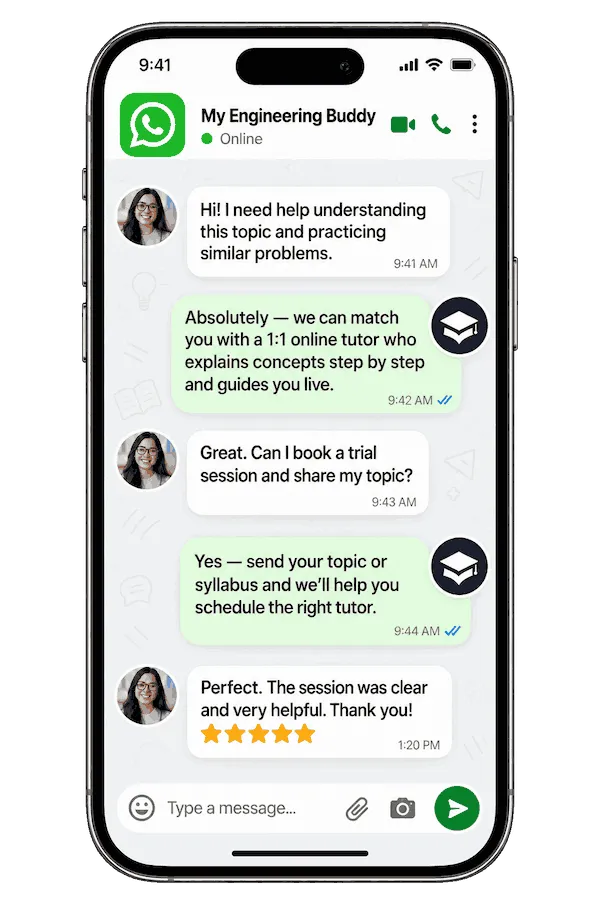
Unlike platforms where you fill out a form and wait, MEB responds in under a minute, 24/7. Tutor match takes under an hour. The $1 trial means you test before you commit. Everything runs over WhatsApp — no logins, no intake forms.
Pricing Guide
IC Engines tutoring starts at $20/hr for standard undergraduate modules. Graduate-level work — engine simulation, emissions modelling, alternative fuel system analysis — typically runs $40–$100/hr depending on tutor expertise and topic depth. Rate factors include your course level, how specialist the topic is, your timeline, and tutor availability during peak exam periods.
For students targeting research positions, automotive industry roles, or graduate programmes at universities where IC Engines is a core qualifier, MEB can match tutors with professional automotive or research backgrounds. Share your specific goal and MEB will match the tier to your ambition.
Start with the $1 trial — 30 minutes, no registration, no commitment. WhatsApp MEB for a quick quote.
Students consistently tell us that the $1 trial session is where they realise what a real IC Engines explanation feels like — not a repeat of the lecture slides, but a targeted breakdown of the exact step they were getting wrong. That’s the difference between a tutor who knows the subject and one who knows how students get stuck in it.
FAQ
Is IC Engines hard?
It’s one of the more demanding mechanical engineering modules. The difficulty comes from combining thermodynamics, fluid mechanics, and chemistry simultaneously. Students who struggled with engineering thermodynamics earlier often hit a wall in IC Engines. Targeted 1:1 sessions close those gaps fast.
How many sessions are needed?
Most students see a clear shift within 5–8 sessions. For full module coverage or exam preparation from scratch, 15–20 hours is a reliable range. The tutor sets a realistic session count after the diagnostic, based on your specific gaps and timeline.
Can you help with homework and assignments?
MEB tutoring is guided learning — you understand the work, then submit it yourself. The tutor explains the method, walks through similar problems, and checks your reasoning. See our Academic Integrity policy and Why MEB page for full details on what we help with and what we don’t.
Will the tutor match my exact syllabus or exam board?
Yes. IC Engines is taught differently across universities and regions. Before the first session, share your course outline or module descriptor. The tutor confirms the match — specific topics, textbooks, and assessment style — before you proceed.
What happens in the first session?
The tutor runs a short diagnostic to locate your gaps precisely — usually 10–15 minutes of targeted questions across thermodynamic cycles, engine performance, and combustion basics. The rest of the session addresses the highest-priority gap. You leave with a clear plan and a practice task.
Is online tutoring as effective as in-person?
For IC Engines, yes — and sometimes more so. The digital pen-pad means diagrams and equations are drawn live and annotated in real time. Students often find they can focus better without the logistics of commuting to a tutoring centre.
Can I get IC Engines help at midnight or on weekends?
MEB operates 24/7. Tutors are available across time zones, so midnight in the US, UK, or Gulf is covered. WhatsApp MEB with your availability and a tutor is matched — average response time under a minute regardless of the hour.
What if I don’t like my assigned tutor?
Request a replacement immediately. MEB re-matches at no penalty. The $1 trial exists partly for this reason — you test the tutor’s approach before committing to a rate or a longer session block. A poor fit is caught early, not after ten hours.
How do I find an IC Engines tutor in my city?
You don’t need to. MEB’s sessions are fully online via Google Meet. Students in New York, London, Dubai, Toronto, and Sydney all access the same pool of verified IC Engines tutors. Location is irrelevant — syllabus fit and time zone are what matter.
What’s the difference between a spark ignition and compression ignition tutor focus?
Some students need depth on petrol/gasoline engine cycles (Otto, knock, fuel injection timing); others are focused on diesel systems (Diesel cycle, injection pressure, NOx trade-offs). MEB matches tutors who have worked specifically with your engine type and course focus — not a generalist thermodynamics tutor drafted in.
Can MEB help with IC Engines simulation and engine modelling software?
Yes. Tutors with experience in GT-Power, AVL BOOST, and MATLAB-based engine models are available. Share the software your course uses when you WhatsApp MEB. Students also working in Simulink tutoring for engine control systems can be matched with tutors who cover both.
How do I get started?
Three steps: WhatsApp MEB, get matched with a verified IC Engines tutor (usually within the hour), then start your $1 trial — 30 minutes of live tutoring or one homework question explained in full. No forms, no waiting, no commitment beyond the first dollar.
Trust & Quality at My Engineering Buddy
Every MEB tutor goes through subject-specific screening before taking sessions. For IC Engines, that means a live demo evaluation on thermodynamic cycle problems and engine performance calculations — not just a CV review. Tutors hold relevant engineering degrees, many with postgraduate or industry experience in automotive or power systems. Ongoing session feedback drives continuous review. Rated 4.8/5 across 40,000+ verified reviews on Google.
MEB tutoring is guided learning — you understand the work, then submit it yourself. For full details on what we help with and what we don’t, read our Academic Integrity policy and Why MEB.
MEB has served 52,000+ students across the US, UK, Canada, Australia, the Gulf, and Europe since 2008 — across 2,800+ advanced subjects. Mechanical Engineering is one of MEB’s core categories, with dedicated tutors across IC Engines, fluid dynamics tutoring, and thermofluids help. See our tutoring methodology for how the learning structure works across sessions.
Our experience across thousands of IC Engines sessions shows that students who arrive with a specific question — even a wrong answer they can’t unpick — make faster progress than students who arrive asking to “go over everything.” Specificity is the fastest route through this subject.
Explore Related Subjects
Students studying IC Engines often also need support in:
- Continuum Mechanics
- Dynamics of Machine
- Energy Engineering
- Kinematics of Machines
- Mass Transfer
- Vehicle Engineering
- HVAC
- Theory of Machines
Next Steps
Before your first session, have ready: your exam board and syllabus (or course outline), a recent past paper attempt or homework you struggled with, and your exam or deadline date. The tutor handles the rest.
- Share your exam board or university module name, your hardest component, and your current timeline
- Share your availability and time zone
- MEB matches you with a verified IC Engines tutor — usually within 24 hours
- First session starts with a diagnostic so every minute is used well
Visit www.myengineeringbuddy.com for more on how MEB works.
WhatsApp to get started or email [email protected].
Reviewed by Subject Expert
This page has been carefully reviewed and validated by our subject expert to ensure accuracy and relevance.




