




~1 min
Average Reply Time
~1 hour
To Be Matched With A Tutor
30 Min Trial
75% Find Their Tutor On The 1st Trial
$20-35+/hr
Premium Yet Affordable Learning
Hire The Best Kinematics of Machines Tutor
Velocity diagrams wrong. Acceleration analysis off. Mechanism synthesis due Friday. If any of those hit close to home, you’re in the right place.
Kinematics of Machines Tutor Online
Kinematics of Machines is an undergraduate mechanical engineering subject covering the geometry of motion in mechanisms — including links, cams, gears, and kinematic chains — equipping students to analyze displacement, velocity, and acceleration in mechanical systems without considering forces.
MEB connects you with a verified Kinematics of Machines tutor online for 1:1 sessions built around your exact syllabus — whether you’re stuck on graphical velocity analysis, struggling with Grashof’s condition, or working through gear train problems. We cover mechanical engineering in depth, and Kinematics of Machines is one of our strongest subject areas. If you’ve searched for a Kinematics of Machines tutor near me, online tutoring gives you access to specialists regardless of your location. Expect a session structure that addresses your gaps directly — not a generic walkthrough of the textbook.
- 1:1 online sessions tailored to your course syllabus and exam board
- Expert verified tutors with specific knowledge of mechanism analysis and synthesis
- Flexible time zones — US, UK, Canada, Australia, Gulf covered
- Structured learning plan built after a diagnostic session
- Ethical academic guidance — you understand the work, then submit it yourself
52,000+ students across the US, UK, Canada, Australia, and the Gulf have used MEB since 2008 — including students in Mechanical Engineering subjects like Kinematics of Machines, Dynamics of Machine, and Theory of Machines.
Source: My Engineering Buddy, 2008–2025.
How Much Does a Kinematics of Machines Tutor Cost?
Most students pay $20–$40/hr. Graduate-level or highly specialised topics can run up to $100/hr. Before committing to ongoing sessions, you can start with the $1 trial — 30 minutes of live 1:1 tutoring or one homework question explained in full.
| Level / Need | Typical Rate | What’s Included |
|---|---|---|
| Standard (most undergraduate levels) | $20–$35/hr | 1:1 sessions, homework guidance, mechanism problems |
| Advanced / Specialist | $35–$70/hr | Expert tutor, synthesis problems, graduate depth |
| $1 Trial | $1 flat | 30 min live session or one full homework question |
Tutor availability tightens during end-of-semester exam periods. Booking early gives you more choice and more consistent scheduling.
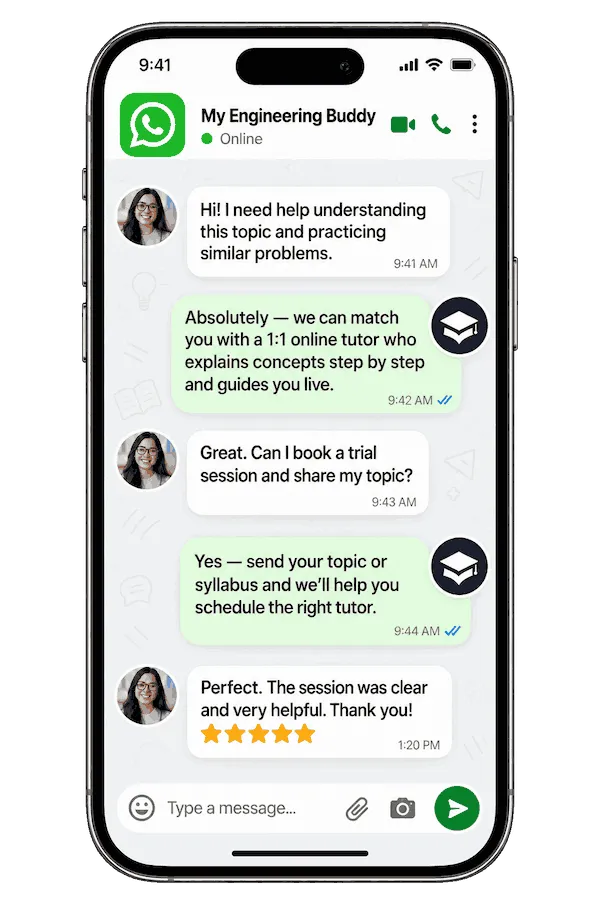
WhatsApp MEB for a quick quote — average response time under 1 minute.
Who This Kinematics of Machines Tutoring Is For
This isn’t a subject where reading the theory twice fixes the problem. Most students who come to MEB are stuck on a specific type of analysis — usually velocity diagrams, acceleration analysis, or cam design — and need someone to work through it with them in real time.
- Undergraduate mechanical or industrial engineering students mid-semester
- Students retaking after a failed first attempt in Kinematics or Theory of Machines
- Students with a university conditional offer depending on passing this module
- Students 4–6 weeks from finals with displacement, velocity, or synthesis gaps still open
- Students needing ethical academic guidance to move past a problem set
- Parents watching a child’s confidence drop alongside their engineering grades
Students who’ve come through MIT, Georgia Tech, Purdue, the University of Michigan, ETH Zurich, Imperial College London, and the University of Toronto have all worked through Kinematics of Machines with MEB tutors. The course structure varies by institution, but the core analysis methods are the same.
At MEB, we’ve found that students who struggle most in Kinematics of Machines aren’t missing intelligence — they’re missing one or two foundational steps in the graphical method that no one slowed down to show them. One session fixing that changes everything downstream.
1:1 Tutoring vs Self-Study vs AI vs YouTube vs Online Courses
Self-study works if the textbook is clear and you can verify your own velocity diagrams — most students can’t. AI tools give fast answers but can’t watch you draw a velocity triangle and tell you where the error is. YouTube covers the basics well; it stops when your specific mechanism doesn’t match the example. Online courses move at a fixed pace and won’t pause because you’re confused about the Klein’s construction. 1:1 tutoring with MEB is live, calibrated to your exact syllabus, and corrects errors in the moment — which matters in Kinematics of Machines, where one wrong assumption in step two makes everything else wrong.
Outcomes: What You’ll Be Able To Do in Kinematics of Machines
After working with an MEB tutor, you’ll be able to analyze the velocity and acceleration of any point in a four-bar linkage using both graphical and analytical methods. You’ll apply Grashof’s condition correctly to classify mechanism types before you begin any synthesis problem. You’ll model cam follower motion — displacement, velocity, and acceleration — for standard profiles including cycloidal and simple harmonic. You’ll solve gear train problems, including compound and epicyclic arrangements, without losing track of which gear ratio applies where. You’ll explain your analysis method clearly, which matters for exam questions that ask you to show working.
Based on feedback from 40,000+ sessions collected by MEB from 2022 to 2025, 58% of students improved by one full grade after approximately 20 hours of 1:1 tutoring in subjects like Kinematics of Machines. A further 23% achieved at least a half-grade improvement.
Source: MEB session feedback data, 2022–2025.
Supporting a student through Kinematics of Machines? MEB works directly with parents to set up sessions, track progress, and keep coursework on schedule. WhatsApp MEB — average response time is under a minute, 24/7.
What We Cover in Kinematics of Machines (Syllabus / Topics)

Track 1: Mechanisms and Kinematic Analysis
- Kinematic pairs, chains, and mechanism classification
- Degrees of freedom — Gruebler’s and Kutzbach’s equations
- Grashof’s condition and four-bar linkage types
- Velocity analysis — graphical (velocity diagram) and analytical methods
- Acceleration analysis — graphical and analytical, Coriolis component
- Klein’s construction for slider-crank mechanisms
- Instantaneous centre of velocity method
Key references: Theory of Machines by S.S. Rattan; Theory of Machines by R.S. Khurmi & J.K. Gupta; Kinematics and Dynamics of Machinery by Wilson, Sadler & Michels.
Track 2: Cams and Gear Trains
- Cam types — radial, cylindrical, and conjugate cams
- Follower types and motion — SHM, uniform acceleration, cycloidal
- Displacement, velocity, and acceleration diagrams for cam followers
- Pressure angle and undercutting in cam design
- Simple, compound, reverted, and epicyclic gear trains
- Gear ratio calculation and tabular method for epicyclic trains
- Bevel and worm gear arrangements
Key references: Mechanisms and Dynamics of Machinery by Mabie & Reinholtz; Theory of Machines by S.S. Rattan; Machine Design by Shigley for gear geometry context.
Track 3: Synthesis and Applied Mechanism Design
- Graphical synthesis of four-bar linkages — two and three position synthesis
- Freudenstein’s equation for analytical synthesis
- Coupler curves and their applications
- Inversion of mechanisms — slider-crank inversions
- Pantograph and straight-line mechanisms
- Introduction to spatial mechanisms and screw theory basics
Key references: Kinematic Analysis and Synthesis by Sandor & Erdman; Theory of Machines by R.S. Khurmi & J.K. Gupta; MIT OpenCourseWare resources on mechanism design.
Students who also need support in mechanical vibrations tutoring or solid mechanics tutoring often find those subjects build directly on the analytical skills covered here.
What a Typical Kinematics of Machines Session Looks Like
The tutor starts by checking where you left off — usually the velocity diagram from the previous session or a cam displacement problem you attempted independently. From there, you and the tutor work through the current problem on screen: the tutor uses a digital pen-pad to draw the mechanism, label the links, and construct the velocity polygon step by step. You replicate each step or explain your reasoning before moving on. If you’re working on a four-bar acceleration analysis, the tutor won’t move past the relative acceleration component until you’ve correctly identified the Coriolis term yourself. The session closes with a specific practice problem set — not a chapter, a specific mechanism type — and the next topic is noted so preparation makes sense. No session ends without a clear next step.
How MEB Tutors Help You with Kinematics of Machines (The Learning Loop)
Diagnose: In the first session, the tutor identifies exactly where your analysis breaks down — whether that’s misapplying the relative velocity equation, skipping the Coriolis component, or mislabelling the velocity polygon. Most students have one or two specific gaps, not a general misunderstanding of the whole subject.
Explain: The tutor works through a fully solved problem on the digital pen-pad — showing every construction line, every vector, every substitution. No steps are assumed. For graphical methods especially, seeing the process drawn live makes a substantial difference compared to reading a textbook solution.
Practice: You attempt a similar problem while the tutor watches. This is where the session earns its value — errors surface immediately, before they become habits.
Feedback: The tutor walks through exactly what went wrong and why. In Kinematics of Machines exams, marks are often lost not for wrong answers but for incomplete diagrams, missing labels, or incorrect direction conventions. The feedback targets exactly that.
Plan: Each session ends with the next topic mapped out and the practice task defined. Whether you need a velocity analysis review or synthesis problems before a specific exam date, the tutor adjusts the sequence based on what you demonstrated in that session.
Sessions run on Google Meet with a digital pen-pad or iPad + Apple Pencil. Before your first session, have your syllabus or course outline ready, along with a recent problem set or past paper question you couldn’t complete. Start with the $1 trial — 30 minutes of live tutoring that also serves as your first diagnostic.
Try your first session for $1 — 30 minutes of live 1:1 tutoring or one homework question explained in full. No registration. No commitment. WhatsApp MEB now and get matched within the hour.
Tutor Match Criteria (How We Pick Your Tutor)
Not every mechanical engineer can teach Kinematics of Machines well. MEB matches on specifics.
Subject depth: Tutors are matched to your level and exam context — undergraduate core module, graduate elective, or a specific institutional syllabus variation. A tutor who has taught graphical velocity analysis repeatedly is different from one who has only used software tools.
Tools: All tutors use Google Meet with a digital pen-pad or iPad + Apple Pencil — non-negotiable for a subject where drawing is part of the method.
Time zone: Matched to your region — US, UK, Gulf, Canada, or Australia — so late-night sessions before exams are genuinely available.
Goals: Whether you need to pass a resit, push for a distinction, or close a specific gap before coursework submission, the tutor is briefed on that before session one.
Unlike platforms where you fill out a form and wait, MEB responds in under a minute, 24/7. Tutor match takes under an hour. The $1 trial means you test before you commit. Everything runs over WhatsApp — no logins, no intake forms.
Students tell us that the biggest gap in Kinematics of Machines isn’t the theory — it’s never seeing a mechanism analysis drawn correctly from start to finish, step by step, by someone who can also explain why each step exists.
Source: My Engineering Buddy, compiled from student intake feedback, 2022–2025.
Study Plans (Pick One That Matches Your Goal)
A tutor working with you on engineering dynamics tutoring or Kinematics of Machines will map the session sequence after the diagnostic. Three common plans: Catch-up (1–3 weeks) for students with specific gaps to close before an exam — velocity analysis, cam design, or gear trains targeted directly. Exam prep (4–8 weeks) for structured revision covering the full syllabus with past paper practice built in. Weekly support for ongoing alignment with your semester schedule and coursework deadlines. The tutor adjusts the plan after each session based on what you’ve demonstrated.
Pricing Guide
Kinematics of Machines tutoring starts at $20/hr for standard undergraduate-level sessions. Most students pay $20–$40/hr depending on topic complexity and tutor specialisation. Graduate-level or highly technical synthesis problems can reach $100/hr.
Rate factors include: level of the course, whether you need graphical or analytical method support, how quickly you need sessions, and tutor availability in your time zone.
Availability tightens during end-of-semester exam blocks. Students who book early get more consistent scheduling and greater choice of tutor.
For students targeting top mechanical engineering programmes or positions at firms where mechanism design and robotics overlap, tutors with professional design or research backgrounds are available at higher rates — share your specific goal and MEB will match the tier to what you’re aiming for.
Start with the $1 trial — 30 minutes, no registration, no commitment. WhatsApp MEB for a quick quote.
Students consistently tell us that the moment that changes their performance in Kinematics of Machines is when a tutor slows down the velocity polygon construction to exactly the speed they need — and doesn’t move on until the logic is genuinely clear, not just copied.
FAQ
Is Kinematics of Machines hard?
It’s conceptually manageable but technically demanding. The graphical methods — velocity polygons, acceleration diagrams — require precision and a clear procedural understanding. Students who struggle usually have one or two specific gaps in the method, not a general lack of ability.
How many sessions are needed?
Most students with a specific gap to close need 4–8 sessions. Students doing full exam prep over 4–8 weeks typically have 1–2 sessions per week. The tutor sets a realistic target after the diagnostic.
Can you help with homework and assignments?
MEB tutoring is guided learning — you understand the work, then submit it yourself. The tutor explains the method and works through a similar problem with you. See our Academic Integrity policy and Why MEB page for full details on what we help with and what we don’t.
Will the tutor match my exact syllabus or exam board?
Yes. You share your course outline, institution, and exam format before the first session. The tutor is matched to that context — not assigned generically. Syllabus variations across institutions are common and are factored in from session one.
What happens in the first session?
The tutor runs a short diagnostic — usually a problem from your recent coursework or a past exam question. This identifies exactly where the method breaks down. The rest of the session addresses that gap directly, and a session plan is set from there.
Is online tutoring as effective as in-person?
For Kinematics of Machines specifically, yes — because the digital pen-pad replicates the whiteboard experience that makes graphical methods learnable. Students report the same quality of explanation and the added benefit of session recordings to review.
What is the difference between Kinematics of Machines and Theory of Machines?
Kinematics of Machines focuses on motion geometry — displacement, velocity, acceleration — without considering forces. Theory of Machines extends this to include dynamics, forces, balancing, and vibration. Most undergraduate programmes cover kinematics first as a prerequisite module.
Can MEB help with both graphical and analytical methods?
Yes. Tutors cover both approaches — graphical velocity and acceleration diagrams as well as loop closure equations and Freudenstein’s method for analytical synthesis. Which method your exam requires is confirmed from your syllabus before sessions begin.
Do you cover epicyclic gear trains and cam design specifically?
Both are core coverage areas. Epicyclic gear trains — including the tabular method and velocity ratio calculation — and cam follower displacement, velocity, and acceleration diagrams for SHM, uniform acceleration, and cycloidal motion are standard topics MEB tutors work through regularly.
Can I get Kinematics of Machines help at midnight?
Yes. MEB operates 24/7. WhatsApp response time averages under a minute regardless of the hour. Tutors span multiple time zones, so late-night sessions before a morning exam or submission deadline are genuinely available, not just a marketing claim.
What if I don’t understand the graphical method at all — do I need prerequisites first?
No separate prerequisite sessions are required. The tutor assesses your starting point in the diagnostic and builds from there. If your vector mechanics foundation needs reinforcing first, that’s addressed as part of the Kinematics of Machines session sequence — not as a separate course.
How do I get started?
Start with the $1 trial — 30 minutes of live tutoring or one problem explained in full. Three steps: WhatsApp MEB, get matched within the hour, start your trial session. No registration, no intake form, no wait.
Trust & Quality at My Engineering Buddy
Every MEB tutor goes through subject-specific screening — not a general aptitude check. For Kinematics of Machines, that means demonstrating ability in mechanism analysis, cam design, and gear train problems during a live demo evaluation before they teach a single student. Tutors hold engineering degrees and many have professional design or research experience. Ongoing session feedback is reviewed to track quality. Rated 4.8/5 across 40,000+ verified reviews on Google.
MEB tutoring is guided learning — you understand the work, then submit it yourself. For full details on what we help with and what we don’t, read our Academic Integrity policy and Why MEB.
MEB has been serving students in Mechanical Engineering and related subjects since 2008 — across 2,800+ subjects in the US, UK, Canada, Australia, the Gulf, and Europe. Students working on design of machine elements tutoring, computational mechanics help, and Kinematics of Machines regularly move between these subjects as their programme progresses. See our tutoring methodology for how sessions are structured across all 2,800+ subjects.
MEB has operated since 2008. 18 years. 52,000+ students. The platform exists because one-to-one explanation — done properly, at the right pace, on the right problem — works in a way that no recorded resource or AI tool currently matches.
Source: My Engineering Buddy, 2008–2025.
Explore Related Subjects
Students studying Kinematics of Machines often also need support in:
- Engineering Mechanics
- Engineering Statics
- Finite Element Analysis (FEA)
- Mechanics of Materials
- Continuum Mechanics
- Manufacturing Processes
- Strength of Materials
Next Steps
Before your first session, have ready: your exam board and syllabus or course outline, a recent past paper attempt or homework problem you couldn’t complete, and your exam or deadline date. The tutor handles the rest.
- Share your syllabus, hardest topic, and current timeline via WhatsApp
- Share your availability and time zone
- MEB matches you with a verified Kinematics of Machines tutor — usually within 24 hours
The first session starts with a diagnostic so every minute is used well. Visit www.myengineeringbuddy.com for more on how MEB works.
WhatsApp to get started or email [email protected].
Reviewed by Subject Expert
This page has been carefully reviewed and validated by our subject expert to ensure accuracy and relevance.



