




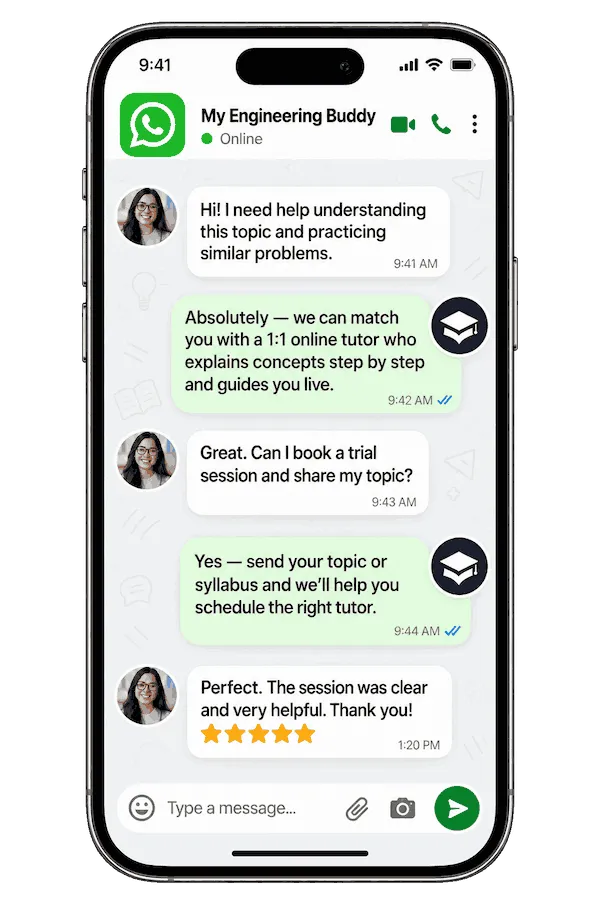
~1 min
Average Reply Time
~1 hour
To Be Matched With A Tutor
30 Min Trial
75% Find Their Tutor On The 1st Trial
$20-35+/hr
Premium Yet Affordable Learning
Most students who struggle with GCSE Home Economics don’t fail on food science — they lose marks on the NEA because nobody told them what the mark scheme actually rewards.
GCSE Home Economics Tutor Online
GCSE Home Economics is a UK secondary qualification covering food, nutrition, consumer studies, and child development, assessed by exam boards including AQA and WJEC, equipping students to apply practical and theoretical knowledge to everyday life decisions.
If you’ve been searching for a GCSE Home Economics tutor near me, MEB offers 1:1 online tutoring and homework help across the full GCSE suite — including Home Economics. Our GCSE tutoring covers every major subject in the programme, and tutors are matched to your exact exam board and syllabus. One session is often enough to see where marks are genuinely being dropped.
- 1:1 online sessions tailored to your AQA, WJEC, or CCEA syllabus
- Expert-verified tutors with subject-specific knowledge of food science and consumer studies
- Flexible time zones — US, UK, Canada, Australia, Gulf
- Structured learning plan built after a diagnostic session
- Ethical homework and assignment guidance — you understand the work before you submit
52,000+ students across the US, UK, Canada, Australia, and the Gulf have used MEB since 2008 — including students in GCSE subjects like GCSE Food Preparation and Nutrition tutoring, GCSE Biology help, and GCSE Home Economics.
Source: My Engineering Buddy, 2008–2025.
How Much Does a GCSE Home Economics Tutor Cost?
Most GCSE Home Economics tutoring sessions run between $20 and $40 per hour, depending on the tutor’s experience and your specific syllabus needs. You can also start with a $1 trial — 30 minutes of live tutoring or one homework question explained in full, no registration required.
| Level / Need | Typical Rate | What’s Included |
|---|---|---|
| Standard GCSE | $20–$35/hr | 1:1 sessions, homework guidance, NEA planning |
| Advanced / Specialist | $35–$70/hr | Expert tutor, niche depth, exam board specifics |
| $1 Trial | $1 flat | 30 min live session or 1 homework question explained |
Tutor availability tightens significantly in April and May as exam season approaches. Book early if your mock results have flagged gaps.
WhatsApp MEB for a quick quote — average response time under 1 minute.
Who This GCSE Home Economics Tutoring Is For
This is for students who know the subject matters but can’t quite land the marks. Whether it’s the written exam, the NEA coursework, or the food science theory — something isn’t clicking, and generic revision guides aren’t fixing it.
- Students who lost marks on NEA tasks and don’t know why
- Students retaking after a failed first attempt
- Students 4–6 weeks from an exam with significant gaps still to close
- Students with a coursework or NEA submission deadline approaching fast
- Parents watching a child’s confidence drop alongside their grades
- International students in UK-curriculum schools in the Gulf, Canada, or Australia
Students who go on to study GCSE Psychology, nutrition degrees, or health-related A Levels often begin their preparation here. The conceptual groundwork in GCSE Home Economics matters more than it looks on a timetable.
1:1 Tutoring vs Self-Study vs AI vs YouTube vs Online Courses
Self-study works if you’re disciplined, but there’s no one to catch a flawed understanding of nutritional science before it costs you in the exam. AI tools answer questions fast but can’t look at your NEA draft and tell you which assessment objective you’re missing. YouTube covers the broad topics well — it stops being useful when you’re stuck on a specific mark-scheme wording for a 6-mark question. Online courses are structured but fixed-pace, with no adjustment for what you already know. With a 1:1 online GCSE Home Economics tutor, the session is calibrated to your exact exam board, your specific gaps, and the component you’re assessed on next.
Outcomes: What You’ll Be Able To Do in GCSE Home Economics
After working with an MEB tutor, you’ll be able to apply nutritional science principles to meal planning questions without second-guessing yourself. You’ll analyse consumer behaviour scenarios and write structured responses that address every mark-scheme point. You’ll explain food safety legislation, preservation methods, and dietary needs with enough precision to handle the longer written questions confidently. Present your NEA research and planning sections in a format that matches what assessors actually reward. Solve unfamiliar exam questions by identifying which assessment objective they’re testing — and answer accordingly.
Supporting a student through GCSE Home Economics? MEB works directly with parents to set up sessions, track progress, and keep coursework on schedule. WhatsApp MEB — average response time is under a minute, 24/7.
“Based on feedback from 40,000+ sessions collected by MEB from 2022 to 2025, 58% of students improved by one full grade after approximately 20 hours of 1:1 tutoring in subjects like GCSE Home Economics. A further 23% achieved at least a half-grade improvement.”
Source: MEB session feedback data, 2022–2025.
What We Cover in GCSE Home Economics (Syllabus / Topics)

Food Science and Nutrition
- Macronutrients and micronutrients — functions, sources, deficiency effects
- Dietary requirements across life stages (infants, adolescents, pregnancy, elderly)
- Energy balance, metabolism, and body weight management
- Food labelling interpretation and nutritional analysis tasks
- Special dietary needs — coeliac disease, diabetes, allergies
- Functional properties of ingredients in cooking (emulsification, coagulation, gelatinisation)
Recommended texts include GCSE Home Economics: Food and Nutrition by Anita Tull and revision guides published for the WJEC and AQA specifications.
Consumer Studies and Resource Management
- Consumer rights legislation — Sale of Goods Act, Consumer Rights Act 2015
- Budgeting, financial planning, and household resource management
- Sustainability, environmental impact of consumption, and ethical purchasing
- Advertising, marketing techniques, and how they influence consumer decisions
- Housing, utilities, and home management principles
Students sitting the WJEC specification find the Consumer Studies for GCSE resource by Doreen Tinker particularly useful alongside the official past paper bank.
Child Development and Family Studies
- Physical, cognitive, and emotional development from birth to age 5
- Parenting styles and their developmental outcomes
- Childcare options, legislation protecting children, and safeguarding basics
- Family structures, roles, and societal influences on family life
- Play as a developmental tool — types, purpose, and age-appropriate activities
The Child Development title by Brennan and Moir provides solid theoretical grounding, and the Child Development Journal is a useful reference for students exploring developmental psychology questions at greater depth.
Non-Examined Assessment (NEA) and Coursework
- Understanding the NEA brief — selecting a task that plays to your strengths
- Research, planning, and justification sections — what assessors look for
- Practical component documentation — photographs, evaluations, annotations
- Time management for coursework deadlines
- Structuring written evaluations to hit each assessment objective
MEB tutors familiar with WJEC and AQA NEA mark schemes provide guidance on structuring each section — helping students understand what counts before they submit.
At MEB, we’ve found that GCSE Home Economics students consistently underestimate how much the NEA mark scheme rewards justification over description. Saying what you did earns one mark. Saying why — and linking it to nutritional science or consumer theory — is where the grade difference lives.
What a Typical GCSE Home Economics Session Looks Like
The tutor opens by checking the previous session’s task — usually a practice question on food labelling analysis or a consumer rights scenario. From there, the session moves into the current focus: if it’s food science, the tutor will work through a specific topic like protein denaturation or the role of fats in pastry-making, using a digital pen-pad to annotate diagrams and mark-scheme structures on screen. The student then attempts a similar question while the tutor watches and corrects reasoning in real time. By the end, the student has a concrete practice task — a timed exam question or a section of the NEA outline — and the tutor notes what to address next.
How MEB Tutors Help You with GCSE Home Economics (The Learning Loop)
Diagnose: In the first session, the tutor identifies which component is losing marks — whether that’s food science theory, consumer studies case studies, child development questions, or the NEA structure. Diagnostic questions are drawn directly from past papers relevant to your exam board.
Explain: The tutor works through problems live using a digital pen-pad — annotating nutrition tables, walking through mark-scheme logic, and breaking down six-mark questions into the steps assessors reward. Nothing is left abstract.
Practice: The student attempts questions while the tutor is present. This is not homework — it happens in the session, with the tutor observing where the student pauses, skips, or misframes an answer.
Feedback: Errors are corrected step by step. The tutor explains not just what went wrong but which assessment objective was missed — so the same mistake doesn’t repeat in the exam.
Plan: Each session ends with a clear topic sequence: what’s been covered, what’s next, and what to practice before the following session. Progress is tracked and shared with parents on request.
Sessions run on Google Meet. Tutors use a digital pen-pad or iPad with Apple Pencil. Before your first session, share your exam board (AQA, WJEC, or CCEA), the component giving you the most trouble, and your exam or NEA submission date. Start with the $1 trial — 30 minutes of live tutoring that also serves as your first diagnostic.
Students consistently tell us that the biggest shift comes not from covering more content — but from finally understanding what the mark scheme is actually asking. One session focused on mark-scheme logic often moves a student from a 4 to a 6 faster than two weeks of re-reading notes.
Tutor Match Criteria (How We Pick Your Tutor)
Every tutor match is deliberate — not automated.
Subject depth: Tutors are selected based on their knowledge of your specific exam board — AQA, WJEC, or CCEA — and the component weighting that matters most for your situation, whether that’s the written paper or the NEA.
Tools: All tutors work on Google Meet with a digital pen-pad or iPad and Apple Pencil — standard for every session.
Time zone: Matched to your region — UK, US, Gulf, Canada, or Australia.
Goals: Whether you need NEA guidance, exam question technique, or homework support through the year, the match prioritises your immediate goal.
Unlike platforms where you fill out a form and wait, MEB responds in under a minute, 24/7. Tutor match takes under an hour. The $1 trial means you test before you commit. Everything runs over WhatsApp — no logins, no intake forms.
Study Plans (Pick One That Matches Your Goal)
After the diagnostic session, the tutor builds your plan. Three common structures: a catch-up plan (1–3 weeks, focused on the highest-value gaps before a mock or exam), an exam prep plan (4–8 weeks, structured revision across all components with timed past-paper practice built in), or weekly support (ongoing through the academic year, aligned to your school’s coursework and NEA deadlines). The tutor determines the sequence — you don’t need to come with a plan ready.
Pricing Guide
GCSE Home Economics tutoring starts at $20/hr for standard syllabus support and runs up to $40/hr for specialist tutors. Rates depend on the level of exam board specificity needed, your timeline, and tutor availability.
For students targeting competitive sixth-form programmes or needing intensive NEA support in a short window, tutors with stronger subject and marking backgrounds are available at higher rates — share your specific situation and MEB will match the right tier.
Availability tightens from March onwards as GCSE exam season approaches. Don’t wait until your mock results come back. Start with the $1 trial — 30 minutes, no registration, no commitment. WhatsApp MEB for a quick quote.
18 years serving students in the UK, US, Gulf, Canada, and Australia. MEB has supported GCSE learners across GCSE Design and Technology tutoring, GCSE Sociology help, and dozens of other subjects since 2008.
Source: My Engineering Buddy, 2008–2025.
FAQ
Is GCSE Home Economics hard?
It’s manageable, but students often underestimate the written paper. The food science questions require precise terminology, and the NEA has strict assessment criteria. Students who haven’t practised mark-scheme-style answers tend to lose marks they didn’t expect to lose.
How many sessions are needed?
Most students see clear improvement within 6–10 sessions. If your exam is 4–6 weeks away, 2–3 sessions per week is realistic. NEA-focused support often runs across several weeks to cover research, planning, and evaluation sections properly.
Can you help with homework and assignments?
MEB tutoring is guided learning — you understand the work, then submit it yourself. Tutors explain the concepts behind a question, model the approach, and help you structure your answer. See our Academic Integrity policy and Why MEB page for full details on what we help with and what we don’t.
Will the tutor match my exact syllabus or exam board?
Yes. When you contact MEB, share your exam board — AQA, WJEC, or CCEA. Tutors are matched specifically. The weightings, question styles, and NEA requirements differ enough between boards that a generic approach genuinely doesn’t work here.
What happens in the first session?
The tutor runs a diagnostic — past-paper questions or a topic check — to identify exactly where marks are being lost. From there, the session moves into the first priority topic. You’ll leave with a clear plan and a practice task for before the next session.
Is online tutoring as effective as in-person?
For GCSE Home Economics, yes. The written and NEA components are well-suited to screen-sharing — tutors annotate past papers, mark schemes, and NEA drafts in real time. The digital pen-pad makes diagrams and written explanations just as clear as a whiteboard.
Can I get GCSE Home Economics help at midnight or on weekends?
MEB operates across multiple time zones, and tutors are available outside standard school hours — including evenings and weekends. WhatsApp MEB at any hour and the team will match availability to yours, usually within the hour.
What if I don’t like my assigned tutor?
Request a change through WhatsApp. MEB will reassign you without delay and without charge. The $1 trial exists precisely so you’re not committing to a tutor blind — use it to check the fit before booking regular sessions.
Do you offer group GCSE Home Economics sessions?
No. MEB sessions are 1:1 only. Group tutoring dilutes the diagnostic precision that makes the sessions work — the tutor needs to focus on your specific gaps, not an average of five students’ weaknesses.
How do I find a GCSE Home Economics tutor in my city?
MEB is fully online, so location doesn’t limit your options. Students in London, Dubai, Toronto, and Sydney all access the same tutor pool. You don’t need someone local — you need someone who knows your exact exam board.
What’s the difference between AQA and WJEC GCSE Home Economics?
AQA focuses more on food science and nutrition, while WJEC offers a broader home economics scope including consumer studies and child development components. The NEA format and written paper structure differ meaningfully between boards. MEB tutors are matched by board.
How do I get started?
WhatsApp MEB with your exam board, the component you’re struggling with most, and your exam or NEA deadline. MEB matches you with a verified tutor — usually within the hour. First session: $1 trial, 30 minutes live, diagnostic included.
Try your first session for $1 — 30 minutes of live 1:1 tutoring or one homework question explained in full. No registration. No commitment. WhatsApp MEB now and get matched within the hour.
Trust & Quality at My Engineering Buddy
Every MEB tutor goes through a multi-stage screening process: qualification check, subject-specific knowledge test, and a live demo session evaluated by the MEB team. Ongoing session feedback is reviewed regularly. Tutors for GCSE Home Economics are selected for their familiarity with AQA, WJEC, and CCEA mark schemes — not just general subject knowledge. Rated 4.8/5 across 40,000+ verified reviews on Google.
MEB tutoring is guided learning — you understand the work, then submit it yourself. For full details on what we help with and what we don’t, read our Academic Integrity policy and Why MEB.
MEB has been serving students across the US, UK, Canada, Australia, the Gulf, and Europe since 2008 — across 2,800+ subjects. Within the GCSE programme, that includes GCSE Economics tutoring, GCSE Business Studies help, and GCSE Geography tutoring — alongside Home Economics. See our tutoring methodology for how sessions are structured across all subjects.
MEB has operated since 2008 — longer than most tutoring platforms have existed. Students in 1:1 GCSE Combined Science help and GCSE Mathematics tutoring return each year because the match quality holds.
Source: My Engineering Buddy, 2008–2025.
Explore Related Subjects
Students studying GCSE Home Economics often also need support in:
- GCSE Art and Design
- GCSE Citizenship Studies
- GCSE Drama
- GCSE Media Studies
- GCSE Physical Education
- GCSE Religious Studies
- GCSE Statistics
Next Steps
When you contact MEB, have these ready:
- Your exam board (AQA, WJEC, or CCEA) and the component giving you the most trouble
- Your exam date or NEA submission deadline
- A recent past-paper attempt or homework question you struggled with
MEB matches you with a verified GCSE Home Economics tutor — usually within 24 hours. The first session starts with a diagnostic so every minute is used well. Before your first session, also have your syllabus or course outline ready if possible. The tutor handles the rest.
Visit www.myengineeringbuddy.com for more on how MEB works.
WhatsApp to get started or email [email protected].
Reviewed by Subject Expert
This page has been carefully reviewed and validated by our subject expert to ensure accuracy and relevance.




