




~1 min
Average Reply Time
~1 hour
To Be Matched With A Tutor
30 Min Trial
75% Find Their Tutor On The 1st Trial
$20-35+/hr
Premium Yet Affordable Learning
Hire The Best ERDAS IMAGINE Tutor

Most students hit a wall in ERDAS IMAGINE the moment real satellite data lands on their screen — and no YouTube tutorial covers what happens next.
ERDAS IMAGINE Tutor Online
ERDAS IMAGINE is a remote sensing and geospatial image processing software platform used to classify land cover, perform image mosaicking, extract spectral data, and produce analysis-ready raster outputs from satellite and aerial imagery.
If you’re searching for an ERDAS IMAGINE tutor near me, MEB connects you with verified specialists in remote sensing software — live, 1:1, over Google Meet. Our civil engineering tutoring network includes tutors with hands-on ERDAS IMAGINE experience across land use mapping, change detection, and multispectral classification projects. One session often clarifies what three hours of forum-reading couldn’t.
- 1:1 online sessions tailored to your exact project, course, or syllabus
- Expert-verified tutors with real ERDAS IMAGINE workflows, not just theory
- Flexible time zones — US, UK, Canada, Australia, Gulf
- Structured learning plan built after a diagnostic session
- Guided project support — we explain the workflow, you run it yourself
52,000+ students across the US, UK, Canada, Australia, and the Gulf have used MEB since 2008 — including students in Civil Engineering subjects like geotechnical engineering, hydrology, and ERDAS IMAGINE remote sensing workflows.
Source: My Engineering Buddy, 2008–2025.
How Much Does an ERDAS IMAGINE Tutor Cost?
Most ERDAS IMAGINE tutoring sessions run $20–$40/hr. Graduate-level or highly specialised remote sensing work — such as hyperspectral analysis or radar image processing — may reach up to $100/hr. The $1 trial gets you 30 minutes of live 1:1 tutoring or a full walkthrough of one project problem before you commit to anything.
| Level / Need | Typical Rate | What’s Included |
|---|---|---|
| Undergraduate / Standard | $20–$40/hr | 1:1 sessions, project guidance, workflow walkthroughs |
| Advanced / Graduate | $40–$100/hr | Expert tutor, hyperspectral or radar workflows |
| $1 Trial | $1 flat | 30 min live session or one project question explained in full |
Tutor availability tightens around semester project deadlines and capstone submission windows. Book early if your deadline is within four weeks.
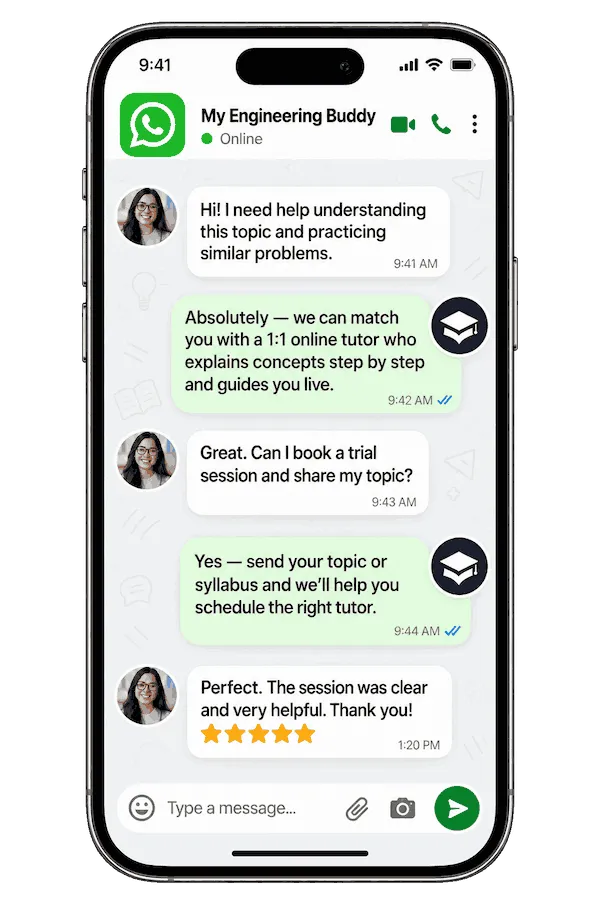
WhatsApp MEB for a quick quote — average response time under 1 minute.
Who This ERDAS IMAGINE Tutoring Is For
ERDAS IMAGINE is rarely taught step-by-step in class. Most students get a dataset, a vague lab brief, and a deadline. If that sounds familiar, you’re in the right place.
- Undergraduate students in environmental engineering, geography, or civil engineering with a GIS or remote sensing lab component
- Graduate students building ERDAS workflows for thesis research or a capstone project
- Students whose classification outputs are wrong and can’t diagnose why
- Students 4–6 weeks from a project submission with significant workflow gaps still to close
- Professionals or researchers new to ERDAS IMAGINE who need to get productive fast
- Students working with multispectral, hyperspectral, or SAR imagery for the first time
MEB has supported students at institutions including MIT, UC Davis, Purdue, the University of Manchester, TU Delft, ETH Zurich, the University of Queensland, and King Abdulaziz University. Try the $1 trial and see whether it fits before committing to a full session plan.
At MEB, we’ve found that most ERDAS IMAGINE struggles aren’t about the software being difficult — they’re about not knowing which tool to reach for first. One session spent mapping out the right processing sequence saves hours of dead ends later.
1:1 Tutoring vs Self-Study vs AI vs YouTube vs Online Courses
Self-study works if you already know what you’re doing wrong. AI tools give fast answers but can’t watch you mis-classify a land cover type in real time. YouTube covers the general steps, not your specific sensor, dataset, or error message. Online courses move at a fixed pace with no one to catch your mistakes. With a 1:1 ERDAS IMAGINE tutor, the session runs at your pace, on your actual data, correcting the specific step where your output breaks down.
Outcomes: What You’ll Be Able To Do in ERDAS IMAGINE
After working with an MEB ERDAS IMAGINE tutor, students report clearer, more confident execution across the full remote sensing pipeline. You’ll be able to apply supervised and unsupervised classification to real satellite datasets, analyse spectral signatures to distinguish land cover types accurately, model change detection between two image dates, solve georeferencing and projection errors that currently break your outputs, and present a polished, analysis-ready raster deliverable with defensible methodology. These aren’t abstract goals — they’re the exact outputs your course or thesis requires.
Based on feedback from 40,000+ sessions collected by MEB from 2022 to 2025, 58% of students improved by one full grade after approximately 20 hours of 1:1 tutoring in subjects like ERDAS IMAGINE. A further 23% achieved at least a half-grade improvement.
Source: MEB session feedback data, 2022–2025.
Try your first session for $1 — 30 minutes of live 1:1 tutoring or one homework question explained in full. No registration. No commitment. WhatsApp MEB now and get matched within the hour.
What We Cover in ERDAS IMAGINE (Syllabus / Topics)

Track 1: Image Import, Preprocessing & Georeferencing
- Importing raster data from Landsat, Sentinel, SPOT, and aerial sources
- Radiometric calibration and atmospheric correction workflows
- Geometric correction, ground control point (GCP) selection, and resampling
- Image mosaicking and subsetting for study area extraction
- Layer stacking and band combination for visual interpretation
- Coordinate system assignment and reprojection to target CRS
Core reference: Remote Sensing of the Environment by John R. Jensen (Pearson); Introduction to Remote Sensing by James B. Campbell & Randolph H. Wynne.
Track 2: Image Classification & Spectral Analysis
- Supervised classification: training sample collection, Maximum Likelihood, Support Vector Machine
- Unsupervised classification: ISODATA and K-Means clustering
- Accuracy assessment: confusion matrix, Kappa coefficient, producer/user accuracy
- Spectral signature analysis using the Signature Editor
- NDVI and other spectral index computation
- Hyperspectral data processing and feature extraction
- Post-classification smoothing and recode operations
Core reference: Remote Sensing and Image Interpretation by Lillesand, Kiefer & Chipman; Hexagon Geospatial ERDAS IMAGINE official documentation.
Track 3: Change Detection, Modelling & Output Production
- Multi-temporal change detection: image differencing, post-classification comparison
- Spatial modelling using the Spatial Modeler graphical workflow tool
- Terrain analysis: DEM import, slope, aspect, and hillshade generation
- SAR data handling and radar image enhancement
- Map composition, cartographic output, and export for GIS integration
- Linking ERDAS IMAGINE outputs with ArcGIS and Civil 3D project workflows
Core reference: Introductory Digital Image Processing by John R. Jensen; Hexagon Geospatial documentation suite.
Platforms, Tools & Textbooks We Support
ERDAS IMAGINE runs on Windows-based workstations and integrates directly with ESRI ArcGIS, ENVI, and QGIS export pipelines. MEB tutors work with students across ERDAS IMAGINE 2020, 2022, and 2023 versions, covering both the standard and Advantage/Professional licence tiers. Supporting platforms and tools include:
- ERDAS IMAGINE 2020 / 2022 / 2023 (Hexagon Geospatial)
- ArcGIS Pro and ArcMap (for output integration)
- QGIS (open-source cross-check workflows)
- Google Earth Engine (for pre-processing before ERDAS import)
- ENVI (for spectral analysis comparison)
- Spatial Modeler graphical interface (built into ERDAS)
What a Typical ERDAS IMAGINE Session Looks Like
The tutor opens by checking where you left off — usually the georeferencing step or a classification that returned unexpected results. You share your screen and the tutor watches you work through the Spatial Modeler or the classification workflow directly. When the output breaks, the tutor stops you at exactly that step — not at the end — and uses a digital pen-pad to annotate the spectral signature, the GCP placement, or the resampling parameter causing the issue. You fix it with the tutor present, then explain your reasoning back. The session closes with a clear task: run the accuracy assessment on your corrected classification layer and note the Kappa coefficient before the next session.
How MEB Tutors Help You with ERDAS IMAGINE (The Learning Loop)
Diagnose: In the first session, the tutor asks you to open your current project file and walk through what you’ve done. Within ten minutes, the gap is usually clear — wrong resampling method, training samples too spectrally similar, or a projection mismatch that invalidates everything downstream.
Explain: The tutor works through a parallel example on their own screen using a digital pen-pad, annotating the decision points — why Maximum Likelihood works here but SVM would be better there, and what the accuracy matrix is actually telling you.
Practice: You replicate the workflow on your own dataset while the tutor watches. No switching tabs and hoping you remembered the steps. The tutor is there when you select the wrong band combination or misread the Signature Editor output.
Feedback: Errors get caught at the step where they happen, not at the end when the output looks wrong. The tutor explains exactly why the classification result failed and what the correct parameter should be.
Plan: Each session ends with a specific task tied to your project deadline. The tutor notes what topic opens the next session, so there’s no warm-up time wasted.
Sessions run over Google Meet. The tutor uses a digital pen-pad or iPad with Apple Pencil to annotate directly on shared screens. Before your first session, have your ERDAS IMAGINE project file open, your sensor metadata available, and your assignment brief or thesis methodology section on hand. The first session also serves as your diagnostic — start with the $1 trial and get 30 minutes of live problem-solving that maps out exactly where to go next.
Students consistently tell us that the moment a tutor watches them work through ERDAS IMAGINE live — rather than just explaining steps — is when the real progress starts. Seeing the mistake happen in real time changes everything about how it gets fixed.
Tutor Match Criteria (How We Pick Your Tutor)
Not every remote sensing expert knows ERDAS IMAGINE’s specific toolchain. MEB matches on four criteria:
Subject depth: The tutor must have hands-on ERDAS IMAGINE experience at your level — undergraduate lab, graduate research, or professional project — not just general GIS knowledge.
Tools: All tutors use Google Meet with a digital pen-pad or iPad and Apple Pencil for live annotation during the session.
Time zone: Matched to your region — US, UK, Gulf, Canada, or Australia — so session times are sustainable across a multi-week plan.
Goals: Whether you need to fix a broken classification, complete a thesis chapter, or learn the software from scratch, the tutor’s background is matched to that specific need.
Unlike platforms where you fill out a form and wait, MEB responds in under a minute, 24/7. Tutor match takes under an hour. The $1 trial means you test before you commit. Everything runs over WhatsApp — no logins, no intake forms.
Study Plans (Pick One That Matches Your Goal)
Tutor builds a specific session sequence after the diagnostic. Catch-up (1–3 weeks): fix the broken workflow fast — georeferencing, classification, or output production. Project support (4–8 weeks): structured sessions aligned to your thesis or capstone milestones. Weekly support: ongoing help through the semester, paced to your lab schedule and submission windows. Every plan starts with the diagnostic session, which is also your $1 trial.
Pricing Guide
ERDAS IMAGINE tutoring starts at $20/hr for standard undergraduate project support. Graduate-level work — particularly hyperspectral analysis, SAR processing, or dissertation methodology — runs $40–$100/hr depending on tutor depth and timeline pressure.
Rate factors: level of the work, software version, complexity of the imagery type, and how tight the deadline is. Availability is limited during peak capstone and thesis submission periods.
For students targeting competitive research programmes or professional remote sensing roles at organisations like USGS, ESA, or private geospatial consultancies, tutors with industry project backgrounds are available at higher rates — share your specific goal and MEB will match the tier to your ambition.
Start with the $1 trial — 30 minutes, no registration, no commitment. WhatsApp MEB for a quick quote.
MEB has supported students in water resources engineering, structural engineering, and geospatial subjects including ERDAS IMAGINE — across 2,800+ advanced engineering and applied science topics since 2008.
Source: My Engineering Buddy, 2008–2025.
FAQ
Is ERDAS IMAGINE hard to learn?
The interface is not intuitive for first-time users, and the processing chain — import, preprocess, classify, validate — has many steps where small errors cascade into unusable outputs. With a tutor watching you work through your actual data, the learning curve is much shorter than going solo.
How many sessions will I need?
Most students fix a specific project problem in 2–4 sessions. Building solid end-to-end competency across classification, accuracy assessment, and change detection typically takes 8–12 sessions. The diagnostic in session one gives a clearer estimate based on your actual starting point.
Can you help with my ERDAS IMAGINE project and assignments?
Yes. MEB tutoring is guided learning — the tutor explains the workflow, you run it yourself and submit your own work. This covers lab reports, thesis chapters, and project deliverables. See our Academic Integrity policy and Why MEB page for full details on what we help with and what we don’t.
Will the tutor match my exact syllabus or software version?
Yes. Before matching, MEB asks for your course brief, software version (2020, 2022, or 2023), and imagery type. The tutor is matched specifically to that context — not assigned generically from a remote sensing pool.
What happens in the first session?
You open your current project file, walk the tutor through what you’ve done, and the tutor identifies exactly where the workflow is breaking. Most students leave the first session with a corrected output and a clear plan for the remaining work. That first session is also your $1 trial.
Is online tutoring as effective as in-person for software training?
For software like ERDAS IMAGINE, screen sharing is actually more effective — the tutor watches you work in real time on your own dataset, which is more direct than sitting beside someone in a lab. The digital pen-pad adds live annotation that most in-person sessions don’t have.
What’s the difference between ERDAS IMAGINE and ArcGIS for image classification?
ERDAS IMAGINE is purpose-built for raster image processing and classification workflows, with deeper tools for spectral analysis, accuracy assessment, and batch processing. ArcGIS is a broader GIS platform. Many projects use both — ERDAS for classification, ArcGIS for spatial analysis and cartographic output. Tutors cover the handoff between them.
Can MEB help with supervised vs unsupervised classification decisions?
Yes. Choosing the right classifier — Maximum Likelihood, ISODATA, SVM — is one of the most common decision points where students get stuck. The tutor walks through your data characteristics and helps you select and parameterise the right approach for your imagery type and land cover categories.
Can I get ERDAS IMAGINE help at midnight or over a weekend?
Yes. MEB operates 24/7 across time zones. WhatsApp the team at any hour — average response time is under one minute. Tutors in multiple regions mean late-night or weekend sessions are regularly available, including around tight project deadlines.
Do you offer group ERDAS IMAGINE sessions?
MEB is structured around 1:1 sessions — that’s what makes it possible to work through your specific dataset and error messages rather than a generic demo. Group sessions are not offered. Every session is built around one student’s project and goals.
How do I get started?
WhatsApp MEB with your software version, project brief, and deadline. MEB matches you with a verified ERDAS IMAGINE tutor — usually within the hour. The first session is your $1 trial: 30 minutes live or one full project question explained step by step. Three steps: WhatsApp → matched → start trial.
Trust & Quality at My Engineering Buddy
Every MEB tutor goes through subject-specific vetting: a live demo session evaluated by MEB, review of their academic and professional background in remote sensing or geospatial engineering, and ongoing session feedback monitoring. Rated 4.8/5 across 40,000+ verified reviews on Google. Tutors covering ERDAS IMAGINE hold degrees in geography, civil engineering, environmental science, or geomatics — and have completed real project work with the software, not just academic familiarity. For surveying and geospatial workflows, that practical depth matters.
MEB provides guided learning support. All project work is produced and submitted by the student. See our Policies page for details.
MEB has been running since 2008 and has served 52,000+ students across the US, UK, Canada, Australia, the Gulf, and Europe — across 2,800+ subjects in Civil Engineering and related fields. Subjects supported alongside ERDAS IMAGINE include groundwater engineering, air pollution control, and transportation engineering. Tutor methodology is documented at MEB’s tutoring methodology page.
Our experience across thousands of sessions shows that students who arrive with their project file open and their error message ready get twice as much done in the first session. Preparation takes two minutes and turns a 30-minute trial into a session that actually moves the project forward.
Explore Related Subjects
Students studying ERDAS IMAGINE often also need support in:
- HEC-RAS
- EPANET
- PLAXIS 2D/3D
- Autodesk InfraWorks
- Coastal Engineering
- Slope Stability Analysis
- Soil Mechanics
- Rock Mechanics
Next Steps
Getting started takes less than two minutes. Share your ERDAS IMAGINE software version, your project or thesis brief, and your deadline. MEB matches you with a verified tutor — usually within 24 hours, often within the hour.
Before your first session, have ready:
- Your course brief, lab manual, or thesis methodology outline
- Your ERDAS IMAGINE project file or the dataset you’re working with
- Your submission or exam date
The tutor handles the rest. First session is diagnostic — every minute is used on your actual problem, not a generic intro to the software.
Visit www.myengineeringbuddy.com for more on how MEB works.
WhatsApp to get started or email [email protected].
Reviewed by Subject Expert
This page has been carefully reviewed and validated by our subject expert to ensure accuracy and relevance.




