Hire Verified & Experienced
Transmission lines and Waveguides Tutors
4.8/5 40K+ session ratings collected on the MEB platform



Hire The Best Transmission lines and Waveguides Tutor
Top Tutors, Top Grades. Without The Stress!

52,000+ Happy Students From Various Universities



How Much For Private 1:1 Tutoring & Hw Help?
Private 1:1 Tutoring and HW help Cost $20 – 35 per hour* on average.
Reflection coefficients, standing wave ratios, and TE/TM mode cutoff — if any of these stopped you cold in last semester’s exam, you’re not alone.
Transmission Lines and Waveguides Tutor Online
Transmission lines and waveguides is an undergraduate and graduate-level electrical engineering subject covering guided electromagnetic wave propagation, impedance matching, S-parameters, and modal analysis in coaxial, microstrip, and hollow metallic structures.
If you’ve searched for a Transmission lines and Waveguides tutor near me, MEB connects you with a 1:1 online Electrical Engineering tutor who knows this subject at the level your course demands — whether that’s undergraduate wave theory or graduate-level microwave circuit design. Sessions run over Google Meet with a digital pen-pad, matched to your time zone and your exact syllabus. You understand the material; you submit the work.
- 1:1 online sessions built around your course syllabus and lecture notes
- Expert-verified tutors with postgraduate depth in electromagnetics and RF engineering
- Flexible time zones — US, UK, Canada, Australia, Gulf covered
- Structured learning plan built after a first diagnostic session
- Ethical homework and assignment guidance — you understand before you submit
52,000+ students across the US, UK, Canada, Australia, and the Gulf have used MEB since 2008 — including students in Electrical Engineering subjects like Transmission Lines and Waveguides, Microwave Engineering, and Electromagnetic Field Theory.
Source: My Engineering Buddy, 2008–2025.
How Much Does a Transmission Lines and Waveguides Tutor Cost?
Most undergraduate and graduate-level sessions run $20–$40/hr. Advanced topics — microwave filter synthesis, waveguide discontinuities, antenna feed design — may reach $60–$100/hr depending on tutor specialisation. New students can test the service for $1: 30 minutes of live 1:1 tutoring or one full homework question explained step by step.
| Level / Need | Typical Rate | What’s Included |
|---|---|---|
| Standard undergraduate | $20–$35/hr | 1:1 sessions, homework guidance |
| Advanced / graduate-level | $35–$100/hr | Expert tutor, RF/microwave depth |
| $1 Trial | $1 flat | 30 min live session or 1 HW question |
Tutor availability tightens significantly around finals and project deadlines. WhatsApp MEB for a quick quote — average response time under 1 minute.
Who This Transmission Lines and Waveguides Tutoring Is For
This subject sits at the intersection of electromagnetic theory and practical RF engineering. Students who struggle here usually aren’t weak at maths — they’re missing the physical intuition behind wave behaviour on bounded structures.
- Undergraduate EE students hitting the transmission line chapter for the first time and losing the thread at Smith Charts
- Graduate students working on microwave circuits, antenna design, or wireless system projects who need to close gaps fast
- Students retaking after a failed first attempt — particularly common in this subject, which many students underestimate
- Students with a university conditional offer depending on this grade in their final semester
- Students 4–6 weeks from finals with standing waves, S-parameters, or waveguide modes still unresolved
- Students at universities including MIT, Georgia Tech, University of Michigan, Imperial College London, University of Toronto, and TU Delft where this subject forms a compulsory core module
1:1 Tutoring vs Self-Study vs AI vs YouTube vs Online Courses
Self-study works if you’re disciplined — but transmission line theory builds on itself fast, and a wrong mental model at the telegrapher’s equations stage compounds every week after. AI tools give quick formula explanations but can’t watch you set up a boundary condition problem and catch where you went wrong. YouTube is fine for visualising wave propagation; it stops when you’re stuck on a specific impedance matching question at 11pm. Online courses move at a fixed pace and won’t pause for your Smith Chart confusion. 1:1 tutoring with MEB is live, corrects errors in the moment, and is calibrated to your exact course — whether that’s a semester module using Pozar or a graduate treatment using Collin.
Outcomes: What You’ll Be Able To Do in Transmission Lines and Waveguides
After consistent 1:1 work, you’ll solve impedance matching problems using both analytical methods and the Smith Chart without hesitation. You’ll analyze TE and TM modes in rectangular and circular waveguides, including cutoff frequency calculations and field pattern derivation. You’ll model coaxial and microstrip transmission lines, apply the telegrapher’s equations to lossless and lossy cases, and explain the physical meaning of reflection coefficient and VSWR to a peer or examiner. You’ll present S-parameter analysis for two-port microwave networks with confidence — a skill that carries directly into Microwave Engineering coursework and RF design roles.
Based on feedback from 40,000+ sessions collected by MEB from 2022 to 2025, 58% of students improved by one full grade after approximately 20 hours of 1:1 tutoring in subjects like Transmission Lines and Waveguides. A further 23% achieved at least a half-grade improvement.
Source: MEB session feedback data, 2022–2025.
At MEB, we’ve found that students who struggle with Transmission Lines and Waveguides almost always have one specific gap — usually the transition from circuit-theory thinking to field-theory thinking. Once a tutor identifies that gap in session one, progress accelerates faster than most students expect.
What We Cover in Transmission Lines and Waveguides (Syllabus / Topics)

Track 1: Transmission Line Theory
- Telegrapher’s equations — derivation and physical interpretation
- Lossless and lossy transmission line models
- Reflection coefficient, transmission coefficient, and VSWR
- Input impedance of terminated transmission lines
- Smith Chart construction, reading, and impedance matching applications
- Quarter-wave transformer and stub matching techniques
- Standing waves: voltage and current distribution along the line
Core texts: Pozar, Microwave Engineering (4th ed.); Hayt & Buck, Engineering Electromagnetics (8th ed.).
Track 2: Waveguide Theory and Modal Analysis
- TE and TM mode derivation in rectangular waveguides
- Cutoff frequencies and the dominant TE₁₀ mode
- Circular waveguide modes and Bessel function solutions
- Group velocity, phase velocity, and dispersion in waveguides
- Waveguide discontinuities, junctions, and equivalent circuits
- Power flow and attenuation in metallic waveguides
Core texts: Collin, Foundations for Microwave Engineering (2nd ed.); Cheng, Field and Wave Electromagnetics (2nd ed.).
Track 3: Microwave Networks and Advanced Topics
- S-parameters, Z-parameters, and Y-parameters for two-port networks
- Signal flow graphs and Mason’s rule applied to microwave circuits
- Microstrip and coplanar waveguide (CPW) transmission lines
- Directional couplers, power dividers, and hybrid junctions
- Resonators: cavity and dielectric types, Q-factor analysis
- Introduction to microwave filter synthesis
Core texts: Pozar, Microwave Engineering (4th ed.); Matthaei, Young & Jones, Microwave Filters, Impedance-Matching Networks, and Coupling Structures.
Platforms, Tools & Textbooks We Support
Transmission Lines and Waveguides coursework frequently involves simulation and design tools. MEB tutors can guide you through sessions that use these platforms directly:
- Advanced Design System (ADS) — S-parameter simulation, matching network design
- MATLAB — transmission line calculations, Smith Chart plotting scripts
- CST Microwave Studio — 3D waveguide and antenna simulation
- HFSS (Ansys) — full-wave EM simulation for waveguide structures
- Keysight LineCalc / AppCAD — microstrip and coaxial line synthesis
- Multisim — equivalent circuit modelling for transmission line networks
What a Typical Transmission Lines and Waveguides Session Looks Like
The tutor opens by checking the previous session’s topic — say, quarter-wave transformer matching — to see whether the method has stuck or whether there are lingering confusions. From there, the session moves into the current problem set: the student shares screen or uploads the worksheet, and the tutor works through a Smith Chart impedance matching problem on the digital pen-pad in real time, annotating each step. The student then replicates a similar problem independently, talking through their reasoning while the tutor listens for where the logic breaks. Errors in sign convention, normalisation, or boundary condition application get corrected immediately — not at the end. The session closes with two specific practice problems and a clear note on what the next session will open with, whether that’s TE mode cutoff frequencies or S-parameter two-port analysis.
How MEB Tutors Help You with Transmission Lines and Waveguides (The Learning Loop)
Diagnose: In the first session, the tutor works through a short diagnostic — usually a mix of telegrapher’s equation setup, a Smith Chart read, and a basic waveguide mode question — to locate exactly where your understanding breaks down. The diagnosis shapes every session after it.
Explain: The tutor works problems live on a digital pen-pad, showing not just the steps but the physical reasoning. Why does the dominant mode matter? What does a reflection coefficient of 0.5∠90° actually mean on the line?
Practice: You attempt problems with the tutor present. This is where most learning happens — not watching, but doing, with someone who can catch a wrong assumption before it propagates through six lines of algebra.
Feedback: Every error gets explained at the step where it occurred. Not “that’s wrong” — but “here’s why the boundary condition you used doesn’t apply to a short-circuit termination, and here’s how that changes the impedance expression.”
Plan: At the end of each session, the tutor sets the next topic and a specific problem to attempt before you meet again. Progress through the syllabus is tracked — nothing gets skipped because it felt familiar.
Sessions run over Google Meet. The tutor uses a digital pen-pad or iPad with Apple Pencil so every derivation is visible in real time. Before your first session, have your lecture slides, a recent problem set you struggled with, and your exam date ready. The first session covers both diagnostic and the first content gap — no time wasted. Start with the $1 trial — 30 minutes of live tutoring that also serves as your first diagnostic.
Students consistently tell us that the moment transmission line problems start making sense is when they stop thinking in lumped circuits and start thinking in waves. That shift doesn’t come from reading — it comes from working problems with someone who can redirect you the moment the old mental model kicks in.
Tutor Match Criteria (How We Pick Your Tutor)
Not every electrical engineering tutor can handle Transmission Lines and Waveguides at the graduate level. MEB matches on specifics.
Subject depth: Tutors are matched on their demonstrated knowledge of your specific course level — undergraduate wave theory, microwave engineering, or RF circuit design — not just “electrical engineering” broadly.
Tools: Every session runs over Google Meet with a digital pen-pad or iPad and Apple Pencil. Tutors are expected to work derivations on screen, not talk through them abstractly.
Time zone: Matched to your region — US Eastern, UK/Europe, Gulf Standard Time, or Australian Eastern. No 3am sessions.
Goals: Whether you need to pass a finals exam, complete a waveguide design assignment, or build deeper conceptual understanding for graduate research, the tutor is selected against that stated goal.
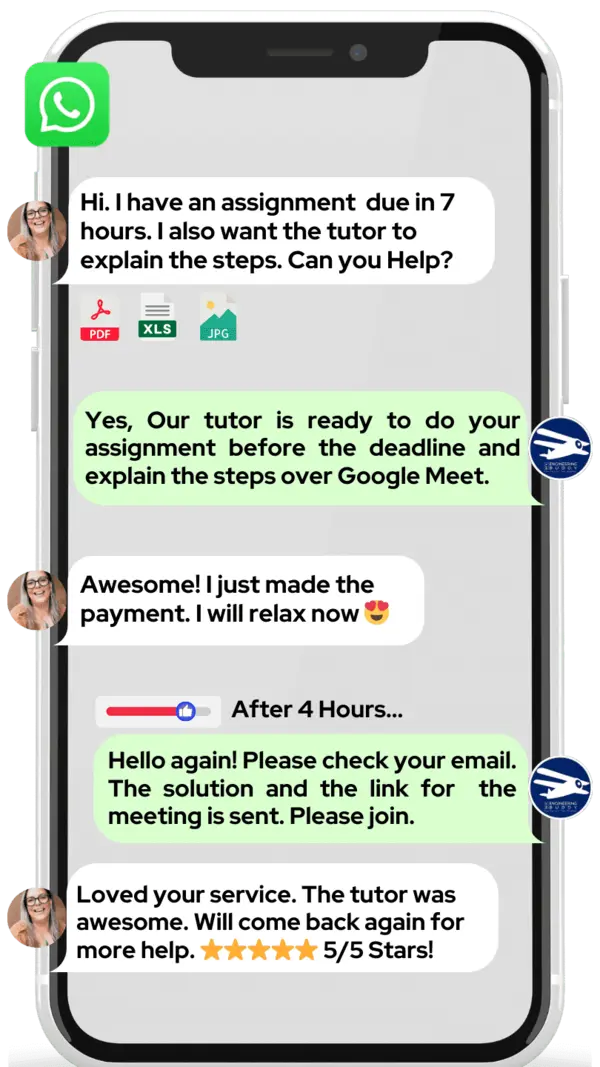
Unlike platforms where you fill out a form and wait days, MEB responds in under a minute, 24/7. Tutor match takes under an hour. The $1 trial means you test before you commit. Everything runs over WhatsApp — no logins, no intake forms.
Study Plans (Pick One That Matches Your Goal)
Catch-up (1–3 weeks): targeted work on your weakest areas — Smith Chart, modal analysis, or S-parameters — before the exam. Exam prep (4–8 weeks): structured run through the full syllabus with timed problem practice and past-paper review. Weekly support: ongoing sessions aligned to your lecture schedule, with homework guidance each week. The tutor builds the specific sequence after the first diagnostic session — the plan is not guesswork.
Pricing Guide
Standard undergraduate Transmission Lines and Waveguides tutoring runs $20–$40/hr. Graduate-level work — microwave network synthesis, full-wave simulation guidance, advanced waveguide design — runs $50–$100/hr depending on tutor background and session complexity.
Rate factors include topic depth, exam timeline urgency, and tutor specialisation. Availability drops sharply in the four weeks before finals and during end-of-semester project submission periods.
For students targeting research roles or positions at companies working in RF and microwave systems, tutors with professional industry backgrounds are available at higher rates — share your specific goal and MEB matches the tier to your ambition.
Start with the $1 trial — 30 minutes, no registration, no commitment. WhatsApp MEB for a quick quote.
Try your first session for $1 — 30 minutes of live 1:1 tutoring or one homework question explained in full. No registration. No commitment. WhatsApp MEB now and get matched within the hour.
FAQ
Is Transmission Lines and Waveguides hard?
It’s one of the most conceptually demanding modules in an EE degree. The maths is manageable, but the shift from circuit thinking to wave thinking trips most students. Targeted 1:1 work on the specific gaps — usually Smith Charts or modal analysis — resolves the difficulty faster than rereading the textbook.
How many sessions are needed?
Most students see clear progress within 5–8 sessions. Students with a full semester’s gaps to close typically need 15–20 hours. The tutor maps the plan after the first diagnostic — no generic package imposed on you.
Can you help with homework and assignments?
MEB tutoring is guided learning — you understand the work, then submit it yourself. See our Academic Integrity policy and Why MEB page for full details on what we help with and what we don’t. The tutor explains the method; you apply it to your submission.
Will the tutor match my exact syllabus or exam board?
Yes. Share your course outline, textbook, and institution during WhatsApp matching. The tutor is selected against that specific syllabus — not a generic transmission lines overview. Pozar-based courses, Hayt-based courses, and institution-specific notes are all handled.
What happens in the first session?
The tutor runs a short diagnostic covering telegrapher’s equations, a Smith Chart problem, and a waveguide mode question. This locates your exact gaps. The rest of the session addresses the most urgent one. You leave with a clear plan for what follows.
Is online tutoring as effective as in-person?
For a derivation-heavy subject like this, yes — often more so. The digital pen-pad means every step is visible on screen in real time, which is harder to replicate over a physical whiteboard at a distance. Students in the US, UK, Canada, and Gulf report equivalent outcomes consistently.
Can I get Transmission Lines and Waveguides help at midnight?
Yes. MEB operates 24/7 across time zones. WhatsApp response time averages under one minute. If you’re working through an impedance matching problem at 1am before a deadline, that’s exactly when MEB is available.
What if I don’t like my assigned tutor?
Request a rematch through WhatsApp — no explanation needed. MEB’s tutor pool for electromagnetics and RF subjects is large enough to offer a genuine alternative, not just a different face with the same gaps.
What’s the difference between a rectangular and circular waveguide, and do I need to know both?
Most undergraduate courses focus on rectangular waveguides and the TE₁₀ dominant mode. Circular waveguides appear in graduate and specialist RF courses. Your tutor will confirm which your syllabus requires and focus accordingly — no time spent on out-of-scope content.
Do I need to know S-parameters for my undergraduate Transmission Lines and Waveguides course?
It depends on your institution. Many undergraduate courses stop at reflection coefficients and Smith Charts; S-parameter matrix analysis is introduced at graduate or advanced undergraduate level. Share your syllabus and the tutor confirms scope in session one.
How do I get started?
WhatsApp MEB, share your course outline and exam date, and get matched with a verified tutor — typically within an hour. The first session is the $1 trial: 30 minutes of live tutoring or one full question explained. Three steps: message, match, start.
Do you offer group Transmission Lines and Waveguides sessions?
MEB specialises in 1:1 sessions. Group sessions are not the standard model — the diagnostic and pacing approach only works when it’s built around one student’s specific gaps. If you have a study group, each student benefits most from their own separate session.
Trust & Quality at My Engineering Buddy
Every MEB tutor goes through subject-specific vetting — not a general screening. For Transmission Lines and Waveguides, that means demonstrated postgraduate-level knowledge of electromagnetic theory, microwave engineering, or RF systems. Tutors complete a live demo evaluation before being assigned to students, and session feedback is reviewed on an ongoing basis. Rated 4.8/5 across 40,000+ verified reviews on Google. Tutors covering this subject typically hold Masters or PhD-level qualifications in Electrical Engineering, with backgrounds at institutions including ETH Zurich, Imperial College London, Georgia Tech, and the University of Toronto.
MEB tutoring is guided learning — you understand the work, then submit it yourself. For full details on what we help with and what we don’t, read our Academic Integrity policy and Why MEB.
MEB has served 52,000+ students across the US, UK, Canada, Australia, the Gulf, and Europe since 2008, covering 2,800+ subjects. In Electrical Engineering — including Electromagnetic Field Theory tutoring, Communication Systems tutoring, and Transmission Lines and Waveguides — our tutors hold subject-specific expertise rather than broad generalist coverage. See our tutoring methodology for how sessions are structured and how tutor quality is maintained across subjects.
MEB has been operating since 2008. That’s 18 years of matching students to verified subject-specialist tutors in Electrical Engineering — not a recently launched marketplace, not an algorithm. A person reviews your request and responds within the minute.
Source: My Engineering Buddy, 2008–2025.
Explore Related Subjects
Students studying Transmission Lines and Waveguides often also need support in:
- Waveguide
- Signals and Systems
- Analog Communication
- Wireless Communication
- Radar Systems
- Satellite Communications
- Optical Communications
- Network Theory
Next Steps
Share your exam board or course outline, your hardest topic right now, and how many weeks you have before your exam or submission deadline. Share your time zone and availability. MEB matches you with a verified Transmission Lines and Waveguides tutor — usually within an hour, always within 24 hours.
Before your first session, have ready:
- Your course syllabus or lecture notes and the textbook your course uses
- A recent problem set or past exam question you couldn’t complete
- Your exam date or assignment deadline
The tutor handles the rest. First session opens with a diagnostic so every minute counts from the start.
Visit www.myengineeringbuddy.com for more on how MEB works.
WhatsApp to get started or email meb@myengineeringbuddy.com.
Reviewed by Subject Expert
This page has been carefully reviewed and validated by our subject expert to ensure accuracy and relevance.