

Hire Verified & Experienced
Wireless Communication Tutors
4.8/5 40K+ session ratings collected on the MEB platform



Hire The Best Wireless Communication Tutor
Top Tutors, Top Grades. Without The Stress!




52,000+ Happy Students From Various Universities





How Much For Private 1:1 Tutoring & Hw Help?
Private 1:1 Tutoring and HW help Cost $20 – 35 per hour* on average.
Most students fail their first wireless communication exam not because the material is too hard — but because nobody explained path loss models and OFDM together, in the same session, at the right level.
Wireless Communication Tutor Online
Wireless communication is the transmission of information between devices without physical connectors, covering modulation schemes, channel models, antenna systems, and standards such as 4G LTE and 5G NR. It equips students to design, analyze, and troubleshoot modern wireless networks.
Finding a wireless communication tutor near me rarely works — this subject demands a specialist who has worked through MIMO derivations, link budget calculations, and OFDM subcarrier spacing with students at your exact level. MEB connects you with a verified electrical engineering expert for 1:1 online sessions built around your course syllabus, your exam date, and the specific topics where you are losing marks. One session can close the gap that weeks of lecture slides left open.
- 1:1 online sessions tailored to your course syllabus and exam board
- Expert verified tutors with deep subject-specific knowledge in wireless systems
- Flexible time zones — US, UK, Canada, Australia, Gulf
- Structured learning plan built after a diagnostic session
- Ethical homework and assignment guidance — you understand the work before you submit
52,000+ students across the US, UK, Canada, Australia, and the Gulf have used MEB since 2008 — including students in Electrical Engineering subjects like Wireless Communication, digital communications, and signals and systems.
Source: My Engineering Buddy, 2008–2025.
How Much Does a Wireless Communication Tutor Cost?
Most wireless communication sessions run $20–$40/hr. Graduate-level topics — MIMO capacity analysis, mmWave propagation, 5G NR numerology — reach up to $100/hr depending on tutor specialization. The $1 trial gets you 30 minutes of live 1:1 tutoring or one full homework question explained — no registration required.
| Level / Need | Typical Rate | What’s Included |
|---|---|---|
| Undergraduate (standard) | $20–$35/hr | 1:1 sessions, homework guidance |
| Advanced / Graduate | $35–$100/hr | Expert tutor, MIMO, 5G, research depth |
| $1 Trial | $1 flat | 30 min live session or 1 homework question |
Tutor availability tightens significantly in the weeks before finals and semester-end project deadlines. Book early.
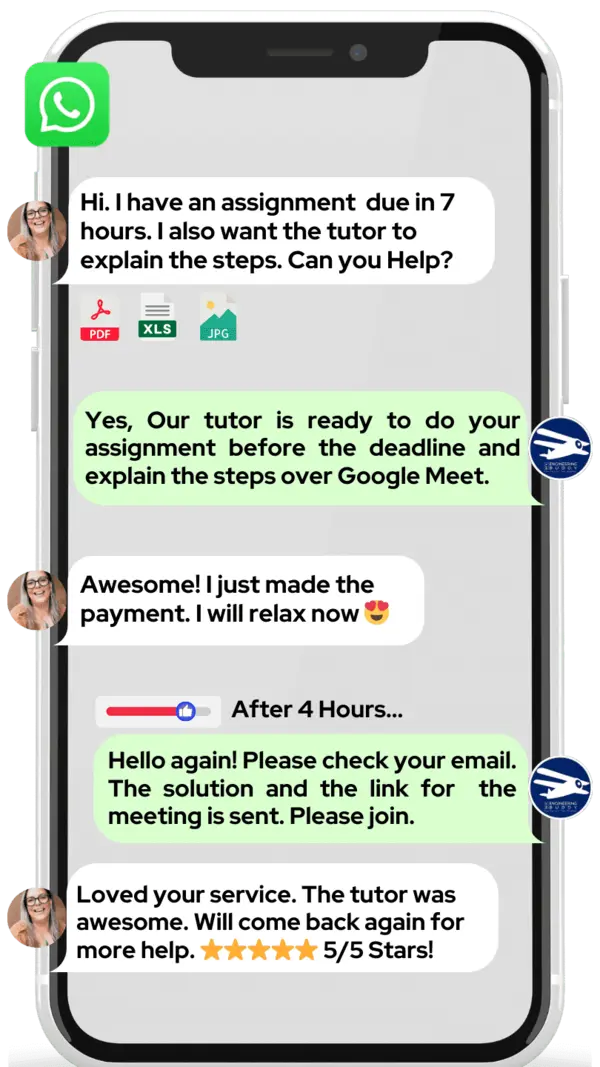
WhatsApp MEB for a quick quote — average response time under 1 minute.
Who This Wireless Communication Tutoring Is For
Wireless communication sits at the intersection of mathematics, physics, and systems engineering. Students who struggle usually aren’t weak — they’re missing one foundational link that makes everything after it harder.
- Undergraduate ECE or EE students covering modulation, channel coding, or OFDM for the first time
- Graduate students working on MIMO systems, beamforming, or 5G NR research with gaps in the underlying theory
- Students retaking after a failed first attempt who need to rebuild from the right starting point
- Students with a university conditional offer depending on this grade and six weeks or fewer left
- Professionals pursuing IEEE certifications or vendor-specific wireless qualifications who need structured homework help
- Parents watching a student’s confidence drop alongside their grades as the semester accelerates
Students come from Georgia Tech, UT Austin, University of Toronto, Imperial College London, TU Delft, ETH Zurich, University of Melbourne, and programs across the Gulf. The subject name changes; the learning gaps follow the same pattern.
At MEB, we’ve found that wireless communication students almost always hit the same wall — they can follow a derivation in class but can’t reconstruct it on paper under exam conditions. The fix isn’t more reading. It’s more worked problems with immediate feedback on where the logic broke down.
1:1 Tutoring vs Self-Study vs AI vs YouTube vs Online Courses
Self-study works if you’re disciplined, but there’s no one to catch the moment your understanding of Shannon capacity diverges from the actual formula. AI tools give fast explanations but can’t watch you work through a link budget and spot where you dropped a dB. YouTube is solid for overviews of OFDM or spread spectrum — it stops when you’re stuck on your specific assignment. Online courses move at a fixed pace and don’t adjust when your channel model unit is weaker than your modulation unit. 1:1 tutoring with MEB is live, calibrated to your exact syllabus, and corrects errors in the moment — before they become exam mistakes.
Outcomes: What You’ll Be Able To Do in Wireless Communication
After targeted 1:1 sessions, students can solve link budget problems end-to-end — from transmit power through free-space path loss to receiver sensitivity — without referring back to formula sheets. They can analyze OFDM systems, explain cyclic prefix design, and apply modulation schemes like QPSK and QAM with confidence. Students can model fading channels using Rayleigh and Rician distributions and apply them to BER calculations. They can present the capacity-spectral-efficiency trade-offs in MIMO configurations and write coherent derivations under timed conditions. Apply these skills to any wireless standard — 4G, 5G NR, Wi-Fi 6 — because the underlying framework is the same.
Based on feedback from 40,000+ sessions collected by MEB from 2022 to 2025, 58% of students improved by one full grade after approximately 20 hours of 1:1 tutoring in subjects like Wireless Communication. A further 23% achieved at least a half-grade improvement.
Source: MEB session feedback data, 2022–2025.
Try your first session for $1 — 30 minutes of live 1:1 tutoring or one homework question explained in full. No registration. No commitment. WhatsApp MEB now and get matched within the hour.
What We Cover in Wireless Communication (Syllabus / Topics)

Track 1: Fundamentals — Signals, Channels, and Modulation
- Signal propagation: free-space path loss, log-distance models, shadowing
- Multipath fading: Rayleigh and Rician models, delay spread, coherence bandwidth
- Modulation schemes: ASK, FSK, PSK, QAM — constellation diagrams and BER curves
- Shannon’s theorem: channel capacity, spectral efficiency, Shannon-Hartley law
- Noise figure, SNR, and link budget analysis from transmitter to receiver
- Spread spectrum techniques: DSSS, FHSS, processing gain
Core texts: Goldsmith, Wireless Communications (Cambridge); Rappaport, Wireless Communications: Principles and Practice; Haykin, Communication Systems.
Track 2: OFDM, MIMO, and Advanced Physical Layer
- OFDM architecture: subcarrier spacing, cyclic prefix, IFFT/FFT implementation
- PAPR problem in OFDM and mitigation strategies
- MIMO systems: spatial multiplexing, diversity-multiplexing trade-off, capacity scaling
- Beamforming: analog, digital, and hybrid precoding for massive MIMO
- Channel estimation techniques: pilot-based, LS, MMSE estimators
- Equalization: zero-forcing, MMSE, successive interference cancellation (SIC)
- Error control coding: convolutional codes, turbo codes, LDPC and polar codes (5G NR)
Core texts: Tse and Viswanath, Fundamentals of Wireless Communication (freely available online); Paulraj, Nabar, Gore, Introduction to Space-Time Wireless Communications.
Track 3: Wireless Standards and System Design
- 4G LTE architecture: E-UTRAN, EPC, resource block structure, HARQ
- 5G NR: numerology framework, FR1 and FR2 bands, mmWave propagation challenges
- Wi-Fi standards: 802.11a/g/n/ac/ax — MU-MIMO and OFDMA in Wi-Fi 6
- Cellular network planning: frequency reuse, handover, interference management
- MAC layer protocols: CSMA/CA, scheduling in LTE/NR downlink and uplink
- IoT wireless protocols: LoRa, Zigbee, Bluetooth LE — range, power, data rate trade-offs
Core texts: Dahlman, Parkvall, Sköld, 5G NR: The Next Generation Wireless Access Technology; Sesia, Toufik, Baker, LTE — The UMTS Long Term Evolution. The American Institute of Aeronautics and Astronautics also publishes relevant work on aerospace wireless link design for graduate students covering satellite and airborne communication systems.
What a Typical Wireless Communication Session Looks Like
The tutor opens by checking the previous topic — usually where you ran into trouble applying the BER formula to a specific fading channel. From there, the session moves to the current problem: you and the tutor work through an OFDM system design or a MIMO capacity derivation on a shared screen, with the tutor writing each step using a digital pen-pad so nothing is left abstract. When you attempt a step, the tutor watches in real time and catches the error before it compounds — whether that’s a sign error in the MMSE equalizer or a wrong assumption about coherence time. By the end of the session, you have a concrete practice task: two unseen link budget problems or a derivation to attempt solo before the next meeting, with the next topic already scoped.
How MEB Tutors Help You with Wireless Communication (The Learning Loop)
Diagnose: In the first session, the tutor runs a short diagnostic — usually a mix of a past exam question and a few conceptual checks — to identify exactly where the understanding breaks down. Is it the probability framework behind BER? The matrix algebra in MIMO? This shapes every session that follows.
Explain: The tutor works through live problems using a digital pen-pad on Google Meet. Every step is visible, every assumption is named. Students watching a derivation built live retain it differently than students reading a finished proof in a textbook.
Practice: You attempt the next problem with the tutor present. Not after the session. During it. This is where real learning happens — not in the explanation, but in the first attempt after it.
Feedback: The tutor reviews your working step by step, identifies where the logic failed, and explains why that error costs marks on an exam. No vague corrections. Specific, actionable feedback tied to the marking scheme.
Plan: Each session ends with a clear next step — a practice set, a topic to revisit, a past paper section to attempt. Progress is tracked so the tutor can see what’s improving and what needs another pass.
Sessions run over Google Meet with a digital pen-pad or iPad and Apple Pencil. Before your first session, share your course syllabus or module guide, one recent assignment or past paper attempt you struggled with, and your exam or submission date. The first session uses that material directly. Start with the $1 trial — 30 minutes of live tutoring that also serves as your first diagnostic.
Students consistently tell us that the moment things click in wireless communication is almost always a live session — not a re-read of the notes. Seeing a MIMO derivation built step by step on screen, with the chance to ask “why that substitution?” mid-line, changes how the whole framework sits in memory.
Tutor Match Criteria (How We Pick Your Tutor)
Not every electrical engineer knows wireless communication deeply enough to teach it. MEB matches on four criteria:
Subject depth: Tutors are matched to your exact level — undergraduate fundamentals, advanced MIMO and 5G NR, or research-adjacent topics — and to your specific communication systems syllabus where possible.
Tools: Every tutor uses Google Meet with a digital pen-pad or iPad and Apple Pencil. No shared PDFs and verbal explanations. Live working only.
Time zone: Matched to your region — US, UK, Gulf, Canada, Australia — so sessions run when you’re actually available to focus.
Goals: Whether you need to pass an end-of-semester exam, close a specific gap in 5G NR knowledge, or get through a MIMO assignment, the tutor selection reflects that goal.
Unlike platforms where you fill out a form and wait, MEB responds in under a minute, 24/7. Tutor match takes under an hour. The $1 trial means you test before you commit. Everything runs over WhatsApp — no logins, no intake forms.
Study Plans (Pick One That Matches Your Goal)
After the first diagnostic, the tutor builds a session sequence specific to your timeline. Catch-up plans (1–3 weeks) address the most exam-critical gaps first — path loss models, modulation BER, OFDM structure — in the order that will recover the most marks fastest. Exam prep plans (4–8 weeks) work through the full syllabus in topic order, with past paper practice and timed problem sets built into the schedule. Weekly support sessions align to your semester or coursework deadlines, keeping homework, lab reports, and take-home assignments on track without cramming.
Pricing Guide
Standard wireless communication sessions run $20–$40/hr. Graduate-level and research-adjacent topics — massive MIMO, mmWave 5G, advanced channel coding — are priced $40–$100/hr depending on tutor background and topic complexity. Rate factors include your course level, how quickly you need to progress, and tutor availability in your time zone.
For students targeting research roles, PhD programs, or industry positions at Qualcomm, Ericsson, Nokia, or similar — tutors with direct industry and research backgrounds in wireless systems are available at higher rates. Share your specific goal and MEB will match the tier to your ambition.
Tutor availability drops sharply in the four weeks before finals. Book sessions before that window closes.
Start with the $1 trial — 30 minutes, no registration, no commitment. WhatsApp MEB for a quick quote.
FAQ
Is wireless communication a hard subject?
Yes — it combines probability theory, linear algebra, signal processing, and systems knowledge in ways that aren’t always well connected in lectures. Students who struggle usually have a specific gap in one of those foundations. A tutor finds it fast.
How many sessions will I need?
Most students see measurable improvement in 4–6 sessions. Closing a full syllabus gap before an exam typically takes 10–20 hours over 4–8 weeks. The tutor scopes this after the first diagnostic so you’re not guessing.
Can you help with homework and assignments?
Yes. MEB tutoring is guided learning — you understand the work, then submit it yourself. Tutors explain the method, work through a similar example, and check your reasoning. See our Academic Integrity policy and Why MEB page for full details on what we help with and what we don’t.
Will the tutor match my exact syllabus or exam board?
Yes. Share your module guide or exam board when you contact MEB. Tutors are matched to your specific course — whether that’s a US university ECE module, an IEEE-aligned certification, or a UK MSc wireless systems unit.
What happens in the first session?
The tutor runs a short diagnostic using material you’ve already encountered — a past paper question, a homework problem, or a topic you found confusing. This shapes the rest of the plan. Nothing is wasted on material you already understand.
Is online tutoring as effective as in-person?
For a mathematical, derivation-heavy subject like wireless communication, the digital pen-pad format is often more effective than in-person. Every working step is visible on screen, saved, and can be reviewed after the session. No whiteboard photos that lose half the detail.
What’s the difference between 4G LTE and 5G NR tutoring — do I need separate sessions?
Not necessarily. 5G NR builds on LTE architecture. A tutor who covers your LTE foundations — resource blocks, HARQ, scheduling — can extend naturally into 5G NR numerology and mmWave specifics. Share your syllabus and the tutor scopes the sequence.
Do you cover MATLAB simulations for wireless systems?
Yes. Many wireless communication assignments require MATLAB simulation of BER curves, channel models, or OFDM implementations. MEB tutors can walk through the code structure, explain what each block does, and help you debug results that don’t match theory.
Can I get wireless communication help at midnight?
Yes. MEB operates 24/7 across time zones. WhatsApp MEB at any hour — average response time is under a minute. For US, UK, Gulf, and Australian students, a tutor is available at most hours, including late-night sessions before a morning submission.
What if I don’t like my assigned tutor?
Tell MEB. Tutor changes are handled over WhatsApp with no friction. The $1 trial exists precisely so you can test the match before committing to a longer schedule.
How do I get started?
Three steps: WhatsApp MEB, share your subject level and exam date, get matched with a verified tutor — usually within the hour. Your first session is the $1 trial: 30 minutes of live tutoring or one full question explained. No forms, no waiting.
How do I find a wireless communication tutor if I’m in a city with no local options?
Location doesn’t matter. MEB tutors cover the US, UK, Canada, Australia, Gulf, and Europe fully online. Students in Riyadh, Amsterdam, Calgary, and rural Queensland all access the same tutor pool. WhatsApp MEB and specify your time zone.
Trust & Quality at My Engineering Buddy
Every MEB tutor in wireless communication goes through subject-specific vetting — not just a general engineering screen. That means demonstrating the ability to teach OFDM, MIMO, and link budget analysis to a student audience before being matched to any session. Tutors hold relevant degrees (typically Masters or PhD in electrical engineering, telecommunications, or a related field) and many have direct industry experience in RF systems, cellular network design, or embedded wireless development. Rated 4.8/5 across 40,000+ verified reviews on Google. Ongoing session feedback means underperforming tutors are identified and removed — not left on the platform.
MEB tutoring is guided learning — you understand the work, then submit it yourself. For full details on what we help with and what we don’t, read our Academic Integrity policy and Why MEB.
MEB has served 52,000+ students across 2,800+ subjects since 2008 — across the US, UK, Canada, Australia, Gulf, and Europe. Electrical Engineering is one of the platform’s largest subject areas, covering everything from digital signal processing tutoring and electromagnetic field theory help to advanced wireless systems. See how we work: MEB Tutoring Methodology.
MEB has operated since 2008 — long enough that students who started as undergraduates now send their own graduate students to the same platform for microwave engineering tutoring and advanced wireless coursework.
Source: My Engineering Buddy, 2008–2025.
Explore Related Subjects
Students studying Wireless Communication often also need support in:
- Analog Communication
- Satellite Communications
- Optical Communications
- Radar Systems
- Transmission Lines and Waveguides
- Internet of Things (IoT)
- FPGA Design
A common pattern our tutors observe is that students who master wireless communication fundamentals early — path loss, fading, and modulation — move through the advanced MIMO and 5G material in roughly half the time. The foundation work always pays off faster than students expect.
Next Steps
Getting started takes two minutes. Share your exam board or university module code, the topic or past paper question giving you the most trouble, your available hours, and your time zone. MEB matches you with a verified wireless communication tutor — usually within 24 hours, often within the hour.
Before your first session, have ready:
- Your course syllabus or module guide (or exam board and paper code)
- A recent homework problem, past paper attempt, or assignment you struggled with
- Your exam date or submission deadline
The tutor handles the rest. First session starts with a diagnostic so every minute counts.
Visit www.myengineeringbuddy.com for more on how MEB works.
WhatsApp to get started or email meb@myengineeringbuddy.com.
Reviewed by Subject Expert
This page has been carefully reviewed and validated by our subject expert to ensure accuracy and relevance.

