Hire Verified & Experienced
Battery technology Tutors
4.8/5 40K+ session ratings collected on the MEB platform



Hire The Best Battery technology Tutor
Top Tutors, Top Grades. Without The Stress!

52,000+ Happy Students From Various Universities





How Much For Private 1:1 Tutoring & Hw Help?
Private 1:1 Tutoring and HW help Cost $20 – 35 per hour* on average.
Most students who fail battery technology modules don’t struggle with chemistry — they struggle with connecting electrochemistry theory to real cell behaviour and BMS design.
Battery Technology Tutor Online
Battery technology is the study of electrochemical energy storage and conversion, covering cell chemistry, battery management systems, thermal behaviour, and performance modelling. It equips students to design, analyse, and evaluate energy storage systems for applications in EVs, grid storage, and portable electronics.
Finding a battery technology tutor near me who actually understands solid-state electrolytes, C-rate behaviour, or State-of-Charge estimation is harder than it sounds. MEB connects you with specialist tutors in electrical engineering and energy storage who have worked through these exact topics at undergraduate and postgraduate level. One focused session can shift how you read a charge-discharge curve entirely.
- 1:1 online sessions tailored to your exact course syllabus and assessment structure
- Expert-verified tutors with subject-specific knowledge in electrochemistry and power systems
- Flexible time zones — US, UK, Canada, Australia, Gulf
- Structured learning plan built after a diagnostic session
- Ethical homework and assignment guidance — you understand the work before you submit it
52,000+ students across the US, UK, Canada, Australia, and the Gulf have used MEB since 2008 — including students in Electrical Engineering subjects like Battery Technology, Energy Storage Systems, and Power Electronics.
Source: My Engineering Buddy, 2008–2025.
How Much Does a Battery Technology Tutor Cost?
Most battery technology tutoring sessions run $20–$40/hr depending on level and topic complexity. Graduate-level work on battery modelling or thermal management can reach $70–$100/hr. Not sure what tier fits your needs? Start with the $1 trial and discuss from there.
| Level / Need | Typical Rate | What’s Included |
|---|---|---|
| Standard (undergrad modules) | $20–$40/hr | 1:1 sessions, homework guidance |
| Advanced / Specialist (grad, BMS, modelling) | $40–$100/hr | Expert tutor, niche depth, research support |
| $1 Trial | $1 flat | 30 min live session or 1 homework question explained |
Tutor availability tightens significantly in the weeks before end-of-semester assessments and project deadlines. Book early if you’re on a fixed timeline.
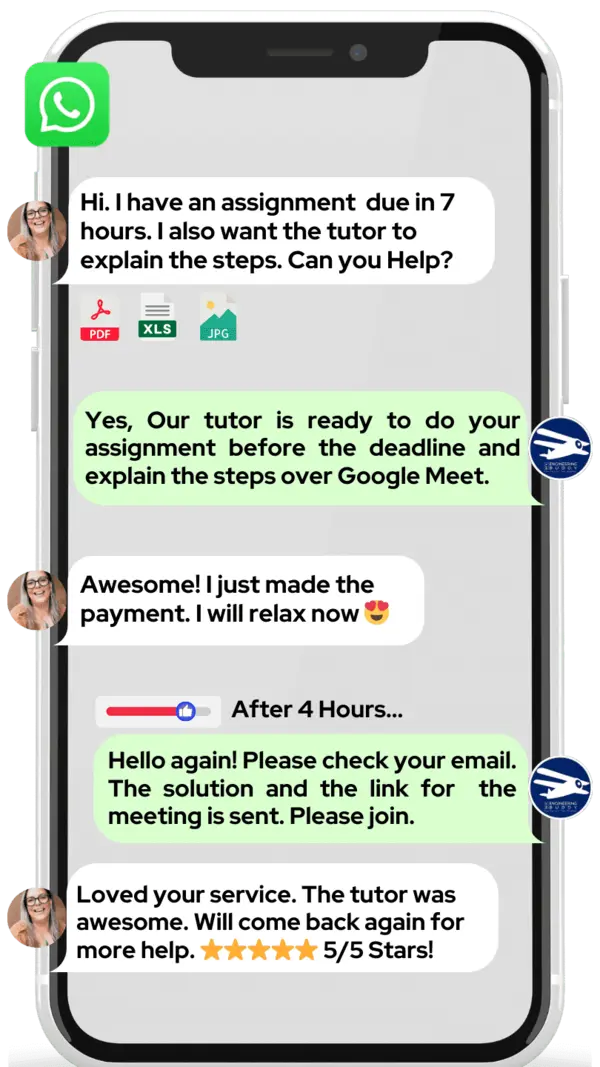
WhatsApp MEB for a quick quote — average response time under 1 minute.
Who This Battery Technology Tutoring Is For
Battery technology sits at the intersection of electrochemistry, materials science, and power systems engineering. It’s difficult precisely because it demands fluency in all three at once — and most courses assume you’ve already built that foundation.
- Undergraduate students stuck on electrochemical impedance spectroscopy, equivalent circuit models, or Butler-Volmer kinetics
- Masters and PhD students working on battery pack design, thermal runaway modelling, or state estimation algorithms
- Students with a university conditional offer depending on passing this module
- Engineering students returning after a failed attempt at a battery systems or energy storage unit
- Students 4–6 weeks from an exam with significant gaps in cell chemistry or BMS design still to close
- Course participants at institutions including MIT, Georgia Tech, Imperial College London, TU Delft, ETH Zürich, University of Michigan, and UNSW who need targeted support beyond lecture content
Parents supporting an undergraduate through an energy systems programme: MEB works directly with families to set up sessions, track topic progress, and keep assignment submissions on schedule. WhatsApp MEB — response time is under a minute, 24/7.
1:1 Tutoring vs Self-Study vs AI vs YouTube vs Online Courses
Self-study works if you’re disciplined, but battery technology has too many interlinked variables for most students to self-correct when stuck. AI tools explain concepts fast but can’t watch you misinterpret a Ragone plot and fix it in real time. YouTube covers cell chemistry overviews well but stops the moment your problem involves a specific BMS topology or degradation model. Online courses are structured but move at a fixed pace with no adjustment for your actual gaps. With a 1:1 battery technology tutor from MEB, every session is calibrated to your exact course content — the tutor sees where your reasoning breaks down and corrects it before it compounds.
Outcomes: What You’ll Be Able To Do in Battery Technology
After focused 1:1 sessions, you’ll be able to apply electrochemical principles to predict cell capacity fade under real cycling conditions. You’ll analyse charge-discharge curves and identify what they reveal about internal resistance, lithium plating risk, and usable capacity. You’ll model equivalent circuit representations of lithium-ion and solid-state cells with confidence. You’ll explain thermal management trade-offs in battery pack design — why cooling architecture matters, and where most EV packs fail. You’ll present State-of-Charge and State-of-Health estimation methods clearly, including Kalman filtering approaches used in commercial BMS implementations.
Based on feedback from 40,000+ sessions collected by MEB from 2022 to 2025, 58% of students improved by one full grade after approximately 20 hours of 1:1 tutoring in subjects like Battery Technology. A further 23% achieved at least a half-grade improvement.
Source: MEB session feedback data, 2022–2025.
What We Cover in Battery Technology (Syllabus / Topics)

Electrochemistry & Cell Fundamentals
- Thermodynamics of electrochemical cells: Gibbs free energy, Nernst equation, open-circuit voltage
- Butler-Volmer kinetics and overpotential analysis
- Electrode reactions in lithium-ion, NiMH, lead-acid, and solid-state chemistries
- Capacity, C-rate, and energy density calculations
- Electrochemical impedance spectroscopy (EIS) — interpretation and equivalent circuit fitting
- Cycle life degradation mechanisms: lithium plating, SEI growth, active material loss
Core texts: Electrochemical Systems by Newman & Thomas-Alyea; Lithium Batteries by Nazri & Pistoia.
Battery Management Systems (BMS) & Pack Design
- State-of-Charge (SOC) and State-of-Health (SOH) estimation: Coulomb counting, OCV methods, Kalman filtering
- Cell balancing strategies: passive vs active balancing topologies
- Protection circuitry: overcharge, over-discharge, short-circuit, and thermal cutoffs
- Pack architecture: series, parallel, and series-parallel configurations
- Thermal management design: liquid cooling, air cooling, phase change materials
- Communication protocols: CAN bus, SMBus integration in automotive and grid BMS
Core texts: Battery Management Systems by Gregory Plett (Volumes 1 & 2); Electric Vehicle Technology Explained by Larminie & Lowry.
Energy Storage Applications & Performance Modelling
- EV battery pack sizing — range estimation, power demand, and duty cycle analysis
- Grid-scale storage: frequency regulation, peak shaving, and second-life battery deployment
- Equivalent circuit models (ECM): Thevenin model, dual-polarisation model parameter fitting
- Physics-based models: Doyle-Fuller-Newman (DFN) model principles
- Ragone plots and comparative analysis of storage technologies
- Safety standards and testing: UN 38.3, IEC 62133, ISO 26262 functional safety in automotive
Core texts: Fuel Cell Fundamentals by O’Hayre et al. (for comparative storage context); Battery Technology Handbook ed. Kiehne. Also see power systems tutoring for grid integration topics.
At MEB, we’ve found that battery technology students who struggle most are usually missing one specific thing: a clear mental model linking cell-level chemistry to pack-level behaviour. Once that connection clicks — usually within the first two sessions — the rest of the course follows much faster.
What a Typical Battery Technology Session Looks Like
The tutor opens by checking where you left off — usually a specific topic like SOC estimation or thermal runaway analysis from the previous session. You share your screen or a problem set, and the tutor works through it with you using a digital pen-pad, annotating equivalent circuit diagrams or BMS block diagrams in real time. You’re not watching — you replicate the reasoning step by step on your end, explain your working, and the tutor catches errors the moment they appear. On energy storage systems topics like Ragone plot interpretation or cell balancing trade-offs, the tutor adjusts the depth based on your course level and assessment format. The session closes with one concrete practice problem set for before next time and a clear note of the next topic in the sequence.
How MEB Tutors Help You with Battery Technology (The Learning Loop)
Diagnose: In the first session, the tutor identifies exactly where your understanding breaks down — whether that’s the Nernst equation, impedance spectra interpretation, or Kalman filter logic for SOC estimation. No assumptions about what you know.
Explain: The tutor works through live examples using a digital pen-pad — drawing cell equivalent circuits, annotating charge-discharge curves, or stepping through BMS state machine logic. You see the reasoning built from scratch, not just the answer.
Practice: You attempt problems with the tutor present. Not after the session — during it. This is where most self-study approaches fail: there’s no one to catch the wrong turn before it becomes a habit.
Feedback: Every error gets a specific explanation — not just “that’s wrong” but exactly which assumption failed and where the marks would be lost in an exam setting. Get circuit analysis help alongside battery modelling if your gaps span both areas.
Plan: At the end of each session, the tutor maps the next topic and sets the practice task. Progress is tracked session by session — not left to chance.
Sessions run over Google Meet. The tutor uses a digital pen-pad or iPad with Apple Pencil. Before your first session, share your course syllabus or module outline, a recent assignment or problem set you struggled with, and your exam or submission deadline. The first session is diagnostic — the tutor uses it to build your session sequence. Whether you need a quick catch-up before an assessment, structured revision over four to eight weeks, or ongoing weekly support through the semester, the plan is built after that diagnostic.
Start with the $1 trial — 30 minutes of live tutoring that also serves as your first diagnostic.
Try your first session for $1 — 30 minutes of live 1:1 tutoring or one homework question explained in full. No registration. No commitment. WhatsApp MEB now and get matched within the hour.
Tutor Match Criteria (How We Pick Your Tutor)
Not every electrical engineering tutor can handle battery technology at postgraduate depth. Here’s how MEB makes the match.
Subject depth: Tutors are matched by their specific background — undergraduate battery modules, Masters in energy storage, or industry experience in EV or grid storage. The level and exam board or course provider shapes who we assign.
Tools: Every tutor uses Google Meet with a digital pen-pad or iPad and Apple Pencil — essential for drawing cell diagrams and annotating BMS schematics live.
Time zone: Matched to your region. Students in the US, UK, Gulf, Canada, and Australia each get options at hours that work for them — not just whatever’s available.
Goals: Whether you’re chasing a specific grade, closing a conceptual gap in semiconductor devices or battery electrochemistry, or preparing for a research presentation, the tutor is briefed on your specific outcome before session one.
Unlike platforms where you fill out a form and wait days, MEB responds in under a minute, 24/7. Tutor match takes under an hour. The $1 trial means you test before you commit. Everything runs over WhatsApp — no logins, no intake forms.
Students consistently tell us that the tutor match process at MEB feels different from other platforms — not because of the technology, but because someone actually reads what they’ve written and picks a tutor who fits the specific problem they’re trying to solve.
Pricing Guide
Battery technology tutoring runs $20–$40/hr for most undergraduate modules. Graduate-level work — BMS algorithm development, thermal modelling, or research-adjacent topics — typically runs $60–$100/hr depending on tutor background and topic depth.
Rate factors include your course level, how specific or niche the topic is, your timeline, and tutor availability. A student revising basic lithium-ion cell chemistry sits at the lower end. A PhD student debugging a Doyle-Fuller-Newman model implementation sits at the higher end.
Availability tightens hard in the four weeks before end-of-semester assessments. If you’re on a fixed deadline, don’t wait.
For students targeting roles at top EV manufacturers, grid storage companies, or research positions at leading engineering schools, tutors with professional industry backgrounds in battery pack development and BMS design are available at higher rates — share your specific goal and MEB will match the tier to your ambition.
Start with the $1 trial — 30 minutes, no registration, no commitment. WhatsApp MEB for a quick quote.
FAQ
Is battery technology hard?
Yes — it draws on electrochemistry, materials science, and power electronics simultaneously. Most students find the jump from basic circuits to BMS design the steepest part. With targeted 1:1 support, the connective tissue between topics becomes clear faster than self-study allows.
How many sessions are needed to see real improvement?
Most students notice a tangible shift in confidence after three to five sessions. Closing significant gaps in electrochemistry or BMS design typically takes eight to fifteen hours of focused 1:1 work, depending on starting point and how much independent practice happens between sessions.
Can you help with homework and assignments?
Yes. MEB tutoring is guided learning — you understand the work, then submit it yourself. The tutor explains the underlying principles, works through similar problems with you, and helps you build the reasoning independently. See our Academic Integrity policy and Why MEB page for full details on what we help with and what we don’t.
Will the tutor match my exact syllabus or exam board?
Yes. Before matching, MEB checks your course outline, institution, and assessment structure. Tutors familiar with your specific content — whether that’s a US graduate program, a UK MEng module, or a Gulf university curriculum — are prioritised in the match.
What happens in the first session?
The tutor runs a diagnostic — reviewing your syllabus, asking you to work through a recent problem, and identifying exactly where your understanding breaks down. The session plan for subsequent sessions is built from that first conversation, not from a generic template.
Is online tutoring as effective as in-person for battery technology?
For a technical subject like this, yes — provided the tutor uses a digital pen-pad. Annotating equivalent circuit models, BMS block diagrams, and charge-discharge curves live on screen is entirely equivalent to a whiteboard. Most MEB students report preferring the recorded reference over in-person sessions.
What’s the difference between lithium-ion and solid-state battery tutoring?
Lithium-ion is the standard undergraduate content — cell chemistry, degradation, BMS basics. Solid-state battery topics sit at graduate and research level, covering electrolyte interfaces, ionic conductivity challenges, and manufacturing constraints. MEB has tutors covering both — specify your focus when you get in touch.
Can MEB help with battery simulation and modelling software?
Yes. Tutors can support work in MATLAB and Simulink for equivalent circuit modelling, Python-based BMS algorithm development, and COMSOL for electrochemical simulation. Specify the tool when you contact MEB so the right tutor is matched. See also control systems tutoring if your BMS work overlaps with feedback control design.
Can I get battery technology help at short notice — including late at night?
Yes. MEB operates 24/7 via WhatsApp. If you have an assignment due tomorrow or an exam in 48 hours, message now — average response time is under a minute, and same-day session booking is available for most topics and time zones.
Do you offer group battery technology sessions?
No. MEB sessions are 1:1 only. Group sessions dilute the diagnostic precision that makes the format effective. Every session is built around one student’s specific gaps — not a shared syllabus overview that works for no one in particular.
How do I get started?
Three steps: WhatsApp MEB with your subject, level, and exam or deadline date. MEB matches you with a verified tutor — usually within an hour. Your first session is the $1 trial — 30 minutes live or one full homework question explained. No forms, no waiting.
Trust & Quality at My Engineering Buddy
Every MEB tutor goes through a structured screening process — subject-knowledge assessment, a live demo session evaluated by senior tutors, and ongoing review based on student feedback. Tutors covering battery technology hold relevant engineering degrees and, in many cases, industry experience in EV development, grid storage, or electrochemical research. Rated 4.8/5 across 40,000+ verified reviews on Google. That track record is built one session at a time, not claimed on a marketing page.
MEB tutoring is guided learning — you understand the work, then submit it yourself. For full details on what we help with and what we don’t, read our Academic Integrity policy and Why MEB.
MEB has served 52,000+ students across the US, UK, Canada, Australia, the Gulf, and Europe since 2008 — across 2,800+ subjects. Within Electrical Engineering, the platform covers battery technology alongside closely related areas like power engineering tutoring, smart grid help, and electrical machines tutoring. See our tutoring methodology for how sessions are structured from diagnostic to exam preparation.
Our experience across thousands of sessions shows that students who share their actual exam paper or assignment brief before the first session get more from session one than students who arrive with a vague sense of what they need. Specificity is everything in battery technology — and in tutoring it.
MEB has supported engineering students in battery technology, photovoltaic and solar energy, and power system analysis across more than 18 years — with tutors matched by course level, exam board, and specific topic gap, not just subject name.
Source: My Engineering Buddy, 2008–2025.
Explore Related Subjects
Students studying Battery Technology often also need support in:
- Analog Electronics
- Embedded Systems
- Thermal Power Plants
- Signals and Systems
- Sensors and Actuators
- Microelectronics
- High Voltage Engineering
Next Steps
When you contact MEB, share your exam board or course outline, the specific topics giving you the most trouble, and your exam or submission deadline. Include your time zone and preferred session times.
MEB matches you with a verified battery technology tutor — usually within 24 hours, often faster.
Before your first session, have ready:
- Your course syllabus or module outline
- A recent past paper attempt, assignment, or problem you couldn’t finish
- Your exam date or submission deadline
The tutor handles the rest. The first session starts with a diagnostic, so every minute is used on what actually matters for your grade.
Visit www.myengineeringbuddy.com for more on how MEB works.
WhatsApp to get started or email meb@myengineeringbuddy.com.
Reviewed by Subject Expert
This page has been carefully reviewed and validated by our subject expert to ensure accuracy and relevance.