Hire Verified & Experienced
Optoelectronics Tutors
4.8/5 40K+ session ratings collected on the MEB platform



Hire The Best Optoelectronics Tutor
Top Tutors, Top Grades. Without The Stress!
52,000+ Happy Students From Various Universities



How Much For Private 1:1 Tutoring & Hw Help?
Private 1:1 Tutoring and HW help Cost $20 – 35 per hour* on average.
Photodetector noise floors, laser rate equations, waveguide coupling losses — most students hit a wall somewhere in Optoelectronics. Here’s how to get through it.
Optoelectronics Tutor Online
Optoelectronics is the study of electronic devices and systems that generate, detect, and control light. It covers semiconductor light sources, photodetectors, optical modulators, and integrated photonic circuits at undergraduate and graduate engineering level.
If you’re searching for an Optoelectronics tutor near me, MEB connects you with a verified specialist — typically within the hour — for 1:1 online sessions built around your exact course, exam board, or research module. Our Electrical Engineering tutoring platform has served 52,000+ students since 2008, and Optoelectronics is one of the most requested advanced subjects we cover. Sessions are live, adaptive, and corrective — you won’t get that from a textbook or a video.
- 1:1 online sessions tailored to your specific course syllabus and exam board
- Expert-verified tutors with graduate-level depth in photonics and optoelectronic systems
- Flexible time zones — US, UK, Canada, Australia, Gulf
- Structured learning plan built after a diagnostic session
- Ethical homework and assignment guidance — you understand before you submit
52,000+ students across the US, UK, Canada, Australia, and the Gulf have used MEB since 2008 — including students in Electrical Engineering subjects like Optoelectronics, Optical Communications, and Semiconductor Devices.
Source: My Engineering Buddy, 2008–2025.
How Much Does an Optoelectronics Tutor Cost?
Most Optoelectronics tutoring sessions run $20–$40/hr. Graduate-level work — think coherence theory, photonic integrated circuits, or quantum dot lasers — can reach $70–$100/hr depending on tutor depth. Start with the $1 trial: 30 minutes of live 1:1 tutoring or one homework question explained in full.
| Level / Need | Typical Rate | What’s Included |
|---|---|---|
| Undergraduate (most levels) | $20–$40/hr | 1:1 sessions, homework guidance |
| Advanced / Graduate | $40–$100/hr | Expert tutor, niche depth, research support |
| $1 Trial | $1 flat | 30 min live session or 1 homework question |
Tutor availability gets tight during spring and fall exam periods. If you have a deadline approaching, reach out now.
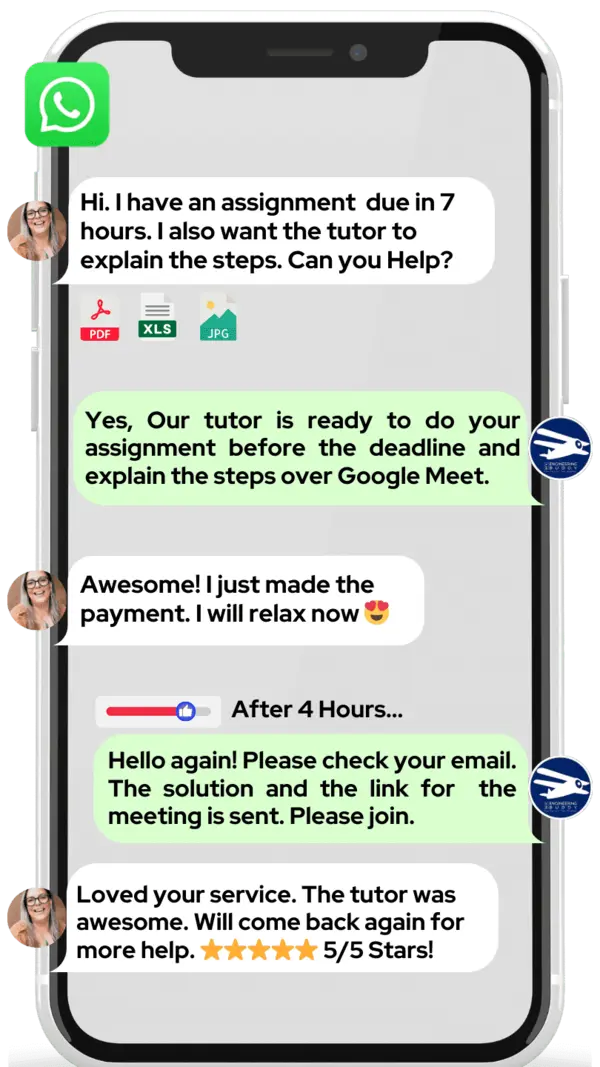
WhatsApp MEB for a quick quote — average response time under 1 minute.
Who This Optoelectronics Tutoring Is For
Optoelectronics sits at the crossroads of photonics, semiconductor physics, and signal processing. It’s demanding even for strong electrical engineering students, and it’s easy to fall behind when lectures move fast.
- Undergraduate EE or photonics students stuck on laser diode rate equations or p-i-n photodiode responsivity
- Graduate students working through coherent optical systems, modulator design, or waveguide coupling theory
- Students retaking after a failed first attempt — particularly those who lost marks on optical power budget calculations
- Students with a conditional university offer that depends on passing this module
- Students 4–6 weeks from finals with gaps still open in detector noise analysis or fiber-optic link design
- Parents watching a student’s confidence drop alongside their marks in a subject that demands both physics intuition and mathematical precision
Students come to MEB from programmes at MIT, Caltech, Imperial College London, ETH Zurich, the University of Toronto, TU Delft, and the University of Melbourne, among others. The tutor is matched to your exact course — not a generic module.
At MEB, we’ve found that Optoelectronics students who struggle early in the semester almost always have a specific gap — not a general weakness. Laser threshold conditions, detector bandwidth derivations, coupling efficiency — it’s almost always one of three things. One targeted session can reset the whole trajectory.
1:1 Tutoring vs Self-Study vs AI vs YouTube vs Online Courses
Self-study works if you’re disciplined — but Optoelectronics problems require someone to catch sign errors in your rate equations before they compound. AI tools give fast definitions but can’t tell you why your optical link budget is 3 dB off. YouTube covers laser basics well but goes quiet when you’re debugging a waveguide mode mismatch. Online courses move at a fixed pace, not yours. With MEB’s 1:1 Optoelectronics tutoring, a specialist is live with you, correcting derivations in real time on a digital pen-pad, calibrated to your exact course structure.
Outcomes: What You’ll Be Able To Do in Optoelectronics
After working with an MEB Optoelectronics tutor online, you’ll be able to analyze semiconductor laser structures and derive threshold current conditions from first principles. You’ll apply photodetector responsivity and noise equivalent power calculations to real fiber-optic link scenarios. You’ll model Mach-Zehnder modulator transfer functions and explain electro-optic effects. You’ll solve waveguide dispersion problems and present coherent optical system designs with confidence. Exam questions that felt opaque become tractable — fast.
Based on feedback from 40,000+ sessions collected by MEB from 2022 to 2025, 58% of students improved by one full grade after approximately 20 hours of 1:1 tutoring in subjects like Optoelectronics. A further 23% achieved at least a half-grade improvement.
Source: MEB session feedback data, 2022–2025.
Try your first session for $1 — 30 minutes of live 1:1 tutoring or one homework question explained in full. No registration. No commitment. WhatsApp MEB now and get matched within the hour.
What We Cover in Optoelectronics (Syllabus / Topics)

Light Sources and Laser Physics
- LED structure, carrier injection, and emission spectra
- Laser diode rate equations and threshold current derivation
- Fabry-Perot, DFB, and VCSEL cavity structures
- Gain-bandwidth relationships and modulation response
- Semiconductor optical amplifiers (SOA) and gain saturation
- Quantum well and quantum dot laser structures
Key references: Saleh & Teich, Fundamentals of Photonics (3rd ed.); Chuang, Physics of Photonic Devices; Coldren & Corzine, Diode Lasers and Photonic Integrated Circuits.
Photodetectors and Optical Receivers
- p-n, p-i-n, and avalanche photodiode (APD) operating principles
- Responsivity, quantum efficiency, and spectral response
- Shot noise, thermal noise, and noise equivalent power (NEP)
- Receiver sensitivity and bit-error-rate (BER) calculations
- Transimpedance amplifier (TIA) design and bandwidth limits
- Photodetector selection for specific wavelength windows (850 nm, 1310 nm, 1550 nm)
Key references: Saleh & Teich, Fundamentals of Photonics; Liu, Photonic Devices; Agrawal, Fiber-Optic Communication Systems.
Optical Waveguides, Modulators, and Integrated Photonics
- Slab and channel waveguide modes — TE/TM analysis
- Coupling efficiency, insertion loss, and mode mismatch
- Electro-optic effect and Mach-Zehnder modulator transfer function
- Electroabsorption modulators and chirp characteristics
- Silicon photonics platform: ring resonators, grating couplers
- Optical power budget analysis for fiber-optic link design
- Photonic integrated circuit (PIC) layout and fabrication constraints
Key references: Okamoto, Fundamentals of Optical Waveguides; Saleh & Teich, Fundamentals of Photonics; Reed & Knights, Silicon Photonics.
What a Typical Optoelectronics Session Looks Like
The tutor opens by checking where you got stuck last time — often the link between laser gain threshold and carrier density. From there, you work through a specific problem set together: today that might be deriving the APD multiplication factor under given bias conditions, or calculating the maximum fiber span in a 10 Gbps IM-DD link. The tutor writes every step on a digital pen-pad, visible on your screen in real time. When you make an error — say, dropping the confinement factor in the gain equation — the tutor flags it immediately, explains why it matters, and has you redo that step. The session closes with two or three targeted practice problems and a clear note on what gets covered next.
Students consistently tell us that Optoelectronics feels abstract until someone draws it out — photon density rate equations, energy band diagrams, waveguide mode profiles. Our tutors work on a digital pen-pad precisely because this subject demands it. The visual click moment is real.
How MEB Tutors Help You with Optoelectronics (The Learning Loop)
Diagnose: In the first session, the tutor asks you to walk through a recent exam question or homework problem. That one exercise reveals where your understanding breaks down — whether it’s Maxwell’s wave equation in a dielectric, carrier recombination rates, or optical modulation index.
Explain: The tutor works through the concept live, using a digital pen-pad to show derivations step by step. You don’t just see the answer — you see the reasoning that produces it, including where sign conventions and unit conversions trip people up.
Practice: You attempt a parallel problem with the tutor present. No looking ahead. The goal is to expose any gap between watching and doing — which is where most Optoelectronics marks are lost.
Feedback: The tutor goes through your attempt step by step. For every error, you get a clear explanation: what went wrong, why it costs marks, and the correct logical path. This is the part that textbooks don’t replicate.
Plan: At the end of each session, the tutor sets the next topic and a specific practice task. Progress is tracked session to session — not assumed.
Sessions run over Google Meet with a digital pen-pad or iPad plus Apple Pencil. Before your first session, send your course syllabus, a recent homework question you couldn’t finish, and your exam date. The first session starts with a 10-minute diagnostic, then moves straight into targeted work. Start with the $1 trial — 30 minutes of live tutoring that also serves as your first diagnostic.
Tutor Match Criteria (How We Pick Your Tutor)
Match quality matters more than speed — but at MEB, you get both.
Subject depth: Tutors are matched to your specific level — third-year undergraduate photonics module, graduate integrated photonics course, or research-adjacent work in laser characterisation or PIC design.
Tools: Every session runs on Google Meet with a digital pen-pad or iPad plus Apple Pencil. Optoelectronics requires visual derivation — tutors who can’t draw are not assigned to this subject.
Time zone: Matched to your region — US, UK, Gulf, Canada, Australia — so sessions land at reasonable hours without compromise.
Goals: Whether you’re targeting exam scores, closing a specific conceptual gap in optical engineering, or preparing for a research viva, the tutor is briefed on your aim before session one.
Unlike platforms where you fill out a form and wait, MEB responds in under a minute, 24/7. Tutor match takes under an hour. The $1 trial means you test before you commit. Everything runs over WhatsApp — no logins, no intake forms.
Study Plans (Pick One That Matches Your Goal)
After the first diagnostic session, your tutor builds the sequence. Three common patterns: a rapid catch-up plan covering the highest-yield Optoelectronics topics in 1–3 weeks for students close to a deadline; a structured 4–8 week exam prep sequence working through laser physics, photodetector analysis, and waveguide design in order of exam weighting; or ongoing weekly sessions aligned to your semester schedule, covering new material as it’s taught and reinforcing it before assessments. The tutor adjusts the pace after every session — no fixed curriculum imposed.
Pricing Guide
Optoelectronics tutoring starts at $20/hr for standard undergraduate modules. Niche graduate-level work — coherent receiver design, quantum dot laser modelling, silicon photonics fabrication constraints — runs up to $100/hr. Rate depends on level, topic complexity, your timeline, and tutor availability.
For students targeting top photonics research programmes or positions at companies working in LiDAR, optical transceivers, or integrated photonics, tutors with active research or industry backgrounds are available at higher rates — share your specific goal and MEB will match the right tier.
Availability tightens significantly in April–May and November–December. Start with the $1 trial — 30 minutes, no registration, no commitment. WhatsApp MEB for a quick quote.
FAQ
Is Optoelectronics hard?
Yes — it’s genuinely demanding. It requires solid grounding in semiconductor physics, electromagnetic wave theory, and signal analysis simultaneously. Most students find laser rate equations and detector noise analysis the steepest parts. Targeted 1:1 help with an microelectronics-adjacent specialist resolves gaps faster than re-reading lecture notes.
How many sessions are needed?
For a specific topic gap — say, APD noise calculations — two to three sessions is usually enough. For exam preparation covering the full module, expect 8–15 sessions spread over 4–6 weeks. The tutor gives a realistic estimate after the first diagnostic.
Can you help with Optoelectronics homework and assignments?
MEB tutoring is guided learning — you understand the work, then submit it yourself. See our Academic Integrity policy and Why MEB page for full details on what we help with and what we don’t. The focus is always on your understanding, not just the answer.
Will the tutor match my exact syllabus or exam board?
Yes. Share your university, module code, and syllabus document before session one. Tutors are selected based on that specific content — not a generic Optoelectronics curriculum. If your module uses a particular textbook, the tutor works from it.
What happens in the first session?
The first 10 minutes are diagnostic — the tutor asks you to explain a recent problem or walks you through a short concept check. The rest of the session targets the highest-priority gap identified. You leave with a clear practice task and a plan for subsequent sessions.
Is online tutoring as effective as in-person?
For Optoelectronics, yes — and in some ways better. The digital pen-pad lets the tutor annotate energy band diagrams, draw waveguide cross-sections, and work through derivations in real time. Students in the US, UK, and Gulf consistently report the same experience quality regardless of location.
Can I get Optoelectronics help at midnight?
MEB operates 24/7. WhatsApp response time is under a minute at most hours. Tutors are available across time zones, so a student in the Gulf at midnight, or a student in Canada at 11 pm, can be matched and start a session the same evening.
What if I don’t like my assigned tutor?
Tell MEB via WhatsApp and a new tutor is assigned — no forms, no delay. The $1 trial is specifically designed so you experience the match before committing to a paid schedule. If it’s not the right fit, MEB fixes it immediately.
Do you cover silicon photonics and photonic integrated circuits?
Yes. Silicon photonics is one of the fastest-growing specialisations within Optoelectronics, and MEB has tutors who work directly in PIC design, ring resonator modelling, and grating coupler analysis. Share your specific module or research focus and MEB matches accordingly.
What is the difference between Optoelectronics and Photonics — and does it matter for tutoring?
Optoelectronics focuses on electronic devices that interact with light — LEDs, laser diodes, photodetectors, modulators. Photonics is broader, including passive optical systems and beam propagation. In practice, most university modules blend both. Your tutor is matched to your actual course content, whichever label your programme uses.
How do I get started?
Start with the $1 trial — 30 minutes of live Optoelectronics tutoring or one homework question explained in full. Three steps: WhatsApp MEB, get matched with a verified tutor (usually within the hour), and begin your trial session. No registration required.
Trust & Quality at My Engineering Buddy
Every MEB tutor goes through a screening process: degree verification, a live subject-specific demo session, and an ongoing review of session feedback. For Optoelectronics, tutors must demonstrate working knowledge of laser physics, photodetector design, and waveguide theory — not just general photonics familiarity. Rated 4.8/5 across 40,000+ verified reviews on Google.
MEB tutoring is guided learning — you understand the work, then submit it yourself. For full details on what we help with and what we don’t, read our Academic Integrity policy and Why MEB.
MEB has served 52,000+ students since 2008 across 2,800+ subjects — from core Electrical Engineering modules to advanced specialisations like Integrated Circuits tutoring and VLSI Design help. Students from the US, UK, Canada, Australia, Gulf, and Europe use the platform every week. See our tutoring methodology for how sessions are structured and how progress is tracked.
MEB has been running since 2008 — 18 years of working through the exact subjects, exam boards, and course structures that trip students up. Optoelectronics is one of the most requested advanced engineering subjects on the platform.
Source: My Engineering Buddy, 2008–2025.
A common pattern our tutors observe is students arriving to Optoelectronics sessions having memorised formulas but never derived them. The student who can re-derive the laser threshold condition from carrier rate equations never freezes in an exam. That’s what we build toward.
Explore Related Subjects
Students studying Optoelectronics often also need support in:
- Analog Circuits
- Electromagnetic Field Theory
- Photovoltaic Cells & Solar Energy Panels
- Signals and Systems
- Microwave Engineering
- Sensors and Actuators
- Waveguide
Next Steps
When you reach out, share: your exam board or university module name, the specific topics giving you the most trouble, your exam or assignment deadline, and your available time slots and time zone. MEB matches you with a verified Optoelectronics tutor — usually within 24 hours, often the same day.
- Have your syllabus or course outline ready
- Bring a recent past paper attempt or a homework question you couldn’t finish
- Note your exam or submission date — the tutor builds the session plan around it
Visit www.myengineeringbuddy.com for more on how MEB works.
WhatsApp to get started or email meb@myengineeringbuddy.com.
Reviewed by Subject Expert
This page has been carefully reviewed and validated by our subject expert to ensure accuracy and relevance.